New U.S. Airbnb Listings Win Extra Page-One Spots That Fade Over Three Months

Hosts have long argued over how long Airbnb's new listing boost lasts, or whether it still exists. Live searches on Oct. 1 found it intact, strongest at launch and fading over about three months.
Listings less than 30 days old filled 4.4% of first-page slots while making up 1.5% of the live listings in the same areas, nearly three times their share, according to AirROI, a short-term-rental data firm, which ran 168 live Airbnb searches on Oct. 1 in sections of 42 U.S. areas, from downtown Nashville and Chicago's North Side to Gatlinburg and Cape Cod.
Listings under a month old took about four first-page spots for every five searches.
Their numbers alone would earn them about one spot every three to four pages.
Airbnb's own help page on search says "many hosts offer lower prices or discounts to attract guests to newer listings," and price moves rank. The searches do not hold price constant, so part of the page-one edge may be launch pricing.
The answer matters to hosts launching now for the holidays, a group Airbnb is working to enlarge. It says it added over 150,000 listings by first-time hosts in the World Cup host cities between October 2025 and July 2026. On Sept. 30 it said Smart Setup, a tool that builds a listing from a home's address, is rolling out now to U.S. hosts with eligible homes.
What Airbnb says it does
Airbnb confirms the favor exists and stops there.
"To help hosts get started, the algorithm is designed to make sure new listings show up well in search results," its Help Center says. The page says new listings usually show up in search within 24 hours. It gives no size for the favor and no end date.
Its engineers once gave a size. In a 2020 paper, Malay Haldar and eight other Airbnb search engineers described a "new listing ranking boost" tuned to give new listings "+8.5% additional first page impressions" while staying "bookings neutral compared to no boosting." That counts extra impressions against no boost, a different measure from the share-of-page-one ratio here.
They then moved away from the flat boost, toward a model that estimates a new listing's appeal from similar listings nearby. In an A/B test, it lifted bookings of newly created listings 14%.
A borrowed estimate of that kind would give way as a listing builds its own record, fading rather than switching off on a set day. The October searches fit that shape, though Airbnb has not said whether the 2020 design still runs.
Grading the folklore
"The new listing boost is gone," a host wrote on Reddit in June 2025. A Top Contributor on Airbnb's community forum wrote last November that the boost seemed to have been shortened. Neither cited a measurement.
Set against the searches, every common version of the folklore misses except one: three months.
| Claim | Where it circulates | What the searches showed | Verdict |
|---|---|---|---|
| "The new listing boost is gone" | Reddit host forum, June 2025 | Under 30 days old: nearly 3x their page-one share | Wrong |
| About 14 to 30 days | Host-advice sites and Google's AI answer, 2026 | 2 to 4 weeks old: 2.4x; 1 to 2 months: 1.9x | Too short |
| Three to five weeks | Airbnb Community posts since 2019 | Still close to 2x at 1 to 2 months | Too short |
| Three months | Host forums since 2019 | 2 to 3 months: 1.5x; no more than older listings by 4 to 6 months | Closest |
Listings in their first two weeks held more than three times their share of page one, and the edge thinned month by month after that. By four to six months, new listings held no more of page one than listings six months to a year old, in every kind of search. Across all searches, listings a year old or more held about nine-tenths of their share.
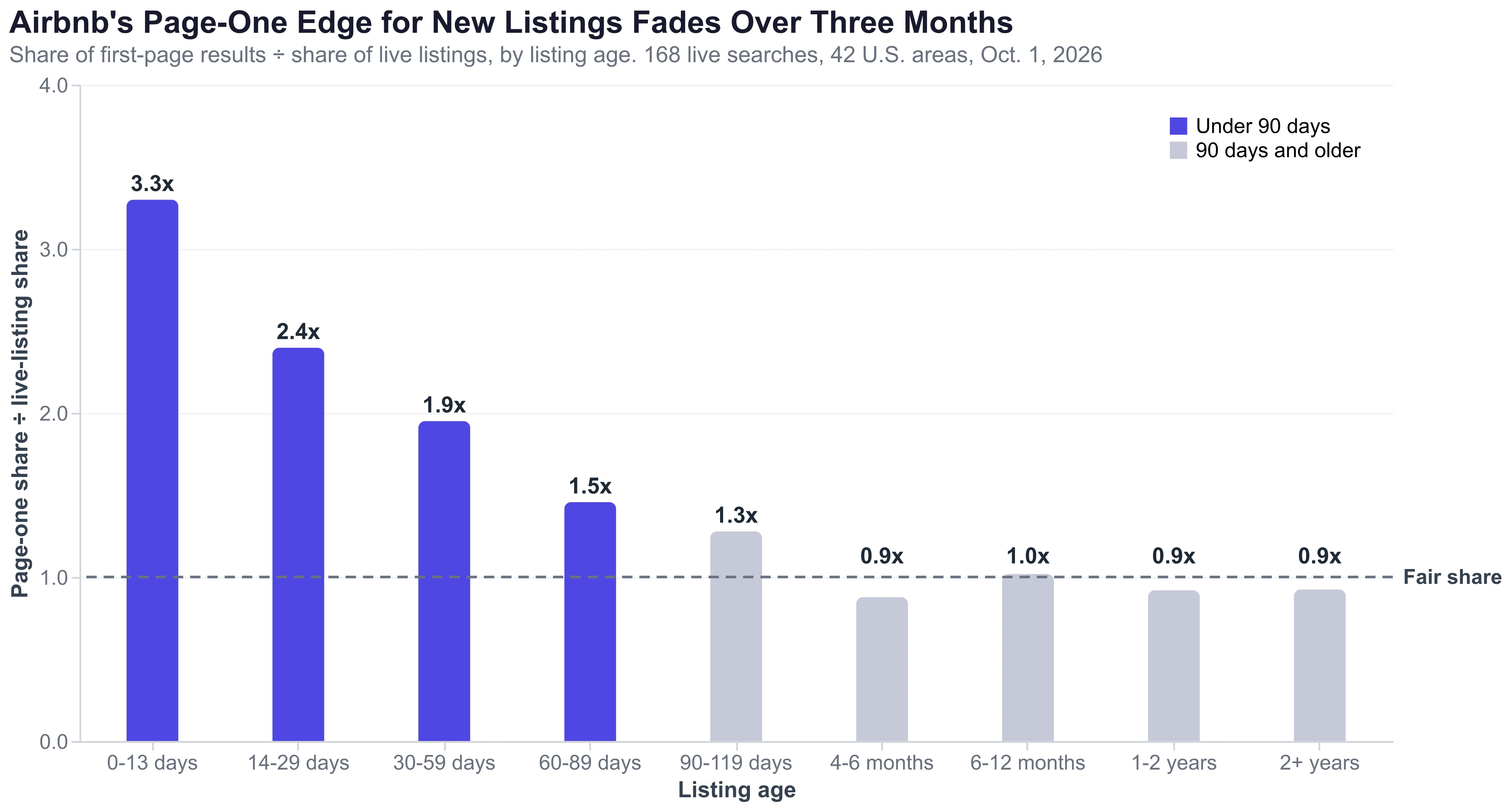
The size depends on how guests search. In searches without dates, listings under a month old held more than three and a half times their share; in searches for weekend stays in October, November and December, about 2.6 times.
The first page shows it in places tourists book. In the slice of Branson, Mo., that AirROI searched, where 852 listings were live, listings created a week earlier ranked first in all four searches.
In the undated search of Broken Bow, Okla., a six-day-old listing ranked first among the 244 live in the area searched, and a week-old one ranked fourth. In Charleston, S.C., listings created 17 days earlier held No. 1 in three of four searches.
The edge is not automatic.
In the part of Destin, Fla., that was searched, 17 listings under a month old were live, and none reached the first page in any of four searches.
Central Austin had 26, and none made the first page of its undated search.
The review lead outlasts the boost
Reviews follow completed stays, so they give a rough read on what new listings got from those early weeks. Here the comparison changes base, from search slots in 42 areas to guest reviews across the U.S.
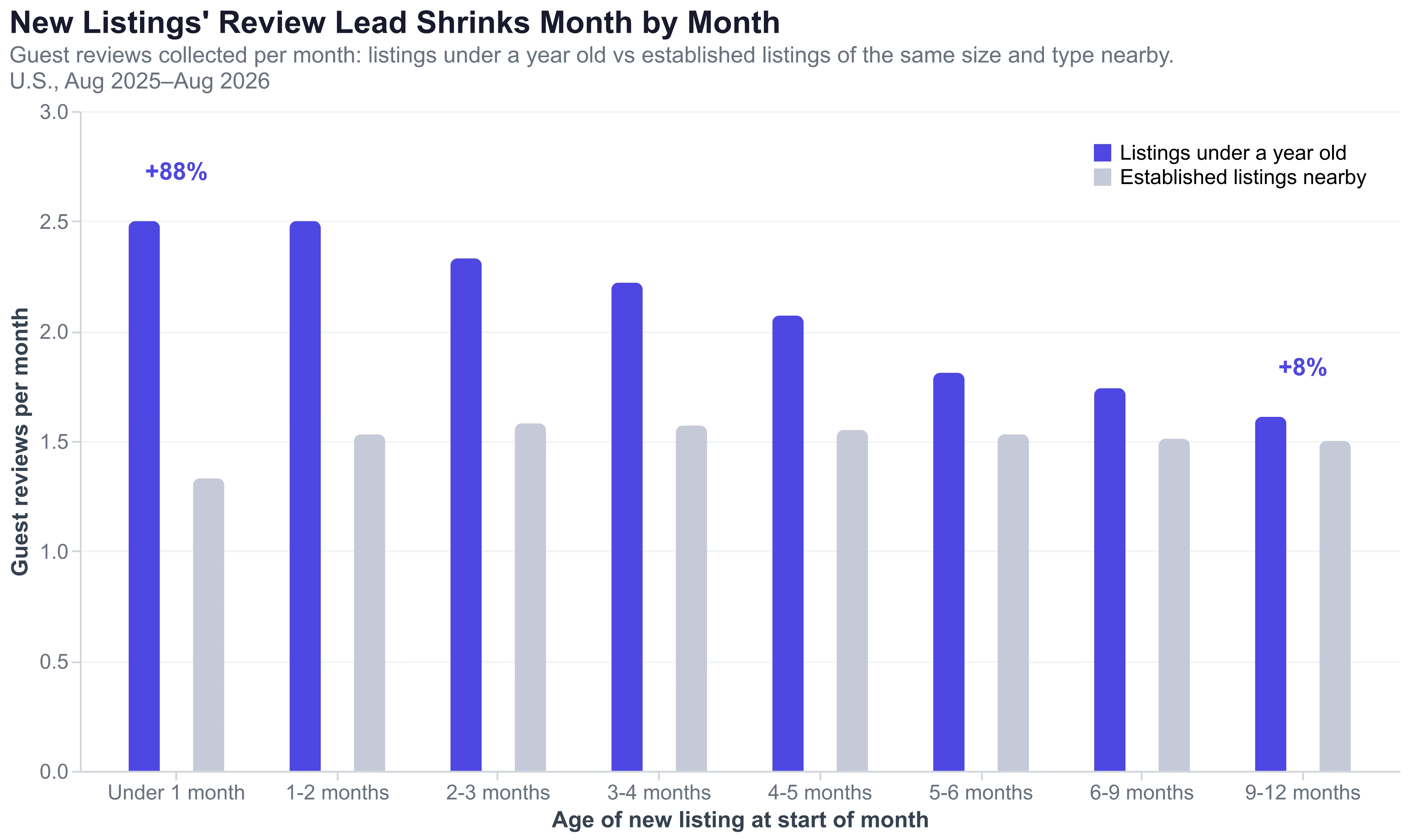
Among new listings that stayed on the market, those in their first two months collected 2.5 guest reviews a month, against 1.5 for established listings of the same size and type nearby. That is about two-thirds more, according to an AirROI analysis of nearly 300,000 listings under a year old, from August 2025 to August 2026.
The lead narrows a month at a time rather than dropping off a cliff. It was still about a third at four to five months, after the search edge had faded, and under a tenth by nine to twelve months.
Nor do the data show a cut to two weeks this year. In the October searches, listings two to four weeks old still held 2.4 times their share of page one.
In the review data, the lead in a listing's first two months was smaller in 2026, at 62% against 74% in late 2025. At two to four months, though, the 2026 lead was the larger one, 47% against 37%: the opposite of a shorter window.
Economists have measured why first reviews count. Florian Dendorfer of the University of Toronto and Regina Seibel of the Rotman School of Management found, in an October 2024 working paper on Manhattan listings, that a good review lifts an unreviewed listing's occupancy more than twice as much as a reviewed one's.
Their paper also found that an unreviewed listing is "around three times as likely to exit in a given month." The pattern here is consistent with early exposure buying a listing its first reviews, which keep working after the exposure ends.
Who gets the lift
In the first two months, the review lead was largest for new listings priced below similar listings nearby and in areas with little competition. Read across each row: every group started well ahead, and only the higher-priced group had no lead left by nine to twelve months.
| Group | Review lead, first two months | Review lead at 9–12 months |
|---|---|---|
| Priced >10% above similar listings nearby | 48% | 0% |
| Priced within 10% | 64% | 11% |
| Priced >10% below | 81% | 16% |
| Crowded areas (600+ similar listings) | 49% | 6% |
| Thin areas (under 150) | 72% | 8% |
Hosts chose their own launch pricing, so the gap shows an association, not the payoff of a discount. The lead was also smaller where competition was thick, in crowded markets with hundreds of similar listings nearby.
Airbnb offers hosts a lever for that stretch. Its new listing promotion takes 20% off a listing's next three bookings and puts a strikethrough price in search results.
Airbnb says listings published in 2025 that used it saw "more than 70% more bookings" over their first three months than those that did not.
Its footnote describes a comparison of listings that used the promotion with listings that did not, with no mention of matching similar listings.
Kansas City showed how little a new listing can get. Bryce Langford, who listed a four-bedroom Midtown home at a higher price point about five months earlier, told KCUR, Kansas City's NPR station, in a June 3 report: "We have not had a single interested person contact us." He added, "It's still listed just to see if anything happens, at this point."
Susan Brown, a host for almost 10 years who rents out five properties and is president of the Kansas City Short-Term Rental Alliance, had two World Cup bookings; her pricier properties had not yet been booked. "We can kind of sit and wait a little bit and see what happens," she said.
Maureen Hosty, a first-time host, listed her place in Kansas City's River Market in February. "I've reduced the price three times and I've changed the minimum to only two nights," she told KCUR. "But that doesn't seem to do anything — still haven't gotten a single bite."
About the data: Ages run from each listing's creation date. Results are the first 18 in 168 live searches on Oct. 1, 2026 (four per area: one undated, three weekend stays), against the 40,506 listings live or shown. Review ages are at each month's start.
Frequently Asked Questions
Airbnb publishes no duration. In October 2026 searches the edge was largest in a listing's first two weeks and still close to double at one to two months; by four to six months, new listings held no more of page one than listings six months to a year old, so the edge fades over about three months. AirROI counted age from the day each listing was created; Airbnb doesn't say when its own clock starts.
It is an optional 20% discount on a listing's next three bookings, open to listings with fewer than three bookings and Smart Pricing turned off. Guests see a strikethrough price in search, and the promotion doesn't stack with other discounts. Airbnb says 2025 listings that used it saw more than 70% more bookings in their first three months than listings that didn't.
There is no sign of it. In October 2026 searches, listings two to four weeks old still held more than twice their share of Airbnb's first page. In review data, the lead in a listing's first two months was smaller in 2026 than in late 2025, but at two to four months it was larger, the opposite of a shorter window.
Among new listings that stayed on the market, guest reviews, which follow completed stays, show no cliff. In their first two months those listings collected about two-thirds more reviews a month than established neighbors of the same size and type, and the lead thinned slowly to under a tenth by nine to twelve months.