Four Paid-Off, Owner-Run Airbnbs Clear a Median Income in the Best Markets

Chris Dickey rents out a three-bedroom house in Moab, Utah, runs it himself and keeps a day job in communications. "It's definitely a small business," he told CNBC Make It in August.
Making a living takes many more homes than that. Owned outright and run by its owner, a typical US entire home on Airbnb would have kept about $8,900 in the year to August, according to AirROI, a short-term-rental data firm, which tracked 822,191 active entire-home listings. Matching the $87,460 median household income the Census Bureau published last month would take 10 such homes.
A home at the top-quarter mark would keep about $25,400, so four would do.
Those counts assume no mortgage, no manager and no pay for the owner's time.
They also assume a lot of money already spent. A typical home in the sample would cost about $407,000 at local values, so ten paid-off homes add up to about $4 million of real estate that would keep about 2% of its value a year.
Borrowing to buy one costs far more than that: the 30-year fixed rate averaged 7.28% in the week of Oct. 1, Freddie Mac's survey shows. That gap matters to anyone buying with a loan, while cities such as Atlanta are deciding how many homes one host may run.
Airbnb's cut now comes straight out of the payout. Under its newer fee structure, "the entire fee is deducted from the host's payout," and most hosts pay 15.5%, Airbnb's help center says. "We anticipate by year end, our entire supply base will be on that single service fee," Chief Financial Officer Ellie Mertz said on the company's Aug. 6 earnings call.
"Unfortunately, as an STR owner, you just have to play by their rules," Dickey said.
Four homes in the best markets
Location moves the count further than any of the running-cost assumptions. In the best-earning local markets, which hold a fifth of US listings and include San Diego, Honolulu and the Smoky Mountains towns around Gatlinburg, a typical home would keep about $22,000. Four of them clear the median income.
Moab is one of those markets. A typical Moab three-bedroom like Dickey's would keep about $23,000 paid off and run by its owner, so four like it would clear the line.
In the weakest-earning markets, which take in Houston, Tucson and El Paso, the count passes 50.
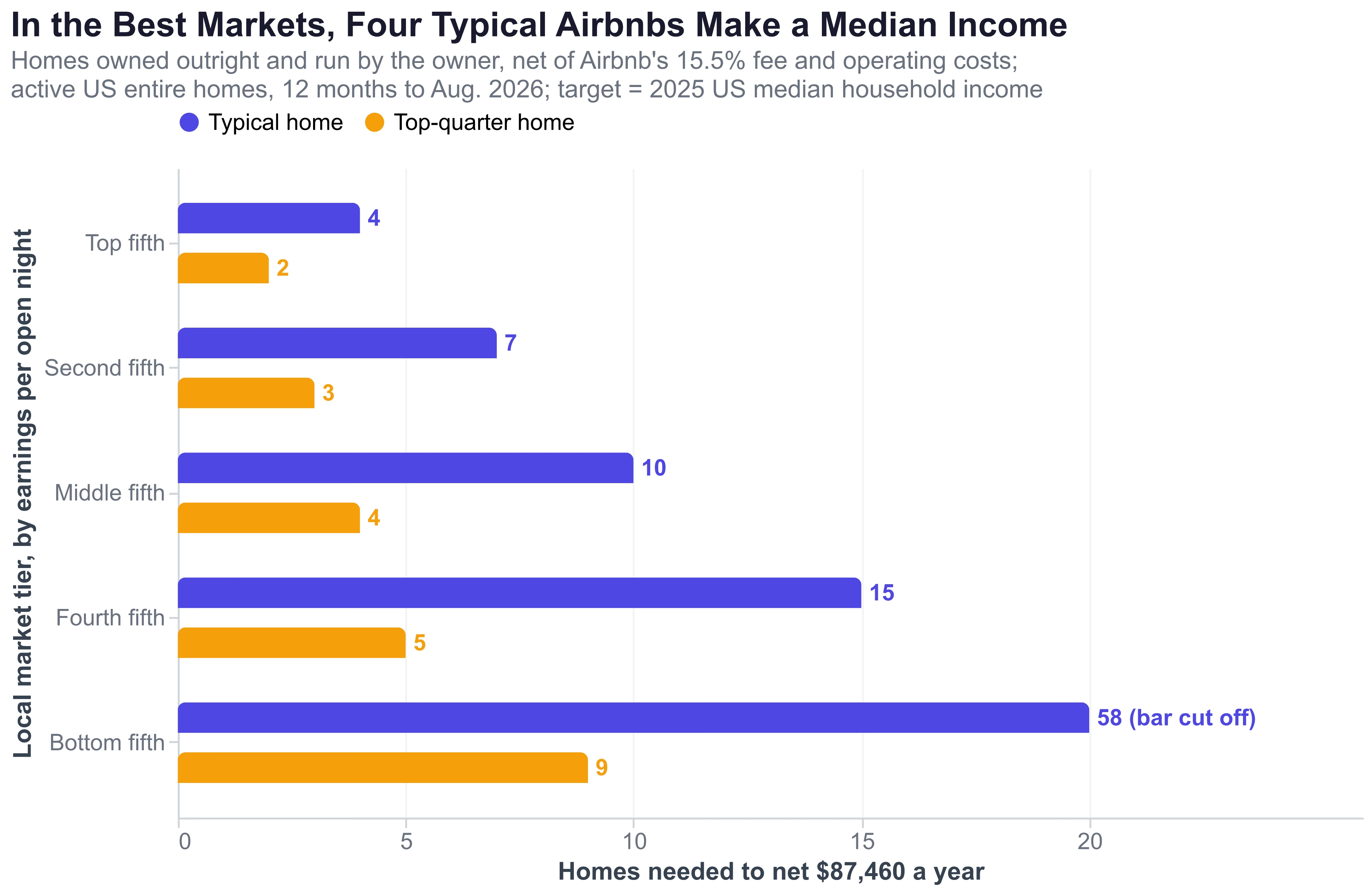
The tiers below hold equal numbers of listings. From top to bottom, a typical home's gross falls by nearly two-thirds, while what it keeps falls far faster.
| Market tier (examples) | Typical home's gross | Typical home keeps | Homes needed, typical |
|---|---|---|---|
| Top fifth (San Diego, Gatlinburg, Honolulu, Gulf Shores, Destin) | $61,900 | $22,000 | 4 |
| Second fifth (Kissimmee, Panama City Beach, Miami, New Orleans) | $46,400 | $14,300 | 7 |
| Middle fifth (Las Vegas, Philadelphia, Portland, Colorado Springs) | $38,200 | $9,600 | 10 |
| Fourth fifth (Myrtle Beach, Austin, San Antonio, Branson) | $30,800 | $5,900 | 15 |
| Bottom fifth (Houston, Tucson, El Paso, Albuquerque, Memphis) | $22,400 | $1,500 | 58 |
Fixed costs explain the gap. Utilities, furniture, insurance, supplies and software cost a typical home about $10,000 to $12,000 a year whatever it books, and Airbnb's fee and cleaning take more than a quarter of gross before any of that. "Cleaning is always the sleeper," Dickey said.
So the net rises much faster than the gross. A top-fifth home grosses less than three times what a bottom-fifth home does, yet would keep about $22,000 against about $1,500.
Under these costs, more than a quarter of homes would lose money even paid off: more than four in ten in the weakest-earning markets and about one in six in the best.
Size helps for the same reason. A typical home with four or more bedrooms would keep about $24,300 a year, so four would clear the line nationally.
The mortgage problem
A loan does more damage still. On a home bought at today's typical local value with 25% down at 7.28%, only about one home in five would cover its payments from Airbnb income after running costs.
For a typical home the loan payment alone, about $25,000 a year, eats roughly two-thirds of what it grosses. Even a top-quarter home with three or more bedrooms in a top-fifth market would keep only about $7,270 after the mortgage, so a living would take 13 of them.
Lenders that make debt-service coverage ratio, or DSCR, loans judge a short-term rental on how well its income covers the loan. They "like to see a DSCR of at least 1.25," says Griffin Funding, a national mortgage lender, which adds that programs often apply an expense factor of about 20% to short-term-rental income.
Under that test, about 46% of homes would pass at 7.28% with 25% down, yet about half of those would still lose money after the full costs.
Fannie Mae won't back a loan on an investment home that would leave a borrower with more than 10 financed properties, counting the new home and a financed primary home.
Some hosts borrow anyway, on purpose. Michael Elefante and his wife started in Nashville and now have 14 houses. "A single property can cash flow thousands per month, appreciate, and save tens of thousands in taxes with the STR tax loophole," he wrote in an X post quoted by Moneywise.
Elefante says his listings took in nearly $1.4 million in 2025, Moneywise reported, and the outlet puts the couple's debt at about $12 million.
Kristina Modares co-owns a three-bedroom beach house in Santa Rosa Beach, Fla. "We're less focused on the monthly income than on the home's long-term value and eventual sale," she said in an as-told-to essay in Business Insider in April.
Sellers are cutting asking prices even in a top-fifth market. In Gatlinburg, real estate agent John Kenney told Business Insider of a two-bedroom cabin first listed at $850,000 that now asks just under $600,000. "We're just chasing the market at this point," he said.
Katelyn Warren, another Gatlinburg agent, told the publication that she typically steers buyers to annual bookings worth 10% of the purchase price, and that most investors there now find 7% or 8%. Their typical reaction, she said: "Oh, well, that's not going to work for me."
Who runs five homes
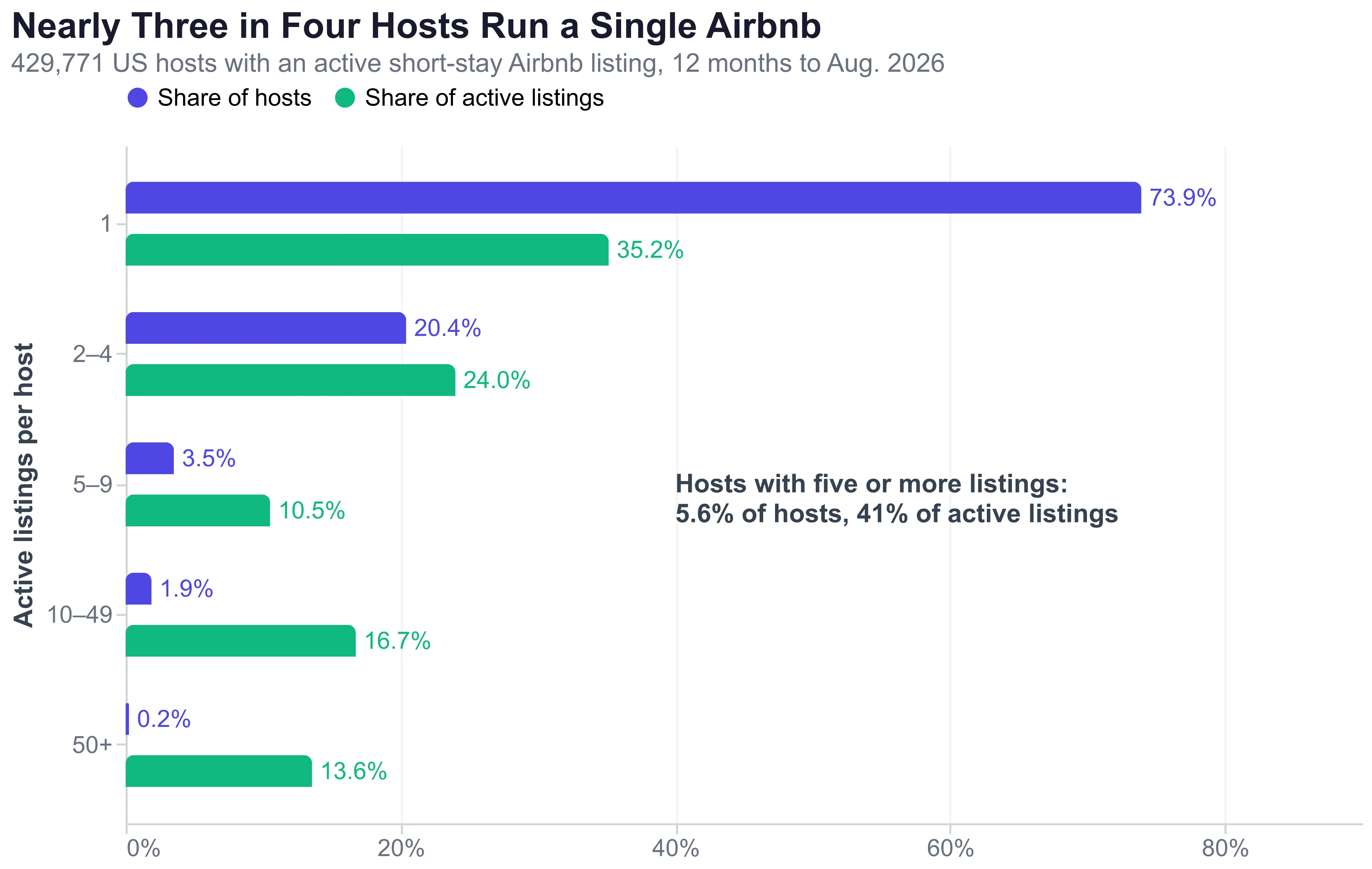
Most hosts run just one.
Among the 429,771 US hosts with an active short-stay listing, counting rooms as well as whole homes, nearly three in four have a single listing. About one in 18 runs five or more, and that group runs about two-fifths of the listings.
Airbnb's own figure for what hosts earn sits far below a living. It says the typical US host earned $15,600 in 2025, a figure it gives for all its US hosts.
Hosts with five to nine listings are the size a would-be full-timer can picture. Among those whose listings are all whole homes, portfolios gross a median of about $252,000 combined. Modeled as if paid off and run by the owner, that would leave about $64,000, and about four in ten would clear the median income.
Their homes with three or more bedrooms gross about 30% more than single-listing hosts' homes of that size in the same market tier, a gap that is small for studios through two-bedrooms. Hosts who scaled may also run better-located homes within the same tier.
Avery Carl, who owns and self-manages 10 short-term rentals and runs a brokerage, told CNBC Make It that two identical homes in one neighborhood can produce "wildly different income numbers." "Systems are great, but you have to manage the systems," she said.
Handing those systems to a property manager taking 20% of gross would leave the typical home about $1,500 a year, and a living would take more than 50 homes. A home at the top-quarter mark would keep about $12,700, so seven would do.
"Not an easy way to make money. Far from it. It's very intense," Sébastien Long, whose company Lodgeur runs about 200 furnished rentals in Texas, told CNBC Make It.
How many homes one host may run
San Diego, a top-fifth market, says on its licensing page that "a Host may only hold one license at a time." Whole-home licenses outside Mission Beach are capped at 1% of the city's housing units there. A typical San Diego home would keep about $26,000, so four would clear the median income.
Atlanta went the other way. Its City Council voted 9-5 on Sept. 21 to remove a 2021 rule that limited hosts to their primary residence plus one other unit.
A typical Atlanta home would keep about $5,300, so it would take 17 to clear the line, against a rule that allowed two.
Council member Kelsea Bond, who opposed the change, warned that it could open the door to "unlimited amounts of short-term rentals per person," WABE reported. Her amendment to keep a two-unit cap failed.
"An ordinance is only as good as its enforcement," Council member Matt Westmoreland, who sponsored the change, told WABE.
Limits like these have critics outside city halls. Restricting short-term rentals, including through restrictions on hosts, "does little to improve affordability and often imposes sweeping burdens on responsible hosts, guests, and platforms," Eliza Terziev, a policy analyst at the free-market Reason Foundation, wrote in a commentary on Sept. 21.
Atlanta's change takes effect Jan. 1, 2027. In San Diego, where four typical homes would clear the median income, a host may still hold one license.
About the data: Figures cover 822,191 active US entire-home Airbnb listings with minimum stays under 28 nights, booked in the 12 months to August 2026. Net assumes the 15.5% fee, cleaning, utilities, insurance, supplies, software and permits, 5% upkeep, furnishing and 1% property tax.
Frequently Asked Questions
The typical active US entire home grossed $36,680 over the past year and would keep about $8,900 of it if paid off and run by its owner. That is after Airbnb's host fee, cleaning, utilities, insurance, supplies, software and permits, upkeep, furnishing and property tax, and before anything is paid for the owner's time.
Rarely at today's prices and rates. With a quarter down at 7.28%, Freddie Mac's average for the week of Oct. 1, 2026, only about one home in five would cover its loan from Airbnb income after running costs. Fannie Mae also won't back a loan on an investment home that would leave a borrower with more than 10 financed properties, counting the new one.
A great deal of property. The ten typical US homes that would net a median household income, paid off and run by the owner, add up to about $4 million at typical local values. In the best-earning markets fewer homes do it, but each one costs more.
Yes. San Diego lets a host hold only one short-term rental license at a time and caps whole-home licenses outside Mission Beach at 1% of housing units. Atlanta is moving the other way: its rule limiting hosts to their primary residence plus one more unit is scheduled to end on Jan. 1, 2027.