
Airbnb Management vs Self-Manage: The Breakeven Math Across 9 Markets

In Destin, Florida — one of America's top vacation rental markets with over 4,200 active listings — professionally managed Airbnb listings earn 19% less annual revenue than self-hosted properties. Drive 2,000 miles west to Joshua Tree, California, and the script flips: managed listings earn 87% more, pulling $76,005 annually versus $40,671 for individually hosted homes. The question of whether to hire a property manager for your Airbnb is not a philosophy debate. It is a math problem, and the answer changes dramatically based on your market, your fee structure, and how you value your time.
AirROI analyzed managed versus self-hosted listing performance across nine diverse U.S. markets. The data reveals where airbnb management creates genuine financial value, where it destroys it, and where most hosts would be better served by a co-hosting arrangement at half the cost.
The Professional Management Premium Is Real — But It Varies 10x by Market
Professionally managed Airbnb listings command higher nightly rates in every market we analyzed. The average daily rate (ADR) premium ranges from 20% in Destin to 69% in Joshua Tree. That rate premium translates to a revenue advantage — but not as consistently as the management industry claims.
Here is the managed-versus-self-hosted breakdown across all nine markets, based on AirROI trailing-twelve-month data:
| Market | Managed Revenue | Self-Hosted Revenue | Revenue Premium | Managed ADR | Self-Hosted ADR | ADR Premium |
|---|---|---|---|---|---|---|
| Austin, TX | $44,864 | $23,162 | +94% | $413 | $270 | +53% |
| Joshua Tree, CA | $76,005 | $40,671 | +87% | $497 | $294 | +69% |
| Denver, CO | $38,588 | $22,035 | +75% | $317 | $208 | +53% |
| Scottsdale, AZ | $58,335 | $38,438 | +52% | $584 | $364 | +61% |
| Nashville, TN | $58,157 | $39,072 | +49% | $440 | $316 | +39% |
| Big Bear Lake, CA | $39,601 | $29,869 | +33% | $590 | $401 | +47% |
| Miami Beach, FL | $42,950 | $36,970 | +16% | $458 | $340 | +35% |
| Gatlinburg, TN | $48,525 | $45,901 | +6% | $422 | $328 | +29% |
| Destin, FL | $41,703 | $51,433 | -19% | $504 | $419 | +20% |
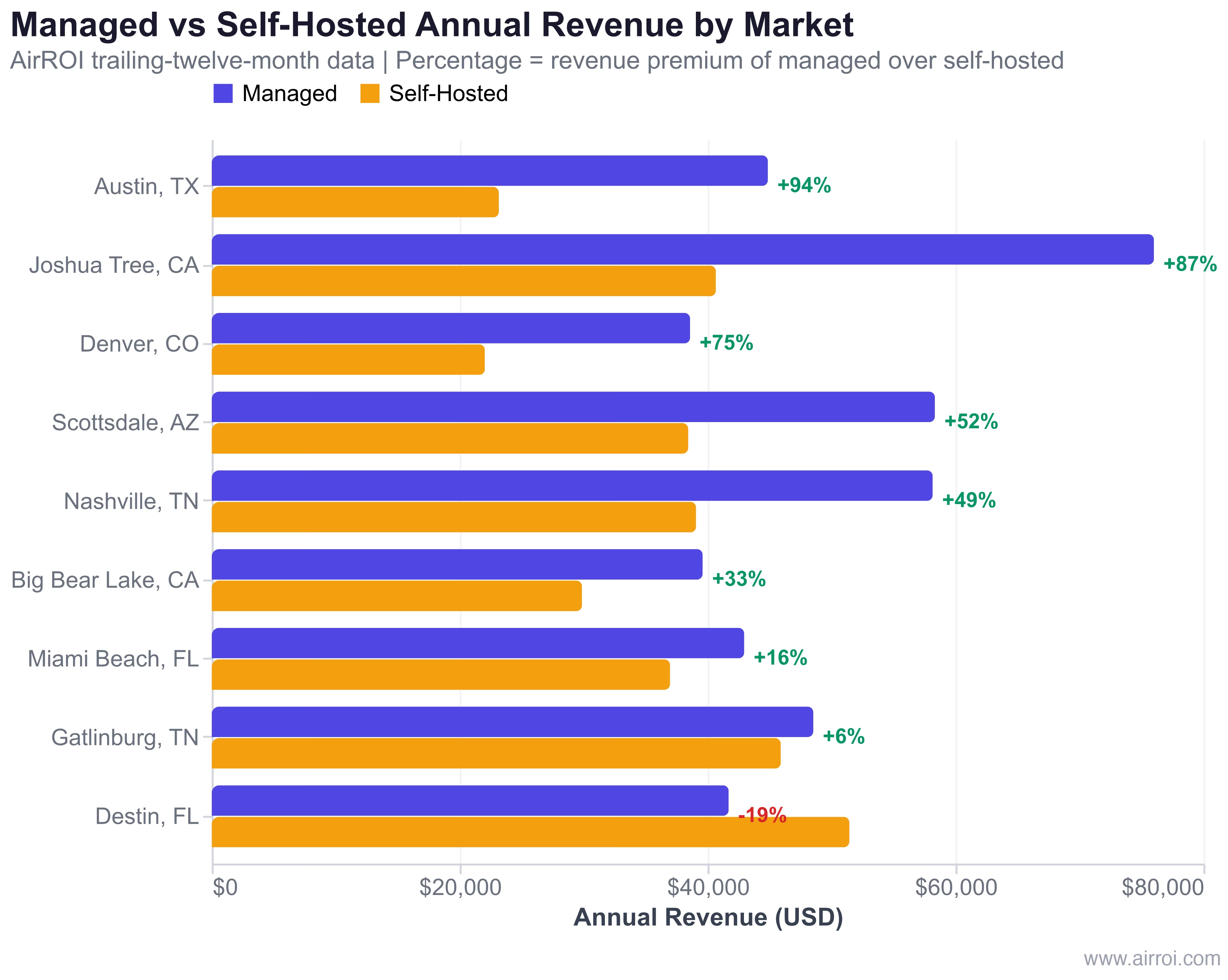
The pattern is clear: managed listings charge more per night in every market, but that rate advantage does not always translate to higher total revenue. In Destin, managed listings charge 20% higher ADR but achieve only 39% occupancy versus 50% for self-hosted — resulting in lower annual revenue despite the rate premium.
According to PriceLabs' 2026 analysis, professional operators "employ dynamic pricing tools, rate protection strategies, and revenue management discipline that prioritize ADR over occupancy." That strategy works in markets where demand supports premium pricing. In oversaturated markets, it backfires.
The revenue premium also reflects a composition effect. Professionally managed portfolios tend to include larger, better-located, and more recently renovated properties. The 94% premium in Austin does not mean hiring a PM will double your revenue — it means the types of properties under professional management already skew toward higher earners. A realistic PM-driven revenue lift for the same property is closer to 20-40%, depending on the market.
What Property Managers Actually Charge (Beyond the Headline Percentage)
The advertised management fee is the starting point, not the total cost. Understanding the full fee stack is essential to calculating whether airbnb property management fees are worth it for your situation.
| Fee Type | Half-Service | Co-Host | Full-Service |
|---|---|---|---|
| Management fee | 10-15% | 10-20% | 20-35% |
| Onboarding/setup | $0-$500 | $0 | $300-$1,000 |
| Maintenance markup | 0% | 0% | 10-20% |
| Linen/supply charges | Host pays direct | Host pays direct | Often marked up |
| Airbnb platform fee (PMS) | 15.5% | 3% (split fee) | 15.5% |
| Early termination fee | Varies | Usually none | $500-$2,000 |
| Effective total cost | 12-18% | 13-23% | 30-45% |
A critical detail most fee guides miss: as of April 2026, Airbnb charges a 15.5% host service fee for all listings connected through property management software. If your PM uses a PMS — and virtually all professional managers do — that 15.5% comes off the top before the PM takes their cut. A host self-managing on the split-fee structure pays roughly 3% to Airbnb; a host with a PMS-connected PM pays 15.5%.
This means a PM advertising a "25% management fee" actually costs the host 25% + 15.5% of gross revenue lost to platform fees, plus any maintenance markups and ancillary charges. The headline fee understates the true cost by 40-80%.
The Breakeven Formula: When PM Fees Exceed the Revenue Lift
Here is the core equation every host needs before deciding whether to hire an airbnb management company:
PM creates net value when: Self-Managed Revenue × PM Revenue Lift % > PM-Boosted Revenue × Total PM Fee %
Let us walk through three real scenarios using AirROI market data:
Scenario 1: Joshua Tree — PM wins decisively
- Self-managed revenue: $40,671
- Realistic PM revenue lift: 40% (conservative vs. the 87% raw premium)
- PM-boosted revenue: $56,940
- Total PM fee at 25%: $14,235
- Net after PM: $42,705
- Net gain from PM: $2,034/year (plus time savings)
At a 40% realistic lift and 25% total fee, the PM creates modest but positive net value. If the PM delivers even close to the 87% raw premium, the net gain exceeds $20,000.
Scenario 2: Nashville — PM breaks even
- Self-managed revenue: $39,072
- Realistic PM revenue lift: 25%
- PM-boosted revenue: $48,840
- Total PM fee at 25%: $12,210
- Net after PM: $36,630
- Net loss from PM: $2,442/year (but offset by time savings)
In Nashville, a 25% fee at a 25% revenue lift produces a net revenue loss. The PM only becomes worthwhile when the time savings are factored in — or when the fee is negotiated below 20%.
Scenario 3: Gatlinburg — PM destroys value
- Self-managed revenue: $45,901
- Realistic PM revenue lift: 5% (matching the raw 6% premium)
- PM-boosted revenue: $48,196
- Total PM fee at 25%: $12,049
- Net after PM: $36,147
- Net loss from PM: $9,754/year
In Gatlinburg, where 55% of listings are already professionally managed, the PM premium has been competed away. Paying 25% for a 5% lift is a losing proposition by nearly $10,000 per year.
The pattern: the breakeven point is where the PM's revenue lift percentage exceeds the total effective fee percentage. A 25% total fee requires at least a 25% revenue lift to break even on pure revenue terms. Markets with raw premiums below 25% are unlikely to clear this bar after accounting for the composition effect.
Market-by-Market: Where PMs Create Value vs Where They Destroy It
The nine-market analysis reveals a clear split between PM-positive and PM-negative market types.
Markets where PMs create the most value:
- Remote desert/mountain markets (Joshua Tree, Big Bear Lake): Hosts often live hours away and cannot manage same-day turnovers. The physical distance alone justifies professional management. Joshua Tree's 87% raw premium is among the highest in our dataset.
- High-ADR urban markets with low PM penetration (Denver, Austin): Only 12-19% of listings are professionally managed, meaning the PM advantage has not yet been competed away. Austin's 94% raw premium is the highest in our dataset, and managed listings in Denver earn 75% more than self-hosted.
Markets where PMs deliver diminishing returns:
- High-PM-penetration resort markets (Gatlinburg, Destin): When 55-72% of listings are already professionally managed, management becomes the baseline, not a differentiator. Destin's 72% PM share — the highest in our dataset — correlates with managed listings earning 19% less than the smaller pool of self-hosted properties.
- Mature urban markets (Miami Beach): A 16% revenue premium does not survive a 25% management fee. Self-management with dynamic pricing tools captures most of the PM's pricing advantage at a fraction of the cost.
The Time-Value Calculation Nobody Does
The breakeven math above only considers revenue. Most hosts forget to account for the cost of their own time.
Here is what that time is actually worth:
| Your Hourly Value | Monthly Hours Saved by PM | Annual Time Cost of Self-Managing | PM Fee on $45K Revenue (25%) | Net After Time Value |
|---|---|---|---|---|
| $25/hr | 15 hrs | $4,500 | $11,250 | -$6,750 |
| $50/hr | 15 hrs | $9,000 | $11,250 | -$2,250 |
| $75/hr | 15 hrs | $13,500 | $11,250 | +$2,250 |
| $100/hr | 15 hrs | $18,000 | $11,250 | +$6,750 |
At $75 per hour or above, the time savings alone justify a 25% PM fee on a $45,000/year property — even if the PM delivers zero additional revenue. This is the tiebreaker when the pure revenue math is close to neutral.
As one host on r/airbnb_hosts described after 3.5 years of self-management:
"I am burnt out. It feels like lately we're having more 'issues' to deal with, from minor stuff like guests needing help figuring out a light switch at midnight to major stuff like a scammer who had me spending a chunk of Christmas Day on the phone with support."
Burnout carries its own cost. Burned-out hosts defer maintenance, respond slowly to guest inquiries, and let pricing stagnate — all of which erode revenue over time. The time-value calculation is not just about hourly rates; it is about sustainable operations over years, not months.
The Co-Hosting Alternative: 80% of the Benefit at Half the Cost
For hosts who fall in the middle — close enough to handle some tasks but too busy for 24/7 guest management — co-hosting offers a compelling middle path.
The co-hosting model captures the single biggest time saver — guest communication at all hours — at roughly half the cost of full-service management. A host spending 15 hours/month on self-management can reduce that to 5-8 hours by offloading guest communication and booking coordination to a co-host.
One important consideration: if the co-host operates without PMS software and you retain the split-fee structure on Airbnb, your platform fee stays at 3% instead of the 15.5% charged to PMS-connected listings. This fee difference alone can save $5,000-$7,000 per year on a $50,000 property, making co-hosting substantially cheaper than full-service management on a total-cost basis.
Four Questions to Answer Before Signing a Management Contract
Rather than asking "should I hire a property manager?" — which invites opinion — answer these four data-driven questions:
1. What is your market's managed-vs-self-hosted revenue premium?
2. What is the PM's effective total fee?
Add the management fee percentage, estimate the Airbnb platform fee impact (15.5% for PMS users vs 3% for split-fee), and account for maintenance markups and ancillary charges. The true cost is almost always 30-80% higher than the advertised fee.
3. How far is the property from your home?
Within 30 minutes: self-management or co-hosting is viable. One to two hours: co-hosting recommended, full-service optional. More than two hours: professional management delivers the highest risk-adjusted return because remote owners cannot handle emergencies, turnovers, or maintenance promptly.
4. What is your time worth per hour?
If your effective hourly rate exceeds $75 and you spend 15+ hours/month on property management, the time savings alone may justify hiring help — regardless of the revenue premium.
| Decision Path | Revenue Premium | Distance | Time Value | Recommendation |
|---|---|---|---|---|
| Self-manage | Below 20% | Under 30 min | Under $50/hr | Self-manage with dynamic pricing tools |
| Co-host | 10-30% | 30 min - 2 hrs | $50-$75/hr | Co-host at 10-20% |
| Full-service PM | Above 30% | Over 2 hours | Above $75/hr | Full-service if fee < premium |
| Full-service PM | Any | Over 2 hours | Any | Full-service for remote properties |
The strongest case for professional management is a remote property in a market with a high PM premium and a host whose time is valuable. The weakest case is a local property in a saturated market where the host has flexible hours. Most hosts fall somewhere in between — which is why co-hosting has become the fastest-growing segment of the management industry.
Frequently Asked Questions
It depends on your market and distance from the property. AirROI data shows managed listings earn 6-94% more revenue across nine U.S. markets, but full-service PM fees of 20-35% erase that premium in markets like Gatlinburg (+6%) and Destin (-19%). The fees are worth it when the revenue premium exceeds the total fee, which typically occurs in remote or resort markets where self-management is impractical.
Full-service managers charge 20-35% of gross booking revenue. Half-service or listing-only managers charge 10-15%. Co-hosts typically charge 10-20%. Additional costs include onboarding fees of $300-$1,000, maintenance markups of 10-20%, and Airbnb's 15.5% platform fee for PMS-connected hosts. Total effective cost often reaches 30-40% of gross revenue.
AirROI data across nine U.S. markets shows professionally managed listings earn 6-94% more annual revenue than self-hosted properties. Austin shows the largest premium at 94% ($44,864 vs $23,162), while Destin actually shows managed listings earning 19% less. The premium comes from higher ADR (20-69% more), not higher occupancy.
An Airbnb co-host handles guest communication, booking management, and sometimes pricing optimization while the host retains control of cleaning and maintenance. Co-hosts typically charge 10-20% of booking revenue, roughly half of full-service management. This model saves hosts 15-25 hours per month and works best for semi-remote properties or burnout prevention.
Use this formula: a PM creates value when your Current Revenue multiplied by the Expected Revenue Lift exceeds the PM-Boosted Revenue multiplied by the Total Fee Percentage. For example, if your listing earns $40,000 per year and a PM boosts revenue 30% to $52,000 but charges 25%, the fee is $13,000 and your net is $39,000 — less than self-managing. The PM only breaks even when the revenue lift exceeds the total fee percentage.