Home-Swap Exodus 2026: What It Reveals About Airbnb Pricing

A 3-night San Francisco Airbnb listed at $224 a night costs an effective $339 a night by the time you reach checkout — and a comparable home swap costs about a seventh of that. That single number, not platform fatigue, explains the wave of June 2026 headlines declaring travelers are "ditching Airbnb." The most credible airbnb alternatives 2026 story isn't about authenticity or wanderlust; it's a referendum on the checkout total. When you stack home swapping vs airbnb on an all-in cost basis, the comparison stops being close.
The trigger was real money. Kindred, a modern home-swap platform, raised $125 million in February 2026 and published its 2026 Global Travel Forecast, which surveyed 4,000 US and UK consumers and found 61% naming affordability as their top motivation for 2026 trips. According to AirROI's analysis of all-in checkout costs, the median 3-night Airbnb total runs 55.9% above the listed nightly subtotal across 28 US markets. Put those two facts together and the home-swap surge reads less like a cultural shift and more like a measurable demand-side response to a pricing problem hosts can actually do something about.
Here is the part that should reassure hosts rather than alarm them: home swapping won't replace short-term rentals for most trips. It can't. But it does cleanly capture one specific booking — the marginal, price-sensitive guest — and that defection is a signal worth reading.
The Home-Swap Surge Is Real — and Funded
The home-swap trend is funded and growing, not anecdotal. Kindred's $125 million raise — a $40 million Series B co-led by NEA and Figma CEO Dylan Field, plus an $85 million Series C led by Index Ventures — landed in February 2026 alongside membership numbers that explain the investor appetite. The platform now counts roughly 300,000 members across 150-plus cities, having added 150,000 members in 2025 alone, with nearly 350,000 nights hosted to date, according to its funding announcement.
The incumbent is bigger still. HomeExchange reports 200,000 members across 155 countries, runs on a flat $220-per-year fee for unlimited exchanges, and completed more than 408,000 exchanges in 2024 — 35% year-over-year growth, and a doubling of its community in two years — per its membership milestone release. When a 30-year-old category and a venture-backed newcomer both inflect upward at the same time, the cause is structural, not faddish.
The June 2026 coverage cluster — AOL, a separate AOL explainer on how house swapping works, and a string of trade outlets — framed home swapping as travel's affordable "third option" between hotels and short-term rentals. HomeExchange CEO Emmanuel Arnaud put the positioning bluntly:
"Airbnb's initial promise was that everything can be rented, even your most precious asset. Our promise is the reverse: Everything can be shared." — Emmanuel Arnaud, CEO, HomeExchange
That's a deliberate counter to the rental model. The framing that's stuck in the trade press is the "third option" — home swapping positioned between expensive, commoditized hotels and a short-term rental category that increasingly charges hotel-like totals. It's a clean narrative, and it's gaining traction precisely because the price argument underneath it is sound. The category isn't selling a different feeling; it's selling a different number.
But the word "exodus" overstates the scale. Home swapping has structural ceilings — reciprocity, a swappable home, date flexibility — that cap how far it can travel. What the data actually shows is a specific, price-sensitive segment moving, not a mass migration off the platform. The 300,000 Kindred members and 200,000 HomeExchange members are real, but they're a rounding error against Airbnb's hundreds of millions of annual bookings. The trend matters not because of its absolute size but because of which booking it removes from a host's calendar. Understanding which segment, and why, is where the analysis gets useful for hosts.
The Real Driver Is the Checkout Gap, Not Disloyalty
The trigger for the switch is the all-in price gap, not platform disloyalty. Travelers don't defect because they've fallen out of love with Airbnb; they defect because the price they see first and the price they pay at checkout diverge by hundreds of dollars. The airbnb fees vs home exchange comparison is really a comparison between a stacked, variable total and a flat, transparent one.
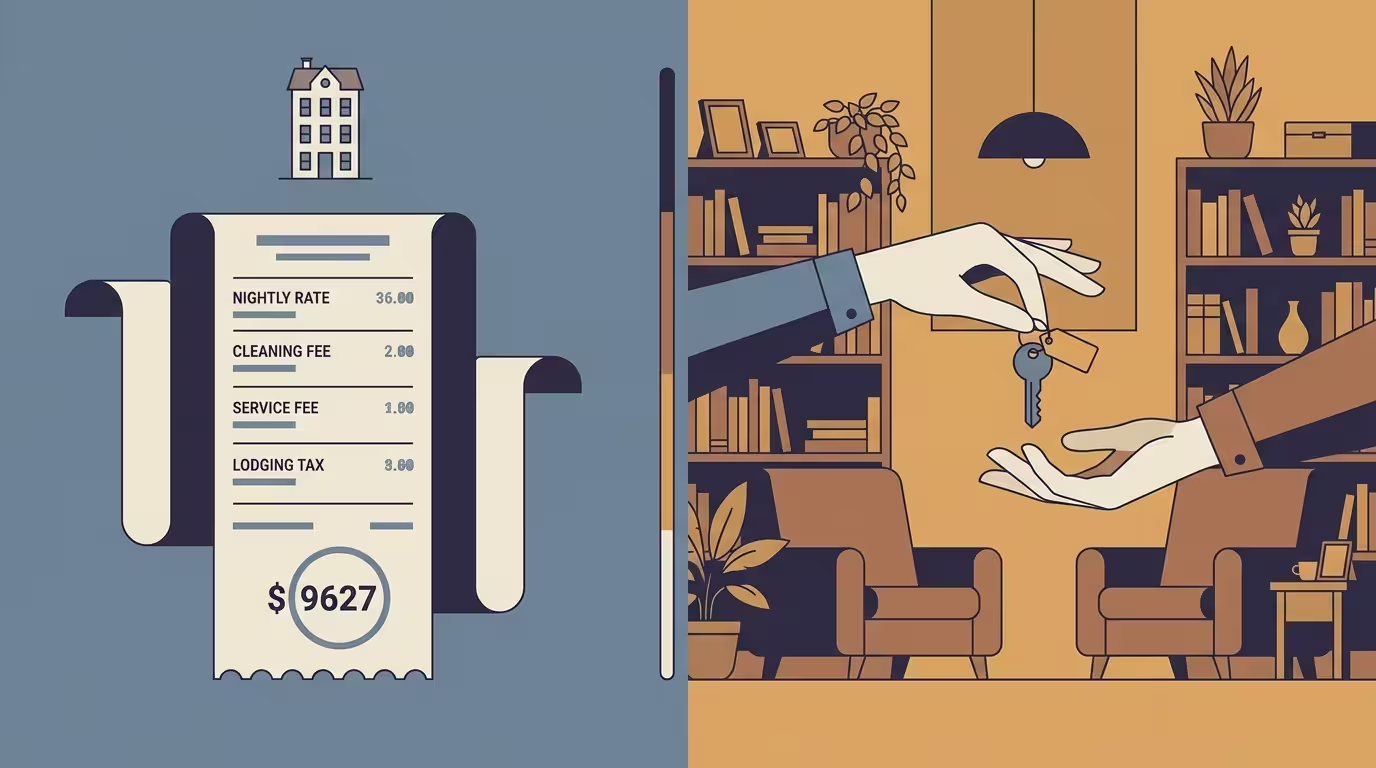
Airbnb's checkout total assembles in layers. On top of the nightly rate sits a per-stay cleaning fee, then a guest service fee of roughly 14% of the nightly-plus-cleaning subtotal, then a local lodging tax. AirROI's all-in price math across 28 US markets found the median 3-night checkout total sits 55.9% above the nightly-rate subtotal, with a range of 45.0% to 72.9%. The widely repeated "40% markup" figure from earlier travel-press analysis turned out to be conservative.
Here is what that stack produces for a representative San Francisco 1-bedroom, priced at the segment's $224 ADR:
| Line item | Calculation | Amount |
|---|---|---|
| Nightly rate | $224 ADR × 3 nights | $672 |
| Cleaning fee | Flat per stay | $110 |
| Guest service fee | 14% of ($672 + $110) | $109 |
| Lodging tax | ~14% of subtotal + service fee | $125 |
| Airbnb all-in total | $1,016 | |
| Effective rate per night | $339 | |
| Markup over nightly subtotal | +51.2% |
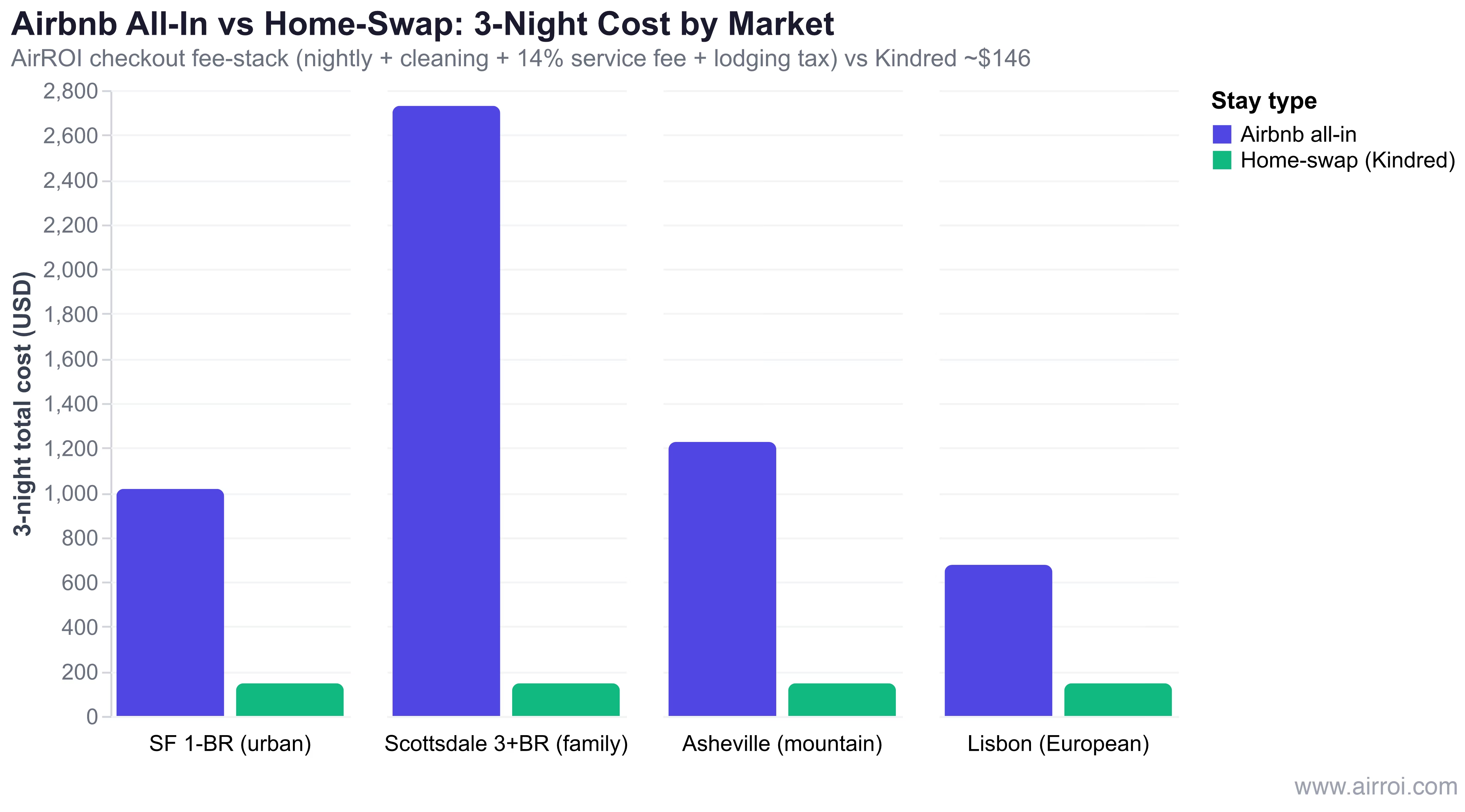
Now run the home-swap equivalent. A comparable Kindred stay carries a service fee of $20 to $45 per night plus a modest cleaning charge — roughly $146 all-in for the same three nights. HomeExchange's flat $220 annual fee amortizes to $11 to $22 per night for an active member, or $33 to $66 across three nights. Kindred's own framing — "one-tenth the price of a comparable short-term rental" — is not marketing hyperbole. Against AirROI's San Francisco figure it checks out almost exactly: $1,016 versus $146 is a roughly 7x gap.
The two models differ on the one axis the 2026 traveler now ranks first. It isn't availability or flexibility, where Airbnb wins easily — it's the visibility and size of the markup. Airbnb's total is variable and revealed late; the home-swap fee is flat and known up front. That structural difference is why the comparison lands at 5x to 19x across markets rather than a few percentage points:
| Dimension | Airbnb (whole unit) | Home-swap (Kindred / HomeExchange) |
|---|---|---|
| What you pay | Nightly ADR + cleaning + 14% service fee + lodging tax | Kindred: $20–45/night + cleaning; HomeExchange: $220/yr flat |
| Median markup over shelf price | +55.9% across 28 US markets | None — fee is flat and disclosed up front |
| Inventory type | Often professionally managed, investor-owned | Over 90% primary residences (Kindred) |
| Requirement to use | Money only | A swappable home plus flexibility and reciprocity |
The affordability pressure isn't uniform across the traveler base, either. Kindred's 2026 survey found women (66%) ranked affordability as their top concern more often than men (57%), and families — for whom lodging is the largest single travel expense — skew the most cost-driven of all. Those are the same cohorts the home-swap platforms target most directly, which is why the surge concentrates rather than spreads evenly.
The survey data points the same direction. Kindred co-founder Justine Palefsky read the shift as economic, not emotional:
"Affordability has always mattered, but it's now the leading driver of travel decisions. People aren't traveling less — they're traveling smarter." — Justine Palefsky, co-founder, Kindred
You can hear the same logic in the way guests now talk about the platform. The sentiment showing up across travel social feeds in mid-2026 is unsparing: "Airbnb used to be the budget option. Now you pay hotel prices, a cleaning fee, a service fee, a checkout chore list, and somehow you're still expected to take the trash out before leaving." That guest is describing a value-perception problem — and value perception is something a host controls.
Which Airbnb Hosts Are Most at Risk
High-ADR urban 1-bedrooms and family-sized whole-home units are the most exposed segments, because that's where the absolute dollar gap is widest and the home-swap substitution is most believable. The threat isn't evenly distributed across the market — it concentrates exactly where the checkout total is largest in dollar terms.
The home exchange cost comparison is most punishing for families. A Scottsdale 3-plus bedroom entire home carries a TTM ADR of $619.90 across roughly 2,380 listings, per AirROI data. A 3-night all-in total reaches approximately $2,730 — an effective $910 per night — once a $250 cleaning fee, the 14% service fee, and a 13.5% lodging tax stack up. Against a Kindred swap near $146, that's a gap closer to 19x. For families, accommodation is the single largest line item in the travel budget, which is precisely why the family-sized, high-ADR whole-home segment is where the substitution is most rational.
Picture the booking that actually moves. A family of five needs a 3-bedroom in Scottsdale for a spring-break week. They price the whole-home segment, see $619.90 a night, and then watch the total climb to $2,730 for three nights once the cleaning fee, service fee, and lodging tax compound. That family already has a 3-bedroom of their own sitting empty while they travel — the exact profile Kindred and HomeExchange are built for. Swapping it costs them near $146 on Kindred or amortizes to $33 to $66 on HomeExchange's annual plan, and it delivers the family-sized space they need without the per-stay cleaning fee that drove the Airbnb total. That's not platform fatigue talking; it's a $2,500-plus arithmetic difference on a single trip.
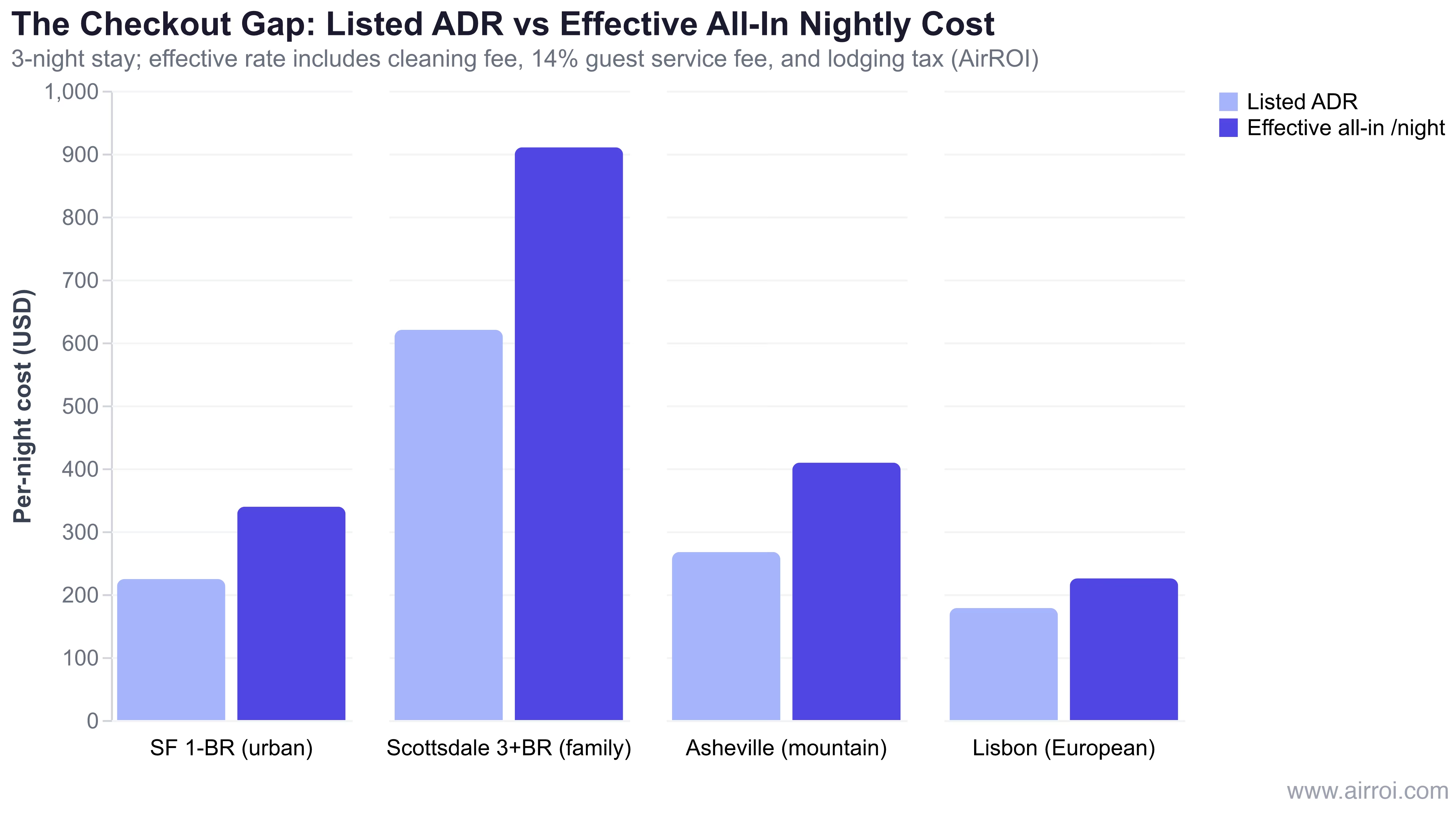
Urban 1-bedrooms are the second exposed segment. San Francisco's 1-bedroom entire-home segment runs 60% occupancy, a $224 ADR, and $139 RevPAR over the trailing twelve months — solid numbers, but the short-trip checkout total of $339 a night is exactly the kind of figure a price-sensitive city traveler will route around. Mid-tier leisure markets feel a quieter version of the same pressure: Asheville's $267.30 ADR carries a +52.9% markup to an effective $409 a night, driven by a cleaning fee that's a high percentage of a moderate nightly rate.
The exposure thins out where fees are lower. Lisbon, at a $177.70 ADR with a low flat city tax and no percentage-based service-fee inflation on lodging tax, lands at a +26.8% markup — an effective $225 a night. The gap to a home swap is still real, but at roughly 5x it's the narrowest in the sample.
| Segment | Why exposed | AirROI signal | Effective all-in /night |
|---|---|---|---|
| High-ADR urban 1-BR (San Francisco) | Big absolute gap on short city trips; authenticity swap is easy | $224 ADR, 60% occupancy | ~$339 |
| Family-sized whole home (Scottsdale 3+BR) | Largest dollar gap; families most cost-driven | $619.90 ADR, ~2,380 listings | ~$910 |
| Mid-tier leisure (Asheville) | Cleaning fee is a high share of a moderate ADR | $267.30 ADR, +52.9% markup | ~$409 |
| Lower-exposure international (Lisbon) | Smaller markup, less room for substitution | $177.70 ADR, +26.8% markup | ~$225 |
One macro factor sharpens all of this in 2026. As AirROI's analysis of rate-driven growth against flat demand shows, short-term rental supply is expanding faster than demand this year, with occupancy roughly flat. When the market is loose, every marginal booking matters more — so the price-sensitive guest a host cedes to a home swap costs more in 2026 than the same loss would have in a tighter year.
Authenticity and the Housing-Criticism Halo
Two secondary forces amplify the price signal: authenticity fatigue and a housing-criticism halo that home swaps enjoy and short-term rentals don't. Neither is the primary driver — price is — but both lower the resistance a guest feels when switching.
The authenticity argument is well-documented. A 2025 Skift report found 86% of travelers prioritize immersive experiences over traditional sightseeing, and the critique of professionalized short-term rentals — "professionally photographed" units "stripped of personal character," as one trend analysis put it — has hardened into a consumer talking point. A home swap, by definition, drops you into a space with the resident's books on the shelf and their kitchen stocked. For the segment that already finds the checkout total objectionable, the authenticity narrative supplies the permission to leave.
The housing-criticism halo is the more strategically important of the two. Home-swap platforms move only primary residences, so they sidestep the displacement backlash that has fueled short-term rental ordinances across dozens of cities. Kindred's Palefsky is explicit about the model's mechanics:
"Over 90% of our homes are the real primary residences of the hosting member... Members are exchanging nights and not dollars, so there's no way to purchase or sell nights on Kindred for cash." — Justine Palefsky, co-founder, Kindred
Because a swap doesn't pull a unit out of the long-term housing stock the way a dedicated short-term rental can, home swapping arrives with clean regulatory hands. That matters for the value-perception contest: the guest who feels vaguely guilty about an investor-owned listing feels no such friction about staying in someone's actual home. It's a reputational tailwind the home-swap category gets for free.
What the Home-Swap Trend Means for Your Pricing
For hosts, this is a value-perception problem with concrete pricing levers — not a reason to panic. The booking at risk is specific and identifiable, and the response is disciplined pricing, not a fire sale. The home-swap surge doesn't demand that you slash your nightly rate; it demands that you manage your all-in total and the perception of value behind it.
The mental shift is to manage the checkout total as the price, not the nightly rate as the price. Guests defect on the number they pay, not the number they first saw — so the lever that retains the marginal guest is rarely a headline rate cut. Often it's a proportionate cleaning fee or a transparent total that removes the late-stage sticker shock. A host who drops their ADR by 10% but keeps a $250 cleaning fee on a 3-night stay has barely moved the all-in total; a host who right-sizes the cleaning fee can cut the markup meaningfully while protecting the nightly rate.
Three levers move the needle. First, rate discipline: hold pricing aligned to delivered value rather than reflexively chasing the top of the market, especially in the loose 2026 demand environment where supply is outrunning demand. Second, a proportionate cleaning fee: when the cleaning fee is a large share of the nightly rate, it's the single most visible driver of the checkout-total surprise — keep it sized to the actual cost of turnover. Third, justify the premium: a guest who perceives genuine value in your space and amenities is far less likely to route around the fee stack. Our guide to amenities that boost revenue covers which upgrades actually move bookings.
There's also a structural play: capture more of the booking yourself. AirROI's analysis of direct-booking fee recapture shows how moving repeat guests off-platform recovers the service-fee layer that inflates the checkout total in the first place — and our starter guide on building a direct-booking channel walks through the mechanics. A guest who books direct never sees the markup that sends them hunting for a swap.
The point is leverage. The marginal, price-sensitive guest is one you can choose to keep with transparent, proportionate pricing — or one you can choose to cede. Either way, it's a decision, not an inevitability.
Why Home-Swap Won't Replace Short-Term Rentals
Home swapping can't fit most trips, and that's the honest bound on the threat. The model requires three things at once: a swappable primary residence, the willingness to host strangers in it, and enough date flexibility to make a reciprocal exchange work. Strip away any one of those and the option disappears.
That eliminates a large share of travel demand. As AOL's explainer on house swapping notes, the model is "best for travelers who own or rent a home they're willing to swap" — it doesn't serve solo travelers without a property to swap, spontaneous bookers who decide on a destination two days out, or younger travelers who prize itinerary flexibility over a fixed exchange. Because the platforms are non-commercial — Kindred members trade nights, not dollars — there's no way to simply buy your way into a stay when the reciprocity math doesn't line up. The same design that gives home swapping its price advantage and its regulatory halo also caps its addressable market.
There's a useful asymmetry buried in that constraint. The guest who can use a home swap is, almost by definition, a homeowner with a desirable property and flexible dates — a high-intent, high-quality traveler. That's the guest a host would most want to keep, and it's exactly the guest the fee stack is best at driving away. Meanwhile the bookings home swapping can't touch — the business traveler on an expense account, the last-minute weekender, the group that needs a specific property on specific dates — are often the least price-sensitive demand on a host's calendar. Read that way, the home-swap surge isn't eroding the base of short-term rental demand. It's skimming a thin, identifiable layer off the top of the price-sensitive segment, and leaving the rest intact. A host who understands that asymmetry can price for the demand that isn't going anywhere and decide, deliberately, how hard to compete for the demand that might.
So the realistic reading is narrow and precise. Home swapping is not coming for the business traveler, the last-minute weekender, or the guest who values certainty over savings. It is coming for the marginal, price-sensitive guest — the couple comparing a $1,016 San Francisco checkout against a $146 swap, the family staring at a $2,730 Scottsdale total. That guest's defection isn't a verdict on Airbnb as a platform. It's a verdict on one number, and it's a number a disciplined host can read in their own market, on their own listing, and decide what to do about.
Frequently Asked Questions
Primarily price, not platform fatigue. Kindred's 2026 Global Travel Forecast found 61% of 4,000 surveyed travelers name affordability as their top trip motivation, and AirROI data shows Airbnb's checkout total runs 45% to 73% above the listed nightly rate across 28 US markets. The gap between the shelf price and the checkout price is the trigger.
High-ADR urban 1-bedrooms and family-sized whole-home units are most exposed, because that is where the absolute dollar gap is widest and the "stay in a real home" substitution is most credible. A Scottsdale 3-plus bedroom at a $619.90 ADR reaches an effective $910 per night all-in for three nights — the kind of total that pushes cost-driven families to alternatives.
No. Home swapping requires reciprocity, a swappable primary residence, and date flexibility, so it cannot fit most trips. It does not serve solo travelers without property, spontaneous bookers, or anyone who cannot host in return. What it reliably captures is the marginal, price-sensitive guest — not the whole market.
Kindred, launched in 2022 with roughly 300,000 members, lets members exchange nights and credits rather than dollars, with over 90% of homes being primary residences. HomeExchange has 200,000 members across 155 countries on a flat $220-per-year unlimited model and completed more than 408,000 exchanges in 2024. Both are non-commercial, which distinguishes them from rental marketplaces.