Airbnb Direct Booking Math 2026: The Real Dollar Recapture and Breakeven Share by Market

Every Airbnb host has heard the chorus: "move to direct bookings." LinkedIn gurus repeat it, PMS vendors sell it, and every r/AirBnB thread has someone insisting they "cut Airbnb out." But almost none of that advice quantifies the dollar impact using actual market revenue data -- and almost none of it honestly accounts for the new costs a direct channel adds.
This article fills that gap. Using AirROI's trailing-twelve-month data across 8 major US Airbnb markets -- a mix of urban and leisure destinations with very different revenue profiles -- we calculate the real annual dollar recapture a host earns by moving a meaningful share of bookings off Airbnb, then subtract the realistic cost floor of running a direct-booking operation, and solve for the breakeven direct-booking share in each market.
The result is a decision framework, not a cheerleader's pitch. In some markets, shifting even 30% of bookings direct generates thousands in recaptured fees. In others, the cost stack eats the savings for breakfast. The airbnb direct booking strategy 2026 that pays off is specific, not universal.
The Airbnb Fee Stack Hosts Actually Pay
Before we can quantify savings, we have to be precise about what's being saved. Airbnb runs two parallel fees that hosts feel very differently.
The host service fee is the one most hosts quote when they complain. On Airbnb's simplified fee plan -- the default path for nearly all US single-property hosts and most small operators -- it runs about 14-15% of the booking subtotal (nightly rate times nights, before cleaning fees and taxes). Airbnb charges it to the host at payout. A parallel "split-fee" plan charges the host around 3% and puts a larger service fee on the guest; split-fee is the default for most hotels and certain markets, but it is not the typical single-property host's experience. Throughout this article we assume the simplified 15% host fee, which is what the majority of readers actually pay.
The guest service fee is the one hosts often forget to model. Guests see a separate fee (typically around 14% of the subtotal) added to their bill at checkout, on top of cleaning fees and taxes. That guest fee doesn't come out of host revenue directly -- but it compresses the nightly rate guests are willing to pay. A host who lists at $300/night competes against the price a guest actually sees, which includes the guest fee baked in. The airbnb platform fee dollar impact is therefore two-sided: it takes a direct cut of the host's subtotal and quietly caps how high the host can push the nightly rate before guest price elasticity kicks in.
Here's a clean worked example. A five-night booking at $300/night in Austin, before cleaning and taxes:
| Line item | Amount |
|---|---|
| Nightly rate x 5 nights | $1,500 |
| Airbnb host service fee (15%) | ($225) |
| Host payout (before cleaning/taxes) | $1,275 |
| Guest service fee (~14%) | +$210 |
| Guest total (subtotal + guest fee) | $1,710 |
On a direct booking of the same five nights at the same $300/night, the host collects the full $1,500, pays roughly 3% ($45) in payment processing, and nets $1,455. That is $180 more per booking -- a 14% increase in host take-home on that reservation. Scale that across a full year of bookings and the savings compound quickly.
Dollar Recapture by Market: AirROI Data Across 8 US Markets
AirROI's trailing-twelve-month market data shows how dramatically annual revenue varies across the 8 markets in our sample, and therefore how different the absolute dollar impact of fee recapture is.
| Market | Median Annual Revenue | ADR | Occupancy | Airbnb Fee @ 15% | Direct Recapture Rate (12%) |
|---|---|---|---|---|---|
| San Diego, CA | $53,734 | $398 | 53% | ~$8,060 | ~$6,448 |
| Gatlinburg, TN | $51,030 | $378 | 48% | ~$7,655 | ~$6,124 |
| Scottsdale, AZ | $47,693 | $424 | 49% | ~$7,154 | ~$5,723 |
| Miami Beach, FL | $40,759 | $366 | 45% | ~$6,114 | ~$4,891 |
| Nashville, TN | $38,331 | $368 | 45% | ~$5,750 | ~$4,600 |
| Orlando, FL | $29,814 | $247 | 50% | ~$4,472 | ~$3,578 |
| Austin, TX | $29,690 | $300 | 45% | ~$4,454 | ~$3,563 |
| Denver, CO | $28,072 | $223 | 54% | ~$4,211 | ~$3,369 |
The Direct Recapture Rate column shows gross dollars recovered if 100% of bookings moved direct (12% net, which is 15% host fee minus 3% payment processing). No host actually moves 100% direct -- that's the upper bound. The more useful number is the dollars recaptured at realistic direct-booking shares:
| Market | Annual Fee Savings at 30% Direct | at 50% Direct | at 70% Direct |
|---|---|---|---|
| San Diego, CA | $1,934 | $3,224 | $4,514 |
| Gatlinburg, TN | $1,837 | $3,062 | $4,287 |
| Scottsdale, AZ | $1,717 | $2,862 | $4,006 |
| Miami Beach, FL | $1,467 | $2,446 | $3,424 |
| Nashville, TN | $1,380 | $2,300 | $3,220 |
| Orlando, FL | $1,073 | $1,789 | $2,504 |
| Austin, TX | $1,069 | $1,781 | $2,494 |
| Denver, CO | $1,011 | $1,684 | $2,358 |
The direct booking vs airbnb revenue comparison is clearest at the 50% direct mark. A typical San Diego host who moves half of bookings off-platform recaptures roughly $3,200 a year in platform fees. A Denver host doing the same recaptures less than $1,700. That four-figure gap is before we've subtracted a single dollar of direct-channel cost -- and as the AirROI host income breakdown for 2026 shows, the absolute-dollar difference between markets is the variable that determines whether direct bookings are even worth the operational overhead.
The Cost Side Nobody Quantifies
Most "go direct" arguments stop at the savings column and never show the cost column. That's misleading. A direct-booking operation replaces Airbnb's platform with your platform -- which means you now pay for the things Airbnb quietly covered.
Here is the realistic cost breakdown for a solo host running one or two properties, expressed as annualized line items:
| Cost line item | Typical annual cost |
|---|---|
| Property management software (PMS) | $360-720 |
| Direct-booking website / calendar widget | $240-1,200 |
| Domain registration + email hosting | $30-100 |
| Payment processing (variable, ~3% of direct rev) | (variable) |
| Liability coverage gap vs AirCover | $300-500 |
| Channel manager (if not bundled with PMS) | $0-600 |
| Basic SEO / local Google Business management | $0-400 |
| Lean stack subtotal (automation-only) | ~$1,500-2,500 |
| Paid ads (Google, Meta) for guest acquisition | $6,000-10,000 |
| Full stack subtotal (with paid acquisition) | ~$8,000-13,000 |
Two separate baselines emerge, and they matter enormously for the math.
The lean stack is what most small operators actually run. No paid ads. The PMS handles automation and calendar sync. A simple direct-booking page captures return visitors who find you through Google Maps, your guestbook, or email. Insurance fills the gap AirCover would have covered. Payment processing eats about 3% of gross, which we already subtracted from the 15% to arrive at the 12% net recapture rate. Annual fixed cost: ~$2,000.
The full stack adds paid customer acquisition. Google Ads on local long-tail keywords ("Gatlinburg 3-bedroom cabin direct booking," "Scottsdale vacation rental pet friendly") can cost $500-800/month when active, per practitioner reports and rental-manager community threads. Add Meta retargeting, SEO tools, and higher-tier PMS features, and the annual cost floor jumps to ~$4,500-$9,000. That's the tier where most "direct booking failure" stories get written.
We'll use $2,000/year (lean) and $4,500/year (full) as the two scenarios for the breakeven math in the next section.
The Breakeven Formula: Direct Booking Breakeven for Airbnb Hosts
The core equation for any direct-booking decision is:
Breakeven direct share = Annual fixed cost / (Net fee savings × Annual gross revenue)
Where:
- Annual fixed cost is the cost floor of running the direct channel ($2,000 lean, $4,500 full).
- Net fee savings is 12% -- the 15% Airbnb host service fee minus the ~3% payment processing you now pay directly.
- Annual gross revenue is the market's typical annual gross from AirROI.
Plug in Scottsdale (revenue $47,693, lean stack):
Breakeven = $2,000 / (0.12 × $47,693) = $2,000 / $5,723 = 0.349 = 35%
A Scottsdale host would need to move 35% of bookings direct just to cover the lean-stack cost floor. Every direct booking beyond 35% generates pure recaptured fees. Below 35%, the direct channel loses money compared to staying 100% on Airbnb.
Plug in Denver (revenue $28,072, lean stack):
Breakeven = $2,000 / (0.12 × $28,072) = $2,000 / $3,369 = 0.594 = 59%
A Denver host needs 59% of bookings moving direct before the math works -- nearly double Scottsdale's bar. That is a massive practical difference, because moving 59% of bookings off-platform takes sustained effort that most solo hosts never reach.
Now run the full stack math for both. Scottsdale's breakeven jumps to 79%. Denver's hits 134% -- which is literally impossible. That's the punchline: paid-ad-driven direct channels don't pencil out for single-property hosts in most US markets, period.
This is where most "how much do airbnb hosts save with direct bookings" content misleads people. The savings figures quoted in popular articles almost always assume a zero-cost direct channel -- as if the host already had a PMS, a booking page, an insurance policy, and an email platform. In reality, those tools are what convert raw fee savings into realized fee savings, and they have to be paid for out of the recapture. Ignoring that side of the equation is why so many hosts spend a weekend setting up a direct-booking page, drive a handful of bookings through it, and quietly abandon the project a year later when the annual bill lands and the math turns out to have been sentimental, not arithmetic.
Breakeven Direct-Booking Share by Market
Here is the full breakeven table across all 8 markets, for both cost scenarios. This is the single most important chart in the article -- print it out, bookmark it, run your own market through the formula.
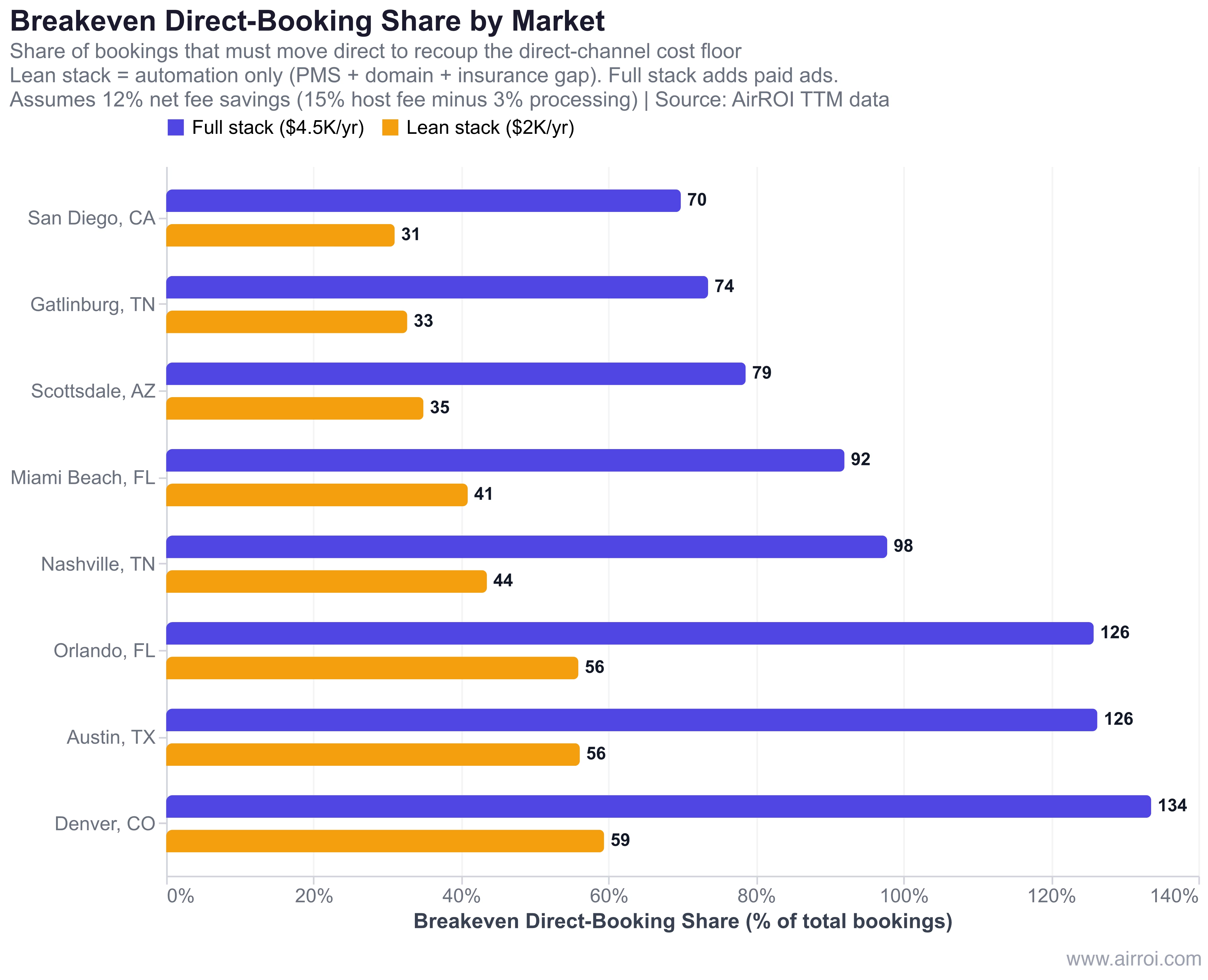
| Market | Annual Revenue | Breakeven (Lean $2K) | Breakeven (Full $4.5K) |
|---|---|---|---|
| San Diego, CA | $53,734 | 31% | 70% |
| Gatlinburg, TN | $51,030 | 33% | 74% |
| Scottsdale, AZ | $47,693 | 35% | 79% |
| Miami Beach, FL | $40,759 | 41% | 92% |
| Nashville, TN | $38,331 | 43% | 98% |
| Orlando, FL | $29,814 | 56% | 126% |
| Austin, TX | $29,690 | 56% | 126% |
| Denver, CO | $28,072 | 59% | 134% |
Three clear tiers emerge.
Tier 1 (sub-35% breakeven): San Diego, Gatlinburg, Scottsdale. High-ADR, high-annual-revenue markets where a lean direct stack pays off quickly. A host with a modest email list of past guests and a simple booking page can plausibly hit 30-40% direct share within 18-24 months. These are the markets where airbnb fees direct booking savings show up as five-figure annual numbers.
Tier 2 (41-43% breakeven): Miami Beach, Nashville. Still viable with a lean stack, but requires serious commitment to rebooking workflow and guest email capture. Paid ads are hard to justify.
Tier 3 (56%+ breakeven): Orlando, Austin, Denver. A lean stack technically works if a host can get to 60% direct share -- but that's a heavy operational lift for lower-dollar savings. Most single-property hosts in these markets are better off staying focused on ADR and review optimization. The broader profitability data for 2026 suggests hosts in these markets often have thinner margins overall, which makes new fixed costs especially risky.
Channel-Mix Strategy: "Airbnb as Discovery, Direct as Rebooking"
The most durable finding buried in practitioner threads and PMS case studies is this: hosts who succeed with direct bookings almost never run an "all direct" playbook. They run a channel-mix playbook.
The winning pattern looks like this:
- Airbnb and Vrbo handle cold discovery. First-time guests find the property through platform search. The host accepts the 15% fee as a customer acquisition cost -- because it is one, and it's cheaper than Google Ads.
- During the stay, the host builds a direct relationship. A welcome note with the brand name and direct-booking URL. A QR code in the guestbook. A check-in email that collects a personal email address outside Airbnb's messaging system.
- After checkout, automated email kicks in. A thank-you email at 48 hours, a review-request at 7 days, a "come back" offer at 90 days, an anniversary-of-stay reminder at 12 months.
- Return guests book direct. The second stay, not the first, is where the 15% recapture happens.
The economics of this pattern are powerful. Practitioner reports across rental-manager communities consistently suggest that 15-20% of past guests who receive a well-timed direct-booking email rebook within 24 months. A host with 60 annual turnovers who builds a guest list over three years has 180 past guests -- and if 20% rebook direct, that's 36 direct bookings a year on top of Airbnb cold traffic. On a $378/night Gatlinburg property with 3.4-night average stays, 36 direct bookings is roughly $46,000 in direct revenue, which is enough to drive direct share to 40-45% without a single paid ad dollar.
This channel-mix approach keeps the host TOS-compliant with Airbnb (no diverting inquiries off-platform before a stay), captures Airbnb's discovery engine for cold traffic, and extracts the fee recapture from the high-intent repeat-guest segment. It is the only pattern that consistently clears the breakeven bar for solo hosts.
The highest-ROI single lever in the direct stack is post-stay email automation. It costs essentially nothing to run once configured, it triggers on behavior the host already captures, and the conversion rate on returning guests is an order of magnitude higher than cold paid-ad conversion.
When Direct Bookings Don't Make Sense
Direct bookings are not universally worth pursuing. The cost stack is real, the breakeven math is unforgiving in some markets, and the operational overhead steals attention from levers that matter more. Skip the direct channel entirely if any of the following apply.
Your market grosses under $30,000 per year per listing. The breakeven share is so high (56%+ on lean, impossible on full) that direct bookings become a second job for mediocre recapture. Focus on ADR and review quality on Airbnb first -- rate discipline in a softening occupancy market moves the needle more than any fee recapture play in this segment.
You operate one property without a service radius or brand. Direct bookings work when guests remember and identify with your brand -- "the Flagstaff cabin with the hot tub," "the Nashville bungalow in East Nashville." A single anonymous property without a name, a story, or a repeat-guest base has no organic direct traffic. You'd be paying for a direct-booking page that sees three visitors a month.
You don't have a repeat-guest profile. Business-travel listings, near-airport layover listings, and pure transient-tourist markets with low return-visit rates are structurally bad fits for the "rebooking" strategy that makes direct math work. A Gatlinburg cabin that attracts multi-generational families returning every summer is the ideal profile. A downtown condo that serves one-off conference attendees is the opposite.
You're not willing to run email automation. Without the rebooking funnel, the only way to hit breakeven is paid ads -- and paid ads flip the math to the full-stack scenario, where breakeven exceeds 70% in every market we analyzed. If you won't set up the email flow, don't start the direct channel.
The Decision Framework
Here is the decision framework, compressed to three numbers every host should calculate before spending a dollar on a direct stack.
Number 1: Your annual gross revenue. Pull the TTM number from AirROI or your own Airbnb earnings statement. Use gross, not net.
Number 2: Your breakeven direct share. Compute $2,000 / (0.12 × your annual gross) for the lean stack, and $4,500 / (0.12 × your annual gross) for the full stack. These are your floors.
Number 3: Your realistic direct-booking share in 24 months. Estimate honestly: how many past guests do you already have? What's your plausible repeat rate? What percentage of a 24-month forward booking pipeline could reasonably come from rebookings and word-of-mouth referrals? Be skeptical -- most hosts overestimate this by 2x.
If Number 3 exceeds Number 2 on the lean stack, build the direct channel. Start with a PMS, a simple direct-booking page, and email automation. Skip paid ads unless you hit 30% direct share organically and still want to scale.
If Number 3 does not exceed Number 2 on the lean stack, don't build the channel. Instead, redirect that attention budget to ADR optimization, review volume, and minimum-stay strategy on Airbnb. In most Tier-3 markets, a 10% ADR improvement adds more annual revenue than a fully-operational direct channel ever would.
The "move to direct bookings" advice gets one thing right: Airbnb's 15% host fee is real money, and on high-revenue listings it adds up to thousands of dollars a year. It gets one thing badly wrong: the cost of running a direct channel is also real money, and it eats the savings in markets and operator profiles where the rebooking engine doesn't reach scale. Do the math on your specific listing before you follow anyone's universal advice. The breakeven share is specific. The winning strategy is specific. Your revenue -- and your sanity -- depend on running your own numbers.
Pull your market's TTM revenue from AirROI's market search, run the two-line breakeven formula, and make the decision from evidence instead of LinkedIn confidence.