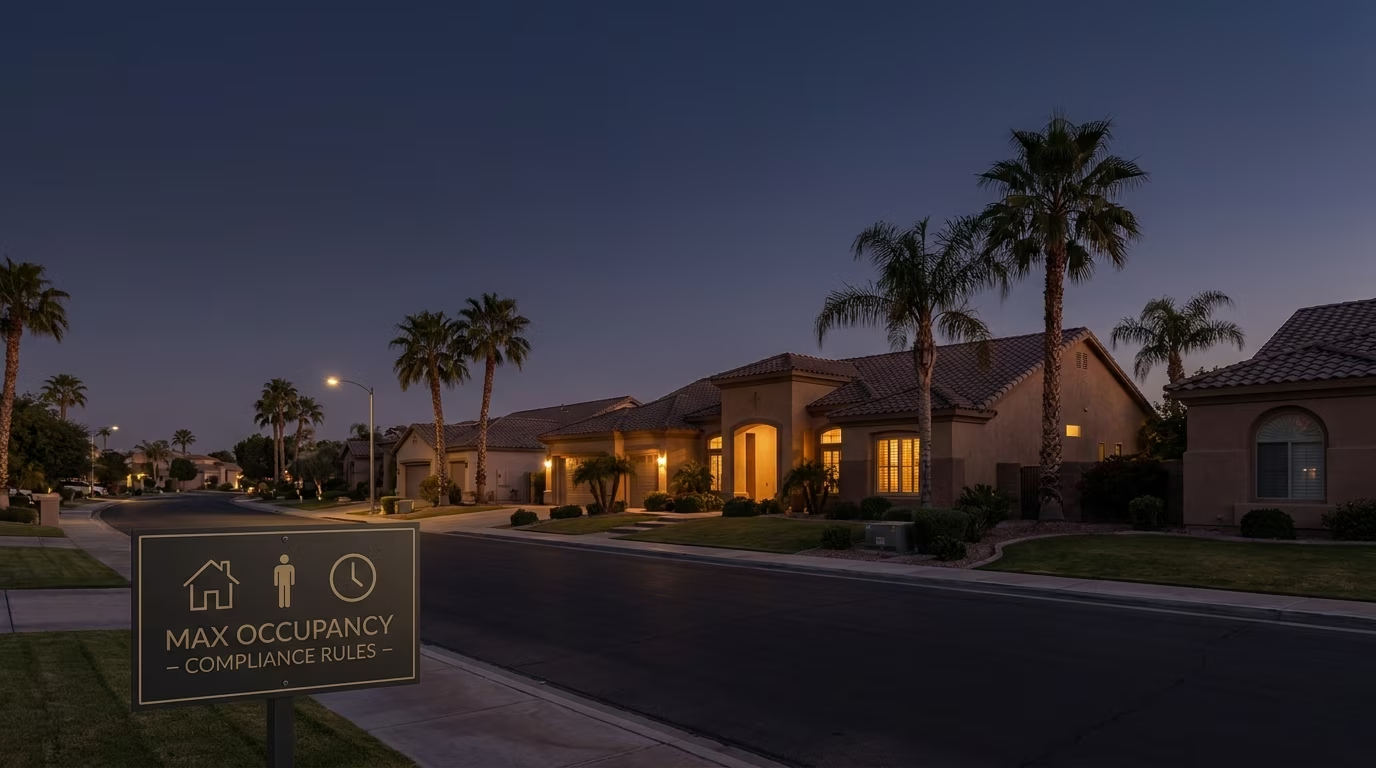
Airbnb Party House Ban 2026: What Enforcement Costs Hosts

A 12-guest Scottsdale Airbnb earns $114,495 a year. The six-guest version of the same house earns $22,166. The airbnb party house ban 2026 wave now sweeping Houston, Scottsdale, and Dallas bills that $92,000 difference straight to the compliant host — because the rule that closes a party house and the rule that erases a legitimate large-group listing are the same rule.
The compliant large-group host pays the enforcement bill. The bad actor ignores it until a complaint arrives.
This analysis stays in the lane that matters for a property P&L: what cities now mandate, and what each line item costs a legitimate operator. (This is market analysis, not legal or investment advice — verify your local ordinance before making decisions.)
From a Viral Incident to a Multi-City Rule Stack
The 2026 enforcement surge is policy reaction, not coincidence. Houston, Scottsdale, and Dallas all moved on short-term rental party house enforcement within days of the West Dallas incident going viral, each reaching for the same regulatory toolkit.
"The collaboration between city departments, combined with stronger enforcement tools and improved training, has helped reduce nuisance activity while increasing accountability for operators who fail to follow the law." — Scottsdale Police Commander Jeromie O'Meara (via Patch, May 2026)
| Rule in the stack | Mechanism | Cost or impact to a compliant host | Source |
|---|---|---|---|
| Registration / permit | One-time + renewal fee | $308.10 (Houston); $250/yr license (Scottsdale) | Houston ordinance; Scottsdale |
| $1M liability insurance | Required CGL policy | $700–$1,500/year | Proper Insurance |
| Occupancy cap (6 adults) | Caps total guests | Compresses revenue toward the standard band | AirROI; Ordinance 4566 |
| Minimum-stay floor | Blocks single-night party bookings | Erodes short event/weekend stays | AirROI; municipal examples |
| Nuisance-party fines | Per-violation penalty | $100–$500/day (Houston); up to $1,500/day (Scottsdale) | ABC13; Scottsdale |
Who Actually Pays: The Large-Group Revenue Premium
The listings these rules target are the highest-grossing properties on the platform — not the marginal ones. AirROI's trailing-twelve-month data shows large-group listings (12 or more guests) out-earn standard listings (six guests or fewer) by 3.27x in Dallas to 5.17x in Scottsdale. The occupancy cap, the centerpiece of every party-house ordinance, is therefore a tax aimed squarely at the top of the revenue distribution.
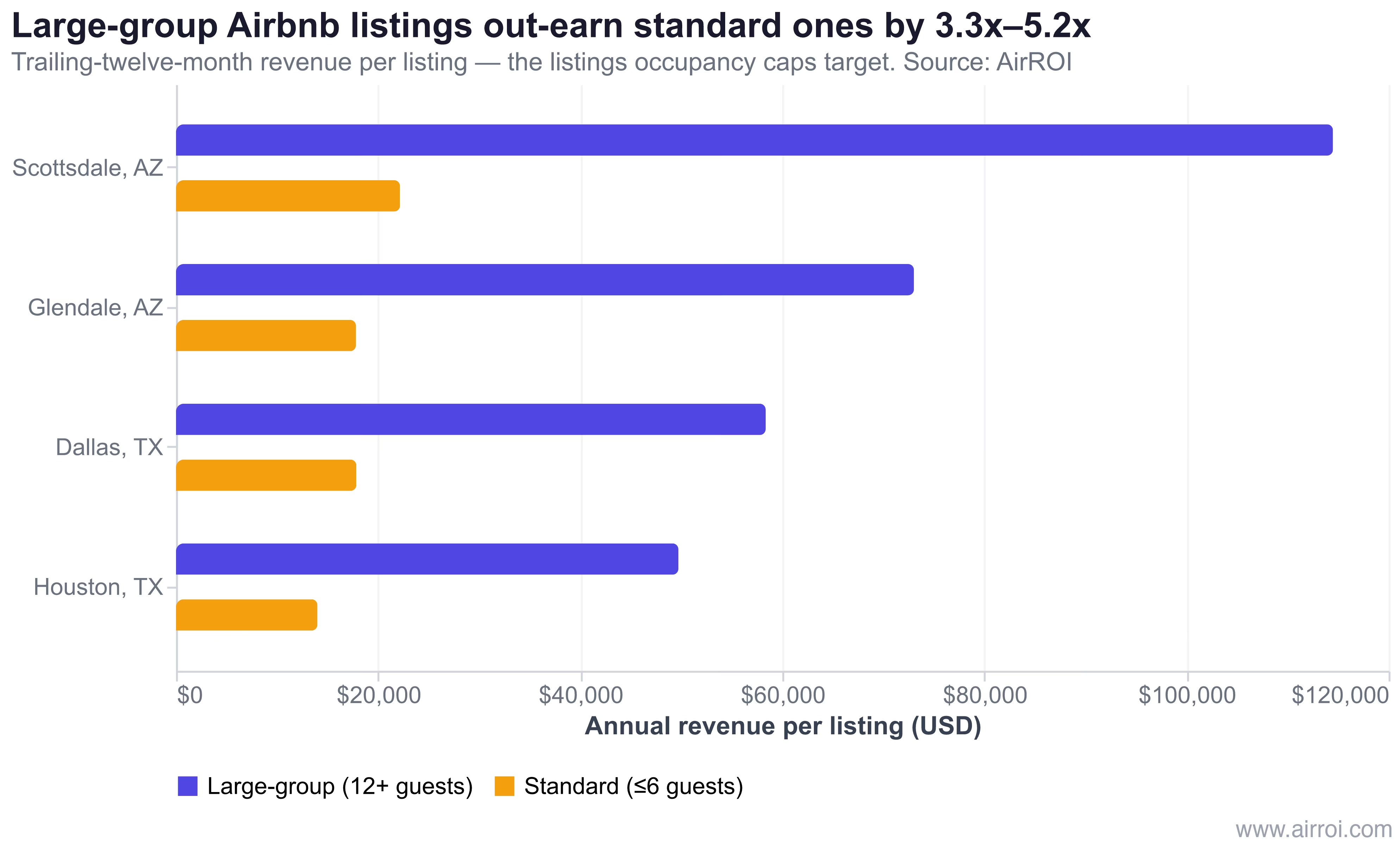
The mechanics matter for the airbnb occupancy cap revenue impact. The premium is driven by average daily rate (ADR), not occupancy. In Houston, large-group listings actually run lower occupancy than standard ones — 39% versus 44% — yet they earn 3.55x more because their ADR is $510.90 against $151.10 for standard listings. A six-adult cap does not trim the premium at the margin; it removes the pricing power that creates the entire premium.
| Market | Large-group revenue (12+ guests) | Standard revenue (≤6 guests) | Premium | Large-group ADR |
|---|---|---|---|---|
| Scottsdale, AZ | $114,495 | $22,166 | 5.17x | $852.90 |
| Glendale, AZ | $73,028 | $17,803 | 4.10x | $594.90 |
| Dallas, TX | $58,353 | $17,846 | 3.27x | $508.30 |
| Houston, TX | $49,716 | $13,991 | 3.55x | $510.90 |
Source: AirROI trailing-twelve-month market data, USD.
Bedroom data sharpens the picture. Scottsdale's five-plus-bedroom listings — the literal group houses — earn $131,678 a year at an ADR of $1,032.30, against $19,738 and $185.10 for one-to-two-bedroom units. Consider a Scottsdale owner who runs a five-bedroom house for golf groups and reunions of 12 to 14, the exact segment the city's tourism economy and rate structure reward. Ordinance 4566's six-adult cap makes that model non-compliant overnight. Repositioned to families and corporate groups of six, the property's revenue migrates toward the standard-listing band — the premium is not preserved, it is traded for the right to keep operating without daily fines. Glendale, Arizona, near State Farm Stadium, shows the same dynamic in an event market: its large-group listings earn $73,028 against $17,803 for standard ones, a premium built on game-weekend and concert demand.
The $1 Million Liability Line Item
A $1-million-per-occurrence commercial general liability policy is now table stakes, and it is a genuine new out-of-pocket cost — not a formality. The short term rental liability insurance requirement showing up in 2026 ordinances cannot be satisfied by a homeowners policy or by platform coverage, because both are the wrong instrument.
"Short-term renting for less than 30 days is a business or commercial transaction. All homeowners insurance policies carry personal liability, which specifically excludes business activity, so any damage claims involving short-term rental could rightfully be denied." — Proper Insurance (2026)
That exclusion is why the mandate bites. The gap is best captured by a host on r/airbnb_hosts who hit it directly:
"My city recently changed the requirements for hosting to now require a $1M Liability Insurance Policy. My current homeowner's policy only goes up to $500k... they said it needs to be a specific $1M policy for me/my home to be up to code."
Airbnb's AirCover and Host Liability coverage do not close that gap either. They are secondary policies that pay only after a primary policy, and Airbnb's program carries a $10-million annual aggregate that maxes out after roughly ten $1-million claims, per Proper. Cities want a named, primary, per-occurrence policy — which means a separate purchase.
| Dimension | Airbnb AirCover / Host Liability | Required city CGL policy |
|---|---|---|
| Coverage tier | Secondary, $1M, $10M annual aggregate | Primary, $1M per occurrence |
| Satisfies a city mandate? | Usually no | Yes |
| Off-premise / assault & battery | Limited | Covered (commercial GL) |
| Cost to host | "Free" but capped and secondary | $700–$1,500/year |
Source: Proper Insurance; Truvi; host reports.
Occupancy Caps and Minimum Stays: Anti-Party Tools With a Revenue Price
The occupancy cap — not the fees — is the line item that destroys the large-group business. Permits and insurance cost four figures a year; the six-adult cap costs the difference between $114,495 and $22,166. Cities reach for caps because they are the cleanest way to make a "party house" structurally impossible, but the same stroke makes a legitimate 12-guest reunion rental impossible too.
The Compliant-Operator Playbook for a Tightening Market
The winning move in a tightening market is to stop selling the party and start selling the premium that survives the cap. Four levers reshape the math.
Reposition under the cap. A six-guest limit ends the bachelor-party model but rewards families, corporate relocations, and traveling-professional groups — segments that book quietly, generate fewer complaints, and rarely trigger citations. The revenue compresses toward the standard band, but it becomes durable.
Price for fewer, higher-value bookings. With guest counts capped, defend RevPAR (revenue per available room-night) through ADR discipline rather than volume. The premium tier already proves the principle: large-group listings earn their multiple on rate, not occupancy. A capped property should hold rate aggressively on the dates that still command it.
Treat $1M CGL as table stakes. Buy a named, primary commercial general liability policy before a city forces it, not after a claim. At $700 to $1,500 a year it is cheap insurance against both lawsuits and delisting, and it converts platform coverage from your only protection into a secondary backstop.
The party-house crackdown is real, and the public-safety case for it is not in dispute. But the data is unambiguous about who carries the cost: the compliant large-group operator, whose listing earns three to five times a standard one and whose premium an occupancy cap is designed to erase. The operators who price that risk in early — and reposition before the rule arrives rather than after — are the ones who keep the part of the premium that compliance allows.
Frequently Asked Questions
Houston, Scottsdale, and Dallas lead the 2026 enforcement wave. Houston's ordinance took effect January 1, 2026 with April 1 enforcement; Scottsdale's task force lifted unlicensed-STR citations 26% year over year. The shared toolkit is occupancy caps, 24-hour emergency contacts, and nuisance-party bans.
A $1-million-per-occurrence commercial general liability (CGL) policy runs $700 to $1,500 per year through specialist insurers like Proper, and $600 to $3,000 depending on property risk per Truvi. Pools, hot tubs, and high guest capacity push premiums up, and legal defense costs typically sit on top of the limit.
Usually no. AirCover and Airbnb's Host Liability coverage are secondary, capped policies, and most cities require a named, primary $1-million-per-occurrence policy in the host's name. As one r/airbnb_hosts host found, a homeowners policy plus AirCover did not satisfy the city; a dedicated CGL policy was required.
Scottsdale caps short-term rental occupancy at six adults (plus their dependent children) under Ordinance 4566, which also bans nuisance parties. The cap is the single most damaging rule for large-group economics: AirROI data shows 12-plus-guest Scottsdale listings earn $114,495 a year versus $22,166 for standard listings.
Occupancy caps compress revenue by removing the large-group premium, which AirROI data puts at 3.27x in Dallas to 5.17x in Scottsdale over standard listings. Because the premium is driven by average daily rate rather than occupancy, capping guests at six pushes a former group house toward the standard-listing earnings band.