Airbnb Guest Screening 2026: How to Screen With Less Info

Airbnb just took away your best screening inputs. As of 2026, hosts get a first name, a temporary phone number that expires two days after checkout, and not much else — right as party-house risk sits squarely in the spotlight. Here is the catch that most host-forum panic misses: the levers that actually prevent bad bookings never depended on knowing who the guest is. Effective Airbnb guest screening keys off how someone books — stay length, lead time, local distance, group size, third-party patterns — not their last name or cell number. This guide shows you how to screen Airbnb guests in this lower-information environment, which listings and markets carry the most party risk according to AirROI data, and exactly what each screening lever costs you in occupancy so you tune your friction instead of over-correcting.
The risk is rare but expensive. Fewer than 0.035% of stays worldwide led to a party allegation in 2024, according to Airbnb's Newsroom — yet a single party can cost a host well over $1,300 in cleaning and replacement, plus a retaliatory review. The job is not to fear every booking. It is to read the few that matter.
What Airbnb Took Away From Hosts in 2026
Airbnb frames the shift as privacy protection. The practical effect for hosts is less identity to screen on — which makes behavior-based screening levers more important than ever.
Screen the Booking, Not the Guest: The Levers That Still Work
Every effective screening lever reads booking behavior, not identity — so none of them broke when Airbnb hid the guest's name and number. Here are the controls that still do the work, with a clear note on which are grounded in AirROI data and which are operational best practice from experienced hosts.
Minimum-stay thresholds
A minimum-stay floor is the single highest-leverage anti-party setting, because most parties happen on a single night. Moving from a 1-night to a 2-night minimum removes the bulk of single-night party demand. This is a data-grounded lever — and we quantify its exact occupancy cost in the next section — but the principle is simple: a party thrower wants one Saturday, not a weekend block.
Instant Book filters (don't disable Instant Book)
Maximum occupancy caps
Set your max occupancy to true sleeping capacity and state explicitly that no additional visitors are permitted. Bookings that try to exceed the cap — or groups that show up larger than booked — are among the most reliable party signals hosts report. One new Superhost on r/airbnb_hosts described booking for six against a max of eight, then watching nine people arrive at 5 p.m. The cap is your documentation and your line in the sand.
House rules plus a pre-booking agreement
Write rules in plain, non-negotiable language — "No parties. Maximum 4 guests. No unregistered visitors." — not soft phrasing like "gatherings are discouraged." Then require guests to confirm they have read and agreed before booking. One strict host summarized the payoff:
"Screen your guests and screen them WELL. This week's violations: an underage group looking to party, a guest who asked to double max capacity once we reminded them we ID at arrival, and a third-party booking with a fake name and a 'verified ID' on file." — Host on r/airbnb_hosts
Rules alone won't physically stop a party, but agreed-to rules give you the evidence Airbnb requires to cancel a violating reservation and win a claim.
Noise-monitoring disclosure
Decibel-based noise monitors measure sound levels without recording conversations, and Airbnb policy requires you to disclose them. Disclosed, audio-free monitoring is the most effective real-time party-detection tool available — and the disclosure itself is a deterrent. This is operational best practice, not an AirROI metric.
Red flags: local, last-minute, and third-party bookings
How Airbnb's Reservation Screening Backs You Up
The platform handles the obvious cases automatically. Your screening job is the gray-area bookings — the ones that look fine until you read the booking behavior closely.
The takeaway is not complacency. Automated screening catches patterns at scale, but it does not know your neighbors' tolerance, your insurance situation, or that a "celebration getaway for two" in a six-bedroom pool house is mathematically suspicious. That judgment is yours.
Which Listings and Markets Carry the Most Party Risk
Large-group entire homes with pools in event and bachelor or bachelorette markets are the most party-exposed segment on Airbnb — and, not coincidentally, the most profitable. AirROI data quantifies the overlap. In Scottsdale, Arizona, entire homes built for 12 or more guests command an average daily rate of $853 versus the whole-market average of $421 — roughly double — and earn about $114,000 a year. Gatlinburg, Tennessee's large-group homes run $686 ADR against a $377 market average; Nashville's hit $632 against $354.
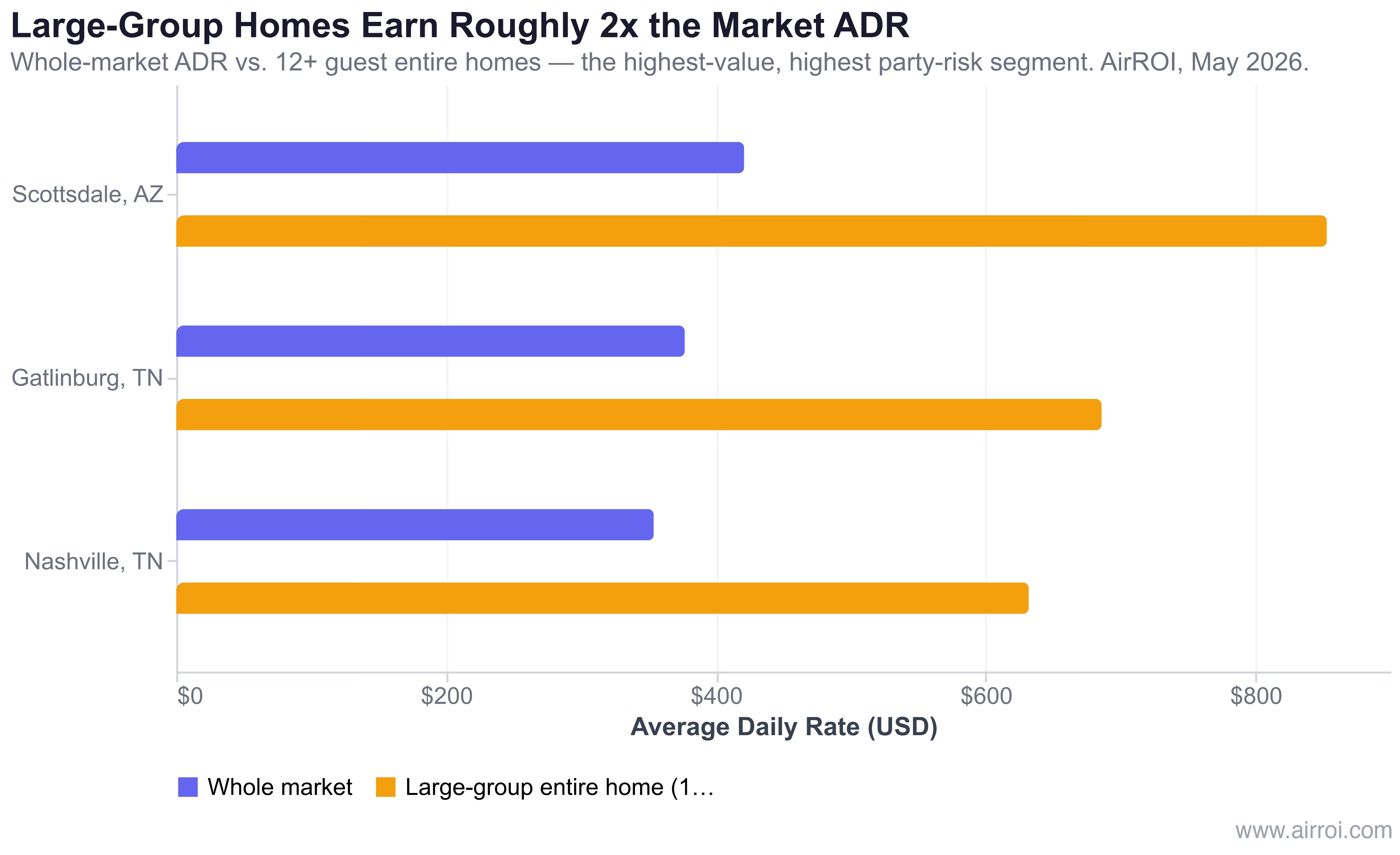
There were 826 of these 12-plus-guest entire homes active in Scottsdale and 729 in Gatlinburg as of May 2026 — a real, sizable segment, not an edge case. And the booking shape tells the story. Scottsdale's large-group homes run an average minimum stay of just 3.3 nights, far below the 8.4-night market average, because their owners deliberately keep stays short to capture high-value weekend group demand. That is precisely the booking pattern parties exploit: high capacity, short stays, weekend-weighted, premium nightly rate.
| Market | Large-group entire homes (12+) | Occupancy | ADR | Annual revenue |
|---|---|---|---|---|
| Scottsdale, AZ | 826 | 48% | $853 | ~$114,500 |
| Gatlinburg, TN | 729 | 46% | $686 | ~$93,300 |
| Nashville, TN | 1,279 | 43% | $632 | ~$79,100 |
Source: AirROI, May 2026.
What Screening Friction Actually Costs You
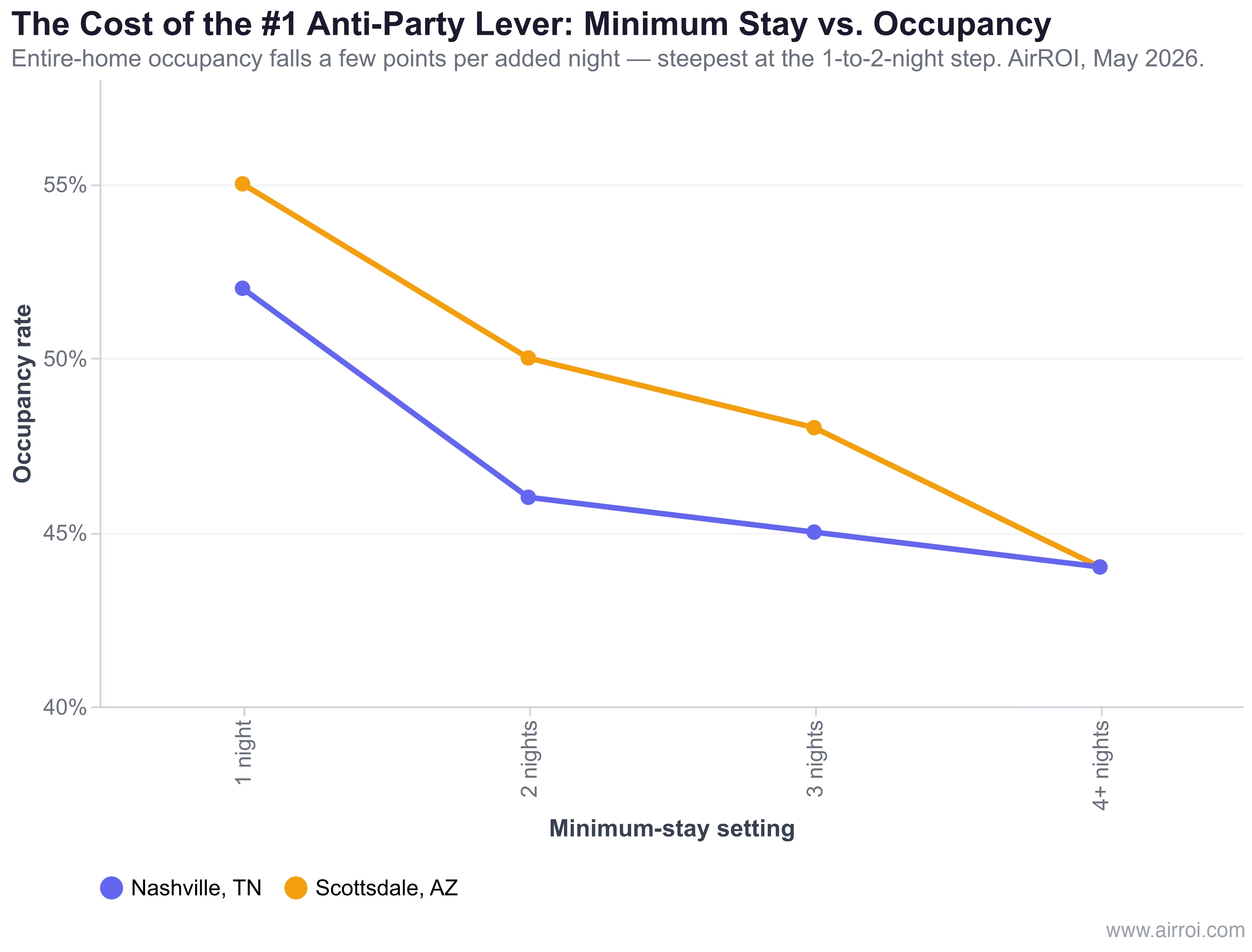
Every step up in minimum-stay friction costs occupancy, but the curve is shallow after night two — and the most valuable step is the cheapest. AirROI data on entire homes in two high-risk markets makes the trade-off concrete. In Scottsdale, entire-home occupancy runs 55% at a 1-night minimum, 50% at 2 nights, 48% at 3 nights, and 44% at 4-plus nights. Nashville follows the same shape: 52%, 46%, 45%, 44%.
| Minimum-stay setting | Scottsdale occupancy | Nashville occupancy |
|---|---|---|
| 1 night | 55% | 52% |
| 2 nights | 50% | 46% |
| 3 nights | 48% | 45% |
| 4+ nights | 44% | 44% |
Source: AirROI entire-home data, May 2026.
Read the curve carefully. The steepest drop — about 5 to 6 occupancy points — happens at the 1-to-2-night step, which is also exactly where you eliminate most single-night party bookings. That is the best safety-per-point-of-occupancy trade in screening. Beyond two nights the curve flattens to a point or two per added night, so blanket 4-plus-night minimums cost extra occupancy for diminishing safety. Notably, ADR tends to rise at 2 and 3 nights as longer stays attract higher-paying, less price-sensitive guests — so the revenue hit is softer than the raw occupancy numbers suggest.
A minimum stay is not a force field, either. One host with a six-bedroom, multi-pool property set a 3-night minimum specifically to deter parties, disclosed quiet hours, and got written agreement — and still got burned:
"I set a 3+ night minimum stay to prevent party guests and had quiet hours communicated and agreed prior to accepting… 18 [guys] arrived… beer bottles, cigarette butts even inside the pools." — Host on r/airbnb_hosts
The lesson is layering. No single lever is enough for a high-capacity home; minimum stay buys you the most per occupancy point, but it works best stacked with ID requirements, occupancy caps, and noise monitoring.
A Tiered Screening Playbook by Risk Level
Match your screening friction to your actual exposure — over-screening a low-risk listing costs occupancy for no real safety gain, while under-screening a large-group home invites the $1,300 night. Use your listing type and market profile to pick a tier.
Low-risk tier — small unit (sleeps 2-6), family or workforce market like Branson, no pool. Keep Instant Book on with a positive-track-record filter, set a 2-night minimum, and post clear house rules with a pre-booking agreement. Light-touch screening preserves the occupancy these markets depend on.
Medium-risk tier — mid-size entire home, urban or mixed-demand market, moderate capacity. Add government-ID verification to Instant Book, enforce a firm occupancy cap, install a disclosed noise monitor, and raise the minimum to 2-3 nights on peak weekends and holidays specifically.
High-risk tier — large-group entire home (10+ guests), pool, event or bachelorette market like Scottsdale, Nashville, or Gatlinburg. Layer everything: ID verification plus positive track record, a strict occupancy cap with explicit no-visitors language, noise monitoring, a 2-3 night minimum that climbs to 3-plus on party weekends, and manual review of every local, last-minute, or third-party booking. This is the segment where aggressive screening pays for itself, because the revenue at stake is the highest and so is the exposure.
The cautionary tale that should anchor this playbook is the veteran host who loosened a single minimum-stay setting after being persuaded it would lift search ranking — then accepted a one-night local booking for "my sister and her three kids" and woke to 30-plus people cycling through a one-bedroom, a destroyed sofa bed, and a near-miss handoff to an incoming grieving guest. The thin profile and sympathetic story were noise. The one-night local booking was the only signal that mattered. Tier your friction to your risk, and read the booking behavior every time.
Screening in the privacy era is not about knowing who your guest is. It is about reading how they book — and Airbnb still shows you all of that.
Frequently Asked Questions
No. For new reservations Airbnb assigns a temporary, anonymized phone number that redirects calls and expires about two days after checkout, and hosts no longer see the guest's real number or last name. You can still screen effectively because the levers that prevent bad bookings key off booking behavior, not identity.
Screen the booking, not the person. Read the trip purpose, check stay length against local and last-minute signals and group size, require government ID and a positive track record through Instant Book filters, and use a pre-booking house-rules agreement. None of these need the guest's phone number.
A 2-night minimum eliminates most single-night party bookings while costing only about 5 occupancy points versus a 1-night setting. AirROI data shows Scottsdale entire homes drop from 55% occupancy at a 1-night minimum to 50% at 2 nights. Reserve 3-plus nights for peak party weekends rather than applying it year-round.
A local guest booking a weekend night, a brand-new account with no reviews or photo, a vague or shifting trip purpose, requests to exceed maximum occupancy, and any third-party booking where someone else will stay. Multiple flags on one booking warrant declining or asking for more verification.
Modestly and predictably. AirROI data shows each step up in minimum-stay friction costs a few occupancy points, but average daily rate often rises as you attract longer, higher-value stays. The goal is to match screening friction to your actual risk profile, not to maximize it.