Airbnb's Professional Operator Gap: Why Managed Listings Earn 46-113% More Revenue in 2026

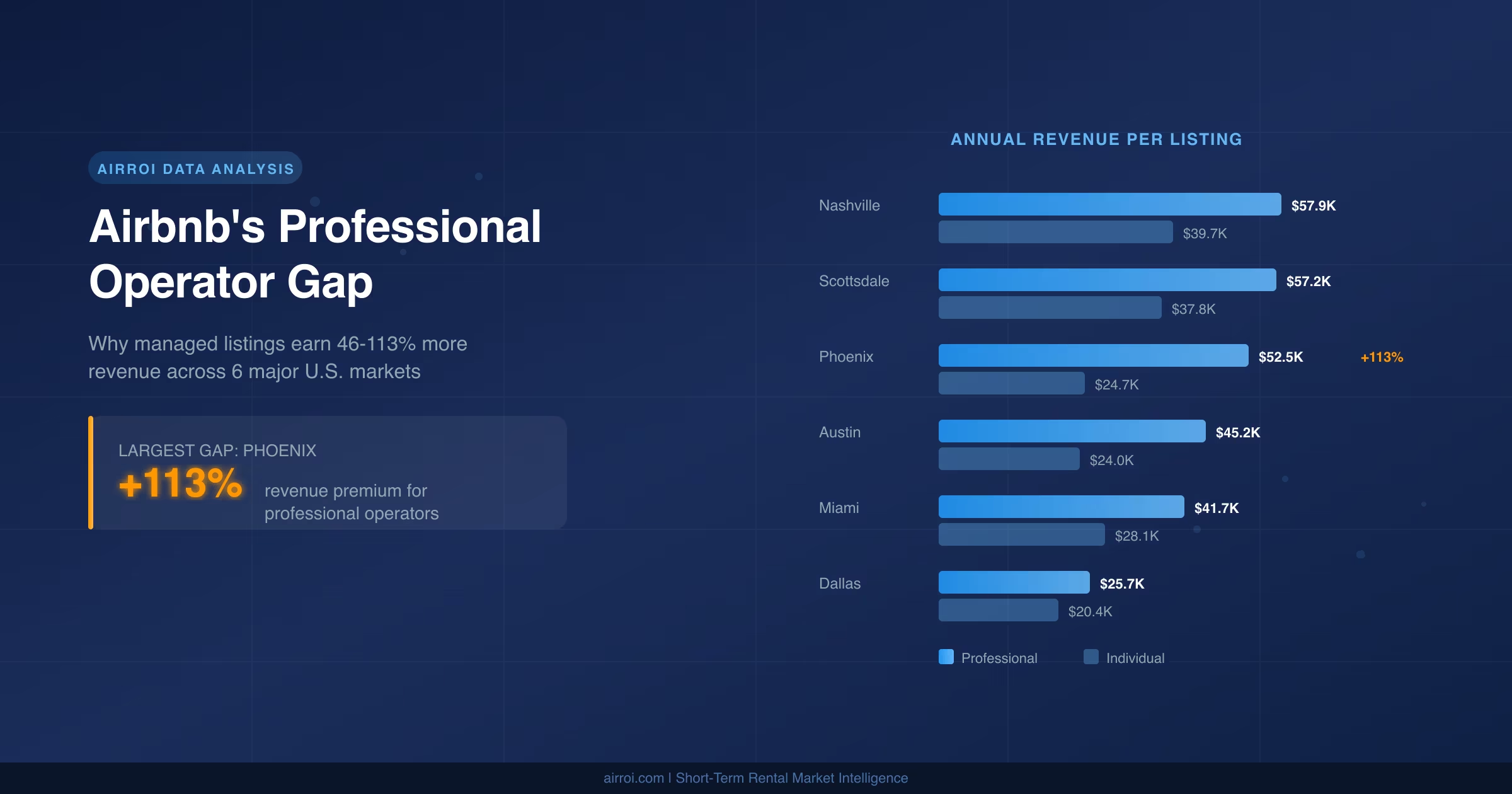
In Phoenix, a professionally managed Airbnb listing generates $52,506 in annual revenue. An individually hosted property in the same market earns $24,711 -- a 113% gap that no amount of hospitality charm can close. Across six major U.S. cities, AirROI data reveals managed listings outperform individual hosts by 46-113% on annual revenue, and the primary driver is not occupancy but pricing power.
This article uses proprietary AirROI data to quantify the performance gap between professionally managed and individually hosted listings in six major U.S. markets. The numbers reveal not just how wide the gap has become, but where it originates -- and, critically, where individual hosts still hold competitive advantages that institutional operators cannot replicate.
The Scale of STR Professionalization in 2026
The short-term rental industry has undergone a structural transformation. What began as a platform for spare-room sharing has evolved into a $72 billion institutional asset class attracting private equity, property management companies, and technology-driven operators managing hundreds or thousands of listings simultaneously.
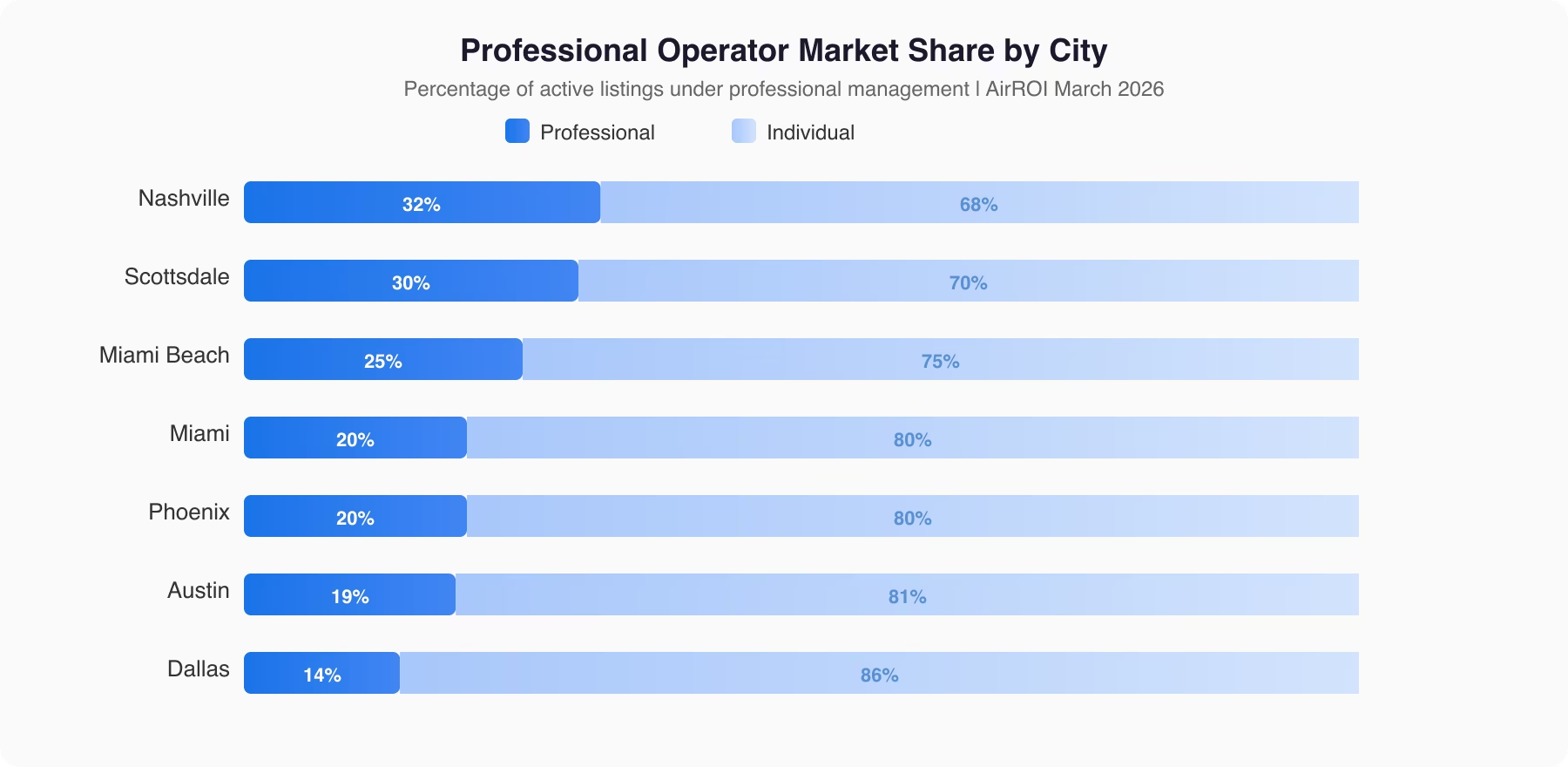
AirROI data quantifies this shift across seven major U.S. markets. Professional operators -- identified by Airbnb's professional management designation -- represent a minority of active listings but command a disproportionate share of market revenue.
| Market | Professional Listings | Individual Listings | Professional Share |
|---|---|---|---|
| Nashville | 1,788 | 3,832 | 32% |
| Scottsdale | 1,119 | 2,660 | 30% |
| Miami Beach | 923 | 2,736 | 25% |
| Miami | 1,359 | 5,593 | 20% |
| Phoenix | 1,072 | 4,233 | 20% |
| Austin | 1,493 | 6,343 | 19% |
| Dallas | 511 | 3,038 | 14% |
Source: AirROI Market Data, trailing twelve months through March 2026
Nashville leads in professionalization at 32%, meaning roughly one in three active listings is under professional management. Scottsdale follows closely at 30%. At the other end, Dallas shows just 14% professional penetration -- and, as the revenue data below reveals, also delivers the weakest economics for both operator types.
The pattern is directional: markets with higher professional operator concentration tend to exhibit higher overall market ADR. Nashville's market-average ADR of $346.90 and Scottsdale's $413.20 both exceed less-professionalized markets like Dallas ($226.20) and Austin ($294.20). Professionalization appears to lift market-wide pricing rather than simply redistributing revenue from individuals to institutions.
The Revenue Gap: Professional vs. Individual Operators
The central finding of AirROI's analysis is stark: professionally managed listings generate dramatically more revenue than individually hosted properties in every market we examined, with the gap ranging from 26% in Dallas to 113% in Phoenix.
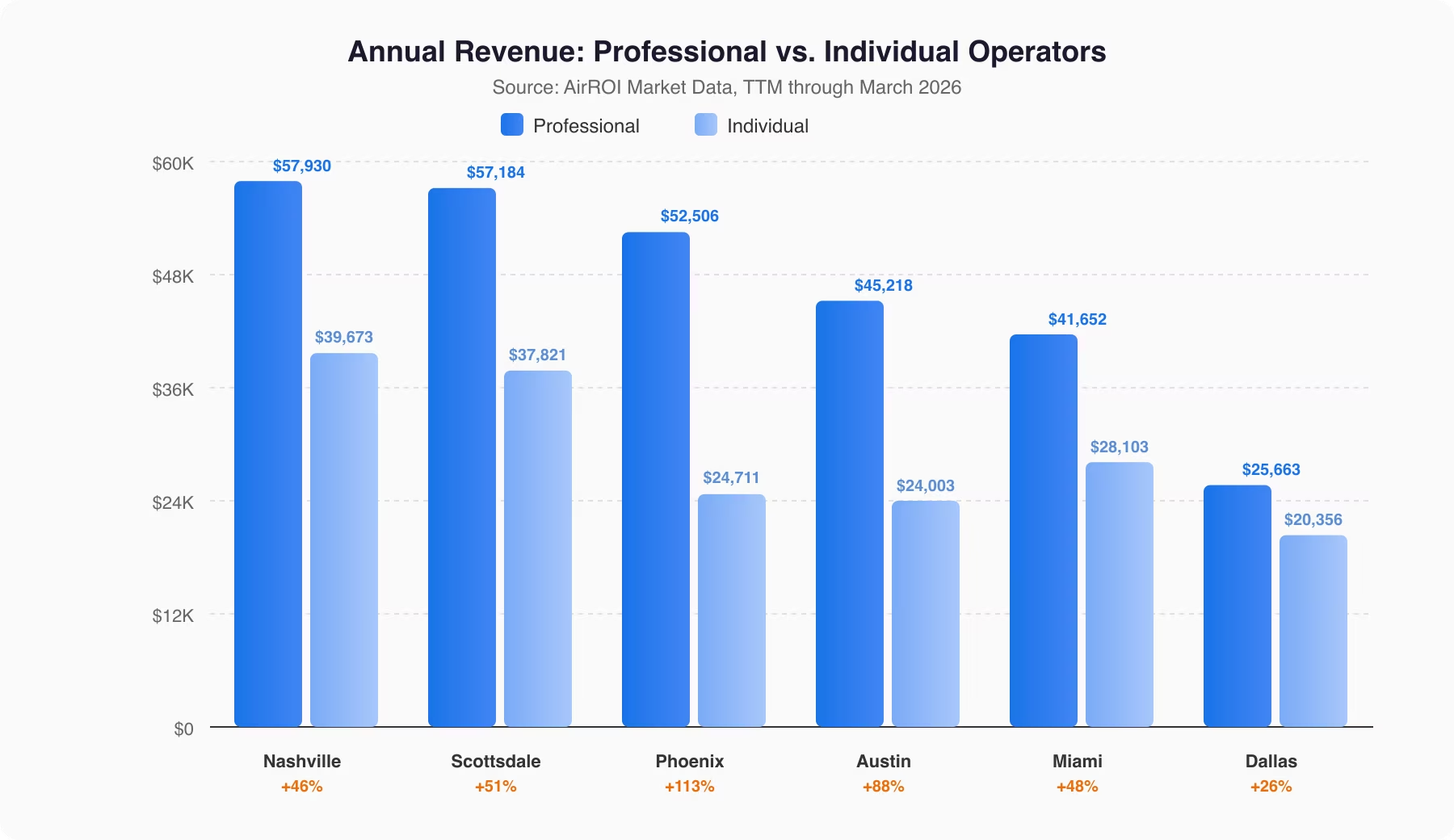
| Market | Pro Annual Revenue | Individual Revenue | Revenue Gap | Pro ADR | Indiv ADR | ADR Gap |
|---|---|---|---|---|---|---|
| Phoenix | $52,506 | $24,711 | +113% | $452.10 | $237.20 | +91% |
| Austin | $45,218 | $24,003 | +88% | $404.20 | $265.50 | +52% |
| Scottsdale | $57,184 | $37,821 | +51% | $564.10 | $353.00 | +60% |
| Miami | $41,652 | $28,103 | +48% | $359.40 | $266.10 | +35% |
| Nashville | $57,930 | $39,673 | +46% | $426.50 | $310.10 | +38% |
| Dallas | $25,663 | $20,356 | +26% | $281.50 | $219.00 | +29% |
Source: AirROI Market Data, trailing twelve months through March 2026
The most striking insight is where the gap originates. ADR -- not occupancy -- is the primary driver of the revenue divide. Professional operators command 29-91% higher nightly rates than individual hosts in the same markets. In Phoenix, the ADR gap alone is $214.90 per night ($452.10 vs. $237.20). In Scottsdale, professional operators charge $564.10 per night compared to $353.00 for individual hosts -- a $211.10 premium per booked night.
Occupancy tells a different story. In several markets, individual hosts actually match or exceed professional operator occupancy rates:
| Market | Pro Occupancy | Individual Occupancy |
|---|---|---|
| Nashville | 46% | 49% |
| Austin | 48% | 46% |
| Miami | 51% | 51% |
| Phoenix | 50% | 50% |
| Dallas | 43% | 47% |
| Scottsdale | 49% | 50% |
Source: AirROI Market Data, trailing twelve months through March 2026
What Drives the Professional Advantage
The revenue gap is not accidental. It reflects systematic operational differences that compound across every booking.
Rate protection over occupancy chasing. The counterintuitive strategy that defines professional management is willingness to accept lower occupancy to protect ADR. A property that books 46% of nights at $426.50 (Nashville professional average) generates more revenue than one booking 49% of nights at $310.10 (Nashville individual average). This requires the analytical confidence to leave nights empty rather than discount -- a discipline most individual hosts find psychologically difficult.
Technology and AI at scale. Hostaway's 2026 data shows AI adoption at 84% among professional managers, enabling automated guest messaging, review solicitation, maintenance scheduling, and dynamic pricing adjustments. These tools are available to individual hosts, but professionals deploy them across hundreds of properties with dedicated revenue managers interpreting the data. The cost of a $500/month revenue management platform is negligible across a 200-property portfolio but significant for a single listing.
Which Markets Are Most -- and Least -- Professionalized
The professionalization of STR markets is not uniform. Nashville and Scottsdale have emerged as professional operator strongholds, while Dallas and Austin remain comparatively fragmented.
Nashville-Davidson (32% professional) leads in both professionalization and professional operator revenue. With 1,788 professionally managed listings generating $57,930 each, the city's entertainment-driven demand base and relatively permissive STR regulations create fertile ground for scaled operators. Nashville's professional operators earn 46% more than individual hosts -- a significant but not extreme gap, suggesting the high professionalization rate has compressed rather than widened the competitive divide as individual hosts in this market adapt to professional standards.
Scottsdale (30% professional) commands the highest professional ADR of any market in our analysis at $564.10 per night. The luxury resort market attracts professional operators who specialize in high-end vacation rentals -- properties with private pools, golf course access, and resort-style amenities that justify premium pricing individual hosts rarely achieve. The 51% revenue gap reflects the quality and amenity premium that scaled operators deliver in this segment.
Austin (19% professional) presents the widest relative gap between operator types: professionals earn 88% more than individuals. This suggests Austin's market rewards optimization and pricing discipline disproportionately -- the difference between a $404.20 professional ADR and a $265.50 individual ADR in a market with abundant supply (11,613 total listings) reflects the competitive penalty for undifferentiated, passively managed properties in an oversaturated metro.
The Individual Host Edge: Where Solo Operators Still Win
The professionalization trend does not eliminate individual host advantages -- it redefines where those advantages matter most.
Occupancy resilience. AirROI data shows individual hosts match or exceed professional operator occupancy in four of six markets. Nashville individual hosts achieve 49% occupancy versus 46% for professionals. Dallas individual hosts reach 47% versus 43%. Guests choosing individual hosts appear to book more reliably, possibly drawn by lower price points or the perceived authenticity of a non-corporate experience.
| Market | Pro Avg Stay | Individual Avg Stay |
|---|---|---|
| Nashville | 3.3 nights | 4.0 nights |
| Austin | 4.7 nights | 6.1 nights |
| Miami | 5.0 nights | 5.3 nights |
| Phoenix | 5.4 nights | 6.2 nights |
| Dallas | 5.5 nights | 6.0 nights |
| Scottsdale | 5.2 nights | 6.3 nights |
Source: AirROI Market Data, trailing twelve months through March 2026
Authenticity and uniqueness. Institutional operators optimize for consistency and replicability. They cannot replicate a host's personal knowledge of the neighborhood's best taco truck, the treehouse they built by hand, or the handwritten welcome note with local tips. As the market professionalizes, uniqueness becomes a competitive moat rather than an operational limitation. PriceLabs' 2026 analysis notes that the market "rewards precision, quality, and hyperlocal agility" -- and no one is more hyperlocal than a host who lives on the same street.
Niche micro-markets. Institutional operators concentrate in high-volume urban markets where scale economics justify management overhead. Markets too small, too seasonal, or too geographically dispersed for portfolio operators remain viable for individual hosts who know the terrain. Cabin communities, coastal towns with 50-100 listings, and rural tourism destinations often lack the listing density to attract professional management companies -- leaving individual hosts as the dominant force.
Strategic Playbook: How Individual Hosts Can Compete in 2026
The data does not condemn individual hosts to irrelevance. It demands strategic precision.
Adopt professional pricing tools on an individual budget. Dynamic pricing platforms like PriceLabs and Wheelhouse cost $20-30/month per listing -- a fraction of the professional ADR premium they can help capture. The single highest-leverage action an individual host can take is replacing intuition-based pricing with data-driven rate management. If professional operators earn 29-91% more per night primarily through pricing discipline, closing even half that gap through a $25/month tool delivers thousands in additional annual revenue.
Protect your rate. Learn the professional operator's core insight: empty nights at a high rate are more profitable than full calendars at a discount. If Nashville professionals earn more at 46% occupancy than individuals earn at 49%, the lesson is clear. Set minimum rate floors, resist the urge to discount during slow weeks, and let the pricing algorithm find the optimal balance between occupancy and ADR.
Specialize and dominate a niche. Professional operators optimize for the median guest across hundreds of properties. Individual hosts can optimize for a specific guest persona. Pet-friendly properties, remote-work-optimized spaces with dedicated office setups, family reunion houses with large gathering areas, or properties themed around local culture all create competitive moats that institutional operators cannot replicate at scale.
Leverage your length-of-stay advantage. AirROI data shows individual hosts already attract longer stays. Lean into this by offering weekly and monthly discounts that capture the mid-term rental market -- a segment where personal hospitality, flexible terms, and residential-style environments create genuine competitive advantages over professionally managed units.
Build direct booking relationships. Professional operators depend on platform algorithms and advertising spend to drive bookings. Individual hosts can build a direct booking channel through a personal website, email list, and repeat guest relationships. Every direct booking eliminates Airbnb's 3% host fee and builds an asset that no platform algorithm change can take away.
"The era of 'list it and forget it' passive income models has ended. Hosts with differentiated properties and strong branding are more likely to succeed than those relying on generic listings." -- Cenk Demircan, founder of Elite Coaching Circle
The professionalization of the short-term rental market is not a death sentence for individual hosts. It is an evolutionary pressure that rewards adaptation. The hosts who thrive in 2026 will be those who borrow the professional operator's pricing discipline while leveraging the individual host's irreplaceable advantages: authenticity, flexibility, and the personal touch that no algorithm can replicate. The revenue gap is real. But the path to closing it starts with $25/month in pricing software and the willingness to treat your listing as a business rather than a side project.
Frequently Asked Questions
AirROI data across six major U.S. markets shows professionally managed listings earn 26-113% more annual revenue than individually hosted properties. The gap is largest in Phoenix, where professional operators generate $52,506 per listing versus $24,711 for individual hosts -- a 113% premium. Across all six markets analyzed, the average revenue advantage for professionally managed listings exceeds 62%.
Professional operators represent 14-32% of active listings across seven major U.S. markets analyzed by AirROI. Nashville leads at 32%, followed by Scottsdale at 30% and Miami Beach at 25%. Dallas has the lowest professional management share at 14%. Despite representing a minority of listings, professional operators command a disproportionate share of total market revenue.
Professional operators employ dynamic pricing tools, rate protection strategies, and revenue management discipline that prioritize ADR over occupancy. PriceLabs 2026 data confirms that managers with 100+ listings consistently drive better RevPAR by protecting their rates rather than chasing bookings with discounts. Professional ADR ranges from $281 to $564 across the six markets AirROI analyzed, compared to $219 to $353 for individual hosts -- a 29-91% premium.
Yes, but through differentiation rather than scale. AirROI data shows individual hosts maintain comparable or higher occupancy rates in several markets -- Nashville individual hosts achieve 49% occupancy versus 46% for professionals. Individual hosts also attract longer average stays in most markets. Solo operators who specialize in niche segments, adopt dynamic pricing tools, and leverage personal hospitality can compete effectively where institutional operators cannot replicate authenticity.
Nashville-Davidson leads with 32% of listings under professional management, followed by Scottsdale at 30% and Miami Beach at 25%. These markets also show the highest absolute revenue for professional operators: Nashville at $57,930 and Scottsdale at $57,184 in annual revenue per professionally managed listing. Markets with higher professional concentration tend to have higher overall market ADR, suggesting professionalization lifts market-wide pricing.