Airbnb Arbitrage Unit Economics: The Real P&L Behind Viral $187K/Month Claims

A 21-year-old TikToker claims she makes $180,000 per month managing nearly 50 Airbnb properties she does not own. A viral tweet about $187,000/month from 30+ arbitrage units has racked up millions of views. AirDNA's 2026 outlook calls this "the best year to invest in short-term rentals since 2021." Airbnb rental arbitrage 2026 is having a moment.
We ran the actual P&L. AirROI analyzed trailing twelve months of revenue data for 2-bedroom entire-home listings across 10 major US arbitrage markets, overlaid real lease costs, and applied a comprehensive operating expense model. The results: only 1 of 10 markets produces positive net margins at median (P50) operator performance. A realistic, well-managed 10-unit portfolio in the best markets nets $4,000-$7,000 per month -- not $187,000.
This is not a hit piece on arbitrage. It is the honest numbers.
The Viral Claim and Why It Spreads
The poster child for viral Airbnb arbitrage is Hailie Anderson, a 21-year-old TikTok influencer who reportedly earns $180,000 per month from nearly 50 properties she does not own. She started at age 19 with three apartments in Austin. The narrative is irresistible: young, no property ownership required, six-figure monthly income, and a lifestyle flaunted across social media.
She is not alone. Viral tweets and TikToks claiming $187,000/month from 30+ units circulate regularly, each collecting millions of views. According to the 2026 Airbnb Search Trends Report, rental arbitrage is one of the top 14 most searched Airbnb topics -- a signal that the audience for this narrative is massive and growing.
The macro environment adds credibility. AirDNA projects STR ADR growth of 1.5% in 2026 while supply growth has decelerated to 4.6% -- down from 20%+ annual expansion in 2021-2022. The Apartment List National Rent Index shows rents declining for 16 consecutive months through early 2026, with median rents down 0.7% year-over-year. Cooling rents plus stabilizing STR revenue creates a wider spread on paper.
But the viral posts share a structural omission: they present gross revenue as if it were profit, ignoring the 30-40% of every dollar consumed by operating costs. The spread between "what the listing earns" and "what the operator keeps" is where the math collapses.
The Full Cost Stack Viral Posts Ignore
Every airbnb arbitrage profitability calculation reduces to one equation:
Monthly STR Revenue - Monthly Rent - Operating Costs = Net Margin
Operating costs for a furnished short-term rental typically run 30-40% of gross revenue. As STRNumbers.com puts it:
"A $30/night increase in ADR swings this deal from a $145 loss to a $437 profit. That is the reality of arbitrage: small changes in rate or occupancy have an outsized impact on profitability."
Here is the full cost stack that viral posts omit:
| Expense Category | Monthly Range | Notes |
|---|---|---|
| Airbnb platform fees | 3-15.5% of revenue | 3% under split-fee; 15.5% under new single-fee structure |
| Cleaning | $800-$2,400 | $100-$200 per turnover x 8-12 turnovers/month |
| Utilities | $200-$400 | Electric, gas, water, internet, trash |
| Insurance | $100-$200 | STR-specific rider on renter's policy |
| Supplies & consumables | $100-$150 | Linens, toiletries, coffee, kitchen supplies |
| Furnishing amortization | $200-$400 | $5,000-$10,000 setup amortized over 24 months |
| Maintenance reserves | $100-$200 | Appliance repair, wear-and-tear |
| Vacancy buffer | 5-10% of revenue | Transition gaps, seasonal vacancies |
Startup costs add $5,000-$15,000 per unit before the first guest arrives: security deposit plus first month's rent ($2,200-$3,800), furnishing ($3,000-$10,000), professional photography ($200-$500), supplies ($300-$500), and permits where required. According to 10XBNB's 2026 Student Success Survey of 1,247 operators, those who calculated profitability before starting had 34% higher success rates than those who did not.
Now let us apply these costs to real revenue data.
AirROI Data: Revenue Reality Across 10 Markets
We pulled AirROI's trailing twelve months of data for 2-bedroom entire-home listings across 10 popular arbitrage markets. Revenue is broken into percentiles because averages obscure the distribution: P50 is the median operator, P75 is the top quartile, and P25 is the bottom quartile.
| Market | Active 2BR Listings | P50 Monthly Revenue | P75 Monthly Revenue | TTM Avg ADR | Occupancy |
|---|---|---|---|---|---|
| Nashville, TN | 1,347 | $3,699 | $5,527 | $285 | 49% |
| Gatlinburg, TN | 1,064 | $3,019 | $5,024 | $272 | 47% |
| Denver, CO | 1,006 | $2,771 | $3,640 | $211 | 55% |
| Austin, TX | 1,981 | $2,800 | $4,177 | $227 | 47% |
| Phoenix, AZ | 1,102 | $2,266 | $3,583 | $182 | 50% |
| Dallas, TX | 870 | $1,913 | $3,150 | $211 | 45% |
| Tampa, FL | 766 | $1,844 | $2,944 | $186 | 47% |
| Houston, TX | 1,624 | $1,808 | $3,042 | $173 | 43% |
| Atlanta, GA | 1,141 | $1,644 | $2,710 | $218 | 42% |
| San Antonio, TX | 905 | $1,384 | $2,710 | $165 | 44% |
Source: AirROI market analytics, 2BR entire-home listings, TTM as of May 2026.
The viral claim of $187,000/month from 30 units requires $6,233/month gross revenue per unit. Nashville's P90 (top 10%) revenue is $3,876/month -- 38% below the threshold. Even stacking 50 units at Nashville's P75 ($5,527), total gross would be $276,350 -- but after rent and operating costs, net would be approximately $34,700. Not $187,000.
The numbers do not work at any percentile in any market.
Where the Math Works and Where It Doesn't
To determine which markets produce positive arbitrage margins, we overlaid Zillow median 2BR rents and applied a 35% operating cost ratio -- the midpoint of the industry-standard 30-40% range.
| Market | Monthly Rent (Est.) | P50 Revenue | P50 Net | P75 Revenue | P75 Net | Verdict |
|---|---|---|---|---|---|---|
| Gatlinburg | $1,100 | $3,019 | +$862 | $5,024 | +$2,166 | Profitable |
| Nashville | $1,900 | $3,699 | -$495 | $5,527 | +$694 | P75 only |
| Denver | $2,000 | $2,771 | -$199 | $3,640 | +$366 | P75 only |
| Austin | $1,700 | $2,800 | -$120 | $4,177 | +$1,015 | P75 only |
| Phoenix | $1,500 | $2,266 | -$27 | $3,583 | +$829 | P75 only |
| Dallas | $1,600 | $1,913 | -$357 | $3,150 | +$448 | Risky |
| Houston | $1,400 | $1,808 | -$225 | $3,042 | +$577 | Risky |
| San Antonio | $1,200 | $1,384 | -$300 | $2,710 | +$562 | Volatile |
| Tampa | $1,700 | $1,844 | -$501 | $2,944 | +$213 | Barely viable |
| Atlanta | $1,700 | $1,644 | -$631 | $2,710 | -$239 | Unprofitable |
Net = Revenue - Rent - (Revenue x 0.35). Rents estimated from Zillow median 2BR data.
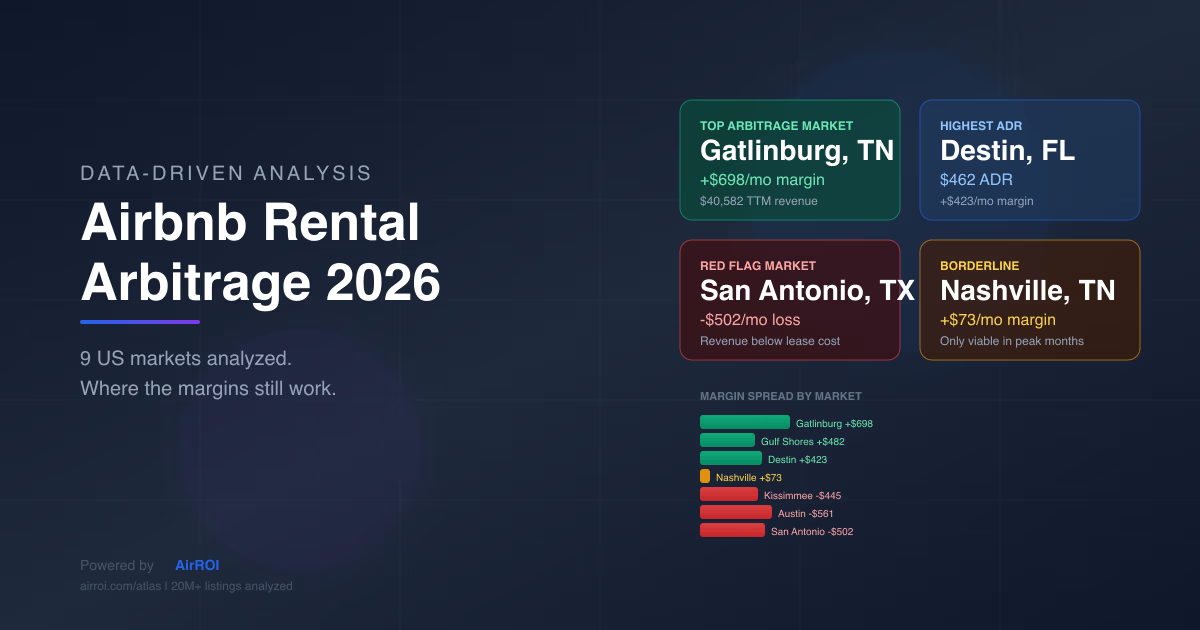
The pattern is unambiguous. At median performance (P50), only Gatlinburg produces a positive margin. The other 9 markets lose money. Even at top-quartile performance (P75), Atlanta remains unprofitable and Tampa barely breaks even at $213/month.
The rule of thumb from our March 2026 arbitrage analysis holds: monthly STR revenue must be at least 2.5x your monthly lease for viable margins. Gatlinburg clears that bar at P50 (2.7x). Nashville reaches it only at P75 (2.9x). Most urban markets fall well below 2.0x.
The Seasonality Trap
Viral arbitrage math assumes 12 months of consistent revenue. Reality delivers 3-4 strong months and 8-9 months of compressed margins or outright losses. AirROI's monthly revenue data exposes the scale of seasonal swings:
| Market | Best Month (P50) | Worst Month (P50) | Seasonal Drop |
|---|---|---|---|
| Gatlinburg | October: $5,582 | January: $1,781 | -68% |
| Nashville | October: $4,859 | January: $2,147 | -56% |
| Phoenix | March: $4,344 | June: $1,836 | -58% |
| Austin | October: $3,812 | January: $2,290 | -40% |
| San Antonio | March: $2,588 | January: $1,523 | -41% |
Source: AirROI monthly revenue data, P50 (median), 2BR entire-home listings.
Gatlinburg's P50 revenue in October ($5,582) generates a healthy $2,781 net after rent and costs. But January's P50 ($1,781) produces a -$542 loss. The bottom-quartile (P25) operator in Gatlinburg during January earns just $918 -- a $1,405 monthly deficit against rent and operating costs.
Phoenix exhibits inverse seasonality: winter snowbird season (February-March) peaks above $4,000/month, while summer months drop below $1,900. An operator who signs a lease after seeing February numbers and extrapolates 12 months of that performance will face 5-6 months of underwater operations.
This is the seasonality trap. Lease payments are fixed at $1,100-$2,000 every month. Revenue is not. The arbitrage operator who assumes October revenue runs year-round is the operator who runs out of cash in February.
Realistic Expectations: What a 10-Unit Portfolio Actually Generates
Here is what a disciplined, top-quartile operator can realistically produce:
Best-case scenario: 10 units in Gatlinburg at P75 performance
| Line Item | Monthly |
|---|---|
| Gross revenue (P75 x 10) | $50,240 |
| Rent ($1,100 x 10) | -$11,000 |
| Operating costs (35%) | -$17,584 |
| Net profit | $21,656 |
That is $260,000/year before taxes from 10 units -- excellent income, but it requires P75 performance (top quartile) in the single best arbitrage market. This is the ceiling, not the average.
More realistic blended scenario: 5 Gatlinburg + 5 Nashville at mixed performance
| Component | Monthly |
|---|---|
| 5 Gatlinburg units at P50 ($3,019) | $15,095 |
| 5 Nashville units at P75 ($5,527) | $27,635 |
| Total gross | $42,730 |
| Total rent | -$15,500 |
| Operating costs (35%) | -$14,956 |
| Net profit | $12,274 |
Even this optimistic blend -- median in the best market plus top-quartile in the second-best -- nets $12,274/month. Not $187,000.
The 10XBNB 2026 Student Success Survey of 1,247 operators found an average monthly profit of $560 per unit and an average ROI of 67% on a $10,000 investment. That aligns with our data: most operators earn $400-$700/month net per unit in workable markets. A 10-unit portfolio at those margins produces $4,000-$7,000/month -- respectable side income or a modest full-time living, but 96% less than the viral headlines promise.
Even Hailie Anderson, the poster child for arbitrage income, told Yahoo Finance: "Because I started Airbnb arbitrage, I am now in a position to be able to afford to buy real estate ... which is obviously the end goal." The arbitrage queen herself views it as a stepping stone, not a destination.
The Scaling Paradox: Why More Units Don't Mean More Profit
Conventional wisdom says scaling arbitrage multiplies income linearly. Thirty units at $500/month net each should produce $15,000/month. But per-unit margins decline as operators scale past 10-15 units.
Operational complexity compounds. Each additional unit adds cleaning coordination, guest communication, maintenance scheduling, and turnover management. A solo operator managing 8 units can personally handle key decisions. At 20 units, mistakes creep in -- late cleanings trigger bad reviews, pricing oversights leave money on the table, and response times slow.
Lease obligations are fixed during low season. Ten lease payments total $11,000-$20,000/month regardless of whether guests book. During the January-February trough, a 30-unit operator with $45,000/month in lease obligations and $25,000 in revenue faces a $20,000+ monthly cash drain -- before operating costs.
Even institutional-scale operators struggle. As STRNumbers.com noted: "Even well-funded operators using master-lease models at scale (like Sonder) have struggled with the economics, demonstrating that thin margins do not become safe margins at volume." Sonder, backed by hundreds of millions in venture capital with 30,000+ master-leased units globally, filed for bankruptcy in 2023 after consistently failing to achieve profitability at scale.
The marginal unit's profit declines because fixed costs (management time, quality control) grow super-linearly while revenue per unit remains constant or decreases. The sweet spot for most operators is 5-10 self-managed units in a single market -- enough for meaningful income without the operational breakdown that erodes margins.
The Bottom Line
Airbnb rental arbitrage is a legitimate business model. It is not a scam. But the viral math circulating on TikTok and Twitter is fantasy.
Three conditions separate the operators who make real money from those who lose it:
-
Market selection matters more than hustle. Tourism-driven markets with low lease costs (Gatlinburg, Nashville, Denver) produce viable margins. Urban markets with high supply and moderate tourism demand (Atlanta, Houston, San Antonio) do not.
-
Top-quartile performance is table stakes. At median (P50) performance, only 1 of 10 markets is profitable. You need professional photography, dynamic pricing, fast guest response times, and 4.8+ star reviews to clear the P75 bar -- and even then, margins are $400-$700/month per unit.
-
Reserves absorb the seasonality trap. The best arbitrage markets have 3-4 peak months and 8-9 months of compressed or negative margins. Without 2-3 months of operating reserves, a single bad winter wipes out a year of gains.
Arbitrage generates $4,000-$7,000/month net from 10 well-managed units in the right markets. That is real income. It is not $187,000, and the gap between those numbers is the gap between data and narrative.
For market-specific STR investment analysis, run your target city through the AirROI revenue calculator or explore the full market data on AirROI Atlas.
Frequently Asked Questions
At P75 (top quartile) performance in viable markets, net profit per unit ranges from $400 to $700/month after rent and operating costs. At median performance, only Gatlinburg produces positive margins at +$862/month. A 10-unit portfolio in the best markets realistically nets $4,000 to $7,000/month total.
Operating costs consume 30-40% of gross STR revenue. The biggest hidden items are cleaning ($100-$200 per turnover, 8-12 times per month), furnishing amortization ($200-$400/month spread over a 24-month cycle), and the Airbnb host service fee -- now 15.5% under the single-fee structure that is replacing the old 3% split-fee model.
AirROI data identifies Gatlinburg, TN as the strongest arbitrage market, profitable even at median performance with +$862/month net per unit. Nashville, TN and Denver, CO work for top-quartile (P75) operators. The common pattern: tourism-driven demand, moderate lease costs under $2,000/month, and manageable STR regulation.
Arbitrage fails when the revenue-to-rent spread is too narrow to absorb 30-40% operating costs. In markets like Atlanta (P50 revenue $1,644 vs. $1,700 rent) and Houston (P50 revenue $1,808 vs. $1,400 rent), operating costs push the unit into negative territory. Seasonality amplifies the problem: 3-4 weak months can erase gains from the strong months.