
EU STR Regulation May 20, 2026: 27 Systems, 116,000 Listings, One Law

Paris has shed 12,696 active Airbnb listings in the past 12 months, a 22.9% year-over-year drop driven by pre-deadline enforcement of the EU short term rental regulation taking operational effect on May 20, 2026. From its July 2025 peak, Paris is down 25.3% — roughly 14,500 listings off the chart in nine months. Four of Europe's six largest STR markets are already running at materially reduced supply, and EU Regulation 2024/1028 is about to bind every platform (Airbnb, Booking.com, Vrbo, and the rest) to verified registration display, monthly data transmission, and automatic suspension orders. Airbnb's Head of EU Government Affairs warned on May 6 that several Member States are not technically ready, fragmenting the single regulation into "27 different systems." This piece uses AirROI's analysis of 116,000+ active listings across Spain, France, Italy, Portugal, and Greece to show what is already happening and what to expect on day one.
For the framework background and the Spanish enforcement context that set the stage for May 20, see our earlier EU regulation overview and our Spain €64M Airbnb fine analysis. This piece is the operational follow-up: what is the AirROI listing-supply data already saying, and what should hosts and platforms expect on day one?
What Actually Happens to Your Listing on May 20, 2026
Four operational changes go live simultaneously across all 27 EU Member States on May 20, 2026.
First, online platforms must verify and display a valid registration number on every short-term rental listing in jurisdictions that require one. France's 13-digit Declaloc number, Spain's NRA, Italy's CIN, Portugal's RNAL/AL number, and Greece's AMA all qualify. A listing without a valid number, in a country that requires one, must be suspended.
Second, large platforms must transmit standardized monthly data through each Member State's Single Digital Entry Point (SDEP) — a national portal each country operates to receive structured rental records. The mandatory fields cover the property's specific address, the registration number, the listing URL, the number of nights rented, and the number of guests per night. Smaller platforms report quarterly rather than monthly. According to the Official Journal of the European Union, the regulation applies from May 20, 2026 across all 27 Member States.
Third, platforms must act on suspension orders from competent authorities. The compliance window is 10 working days for standard violations and 48 hours for serious cases — for example, willful misconduct or fraud. This is a legal duty, not a courtesy: a platform that ignores a competent authority's order risks fines that vary by Member State.
Fourth, the regulation enables cross-border enforcement. One Member State can request action affecting a platform or listing in another. A Spanish authority can ask Airbnb (legally headquartered in Ireland) to act on a German operator marketing a Madrid listing through a Dutch booking system. The European Commission's EU Tourism Platform maintains the official policy framing for hosts and operators.
"Previously, rental platforms didn't share data, making it hard to enforce city rules. This new law changes that, giving cities more control." — MEP Kim van Sparrentak, European Parliament
The scale is meaningful. Across Q3 2025 alone, EU short-term rental platforms hosted 398 million guest nights by Eurostat's published count. That is the data flow now becoming visible to municipal regulators on a monthly cadence.
Pre-Deadline Supply Contraction: What AirROI Data Reveals
Across six major EU short-term rental markets, AirROI tracks roughly 124,500 active Airbnb listings as of April 2026 — and four of the six are down significantly from a July 2025 peak. The pattern is consistent: in jurisdictions where pre-deadline registration enforcement is live, hosts are exiting before forced delisting begins.
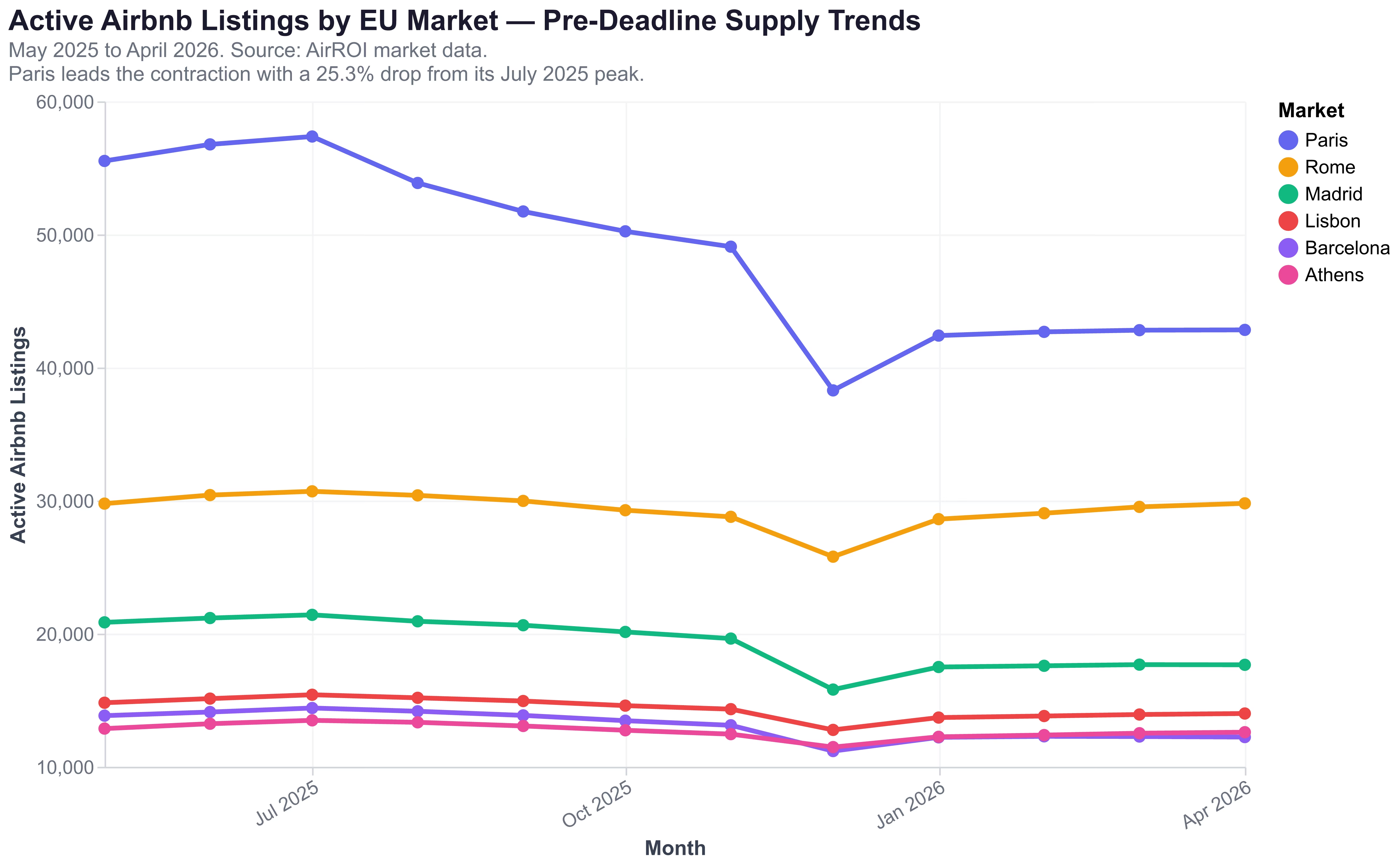
The peak-to-current declines are most pronounced in markets that activated national registration before the EU deadline. Paris (where France's Declaloc display requirement takes binding force on May 20) has lost more than a quarter of its active inventory since last summer. Madrid and Barcelona, both subject to Spain's NRA system since July 2025, are down 17.5% and 15.2% respectively from July peaks. Italy's flat year-over-year supply is not a sign that the regulation is toothless — it is a sign that CIN enforcement, in effect since January 2025, already removed non-compliant inventory more than a year ago.
| Market | May 2025 | April 2026 | YoY Change | Peak (Jul 2025) → Apr 2026 |
|---|---|---|---|---|
| Paris | 55,525 | 42,829 | –22.9% | –25.3% |
| Madrid | 20,851 | 17,660 | –15.3% | –17.5% |
| Barcelona | 13,839 | 12,229 | –11.6% | –15.2% |
| Lisbon | 14,810 | 14,000 | –5.5% | –9.1% |
| Athens | 12,867 | 12,595 | –2.1% | –6.6% |
| Rome | 29,773 | 29,793 | +0.07% | –2.9% |
Source: AirROI active listings time-series, May 2025 to April 2026.
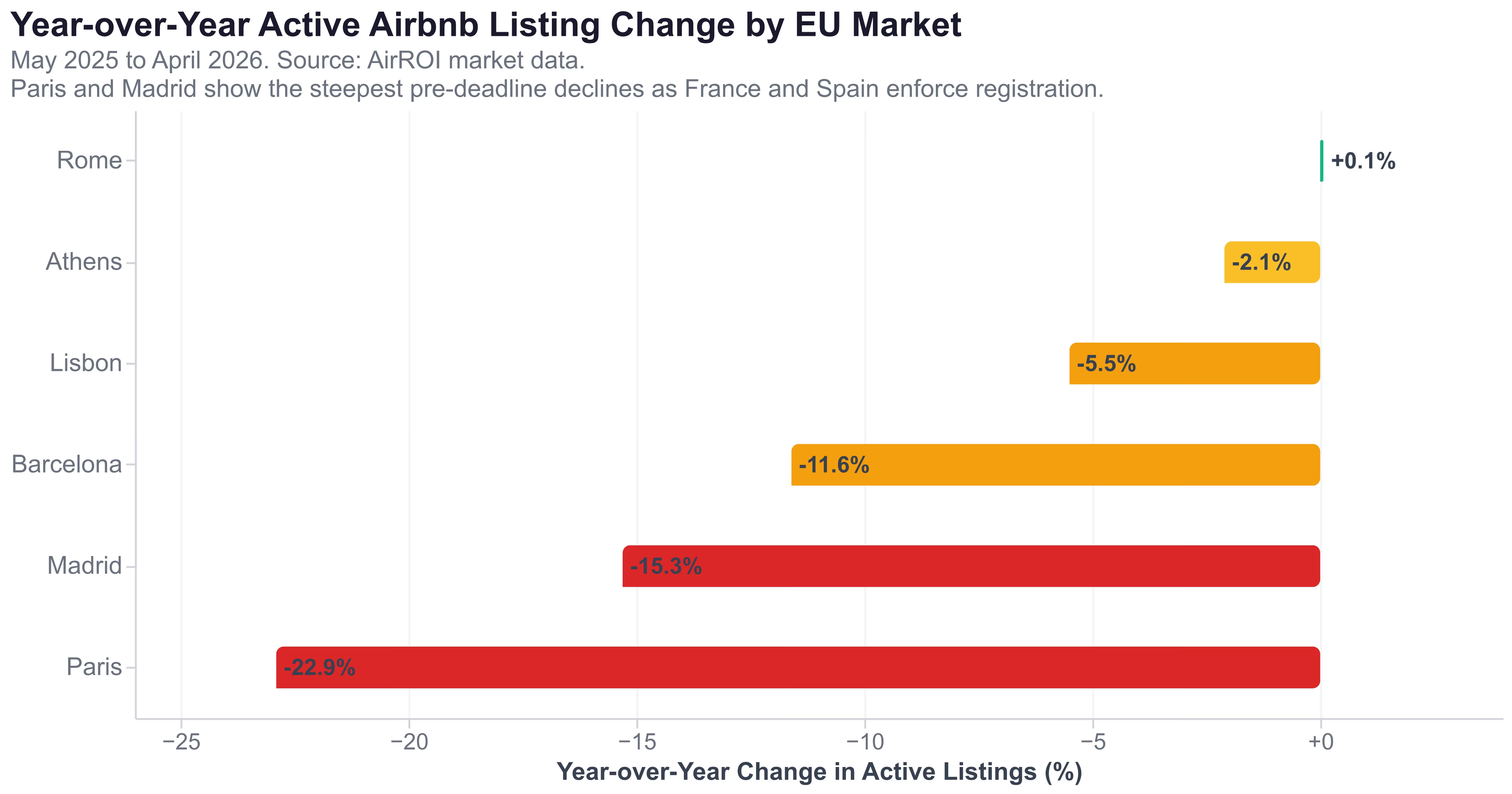
Two patterns matter. First, the steepest contractions cluster in markets where local penalties for non-compliance are well-publicized and platform suspension is now automatic — Paris (€10K-€50K, with cited cases reaching €1M) and Madrid/Barcelona (post-€64M fine context). Second, December 2025 marks the inflection point: every market shows a sharp dip that month, suggesting platform-side cleanups timed to year-end registration deadlines, with partial recovery in Q1 2026 as compliant hosts re-listed.
Spain: €64M Fine Sets the Enforcement Bar
Spain entered the May 20 deadline with the most aggressive enforcement record in Europe. Royal Decree 1312/2024, the national framework that created the NRA registration system, took effect January 2, 2025, with full enforcement from July 1, 2025. The NRA — issued by the Spanish Land Registry through the Registro Único de Alquileres — costs €27 (taxes excluded) and is mandatory for every entire-home rental, individual room, and even certain boats used for paid overnight stays. The Airbnb Help Center provides the platform's guided application flow for Spanish hosts.
The penalty side is the more decisive signal. Spain's Ministry of Consumer Affairs fined Airbnb €64,055,311 in December 2025 for advertising over 65,100 unlicensed listings — calculated as roughly six times the host profit those listings generated. Madrid's High Court upheld the fine on March 23, 2026, rejecting Airbnb's bid to suspend payment during appeal. For full context on how Spain reached this enforcement posture, see our coverage of Spain's €64M Airbnb fine and what AirROI data revealed about the enforcement crackdown.
AirROI's data on the two largest Spanish STR markets confirms the contraction. Madrid is down 15.3% year-over-year to 17,660 active listings; Barcelona is down 11.6% to 12,229. Yet the per-listing economics for compliant operators remain robust: Barcelona's trailing-twelve-month ADR sits at €227 with 57% occupancy, generating roughly €32,386 in annual revenue per listing. Madrid runs at €160 ADR and €22,352 annual revenue. Supply compression is not the same as revenue collapse — the surviving cohort tends to absorb demand at improved per-night pricing.
Barcelona's other regulatory layer continues to operate alongside the EU framework: the city's plan to phase out all 10,101 HUT (tourist apartment) licenses by November 2028 was upheld by Spain's Constitutional Court in March 2025. The May 20 EU framework adds platform-level enforcement teeth to a market that was already shrinking under municipal pressure.
France: Declaloc, Loi Le Meur, and the Steepest Supply Drop
France entered the May 20 deadline with the largest pre-deadline supply contraction of any major EU market. AirROI data shows Paris active listings dropped from 57,361 in July 2025 to 42,829 in April 2026 — a 25.3% peak-to-current decline and a 22.9% year-over-year loss. That is roughly 12,696 listings exited from a single city.
The driver is operational. Every meublé de tourisme in France must obtain a 13-digit Declaloc registration number through the national portal at service-public.fr and the local mairie. Display becomes mandatory on May 20, 2026, and Airbnb and other platforms are required to suspend listings without a valid number on or after that date. Penalties under Loi Le Meur range from €10,000 (missing registration) to €20,000 (false declaration) to €50,000 (more serious infractions), with reported Paris cases reaching €1 million for repeat or commercial-scale violators.
Layered on top of registration is the Paris-specific night cap: 90-120 nights annually for primary residences, depending on the unit type and zoning. The combination of registration enforcement, night caps, and platform suspension creates a triple gate that long-term commercial operators in particular have struggled to clear.
Hosts on r/airbnb_hosts have echoed the confusion. One non-resident French host described being "uncertain as to how to get this" registration number despite owning a property scheduled for short-term rental. The administrative complexity is itself a deterrent — and it shows up directly in AirROI's supply data.
For the operators who do clear the gates, the revenue case remains intact. Paris TTM ADR sits at €239 with 53% occupancy and €27,245 in annual revenue per listing. The booking lead time of 56.9 days is among the longest in the EU, reflecting Paris's status as a destination travelers plan well in advance.
Italy: CIN Already Did the Work
Italy's active Airbnb supply is essentially flat year-over-year — +0.07% in Rome between May 2025 and April 2026 — and that flatness is the most informative number in this entire dataset.
The reason: Italy's CIN (Codice Identificativo Nazionale) regime has been mandatory since January 2, 2025 under Article 13 of Decree Law 145/2023. Penalties are tiered — €800 to €8,000 for not possessing a CIN, and up to €5,000 for failing to display it on listings. Online platforms including Airbnb, Booking.com, and Vrbo have been required to verify CIN compliance and delist non-compliant properties for over a year. By the time the EU 2024/1028 deadline arrives on May 20, 2026, Italy will have already executed the cleanup that France, Spain, Portugal, and Greece are still in the middle of.
AirROI's Rome data tells the story: 29,773 active listings in May 2025, 29,793 in April 2026 — essentially identical. Rome runs at €197 ADR, 52% occupancy, and €26,610 in annual revenue per listing on a TTM basis. Italy's national STR market sits between 340,000 and 360,000 active listings, with Rome alone accounting for over 45,000.
The implication is significant for cross-border operators. Italy is the operational template for what the post-May 20 European STR market looks like once the dust settles: stable supply, consistent registration display, and a clear compliance ledger that flows through monthly data transmission to the SDEP. Markets that activated national registration earliest will see the smallest May 20 disruption.
Portugal and Greece: Localized Tightening
Portugal — Alojamento Local
Portugal's Alojamento Local (AL) regime did not require a sudden pre-deadline overhaul, but two enforcement vectors are tightening simultaneously. First, insurance compliance: industry reports indicate over 70,000 alojamento local units are at risk of having their licenses cancelled if owners fail to submit valid civil liability insurance documentation. Second, density containment in Lisbon — the city now applies neighborhood-level zoning thresholds at 5% and 10% AL density. In "absolute containment zones" (where AL units exceed 10% of permanent dwellings), new AL registrations for entire homes are generally prohibited.
The Algarve, which holds roughly 40,000 AL units (about a third of the national total), remains broadly open to new registrations as of April 2026, though individual municipalities may apply for containment zoning under DL 76/2024 powers. Penalties for AL violations can reach €40,000.
AirROI's Lisbon data shows the localized effect: 14,810 active listings in May 2025 dropped to 14,000 by April 2026 — a 5.5% YoY decline, modest compared to Paris but consistent with the pattern of pre-deadline cleanup. Lisbon TTM ADR sits at €152 with 55% occupancy and €22,718 in annual revenue per listing.
Greece — AMA and AADE Enforcement
Greece's AMA (Property Registration Number) regime is administered by the Independent Authority for Public Revenue (AADE). The fine schedule escalates sharply: €5,000 for the first offense, €10,000 for the second, €20,000 for the third within a year. Required compliance includes civil liability insurance, certified electrical installation, fire extinguishers, smoke detectors, emergency signage, pest control certification, and first-aid kits.
Two policy moves are reshaping Athens specifically. First, the 1st, 2nd, and 3rd Municipal Districts — covering Plaka, Monastiraki, Syntagma, Kolonaki, Exarcheia, Mets, Pagrati, Petralona, Thiseio, and Gazi — remain restricted for new STR registrations. Second, in restricted zones, the AMA is now decoupled from the property itself: when ownership changes through sale or inheritance, the registry entry is automatically deleted, and new owners cannot obtain registration. This effectively eliminates STR salvage value from real-estate transactions in those districts.
A parallel expansion hits Thessaloniki on March 1, 2026: the 1st Municipal Community now falls under similar containment, affecting roughly 4,800 of the city's 7,500 active short-term rentals.
Athens AirROI data: 12,867 listings in May 2025 down to 12,595 by April 2026 (–2.1% YoY). TTM Athens runs at €113 ADR, 47% occupancy, and €13,458 in annual revenue per listing — the smallest top-line of the six markets analyzed but with the longest natural runway for compliant new entrants outside restricted districts.
Why Airbnb Is Warning of "27 Different Systems" Nine Days Out
"To avoid platforms having to navigate 27 different systems, Member States should ensure consistent local registration frameworks and APIs for data sharing." — George Mavros, Head of EU Government Affairs, Airbnb (statement to Short Term Rentalz, May 6, 2026)
Mavros's statement, made just two weeks before the deadline, names the central architectural tension of EU 2024/1028. The regulation is a single text, but each Member State builds its own SDEP infrastructure, registration scheme, and verification API. A single regulation can produce 27 different operational realities — exactly the fragmentation the law was meant to prevent.
A working tier framework helps. Code red (live and enforcing): Spain, Italy, Greece, Portugal — each has a national registration system in production, penalty teeth in place, and platform suspension live or imminent. Code yellow (live but tightening): France — the Declaloc portal is operational, but May 20 marks the binding suspension date. Code green (under development): Germany, the Netherlands, and several Central and Eastern European Member States — infrastructure is still being built, meaning enforcement on day one will be partial at best in those jurisdictions.
The operator implication is concrete. A property management company with portfolios across, say, Paris, Madrid, Rome, Lisbon, and Berlin must support five different registration formats and (potentially) five different SDEP API contracts. That is not "harmonization" — it is the same compliance burden the regulation was designed to eliminate, redistributed.
For tens of thousands of hosts, the readiness question is not academic — it is a binary operational one. Either a Member State has a working registration scheme on May 20 or it does not, and if it does not, the regulation's verify-and-suspend teeth simply do not bite in that jurisdiction yet.
The Berlin precedent is the empirical counterweight. The Berlin Senate's press office reports that platform data sharing has already returned over 8,000 vacation apartments to the long-term housing market, with Press Officer Anett Seltz noting that "with the platform data, a possible unreported figure can be addressed more effectively." Berlin's national SDEP is not uniformly ready, but local data sharing already reshapes supply where it operates — and that effect compounds across the EU through 2026 as more SDEPs come online. Airbnb's own commentary on the regulatory backdrop is worth reading alongside this piece: see our coverage of Airbnb's Q1 2026 earnings and what hosts should watch for the platform's framing.
What the EU Deadline Means for US Hosts and Investors
California's SB 346 took effect January 1, 2026 — the closest US analog to EU 2024/1028 — but the two laws differ sharply in scope and enforcement design.
| Dimension | EU Regulation 2024/1028 (May 20, 2026) | California SB 346 (Jan 1, 2026) |
|---|---|---|
| Geographic scope | All 27 Member States, automatic | California cities (must opt in via local ordinance) |
| Required data fields | 5+ (address, reg #, URL, nights, guests) | 4+ (address, APN, listing URL, nights) |
| Reporting cadence | Monthly (large platforms), quarterly (small) | Quarterly minimum, monthly if TOT cycle aligned |
| Platform fine ceiling | Varies by Member State | $10,000/day per violation |
| Self-executing? | Yes — Member States must implement | No — each city adopts its own ordinance |
| Cross-border enforcement | Built in (one MS can request action in another) | Not applicable (state-level only) |
California's law is the broadest US data-sharing framework to date, but it is permissive — each city must adopt a local ordinance referencing California Government Code Chapter 4.6 to activate it. The EU regulation is mandatory and uniform in legal text (if not yet uniform in implementation). For US operators with portfolios in regulated markets like New York (Local Law 18, since 2023), San Francisco, and San Diego, the EU rollout is a preview of where US state law is heading. Investors evaluating cross-border STR strategy should also weigh the global tax burden across Airbnb markets alongside compliance overhead.
For US hosts, Europe is the leading indicator. Platform data sharing reshapes supply, and the surviving cohort of registered operators tends to absorb demand at improved per-night pricing — a pattern documented in Italy since 2025 and in Spain since mid-2025, and one now extending to the rest of the EU on May 20. California cities that adopt SB 346 ordinances through 2026 and 2027 are likely to see the same supply concentration and revenue-per-listing pickup, with or without an explicit local cap.
How Hosts Should Prepare for May 20
For hosts and operators with European exposure, the practical checklist is short and immediate.
- Verify your registration status in every Member State where you list — NRA in Spain, Declaloc in France, CIN in Italy, RNAL/AL in Portugal, AMA in Greece. Missing or expired numbers trigger automatic suspension.
- Document audit-ready proof: registration certificates, platform display screenshots, civil liability insurance proof (Greece, Portugal especially), and any required safety equipment certifications.
- Reconcile your portfolio against any local night caps — Paris (90-120 nights), Amsterdam (30 nights, with proposals to reduce to 15), and others continue to operate alongside the EU registration framework.
- Build a 10-working-day response window into your operational playbook. If a competent authority issues a suspension order, you have 10 working days to remediate (or 48 hours for serious violations).
- Benchmark your market: per-listing revenue benchmarks vary widely across the EU. Use AirROI Atlas to size your market's TTM revenue, ADR, and supply trends before making compliance-cost decisions.
One Regulation, Twenty-Seven Realities
The pre-deadline contraction is the loudest signal in the data. Hosts who could not or would not register have already exited Paris, Madrid, and Barcelona — that work is done. What May 20 actually triggers is enforcement under uniform legal text and uneven national implementation, and the Mavros "27 different systems" warning is a precise operational forecast, not a rhetorical flourish. Italy is the template for what stable looks like once the dust settles; France is the template for what an unfinished cleanup looks like one week before the gun. For platforms, hosts, and the long-term housing markets that absorb returning supply (Berlin alone has reclaimed 8,000+ units), the next twelve months will be defined by a single binary: a valid registration number on file, or no listing on Airbnb in Europe.
Frequently Asked Questions
The Single Digital Entry Point is the national portal that each EU Member State must operate under EU Regulation 2024/1028. Platforms transmit standardized monthly data — host identity, property address, registration number, listing URL, nights booked, guests per night — to the SDEP, which makes the data available to local competent authorities for enforcement.
The regulation still applies, but its registration-verification provisions only bite where a Member State has a functioning national registration scheme. Airbnb's Head of EU Government Affairs, George Mavros, warned on May 6, 2026 that several Member States are not technically ready. In practice, this fragmentation means the same regulation looks like 27 different operational realities depending on jurisdiction.
EU Regulation 2024/1028 applies automatically to all 27 Member States, and large platforms must report monthly. California's SB 346 (effective January 1, 2026) is permissive — each California city must adopt its own ordinance to activate platform data-sharing requirements. The EU framework is broader, mandatory, and includes built-in cross-border enforcement, while SB 346 caps fines at $10,000 per day per violation.
Yes, in jurisdictions that require registration. France, Spain, Italy, Portugal, and Greece have national registration numbers that platforms must verify before listings can remain visible. Airbnb is required to suspend listings without a valid number on or after May 20, 2026 in these jurisdictions; smaller platforms must comply on a quarterly cadence.