
EU Short-Term Rental Regulations 2026: What the Data Shows About Markets Under Pressure

Guests booked 854.1 million nights in EU short-term rentals during 2024 -- an 18.8% surge over the prior year, according to Eurostat. On May 20, 2026, EU Regulation 2024/1028 takes effect across all 27 member states, requiring every major platform to share monthly host activity data with national authorities and every host in a registered jurisdiction to display a unique registration number. The framework covers an estimated 4 million short-term rental properties.
The fear narrative is predictable: regulation kills revenue. But AirROI data from five major European markets tells a different story. Amsterdam, operating under Europe's strictest 30-night annual cap, maintains a $307.60 average daily rate -- the highest among the markets we analyzed. Barcelona, facing a complete phase-out of 10,101 tourist apartment licenses by November 2028, still generates $26,510 in median annual revenue with 58% occupancy. The EU's new framework reshapes STR economics rather than eliminating them, and the data reveals exactly how.
What EU Regulation 2024/1028 Actually Requires
The regulation is enforcement infrastructure, not a ban. Under Regulation (EU) 2024/1028, the EU standardizes three pillars: host registration, platform data sharing, and local enforcement tools. It does not impose EU-wide night caps, licensing mandates, or zoning restrictions. Local authorities retain full control over substantive rules.
As Ben Schroeter, Director for Economic Policy at Booking.com, wrote in The Regulatory Review: the regulation "materially alters evidentiary standards for policymaking" by providing property-level activity data that enables rigorous empirical analysis, "simultaneously empowering and constraining regulators."
Here is what the regulation requires:
Host obligations: Register with the competent local authority where a registration scheme exists. Provide standardized information including property address, type, capacity, and residency status. Display the assigned registration number on all platform listings.
Platform obligations: Collect and verify registration numbers before listing properties. Display numbers prominently. Conduct random compliance checks via member state APIs. Transmit standardized monthly activity data -- including nights booked, guest counts, and property addresses -- to national Single Digital Entry Points. Remove non-compliant listings upon valid authority requests.
Member state obligations: Establish a national Single Digital Entry Point by May 20, 2026. Appoint a national coordinator. Determine penalties for non-compliance by platforms and hosts.
What the regulation explicitly does not do: legalize STRs EU-wide, override national housing policy, require universal registration in every jurisdiction, or impose EU-wide night caps. Local rules still govern what is legal and where -- the EU provides the data infrastructure to enforce those rules consistently.
Country-by-Country Compliance Map: Where the Rules Are Tightest
The EU framework creates a baseline, but enforcement intensity varies dramatically by country. France captured 192 million guest nights in 2024, Spain 171 million, Italy 127 million, Germany 60 million, and Greece 45 million. Each is implementing the regulation against a backdrop of pre-existing local rules that range from moderate to aggressive.
| Market | Night Cap | Registration | Key Fine | Tax Rate | Active Listings | ADR (USD) | Annual Revenue (USD) |
|---|---|---|---|---|---|---|---|
| Amsterdam | 30/year (15 proposed) | Permit, EUR 73 | Up to EUR 21,750 | Income tax | 8,371 | $307.60 | $25,803 |
| Barcelona | License expires 2028 | Tourist license + NRA | EUR 64M platform fine | Regional + ITP | 14,573 | $250.10 | $26,510 |
| Paris | 120/year | 13-digit number | EUR 10K-50K | Income + tourist tax | 59,421 | $262.60 | $21,834 |
| Florence | None currently | CIN mandatory | EUR 800-8,000 | 21% / 26% cedolare | 12,197 | $224.40 | $24,729 |
| Lisbon | None currently | Alojamento Local | Varies by municipality | 28% flat rate | 15,327 | $169.20 | $20,574 |
Source: AirROI market data, March 2026. Revenue and ADR in USD.
Spain -- First to Comply, Hardest to Ignore
Spain became the first EU country to implement a compliant registration scheme through Royal Decree 1312/2024. Since July 1, 2025, every STR listed on a platform must display a national registration number (NRA). Platforms must remove listings without an NRA within 48 hours. The registration fee is EUR 27.
Barcelona represents the most aggressive local enforcement in Europe. The city will not renew any of its 10,101 tourist apartment licenses when they expire in November 2028 -- a move upheld by Spain's Constitutional Court in March 2025. The objective: return those apartments to long-term housing and address the 62.1% rent increase Barcelona families experienced over the past decade. Spain also fined Airbnb EUR 64 million in December 2025 for advertising unlicensed rentals, according to Euronews.
Despite these restrictions, AirROI data shows Barcelona's 14,573 active listings maintain a $250.10 ADR and 58% occupancy, generating $26,510 in median annual revenue. The shrinking supply of licensed properties is driving premium pricing for compliant operators. For hosts with existing licenses, the window through 2028 offers strong revenue potential -- but no path to renewal.
France -- The 120-Night Enforcer
Paris enforces a 120-night annual cap on primary residence STR rentals, with platforms automatically blocking calendars beyond the limit. Fines escalate sharply: EUR 10,000 for failure to register, EUR 50,000 for renting a secondary residence without a change-of-use authorization, and EUR 12,500 per non-compliant listing for platforms. The city maintains a dedicated enforcement brigade monitoring tourist rentals.
France's national law strengthened these tools in November 2024, and a national declaration portal rolls out by May 20, 2026, aligned with the EU deadline. Principal residence limits in Paris and Lyon become more enforceable because booking activity can now be matched to registration records through platform data sharing.
With 59,421 active listings, Paris is Europe's largest STR market by volume. AirROI data shows a $262.60 ADR and 55% occupancy, generating $21,834 in median annual revenue. The enforcement infrastructure is mature -- hosts who operate within the 120-night framework face a well-defined, manageable compliance environment.
Netherlands -- The 30-Night Experiment
Amsterdam operates the strictest night cap in Europe: 30 nights per calendar year for primary residences, with a EUR 73 permit requirement. The city is considering reducing the cap to 15 nights in central zones like Centrum and De Pijp from April 2026 under its "Holiday Rental Escalation Ladder."
Oxford Economics estimates EUR 269 million in lost host earnings since the implementation of Amsterdam's current restrictions. Yet the market data reveals a counterintuitive outcome. AirROI data shows Amsterdam's 8,371 active listings achieve a $307.60 ADR -- the highest among the five markets analyzed -- with $25,803 in median annual revenue despite the severe night cap.
The mechanism is supply compression. Fewer available nights per listing concentrates demand into a smaller window, driving rates upward. For hosts who can operate within the 30-night framework, each night commands a premium that partially offsets the volume constraint. The mid-term rental strategy -- stays of 30+ days that fall outside STR regulation -- offers an alternative revenue path for Amsterdam property owners.
Italy -- CIN Codes and Climbing Tax Rates
Italy's CIN (Codice Identificativo Nazionale) became mandatory for all short-term rentals on January 1, 2025. The code must appear on the property's exterior and on all online listings. Non-display triggers fines of EUR 800 to EUR 8,000.
Tax policy is tightening. The current structure applies a 21% cedolare secca (flat tax) on the first rental property and 26% on additional properties. The 2026 budget law dropped the threshold for mandatory business registration from four properties to two -- hosts with three or more STRs must now register for VAT and operate as a business. A proposed standardization of the flat tax at 26% for all properties is under parliamentary debate.
Italy also eliminated key-box-only check-ins. Hosts must verify guest identities visually, either in person or via video intercom. AirROI data shows Florence's 12,197 active listings maintain a $224.40 ADR and 52% occupancy, generating $24,729 in median annual revenue.
Greece -- The Data Cross-Reference Pioneer
Greece is implementing the most sophisticated enforcement technology in Europe. Under Law 5170/2025, the country created a unified property register linking tax declarations, property records, platform data, bank accounts, and credit card payments. The AADE (Independent Authority for Public Revenue) cross-references all data sources to identify non-compliant hosts.
The results are measurable: STR tax revenue in Greece neared EUR 1 billion in 2025, according to GTP Headlines. The country has also begun limiting STR permits in 5+ regions to address housing pressure in tourism-heavy areas. Greece's approach previews what the EU framework enables at scale -- when authorities can see every booking, every payment, and every tax filing in one system, the compliance gap shrinks rapidly.
The Regulation-Revenue Paradox: AirROI Data from 5 European Markets
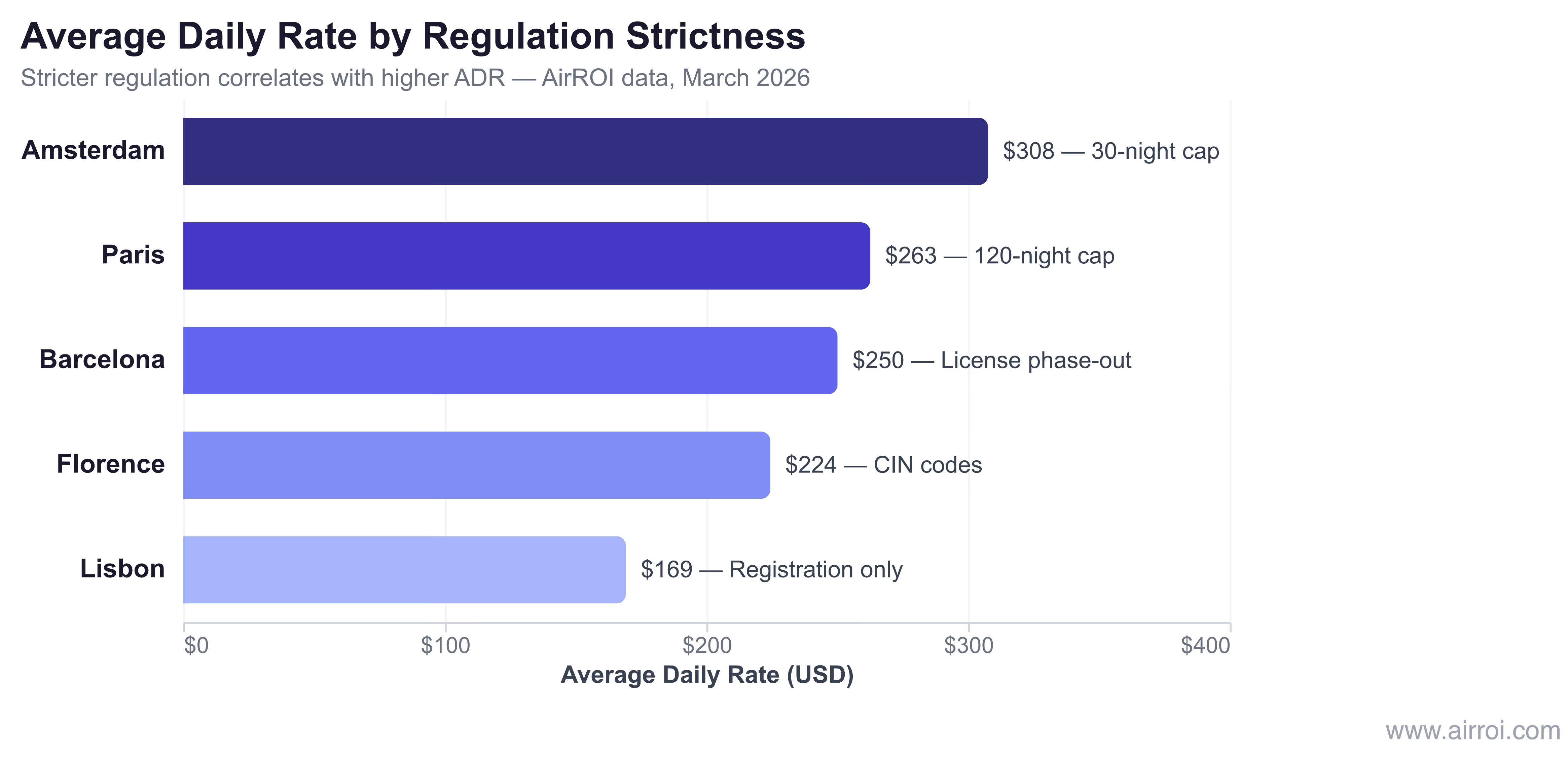
The data from 109,000+ active listings across five European markets challenges the assumption that regulation destroys STR revenue. The two strictest markets -- Amsterdam (30-night cap) and Barcelona (license phase-out) -- generate the highest ADR and near-highest annual revenue among the group.
Amsterdam's $307.60 ADR is 82% higher than Lisbon's $169.20, despite Amsterdam hosting fewer than half the listings. Barcelona's $26,510 median annual revenue leads all five markets despite facing the most existential regulatory threat.
The pattern reflects a fundamental economic principle: supply compression drives price. When regulation removes non-compliant or casual listings from a market, the remaining compliant supply absorbs demand at higher rates. Berlin's experience confirms this at the housing level -- enforcement of the Zweckentfremdung law returned approximately 8,000 apartments to the long-term housing market, removing supply from the STR pool and concentrating demand among remaining operators.
This does not mean regulation is painless. Oxford Economics' estimate of EUR 269 million in lost Amsterdam host earnings captures the aggregate impact. Individual hosts who cannot operate within night caps lose revenue entirely. But for compliant, professionally managed properties, the data suggests regulation creates a competitive moat that supports premium pricing.
Key takeaway: Regulation does not eliminate STR revenue -- it redistributes it from non-compliant to compliant operators and compresses supply in ways that support higher per-night rates.
The Atlantic Preview: What EU Rules Signal for US Markets
US cities are watching Europe's regulatory evolution closely. The architectural parallels are clear, but the approaches differ in important ways.
NYC's Local Law 18 represents the aggressive end of the spectrum. Since its enforcement began in September 2023, Airbnb listings dropped from approximately 38,000 to roughly 3,000 -- a 90%+ reduction. The economic impact has been severe: an estimated $2.5 billion in lost visitor spending citywide, 21,000 affected jobs, and a $96 million tax revenue shortfall. Hotel ADR rose 6% year-over-year in response.
The Sacramento primary residence rule takes a softer approach, limiting STRs to owner-occupied properties. Hawaii imposes fines of up to $10,000 per day for non-compliant operators.
The EU framework is architecturally different from all of these. Rather than creating near-bans (NYC) or blunt residency requirements (Sacramento), the EU standardizes enforcement infrastructure while leaving substantive restrictions to local authorities. This layered approach allows graduated responses: a 120-night cap in Paris, a 30-night cap in Amsterdam, a license phase-out in Barcelona -- each calibrated to local conditions, all enforced through the same data-sharing infrastructure.
For US-based investors with European STR portfolios, the implications are immediate. Platform activity will be reported monthly to tax authorities. Registration compliance is binary -- you either have a number or your listing gets removed. The World Cup 2026 host city STR rules add another layer of regulatory complexity for hosts in markets like Barcelona.
The Compliance Checklist: What Hosts Must Do Before May 20, 2026
For hosts and investors operating STR properties in Europe, here are the concrete steps required before the May 2026 deadline:
-
Verify registration status -- Confirm whether your property's jurisdiction requires registration. Check the national authority website for your country (Spain's NRUA, France's national portal, Italy's BDSR database, Greece's AADE system).
-
Obtain your registration number -- Apply through the local competent authority. Timelines vary: Spain is already live (EUR 27 fee), Italy CIN is mandatory since January 2025, France's national portal launches May 2026.
-
Display the number everywhere -- Add the registration number to all platform listings (Airbnb, Booking.com, Vrbo) and, in Italy, to the physical exterior of the property. Non-display fines range from EUR 800 (Italy) to EUR 10,000 (Paris).
-
Track night counts per property -- If your jurisdiction imposes a night cap (Paris: 120, Amsterdam: 30), implement a tracking system. Platforms will auto-block in some cases, but you are ultimately responsible for compliance.
-
Reconcile tax obligations -- Review your tax status in each jurisdiction. Italy's cedolare secca applies at 21% for the first property and 26% for additional ones. Greece cross-references platform data with tax filings. Multiple properties may trigger business registration requirements.
-
Prepare audit-ready documentation -- Maintain records of all bookings, guest identities (Italy requires visual verification), registration correspondence, and tax filings. The EU's data-sharing framework means authorities can now request specific records backed by platform-reported data.
-
Classify properties by regulatory resilience -- Assess each property against its local regulatory trajectory. A licensed Barcelona property has value through 2028 but no renewal path. An Amsterdam primary residence operates within a 30-night constraint. A Florence property faces a lighter regime but rising tax rates.
-
Monitor enforcement developments -- Amsterdam's proposed reduction from 30 to 15 nights (April 2026), Italy's proposed 26% flat tax standardization, and Greece's expanding permit restrictions are all pending. Use AirROI Atlas to track market performance metrics as regulatory changes take effect.
For hosts managing properties across multiple EU countries, a centralized compliance matrix mapping each property to its local registration number, night cap, tax rate, and enforcement timeline is essential. The comprehensive STR regulations guide provides additional detail on compliance frameworks by market.
Disclaimer: This article provides general information about EU short-term rental regulations. It does not constitute legal or tax advice. Hosts and investors should consult qualified legal and tax professionals in each jurisdiction where they operate.
Frequently Asked Questions
AirROI data from five major European markets suggests regulation reshapes rather than destroys revenue. Amsterdam, with Europe's strictest 30-night annual cap, maintains a $307.60 average daily rate -- the highest among the five markets analyzed. Barcelona generates $26,510 in median annual revenue despite its tourist apartment license phase-out. Supply compression drives up per-night pricing for compliant operators.
The Netherlands (Amsterdam's 30-night annual cap with proposals to reduce to 15 nights), Spain (Barcelona phasing out all 10,101 tourist apartment licenses by November 2028, plus a EUR 64 million Airbnb fine), and France (Paris 120-night cap with fines up to EUR 50,000) enforce the strictest rules. Italy and Greece are tightening rapidly with mandatory CIN codes and cross-referenced tax data.
Platforms must collect and verify host registration numbers before listing properties, share monthly activity data with national authorities, conduct random compliance checks via member state APIs, and remove non-compliant listings upon authority request. Smaller platforms report quarterly rather than monthly. Spain already demonstrated enforcement willingness by fining Airbnb EUR 64 million for advertising unlicensed rentals.
US investors with European STR portfolios must comply with local registration requirements before May 20, 2026. This means obtaining registration numbers in each jurisdiction, tracking night caps per property, and maintaining audit-ready documentation. The regulation's data-sharing mechanism means platform activity is now directly visible to tax authorities. Greece's AADE already cross-references platform data with bank accounts and tax filings.