
World Cup 2026 Airbnb Regulations: Which Host Cities Let You Cash In (and Which Don't)

Kansas City's Airbnb fill rate for World Cup match days has hit 49% with available rates topping $690/night. Boston is already at 63% for opening weekend. Meanwhile, New York City — which will host the World Cup final at MetLife Stadium — sits at just 20% fill rate for the same period, because Local Law 18 locks most hosts out entirely.
This article uses AirROI's real-time booking pacing data across 11 US host cities to show you exactly where the opportunity is, which regulations stand in the way, and what hosts should do in the next 90 days.
NYC's Local Law 18: The $5,700 Opportunity That Most Hosts Can't Touch
New York City's approach to the World Cup 2026 Airbnb opportunity can be summarized in a single headline from The Real Deal: "Not even the World Cup can revive short-term rentals in NYC."
On March 12, 2026, NYC's City Council and Mayor Zohran Mamdani formally rejected Airbnb's request to temporarily suspend Local Law 18 for the tournament. The law, which took effect in 2023, requires all short-term rental hosts to register with the Mayor's Office of Special Enforcement (OSE) and prohibits booking platforms from processing transactions for unregistered listings.
"City Council leaders and Mayor Zohran Mamdani are refusing to lift restrictions on short-term rentals for the tournament because they want to maintain housing stability." — ABC7 New York, March 12, 2026
The practical impact is severe. Under Local Law 18, entire-home rentals under 30 days are only legal when the permanent occupant is physically present and shares the unit as a common household. For a soccer fan looking to rent a Manhattan apartment for a week, this effectively means: you cannot.
AirROI data quantifies the result. Despite having 12,475 active listings, New York City's fill rate for the World Cup opening weekend (June 12-13) is just 19-20%, with booked rates averaging $274-$284/night. Compare that to Boston at 58-63% fill rate, or Kansas City at 27-30% — markets with a fraction of NYC's inventory but far more regulatory flexibility.
New Jersey Is Dominating — The Demand Spillover Effect
Jersey City — just one PATH train stop from Manhattan and 15 minutes from MetLife Stadium — shows available rates of $430-$475/night for World Cup dates in June. That represents a 2x-2.4x premium over its normal ADR of $207. For comparison, Manhattan's available rates for the same period are $248-$255 — barely above its $225 baseline.
| Metric | New York City | Jersey City |
|---|---|---|
| Active Listings | 12,475 | 1,622 |
| Normal ADR | $225 | $207 |
| WC Available Rate (June 12) | $250 | $431 |
| WC Fill Rate (June 12-13) | 19-20% | 26-27% |
| Regulatory Status | Host-presence required (LL18) | Registration required, entire-home allowed |
| Projected Host Earnings | Limited by LL18 | $5,700 (NY/NJ metro) |
The pattern is unmistakable. Jersey City has one-eighth of NYC's inventory but is commanding nearly double the nightly rate for World Cup dates. The supply constraint in NYC is creating a pricing premium for the nearest unrestricted market.
For hosts in northern New Jersey, the math is compelling. A 2-bedroom listing near MetLife Stadium priced at $400-450/night for a 7-night tournament stay could generate $2,800-$3,150 — plus Airbnb's $750 new-host bonus for first-time hosts, bringing the total to $3,550-$3,900 from a single event.
LA's "Doomsday" Warning and the Home Sharing Ordinance
On March 15, 2026, Airbnb issued what media outlets called a "doomsday letter" to Los Angeles, demanding the city end rules that prevent second homeowners from listing their properties as vacation rentals during the tournament.
"Airbnb has issued a doomsday letter to Los Angeles ahead of the 2026 FIFA World Cup, demanding the city end rules banning second homeowners from letting out their properties as vacation rentals during the tournament." — Los Angeles Today, March 15, 2026
The supply constraint is already visible in pricing. LA Airbnb prices for World Cup dates jumped 56% compared to the same period in prior years, per the LA Times. With 11,301 active listings and an average occupancy of just 48%, LA has significant untapped inventory — but the regulatory ceiling prevents it from responding to World Cup demand the way host-friendly markets can.
Airbnb's letter also called for the city to require all vacation rental platforms to share data and remove illegal listings — a notable stance given that stronger enforcement would affect Airbnb's own supply. The company is essentially arguing that a level playing field with enforcement would be better than the current patchwork of unenforced rules.
Meanwhile, Deloitte projects LA hosts could earn up to $5,100 during the tournament — the third-highest market. But that figure assumes hosts can actually list legally, which the 120-day cap and primary-residence requirement make difficult for many property owners.
The Three Regulatory Tiers — Every Host City Ranked
Not all 16 World Cup host cities are created equal when it comes to short-term rental regulations. Based on our analysis of each city's STR rules, we've categorized them into three tiers:
Tier 1: Heavily Restricted
| City | Key Restrictions | Impact on WC Hosting |
|---|---|---|
| New York City | Host-presence required, OSE registration, platforms must verify | Entire-home rentals effectively banned |
| Los Angeles | 120-day cap, primary residence only, HSO enforcement | Second homes and investment properties excluded |
| San Francisco Bay Area | 90-day cap (unhosted), registration required, building restrictions | Limited supply for WC period in SF proper |
Tier 2: Moderately Regulated
| City | Key Restrictions | Impact on WC Hosting |
|---|---|---|
| Boston | Registration required, some neighborhood restrictions | Hosting allowed but compliance needed |
| Seattle | Registration, platform accountability, primary residence in some zones | Most hosts can list with proper registration |
| Philadelphia | Permit required, safety inspections | Straightforward compliance path |
| Miami | Varies by municipality, Miami Beach has strict rules (6-month minimum in some zones) | City of Miami more permissive than Beach |
| Vancouver | Principal residence only, business license required, 130% surge in license applications | Active enforcement, but hosts responding |
| Toronto | Principal residence, registration required, 180-day cap proposal | Compliance required but feasible |
Tier 3: Host-Friendly
| City | Key Restrictions | Impact on WC Hosting |
|---|---|---|
| Kansas City | Minimal local regulation, state preemption of local STR bans | Wide open for new and existing hosts |
| Dallas | Registration, TOT collection, relatively few restrictions | Strong hosting environment |
| Houston | Registration required, TOT collection | Large inventory, permissive rules |
| Atlanta | Registration and TOT required, some zoning considerations | Large existing market (6,100+ listings) |
| Monterrey | Federal tax registration required | Emerging market, few restrictions |
| Guadalajara | Federal tax registration required | Similar to Monterrey |
| Mexico City | City-level registration proposed but not yet enforced | Currently permissive |
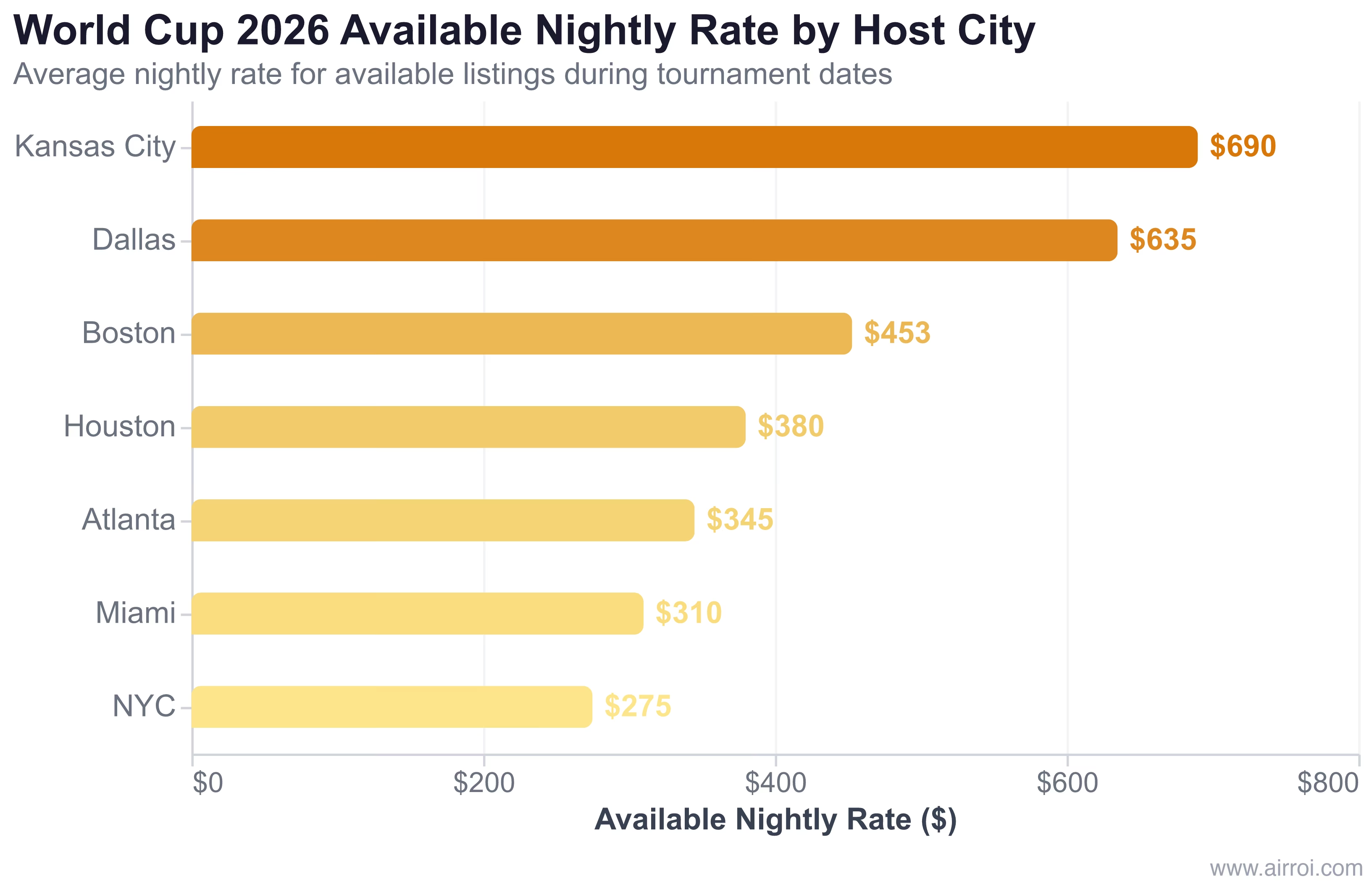
The regulatory tier directly correlates with available rate surges. Host-friendly markets like Kansas City show available rates of $690/night for peak World Cup dates — a 3.2x multiple over baseline. Restricted markets like NYC show available rates barely above their daily average because the supply that would command premium pricing cannot legally exist.
AirROI Booking Pacing: Which Cities Are Filling Up Fastest
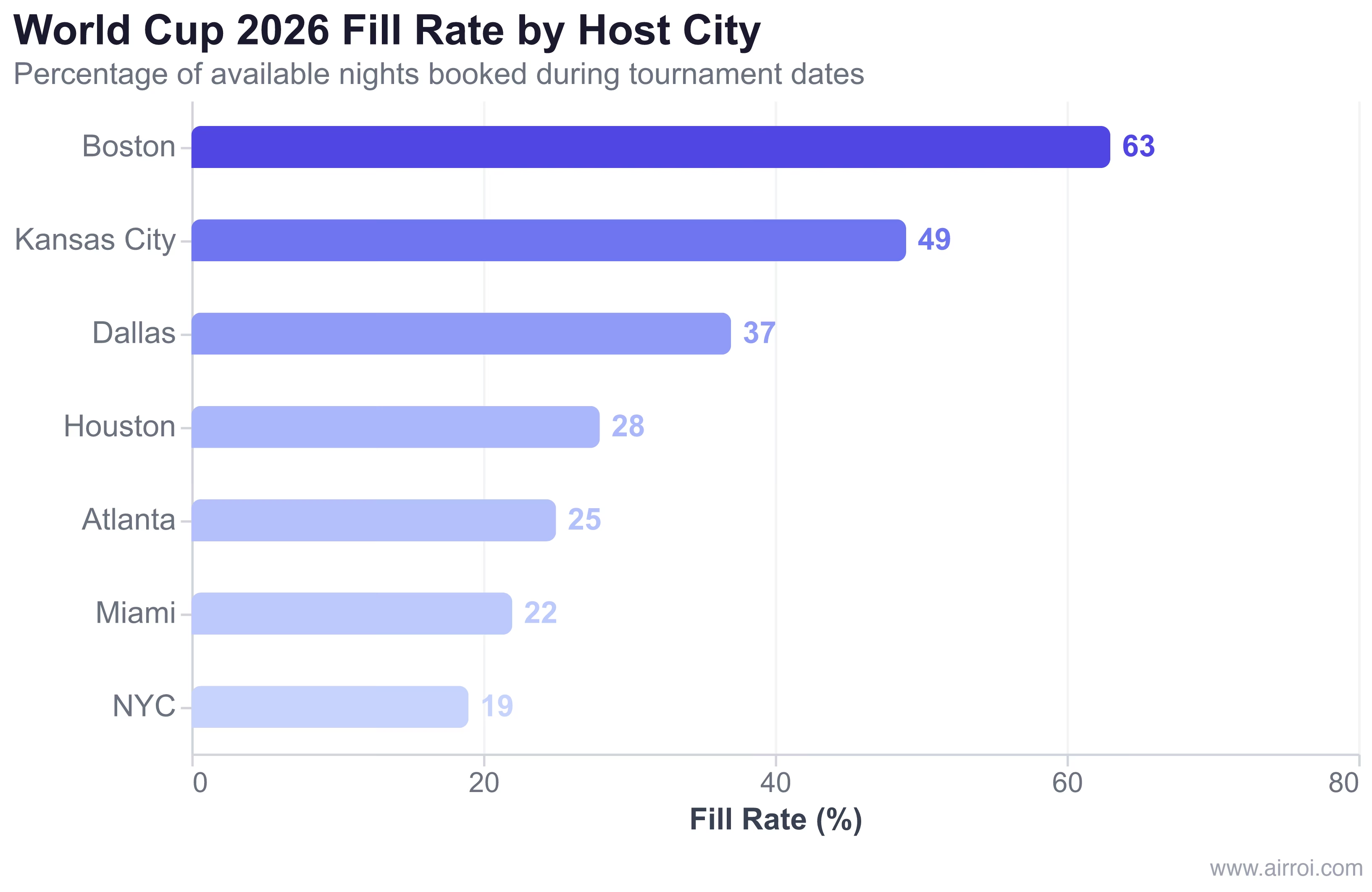
AirROI's booking pacing data provides the clearest picture of where World Cup demand is strongest relative to supply. Here's how key US host cities compare for the tournament period (June 11 - July 19, 2026):
| City | Peak WC Fill Rate | Peak Date | Available ADR | Booked ADR | Active Listings | Baseline ADR |
|---|---|---|---|---|---|---|
| Boston | 63% | June 13 | $428 | $453 | 3,025 | $285 |
| Kansas City | 49% | June 25 | $690 | $508 | 1,433 | $214 |
| Jersey City | 29% | June 26 | $440 | $385 | 1,622 | $207 |
| New York City | 20% | June 13 | $248 | $284 | 12,475 | $225 |
Boston leads all US host cities with a 63% fill rate for opening weekend — driven by strong existing tourism infrastructure and moderate regulations that allow hosts to respond to demand. The city's 3,025 listings are pricing at an average of $453/night for booked reservations during peak World Cup dates, a 59% premium over the $285 baseline.
Kansas City shows the most dramatic pricing signal. Its 49% fill rate for June 25 (a match day) comes with available rates averaging $690/night — a 3.2x multiple. Hosts who booked early are averaging $508/night, suggesting that significant pricing upside remains for available inventory. With just 1,433 active listings and minimal regulatory barriers, KC represents the highest-yield World Cup hosting opportunity per listing.
What Hosts Should Do Now — A 90-Day Action Plan by Regulatory Tier
With the tournament starting June 11, 2026, hosts have approximately 90 days to prepare. Your strategy depends entirely on your city's regulatory tier.
If You're in a Tier 1 (Restricted) Market
NYC, LA, SF Bay Area: The path to legal World Cup hosting is narrow but not impossible.
- NYC: You can only host guests under 30 days if you are physically present in the unit and registered with OSE. Consider listing a private room rather than an entire home. Alternatively, explore 30+ day bookings — many World Cup visitors will stay for multiple weeks.
- LA: Verify you're under your 120-day annual cap. If you've used most of your days, consider saving them for the highest-demand World Cup dates. Register or re-register with the city to avoid being among the 7,500 estimated violators.
- SF: The 90-day cap on unhosted stays means planning is critical. Prioritize World Cup dates for your limited allocation.
If You're in a Tier 2 (Moderate) Market
Boston, Seattle, Philadelphia, Miami, Vancouver, Toronto: You have a clear path to hosting — the key is compliance and optimization.
- Register now. Vancouver has seen a 130% surge in STR license applications. Don't wait until May.
- Set event-based pricing. AirROI's pacing data shows Boston's available rates at $428-$460/night. Use AirROI Atlas to benchmark your pricing against local competitors.
- Optimize your listing. World Cup guests are international travelers — highlight transit access to the stadium, multi-language welcome guides, and soccer-themed touches.
- Consider insurance. STR-specific insurance is essential for event-period hosting, when guest volumes and property risk increase.
If You're in a Tier 3 (Host-Friendly) Market
Kansas City, Dallas, Houston, Atlanta: You have the widest opportunity — and the least time to waste.
- List immediately. First-time hosts who welcome a guest by July 31 qualify for Airbnb's $750 bonus. At Kansas City's current available rates of $690/night, a single match-day weekend could earn $2,000+ before the bonus.
- Price aggressively. AirROI data shows KC available rates at 3.2x baseline. Don't anchor to your normal pricing — this is a once-in-a-generation event.
- Set minimum stays. For match weekends, consider 2-3 night minimums to capture full event value and reduce turnover costs.
- Use dynamic pricing strategies to adjust rates as demand signals evolve over the next 90 days.
The Bottom Line
The 2026 World Cup will generate unprecedented Airbnb demand across 16 host cities — but the regulatory patchwork means that demand won't be distributed evenly. NYC's refusal to loosen Local Law 18 is a $5,700-per-host opportunity that most New Yorkers can't access. LA's doomsday letter may or may not produce results before June. But in Kansas City, Dallas, Houston, and Atlanta, the door is wide open.
AirROI's pacing data tells the story clearly: markets with fewer regulatory barriers are showing the strongest pricing signals. Kansas City's $690/night available rate and 49% fill rate for match days isn't just a data point — it's a market signal that host-friendly regulation creates hosting opportunity.
Whether you're a first-time host considering Airbnb's $750 bonus or an experienced operator planning event pricing, the next 90 days will determine your World Cup revenue. Know your city's rules. Check your compliance. And use data — not guesswork — to set your pricing.
Frequently Asked Questions
It depends on your city's regulations. Host-friendly cities like Kansas City, Dallas, Houston, and Atlanta allow short-term rentals with minimal restrictions beyond registration and tax collection. NYC effectively bans entire-home STRs under Local Law 18 unless the host is present. LA caps hosting at 120 days per year under its Home Sharing Ordinance. Always verify your local rules before listing.
A Deloitte study commissioned by Airbnb projects the average US host in a World Cup city could earn approximately $3,000-$4,000 during the tournament. Top markets include New York/New Jersey ($5,700 per host), Boston ($5,200), and Los Angeles ($5,100). AirROI pacing data shows available rates in Kansas City already topping $690/night for peak match days.
Yes. Airbnb launched its largest-ever host incentive in February 2026, offering $750 USD ($1,000 CAD) to first-time hosts in any of the 16 World Cup host cities who welcome their first guest by July 31, 2026. You must be a new host or have no active listings as of February 1, 2026, and reside in a designated zip code near a host city.
NYC's City Council and Mayor Zohran Mamdani refused to suspend Local Law 18 because they prioritize housing stability over event-driven tourism revenue. The law requires hosts to register with the Mayor's Office of Special Enforcement and prohibits booking platforms from processing unregistered STR transactions. Officials argue that maintaining the law prevents apartments from becoming de facto hotels.
Dallas, Houston, Kansas City, and Atlanta have the most permissive STR regulations among US host cities. These cities generally require registration and tax collection but do not impose day caps, host-presence requirements, or building-type restrictions. AirROI data shows these host-friendly markets also have the highest available rate surges, with Kansas City leading at $690/night for peak World Cup dates.