
Spain's €64M Airbnb Fine: What AirROI Data Reveals About Europe's Enforcement Crackdown

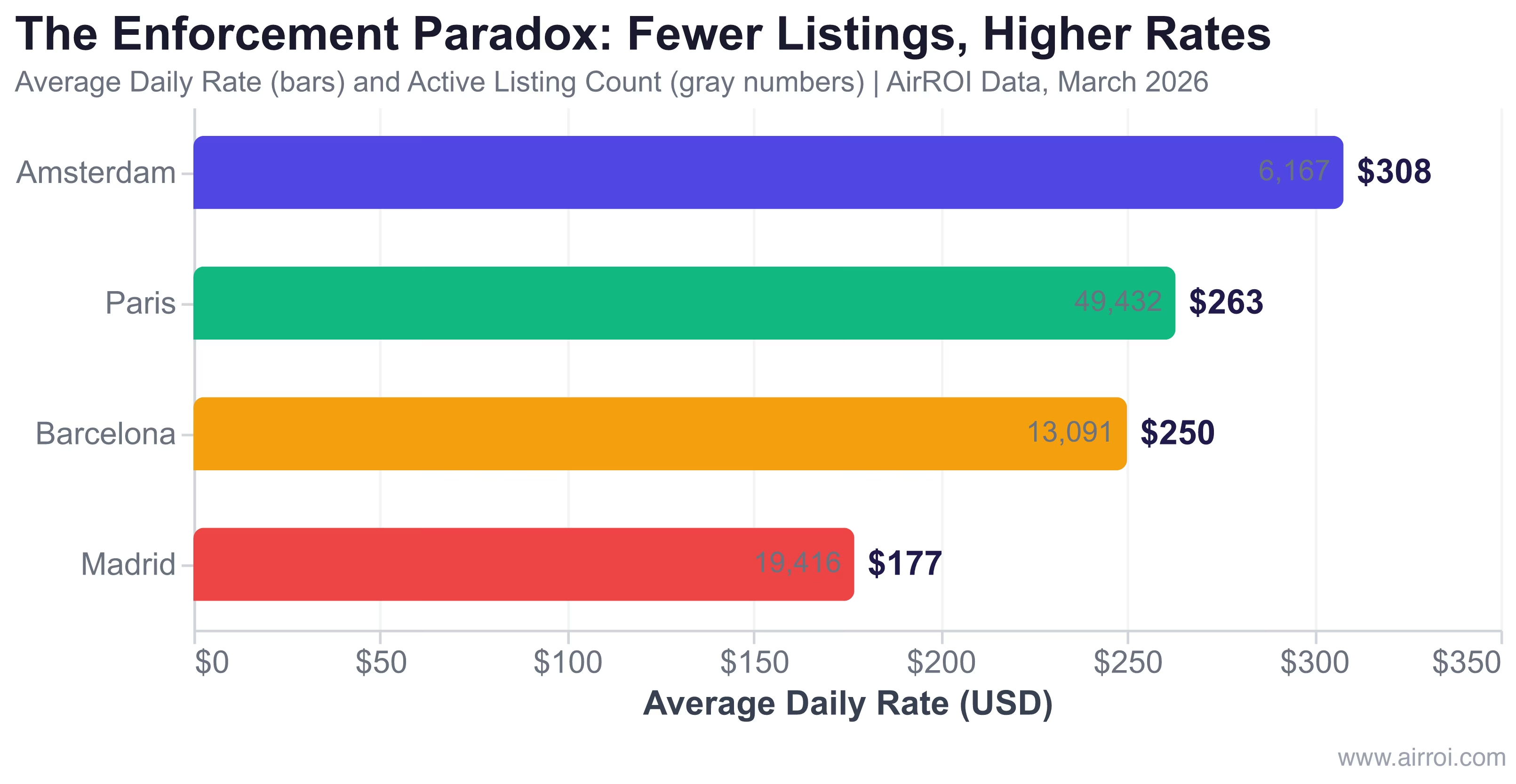
Spain just forced Airbnb to pay €64 million — the largest short-term rental enforcement penalty in European history — for listing 65,100 tourist apartments without valid licenses. But the real story isn't the fine itself. AirROI data from four major European markets reveals a counterintuitive pattern that every STR investor should understand: cities with the strictest enforcement generate the highest per-listing revenue. Amsterdam commands a $308 average daily rate with just 6,167 active listings, while Madrid — with lighter enforcement — manages only $177 ADR despite having three times the supply.
The Spain Airbnb fine 2026 ruling landed on March 23, just 58 days before EU Regulation 2024/1028 creates mandatory data-sharing infrastructure across all 27 member states. Europe isn't debating regulation anymore. It's enforcing it. Here's what the data shows about what happens next.
What Spain's Record €64 Million Airbnb Fine Actually Covers
Spain's Ministry of Social Rights, Consumer Affairs and Agenda 2030 imposed the €64,055,311 fine in December 2025 after identifying more than 65,100 tourist apartment listings on Airbnb that violated Spanish rental regulations. According to Euronews, the violations fell into three categories: listings without valid tourist licenses, the use of false or incorrect registration numbers, and misleading information about host legal status.
The penalty amount was calculated as six times the profit Airbnb generated from these non-compliant listings — a deterrent multiplier designed to ensure the fine exceeds the economic benefit of non-compliance. For context, Airbnb reported approximately $2.2 billion in net income for 2025, making the fine roughly 3% of annual profit.
"No economic interest should be above the right to housing, and no company, no matter how large and powerful, can be above the law." — Pablo Bustinduy, Spain's Minister for Social Rights, Consumer Affairs and Agenda 2030
On March 23, 2026, Madrid's High Court of Justice (TSJM) rejected Airbnb's request to suspend payment while its broader appeal proceeds. The company must pay the full amount now. Airbnb argues the fine violates both Spanish and EU digital platform regulations, noting that over 70,000 properties have since corrected their registration statuses. But the court was unmoved.
The enforcement didn't emerge in a vacuum. Spain's Unified National Rental Registry (NRU) launched on January 2, 2025, requiring all tourist apartment owners to register and obtain a unique rental ID by July 1, 2025. Properties without valid NRU numbers face delisting from platforms. The 65,100 removed listings were identified during this registration sweep — and the €64 million fine is the consequence of what authorities found.
For a broader look at how Airbnb regulations work across jurisdictions, see our comprehensive guide.
The Enforcement Paradox: What AirROI Data Shows Across Four European Markets
The conventional assumption — that heavy regulation kills STR markets — doesn't hold up under scrutiny. AirROI analysis of 88,000+ active listings across Barcelona, Madrid, Amsterdam, and Paris reveals a consistent pattern: supply compression from enforcement drives up per-night pricing for remaining compliant operators.
| Market | Active Listings | Occupancy | ADR (USD) | RevPAR (USD) | Median Annual Revenue |
|---|---|---|---|---|---|
| Amsterdam | 6,167 | 53% | $308 | $167 | $25,803 |
| Barcelona | 13,091 | 58% | $250 | $153 | $26,510 |
| Paris | 49,432 | 55% | $263 | $150 | $21,834 |
| Madrid | 19,416 | 57% | $177 | $105 | $18,174 |
Source: AirROI market data, March 2026. All figures in USD.
The data tells a clear story. Amsterdam — with Europe's strictest 30-night annual cap and the fewest active listings among these four markets — commands the highest ADR at $308 and the second-highest median annual revenue at $25,803. Barcelona, despite its license phase-out that will eliminate all 10,101 tourist apartment permits by 2028, generates the highest median annual revenue at $26,510.
Meanwhile, Madrid — which has lighter enforcement and 19,416 active listings — records the lowest ADR ($177) and lowest annual revenue ($18,174) of the four markets. More supply and less enforcement have not produced better outcomes for individual operators. They've produced worse ones.
The mechanism is straightforward: enforcement removes non-compliant listings from the market, reducing supply. Demand remains strong — EU tourist rental nights nearly doubled between 2018 and 2025, reaching 398 million according to Fortune's coverage of Eurostat data. Fewer listings competing for the same traveler demand means higher nightly rates and stronger occupancy for those who remain.
Barcelona's License Phase-Out: From 10,101 Permits to Zero by 2028
Barcelona represents the most aggressive regulatory experiment in European STR history. In March 2025, Spain's Constitutional Court upheld the city's plan to phase out all tourist apartment (HUT) licenses by October 2028, ruling that the non-renewal of time-limited permits does not constitute expropriation requiring compensation.
The numbers are stark: all 10,101 HUT licenses will expire, no new licenses are being issued as of April 2025, and the city has imposed 9,077 enforcement fines since 2016 — including a notable €420,000 penalty for 14 illegal apartments in the Ciutat Vella district alone. Maximum fines per violation reach €600,000 in Catalonia.
Yet AirROI data shows Barcelona's compliant operators are performing well. The market's $250 ADR and 58% occupancy translate to $26,510 in median annual revenue — the highest of the four European markets analyzed. Barcelona also sees a 54-day average booking lead time, indicating strong forward demand. Tourist apartments in prime locations generate 40-60% more revenue than equivalent long-term rentals, according to Investropa's analysis.
Spain's Ley Orgánica 1/2025 has added another layer: apartment owners in shared buildings now need 3/5 majority neighbor approval to convert residential units into tourist rentals — effective April 2025. Combined with the license phase-out, Barcelona's STR supply is contracting from both regulatory and communal directions.
The irony is that this compression benefits the remaining licensed operators. With 13,091 active listings (down from over 20,000 at the market's peak), each compliant property captures a larger share of Barcelona's tourism demand. As our analysis of EU STR regulations noted, regulation reshapes revenue rather than destroying it.
Paris and Amsterdam: Two Enforcement Models, One Outcome
Paris: Europe's Enforcement Ground Zero
Paris operates the largest STR market among the four cities analyzed, with 49,432 active listings tracked by AirROI. But the city's enforcement apparatus is equally massive. According to Fortune, Paris is "ground zero for Europe's backlash against illegal Airbnbs."
The city deploys a dedicated enforcement brigade that has handled over 420 cases with an average fine of €50,000. The penalty structure is tiered: €10,000 for failure to register, €50,000 for renting a secondary residence without change-of-use authorization, and up to €100,000 for repeat offenses. In 2021, a Paris court fined Airbnb itself €8 million for 1,010 unregistered listings.
Since 2025, Paris has reduced its primary residence rental cap from 120 to 90 nights per year. The Loi Le Meur, adopted in 2024, gave municipalities new monitoring and enforcement tools. By May 20, 2026, all furnished tourist rentals across France must be declared and registered through a new national online service. The city reports a 78% compliance rate — a figure that reflects both aggressive enforcement and the financial incentives of maintaining legal status in a market with a $263 ADR.
Amsterdam: The Night-Cap Pioneer
Amsterdam takes a fundamentally different approach — capping the number of nights rather than the number of licenses. The city's current 30-night annual cap is poised to become even stricter: Amsterdam plans to halve the limit to just 15 nights per year in the city center and De Pijp district starting April 2026, as part of its "Holiday Rental Escalation Ladder."
The data reveals what this constraint produces. With only 6,167 active listings — the fewest among the four markets — Amsterdam's hosts command a $308 ADR, the highest of any market in our analysis. The average booking lead time of 61 days (longest in the group) and 7.2-night average stay suggest travelers plan well ahead and stay longer, maximizing each booking's value.
Amsterdam also enforces a city-wide tourism cap of 20 million tourist overnight stays per year and has banned all new hotel construction. The combination of supply constraints across both STR and hotel sectors has created a market where every available room commands premium pricing.
Ireland's Rural STR Showdown Adds a New Front
European enforcement isn't limited to major cities. Ireland is opening a new front: rural short-term rental planning rules that have sparked intense backlash from small operators.
According to The Irish Times, short-term let properties now outnumber long-term rental properties by 4 to 1 in Ireland — a ratio that housing charity Threshold calls unsustainable. The government is introducing new planning requirements for STR operators in rural areas, where many hosts are retirees using Airbnb income to supplement pensions.
"Our AirBnB income supplements our meagre pension." — Rural STR operators, quoted in Irish Independent, March 29, 2026
The Irish Self-Catering Federation published a 2026 report warning of lost tourism beds. Operators who have been renting for seven or more years may receive a planning reprieve if they demonstrate tax compliance, according to Irish Times reporting. But the broader direction is clear: Ireland's Register for STR Bill will bring the country's regulatory framework closer to continental European standards.
Ireland's situation illustrates a principle that recurs across European enforcement: regulation follows supply imbalance. When short-term lets visibly displace long-term housing, political pressure for enforcement becomes irresistible — regardless of whether the market is urban Paris or rural County Cork.
EU Regulation 2024/1028: The Infrastructure That Makes Enforcement Scale
Everything described above — Spain's €64 million fine, Barcelona's license sweep, Paris's enforcement brigade, Amsterdam's night caps — has been enforced with local tools and local data. That changes on May 20, 2026, when EU Regulation 2024/1028 goes live across all 27 member states.
The regulation does not impose EU-wide night caps, licensing requirements, or bans. Instead, it builds the data infrastructure that makes local enforcement scalable:
- Standardized registration: platforms must collect and verify host registration numbers
- Monthly data sharing: platforms transmit activity data per listing to national Single Digital Entry Points (SDEPs)
- Random compliance checks: platforms must conduct spot checks on registration validity
- Cross-border transparency: authorities gain visibility into platform activity across jurisdictions
According to Rental Scale-Up's enforcement readiness analysis, the landscape is uneven. Spain and Italy are "Code Red" — already enforcing before the EU deadline. France is "Code Yellow" — the national registration portal is live and mandatory by May 2026. Many other member states are still building their SDEPs, meaning enforcement intensity will ramp unevenly through 2027.
"The professional property managers who will thrive under Regulation 2024/1028 are those who understand their local timelines, treat PMS-to-OTA data parity as a core operational metric, and update their owner contracts to reflect the new liability landscape." — Uvika Wahi, Editor, Rental Scale-Up by PriceLabs
The practical impact is clear: the data firehose that enabled Spain to identify 65,100 non-compliant listings will soon be available to every EU member state. Markets that have operated with limited enforcement — much of Southern and Eastern Europe — will gain the tools to follow Spain's example.
For a detailed breakdown of the regulation's requirements, see our earlier EU short-term rental regulations analysis.
What This Means for STR Investors Targeting European Markets
The AirROI data points to a clear conclusion: in Europe's regulated STR markets, compliance is a competitive moat, not merely a cost of doing business. Here's the investment framework that emerges.
The Compliance Premium Is Real
Amsterdam's 6,167-listing market generates $308 ADR. Madrid's 19,416-listing market generates $177 ADR. The per-listing revenue difference is 46% ($25,803 vs $18,174 annually). Supply compression from enforcement doesn't just remove competitors — it lifts the revenue ceiling for those who remain.
This mirrors what we found in our analysis of professional STR operators earning 46-113% more than individual hosts — professionalization and compliance compound to create outsized returns.
Four Steps for European STR Investors in 2026
-
Register before May 20, 2026. The EU regulation deadline is absolute. Properties without valid registration numbers face platform delisting — which means zero revenue, not reduced revenue.
-
Budget compliance as an operating expense. Registration fees, energy performance certificates (required in France for listings), neighbor approval processes (Spain), and ongoing documentation represent real costs — but they're the entry fee to a market with $250-$308 ADR.
-
Target supply-compressed markets. Barcelona, Amsterdam, and Paris all show higher per-listing revenue than less-regulated alternatives. The enforcement moat protects compliant operators from new entrants who can't or won't comply.
-
Monitor country-by-country implementation. EU 2024/1028 readiness varies dramatically. Spain and Italy are already enforcing. France's portal is live. Others won't be fully operational until 2027. Early compliance in lagging markets creates first-mover advantage.
Risks to Watch
Barcelona's 2028 license expiration is an existential risk — not a regulatory hurdle. Amsterdam's proposed 15-night cap makes casual hosting economically unviable. And the end of Spain's Golden Visa program (April 2025) removes the residency incentive that once attracted foreign STR investors.
Investors should model European STR positions with regulatory timelines built into cash flow projections, not treated as tail risks. The data shows enforcement is accelerating, not retreating.
Disclaimer: This analysis is for informational purposes only and does not constitute investment advice. STR regulations vary by jurisdiction and change frequently. Consult legal and financial professionals before making investment decisions.
Explore European market data for any city using AirROI Atlas, or access granular listing-level metrics through the AirROI API.
Frequently Asked Questions
AirROI data shows enforcement concentrates revenue among compliant operators rather than destroying markets. Amsterdam maintains a $308 ADR — the highest among four major European markets — despite having the fewest active listings (6,167) and Europe's strictest 30-night annual cap. Barcelona generates $26,510 in median annual revenue per listing despite its license phase-out.
EU Regulation 2024/1028 takes effect May 20, 2026 and standardizes data collection and sharing for short-term rental services across all 27 EU member states. Platforms must collect host registration numbers, display them on listings, conduct random compliance checks, and transmit monthly activity data to national digital entry points. It does not set EU-wide night caps — local authorities retain that power.
Barcelona plans to phase out all 10,101 HUT (tourist apartment) licenses by October 2028. Spain's Constitutional Court upheld this plan in March 2025, ruling it does not constitute expropriation requiring compensation. No new licenses are being issued as of April 2025. Mid-term rentals and other accommodation types may still operate under different frameworks.
Treat compliance as a competitive moat. AirROI data shows markets with strict enforcement maintain strong per-listing revenue — Amsterdam commands a $308 ADR with just 6,167 listings. Key steps: obtain registration before the May 20, 2026 EU deadline, budget compliance costs into operating expenses, target markets where enforcement creates supply compression and ADR premiums, and monitor EU 2024/1028 implementation timelines by country.