
Is It Legal to Scrape Airbnb Data?

If you work in proptech, real estate analytics, or short-term rental investing, you've asked this question — or searched it at 2 AM while weighing whether to spin up a scraping pipeline. Is it legal to scrape Airbnb data?
The short answer: for publicly visible data, US courts have broadly said yes. The Ninth Circuit's landmark ruling in hiQ Labs v. LinkedIn and the 2024 decision in Meta Platforms v. Bright Data both reinforced that scraping public web pages does not violate federal computer fraud law. But that answer, while technically correct, misses the point entirely.
The real question isn't whether you can scrape Airbnb. It's whether you should. After spending years building AirROI's data infrastructure — one that processes millions of short-term rental listings globally — I can tell you that legality is the easiest part. The hard part is doing it reliably, affordably, and at a scale that actually produces usable Airbnb market data. Most teams that start down the scraping path abandon it within months.
This article breaks down exactly what the courts have ruled, what Airbnb's Terms of Service say, and why the practical economics of Airbnb data scraping make the legal question almost irrelevant.
Disclaimer: This article is for informational purposes only and does not constitute legal advice. Consult a qualified attorney for guidance specific to your situation.
The Question Every Proptech Founder Asks
Every quarter, I talk to dozens of founders building property management software, investment analysis tools, and market intelligence platforms. The conversation almost always starts the same way: "Can we just scrape Airbnb?"
The appeal is obvious. Airbnb doesn't offer a public API for market-level data. Listings, pricing, availability, reviews, and amenities are all visible on the website if you search for them. A quick prototype with Python, BeautifulSoup, and a proxy service can pull a few hundred listings in an afternoon. It feels free. It feels fast.
Then reality sets in. The prototype breaks when Airbnb updates its frontend. The proxy costs start climbing. The data is incomplete — no historical trends, no revenue estimates, no occupancy calculations. The engineering team spends more time maintaining the scraper than building the actual product.
But before we get to the practical problems, let's address the legal landscape head-on. Because the case law is actually more nuanced — and more favorable to scrapers — than most people realize.
What the Courts Have Actually Ruled on Web Scraping
Five court decisions have shaped the modern legal framework for web scraping in the United States and Europe. Understanding them is essential for anyone working with short-term rental data or any form of public web data.
hiQ Labs v. LinkedIn (2017–2022): The Foundational Precedent
This is the case that started the modern era of scraping jurisprudence. hiQ Labs, a small analytics company, scraped publicly visible LinkedIn profiles to build workforce analytics products. LinkedIn sent a cease-and-desist, then blocked hiQ's access. hiQ sued for an injunction.
The case traveled a remarkable path:
- 2017: The Northern District of California granted hiQ's preliminary injunction
- 2019: The Ninth Circuit affirmed, holding that scraping public data doesn't violate the Computer Fraud and Abuse Act (CFAA)
- 2021: The Supreme Court vacated the decision and remanded it in light of Van Buren v. United States, which narrowed the CFAA's "exceeds authorized access" provision
- 2022: The Ninth Circuit reaffirmed its original holding, ruling that Van Buren actually strengthened its position
The Ninth Circuit established what's now called the "gates-up-or-down" test. The question is simple: does the website require authentication to access the data? If not — if the gates are "down" — there is no authorization requirement, and therefore no "access without authorization" under the CFAA.
"A defining feature of public websites is that their front pages are open to anyone with a web browser." — Ninth Circuit, hiQ Labs v. LinkedIn
The case eventually settled in December 2022, with hiQ agreeing to cease scraping and pay $500,000 in damages. But critically, the CFAA precedent stands. The settlement was a contract-based resolution, not a reversal of the legal principle.
Meta Platforms v. Bright Data (2024): The Logged-Out Distinction
If hiQ established the CFAA framework, Meta v. Bright Data defined its boundaries for platform Terms of Service.
| Issue | Court's Ruling |
|---|---|
| Do ToS bind logged-out scrapers? | No. Meta's terms apply to "users," and a logged-out scraper is not a user. |
| Does removing "accessing = agreement" language matter? | Yes. Meta removed that clause post-2009, signaling intent to bind only active users. |
| Can terminated accounts still be bound? | No. Once Bright Data closed its accounts, Meta's ToS no longer applied. |
| Did Bright Data access non-public data? | Meta failed to prove Bright Data scraped while logged in. |
The Bright Data lawsuit outcome is widely seen as the strongest legal validation for scraping public data from major platforms.
Ryanair v. PR Aviation (CJEU, 2015): The European Counterweight
The key holding: when a database isn't protected by IP rights, the Database Directive's user-friendly exceptions don't apply either. This means the website operator can enforce contractual restrictions (click-wrap Terms of Service) against scraping — even for unprotected data.
For anyone scraping European platforms, this ruling means Terms of Service carry more legal weight in the EU than in the US. A breach of contract claim is viable even where no IP right exists.
Van Buren v. United States (2021): The Supreme Court Narrows the CFAA
Though not a scraping case, Van Buren fundamentally shaped the CFAA landscape. A police officer used his authorized access to a law enforcement database to look up a license plate for personal reasons. The Supreme Court ruled 6-3 that this did not "exceed authorized access" under the CFAA — the statute only applies when someone accesses areas of a system they were never authorized to enter, not when they misuse data they're allowed to see.
This narrow reading of the CFAA directly reinforced the hiQ framework: if a website doesn't require authorization, there's nothing to "exceed."
Reddit v. Perplexity AI (2025–Present): The New Frontier
The latest major case may shift the landscape again. Reddit sued Perplexity AI and multiple scraping/proxy providers, alleging they bypassed technical barriers to harvest content for AI training. Unlike previous cases, Reddit is invoking DMCA Section 1201 — the anti-circumvention provision — rather than relying solely on the CFAA.
This case is worth monitoring because it could establish that bypassing anti-scraping measures (CAPTCHAs, rate limits, JavaScript challenges) constitutes circumvention of technological protection measures, which carries separate legal liability. For anyone considering scraping Airbnb's increasingly sophisticated bot-detection systems, this distinction matters.
What Airbnb's Terms of Service Actually Say
- No automated access, scraping, or data mining of the platform
- No use of bots, crawlers, or automated tools to access the service
- Airbnb's
robots.txtdisallows scraping of/s/*(search results),/rooms/*(listing detail pages), and/calendar/*(availability calendars)
Under the Meta v. Bright Data framework, these terms are enforceable against anyone who is a "user" — meaning someone who has created an Airbnb account and agreed to the ToS. Whether they bind a purely logged-out scraper is an open question that no court has directly addressed in Airbnb's specific context.
However, there's a practical point here: Airbnb aggressively enforces its anti-scraping policies through technical measures. IP blocking, CAPTCHA challenges, JavaScript rendering requirements, and device fingerprinting make unauthorized scraping increasingly difficult regardless of legal status.
The CFAA, GDPR, and the Patchwork of Web Scraping Laws
The legal landscape for web scraping isn't a single rule — it's a patchwork that varies by jurisdiction, data type, and intended use.
United States
| Law / Doctrine | Applies to Scraping? | Key Principle |
|---|---|---|
| CFAA | Unlikely for public data | "Gates-up-or-down" test — no authentication = no CFAA violation |
| Copyright Act | Depends on content | Facts aren't copyrightable; creative compilations may be |
| Trespass to Chattels | Possible | If scraping imposes measurable server burden |
| Breach of Contract | If ToS was agreed to | Strongest remaining theory against scrapers who were "users" |
| State Computer Fraud Laws | Varies | Some states have broader statutes than federal CFAA |
European Union
| Law / Directive | Applies to Scraping? | Key Principle |
|---|---|---|
| GDPR | Yes, for personal data | Scraping names, photos, or contact info requires a legal basis |
| Database Directive | If database qualifies | Sui generis right protects substantial investment in database |
| Ryanair precedent | Even without DB rights | Contractual ToS restrictions enforceable in click-wrap |
| DSM Directive (Art. 4) | Text/data mining exception | Research exemption exists; commercial use may be restricted |
Key Takeaway
In the US, scraping publicly accessible data is unlikely to trigger the CFAA. But that doesn't mean it's risk-free. Contract claims, trespass to chattels, copyright (for creative content), and an evolving DMCA circumvention theory all remain viable. In the EU, GDPR adds a significant layer of complexity for any data that could identify individuals.
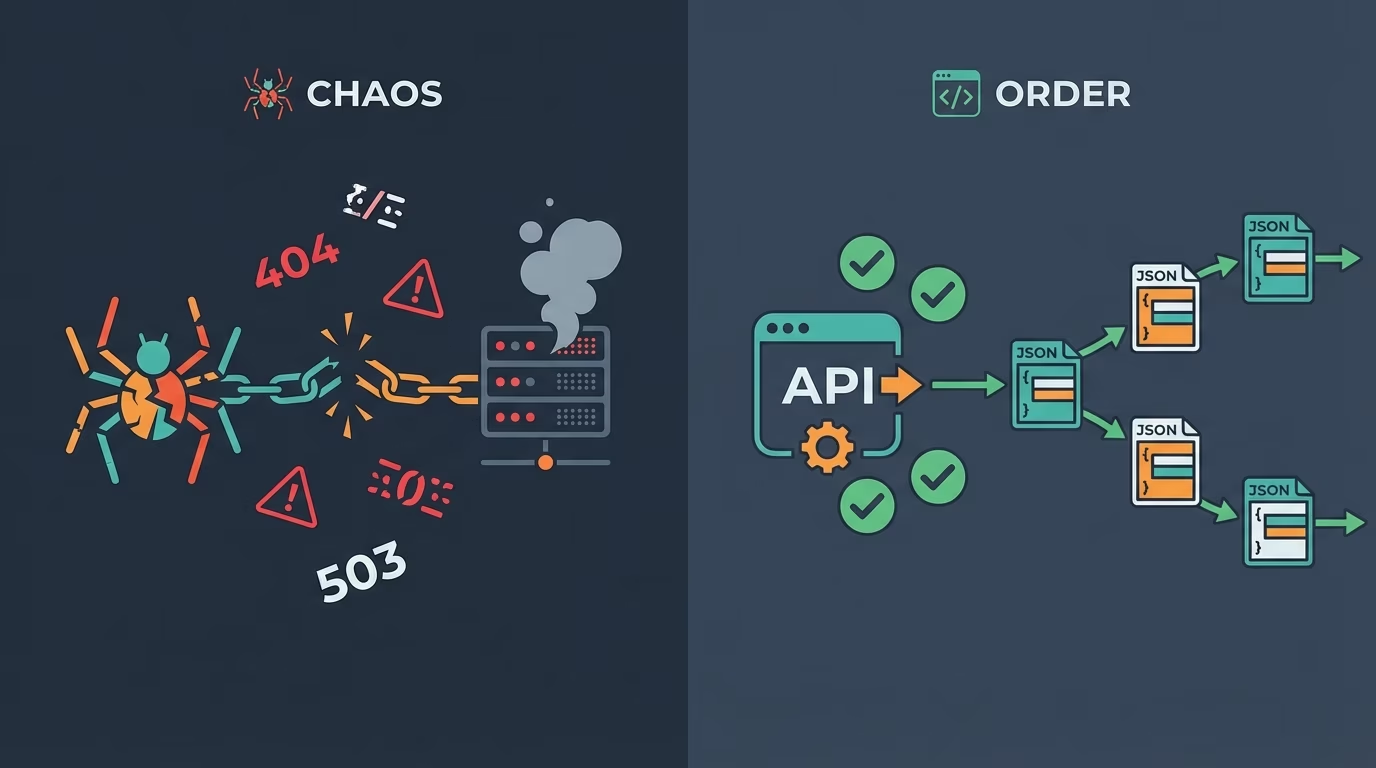
Legal ≠ Practical: Why Scraping Airbnb at Scale Fails
This is where the conversation shifts from what you're allowed to do to what actually works. In my experience, the legal question is a distraction. The practical barriers to scraping Airbnb data at global scale are far more prohibitive.
Anti-Bot Infrastructure
Airbnb runs sophisticated bot-detection systems. Requests must render JavaScript, maintain consistent browser fingerprints, rotate IP addresses through residential proxies, and solve CAPTCHAs. Scaling this beyond a few hundred listings requires significant infrastructure.
Proxy and Infrastructure Costs
Residential proxy services — required to avoid detection — cost $8–15 per GB of traffic. A single scraping pipeline covering one US city can consume 50–100 GB/month. At global scale (AirROI tracks millions of listings across 120+ countries), the proxy costs alone would exceed the subscription cost of most data providers.
Data Quality and Coverage
Scraping captures a snapshot. It doesn't tell you:
- Historical performance — occupancy rates, revenue trends, or ADR changes over time
- Estimated revenue — which requires algorithmic modeling, not just price extraction
- Booking status — Airbnb doesn't expose whether a listing is booked or blocked on its public pages
- Normalized comparisons — bedroom counts, property types, and amenities need standardization across millions of listings
Turning raw scraped HTML into structured, analytics-ready short-term rental data requires a full data engineering pipeline on top of the scraper itself.
Maintenance Burden
Airbnb redesigns its frontend regularly. Every time the HTML structure changes, scraping scripts break. Teams report spending 20–40% of their engineering capacity on scraper maintenance — time that could be spent building their actual product.
No Historical Depth
Even if you build a perfect scraper today, you start with zero historical data. Market analysis, trend detection, and revenue estimation all require months or years of longitudinal data. You can't scrape the past.
The Real Cost of DIY Scraping vs. Using an API
Here's the honest math for a team considering building their own Airbnb scraping pipeline versus using a data API:
| Cost Factor | DIY Scraping Pipeline | Data API (e.g., AirROI) |
|---|---|---|
| Proxy services | $500–5,000/mo | $0 |
| Cloud compute | $200–2,000/mo | $0 |
| Engineering time (build) | 2–4 months | Days to integrate |
| Engineering time (maintain) | 20–40% ongoing | 0% — API is maintained |
| Data coverage | Limited by capacity | Global, millions of listings |
| Historical data | Starts at zero | Years of historical records |
| Revenue estimates | Must build model | Included |
| Occupancy data | Inferred, inaccurate | Modeled from booking patterns |
| Legal risk | ToS violation, possible litigation | Licensed, compliant |
| Reliability | Breaks with site changes | 99.9% uptime SLA |
For a startup spending $3,000/month on scraping infrastructure and $8,000/month in engineering time allocated to maintenance, the cost comparison isn't close. A data API typically runs a fraction of that — and delivers cleaner, deeper, more reliable data.
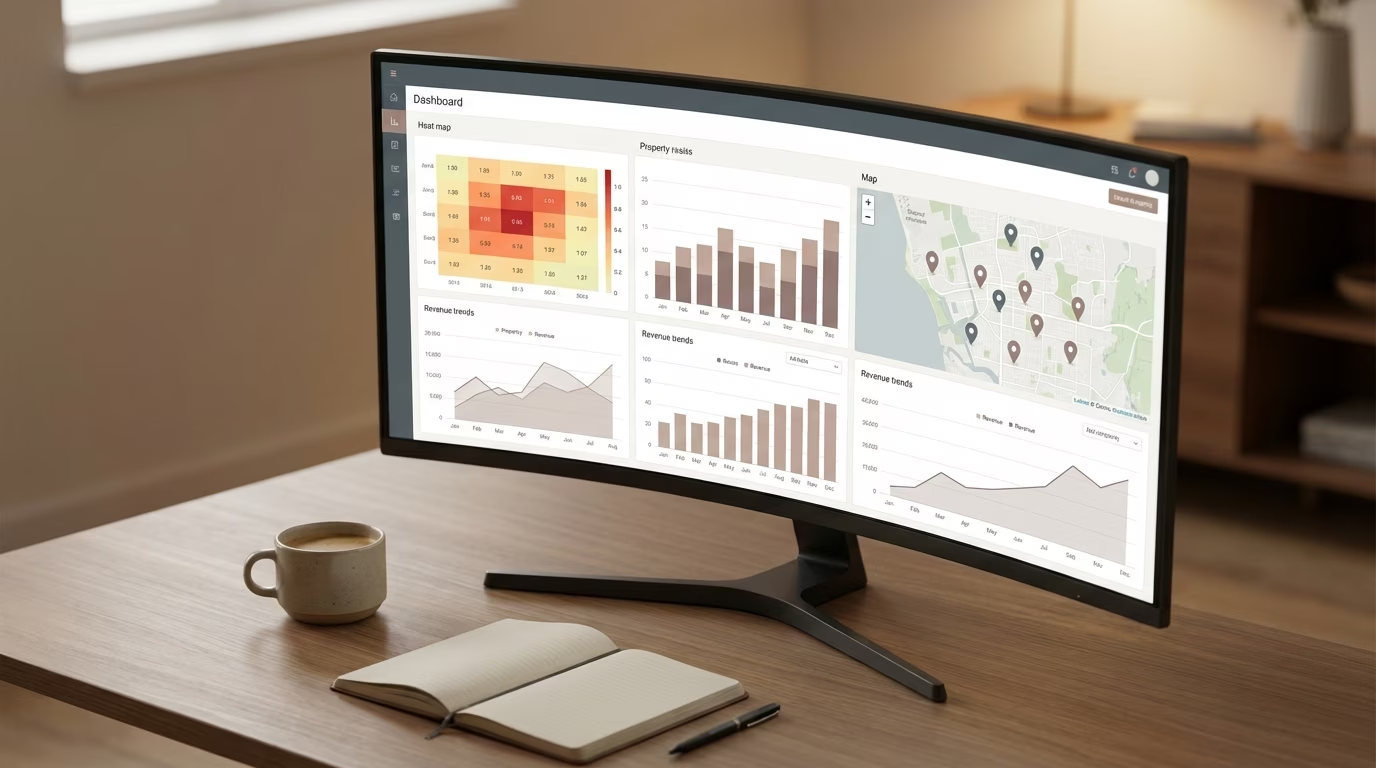
How Companies Legally Access Airbnb Market Data Today
The market for Airbnb market data has matured significantly. Companies no longer need to choose between "scrape it yourself" and "go without data." Several legitimate pathways exist:
Licensed Data Providers
Companies like AirROI maintain comprehensive short-term rental databases and serve Airbnb analytics through structured APIs. The data is curated, normalized, and enriched with proprietary models — so you get investment-grade analytics without building anything yourself.
AirROI's API provides:
- Global coverage — millions of active listings across 120+ countries
- Revenue estimates — algorithmic projections based on booking patterns, not just listed prices
- Historical trends — occupancy rates, ADR, and RevPAR over time
- Market-level analytics — search by location, viewport, or custom polygon
- Listing detail — amenities, reviews, host data, and comparable properties
- Pay-as-you-go pricing — no annual contracts or minimum commitments
Public Datasets
Airbnb's Own Partnerships
Airbnb selectively partners with governments and research institutions to share aggregated data. These partnerships are limited in scope and not available to commercial developers.
The Professional Approach
The teams building the most successful proptech products — property management platforms, investment analysis tools, market intelligence dashboards — have moved past the "can we scrape it?" phase. They use licensed data providers because the data is better, the integration is faster, and the risk is zero.
If you're evaluating how to get short-term rental data into your product, the decision tree is straightforward:
- Need structured, historical, global Airbnb data? Use an API like AirROI.
- Need city-level snapshots for academic research? Inside Airbnb is a solid free option.
- Building a one-off analysis for a specific market? AirROI's free Atlas tool provides market analytics without code.
- Determined to build your own pipeline? Understand the legal boundaries, budget for ongoing maintenance, and plan for the coverage gaps.
A Note on the AI Training Dimension
The legal landscape is evolving rapidly due to AI. The Reddit v. Perplexity AI case introduces the theory that bypassing technical barriers to scrape content for AI training may violate DMCA anti-circumvention provisions — a theory that wasn't relevant in the hiQ era.
If you're considering scraping Airbnb data to train machine learning models, this is an area where the law is actively being litigated. The safe path is to use licensed data with clear terms for derivative use.
Frequently Asked Questions
Scraping publicly visible Airbnb listing data — such as titles, prices, and photos viewable without logging in — is generally legal under US law following the hiQ v. LinkedIn and Meta v. Bright Data precedents. However, Airbnb's Terms of Service prohibit automated data collection, which means you could face a breach of contract claim, IP blocking, or account termination even if no criminal statute is violated.
Yes. While the CFAA likely does not apply to scraping public pages, Airbnb can pursue civil claims under breach of contract (Terms of Service), trespass to chattels (server burden), or state-specific computer access laws. The Meta v. Bright Data ruling showed that Terms of Service enforceability depends on whether the scraper is a "user" bound by those terms.
The Ninth Circuit ruled in hiQ v. LinkedIn that scraping publicly accessible data does not violate the Computer Fraud and Abuse Act because public websites have "no gates to lift or lower." The Supreme Court vacated and remanded the case, but the Ninth Circuit reaffirmed its position in 2022. This established the "gates-up-or-down" framework that remains the leading CFAA test for scraping cases.
Web scraping extracts data by parsing HTML from web pages, which is fragile, rate-limited, and can break when the site changes layout. An API provides structured data through authorized endpoints with consistent formatting, historical coverage, and guaranteed uptime. For Airbnb market analytics, an API like
The most reliable and compliant approach is to use a licensed data provider like AirROI, which offers a