
Minimum Stay

Key Takeaways
- Minimum stay is the threshold below which a guest's search will not surface your listing — it is both a revenue lever and a regulatory compliance tool
- Heavily regulated markets force far higher minimums: AirROI data shows New York at 25.8 median nights versus 2.1 nights in Gatlinburg, TN
- Every booking triggers one turnover cycle; the break-even minimum is your turnover cost divided by your nightly rate
- Seasonal rules and gap-night automation allow dynamic minimums without locking in a permanent low floor
- Dynamic pricing and minimum stay should be calibrated together — the two settings interact on RevPAR
How Minimum Stay Works
When you configure a minimum stay on Airbnb, Vrbo, or a channel manager, three mechanics activate simultaneously.
Search filtering. Guests searching for fewer nights than your minimum will not see your listing in results. A 3-night minimum makes the property invisible to travelers searching for 1- or 2-night trips — a meaningful segment in most urban markets.
Calendar gapping. Minimum stays create orphan nights: short windows between bookings that no guest can fill because the gap is shorter than the required minimum. A 3-night minimum leaves a Tuesday-Wednesday gap unbooked if guests have checked out Monday and check in Thursday. Gap-night rules (supported by most platforms) auto-reduce the minimum when only a short window remains, recovering those nights.
Turnover economics. Each reservation triggers exactly one turnover regardless of length. Seven 1-night bookings cost seven cleaning cycles; one 7-night booking costs one. The crossover point — where a longer minimum produces higher net revenue despite lower booking volume — is the property's break-even minimum stay: turnover cost ÷ nightly rate.
Minimum Stay by Market and Regulatory Regime
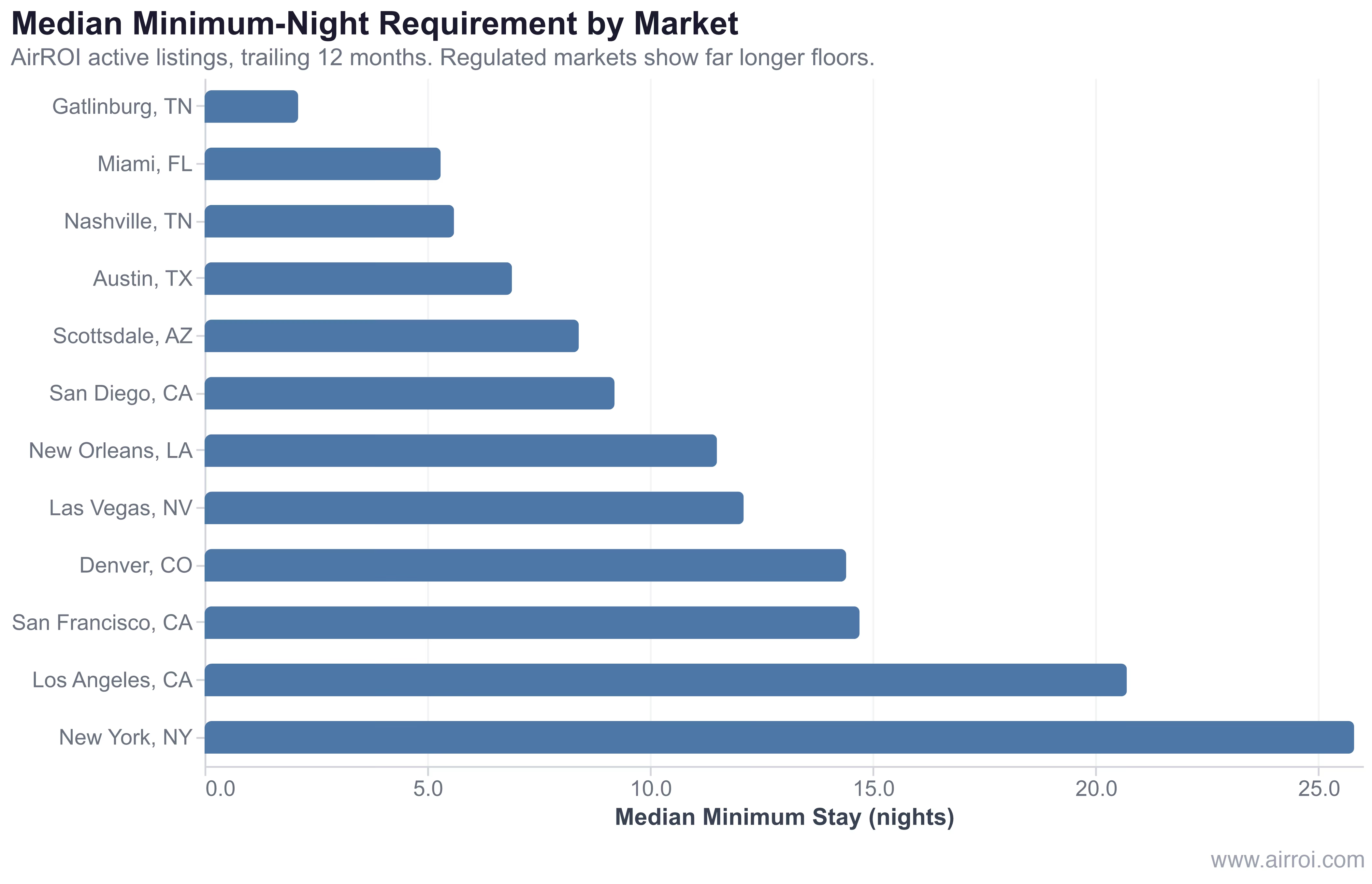
In AirROI's analysis of 78,458 active listings across 12 markets, the median minimum-night requirement ranges from 2.1 nights in Gatlinburg, TN to 25.8 nights in New York, NY — a 12-fold spread driven overwhelmingly by regulatory stringency, not guest preference. San Francisco's 14.7-night median and Los Angeles's 20.7-night median both reflect city-level registration requirements that functionally push operators toward longer stays. San Diego (9.2 nights), Scottsdale (8.4 nights), and Austin (6.9 nights) sit in a moderate middle band consistent with their permit-required but less restrictive regimes.
The minimum stay floor in any market is set more by local regulation than by host strategy. New York's 25.8-night median sits exactly where Local Law 18 forces it; Gatlinburg's 2.1-night median reflects a market free to optimize for revenue alone.
Minimum Stay Strategy by Property Type
| Property Type | Recommended Minimum | Primary Rationale |
|---|---|---|
| Urban apartment | 1-2 nights | High demand for business and weekend stays; low turnover cost |
| City condo (premium) | 2-3 nights | Reduces turnover cadence while preserving broad guest access |
| Beach / vacation home | 3-7 nights | Guests plan week-long trips; high cleaning and linen cost |
| Luxury estate | 3-5 nights | Premium nightly rate absorbs turnover; longer stays fit profile |
| Ski / resort property | 3-7 nights peak, 2 nights shoulder | Peak weeks fill at longer blocks; shoulder needs flexibility |
| Mid-term rental | 28-30 nights | Targets remote workers, traveling professionals, relocation |
Calculating Your Break-Even Minimum
The break-even minimum stay answers: at what stay length does a booking cover its own turnover cost?
Break-even nights = Turnover cost ÷ Nightly rate
A property charging $250/night with $100 in turnover costs breaks even at 0.4 nights — meaning even a 1-night stay is profitable. At $400 in turnover costs against the same nightly rate, break-even is 1.6 nights, suggesting a 2-night minimum. A luxury cabin at $600/night with $900 in linen, cleaning, and restocking costs breaks even at 1.5 nights — but the host likely sets 3 nights to protect weekday calendar structure.
This calculation should be run for every property and revisited when nightly rates or cleaning costs change materially.
Why Minimum Stay Matters for STR Revenue
Two tools make ongoing calibration practical. First, gap-night rules: automated platform settings that reduce your minimum to fill short windows between existing bookings. Second, seasonal override rules: higher minimums during peak periods when demand fills longer blocks, lower minimums during shoulder and off-peak when capturing any booking is preferable to leaving nights empty.
Frequently Asked Questions
The right minimum stay depends on your market's regulatory environment and property type. Urban properties in permissive markets typically perform best with 1-2 night minimums to maximize booking volume. Vacation homes in resort markets often set 3-7 nights to reduce turnover against high cleaning costs. AirROI data shows median minimums ranging from 2.1 nights in lightly regulated Gatlinburg to 25.8 nights in heavily regulated New York — confirming that regulatory context, not just preference, sets the floor.
Not automatically. A lower minimum increases booking flexibility and can lift occupancy, but each additional booking triggers one full turnover. Seven one-night bookings generate seven turnover cycles versus one seven-night stay with a single cycle — so net revenue depends on your nightly rate, cleaning fee, and actual turnover cost. The break-even calculation (turnover cost ÷ nightly rate) tells you the minimum stay length at which each booking is profitable.
Yes. Most platforms and property management systems support seasonal minimum-stay rules. The standard approach is a higher minimum (3-7 nights) during peak demand periods when longer blocks fill naturally, and a lower minimum (1-2 nights) during slow seasons to capture any available bookings. Gap-night rules — which let you reduce the minimum when only 1-2 nights remain between existing reservations — add a further layer of calendar efficiency.
Directly and substantially. Cities that restrict short-term rentals often do so through minimum-stay mandates rather than outright bans. New York's Local Law 18 effectively pushed hosts toward 30-night-plus stays, driving the city's median minimum nights to 25.8. San Francisco's strict registration rules produce a 14.7-night median. Lightly regulated markets like Gatlinburg record just 2.1 nights. Regulatory stringency is the single largest driver of how long the minimum stay floor sits.
A gap-night rule automatically lowers your minimum stay when a short window between existing bookings would otherwise remain unbooked. For example, if you have a 3-night minimum but only 2 nights are open between confirmed reservations, the gap-night rule drops the minimum to 2 so that window can be filled. Most major platforms and PMS tools support this setting, and it is one of the most effective ways to reduce calendar fragmentation without permanently relaxing your minimum.