San Juan's Established Airbnbs Now Book Fewer Nights Than Before Bad Bunny's Residency

A year after Airbnb credited Bad Bunny's residency with $560 million in economic impact for Puerto Rico, established San Juan rentals are booking fewer nights than they did before he played.
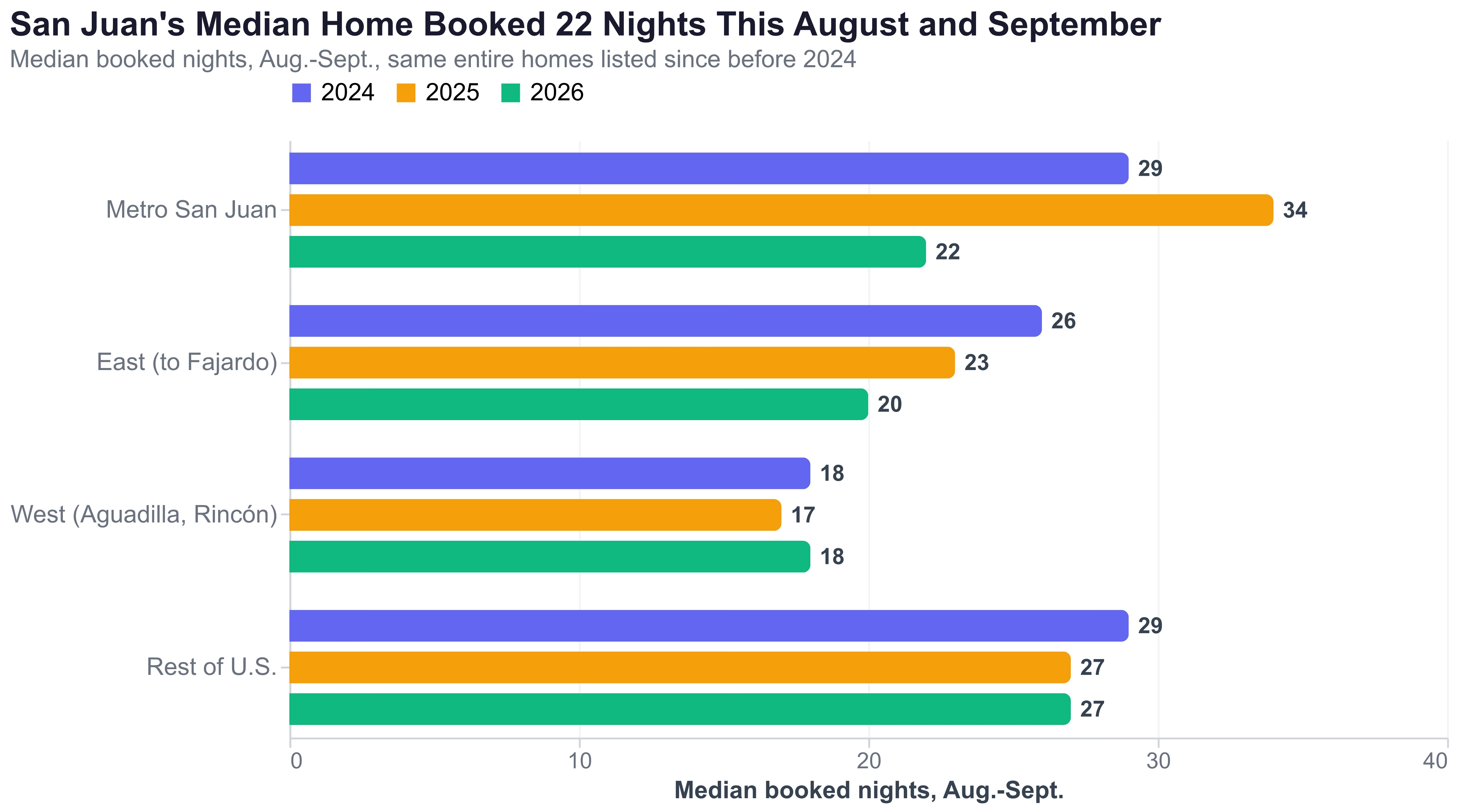
The median home booked 22 nights this August and September, down from 34 during the residency and 29 in 2024, according to AirROI, a short-term-rental data firm. The firm tracked about 2,000 entire homes in metro San Juan listed since before 2024. In the rest of the U.S., the same median slipped two nights and stayed there.
Total nights for these homes fell 18% from 2024, against 6% for similar U.S. homes, even though Ernesto left nearly half of the island's power customers without electricity that August and no named storm struck this August through October.
Counted across every entire home, including those added since, total metro nights still appear to be above 2024, spread across more homes. Nights per home fell about a fifth in the metro over those two years, against about a tenth elsewhere in the U.S.
A little under half of the nights these homes lost since last year only returned them to their 2024 level; the rest took them below it. That split matters to owners pricing a San Juan condo off residency-year numbers, and to lawmakers weighing rental rules while Discover Puerto Rico, the island's tourism marketer, reports rental nights up about 4% island-wide this year.
Bad Bunny came back, and the homes stayed far below last year's level. His tour closed the weekend of Aug. 22 at Hiram Bithorn Stadium, near the Coliseo that hosted the residency, with water rationing under way. A Visa analysis in El Nuevo Día had transactions during the closing concerts up 11% from a year earlier.
Established homes within about 3 miles of the Coliseo were 55% booked that Saturday, about level with a week earlier as homes outside the metro slipped. On visitor-show Saturdays in August last year, the area averaged about 78%.
Among the four areas below, only metro San Juan's median rose during the residency, and none lost as many nights afterward.
What the shows added
CoStar counts 31 shows at San Juan's Coliseo from July to late September last year, including a locals-only date added at the end. The first nine were for island residents only, and in July these homes showed no measurable lift, falling about as much as U.S. homes.
The lift came in August and September, after the shows opened to visitors. The same homes booked 16% more nights than a year earlier, while the rest of the U.S. booked 5% fewer. Homes in the island's east and west shared that storm-hit August and still fell, so a weak 2024 doesn't by itself explain the rise.
Discover counted a far bigger surge, 48% more San Juan metro rental nights that August, across all listings. In AirROI's data, homes added in the prior year took about a quarter of metro nights in those months, so most of that surge likely came from a market that had grown.
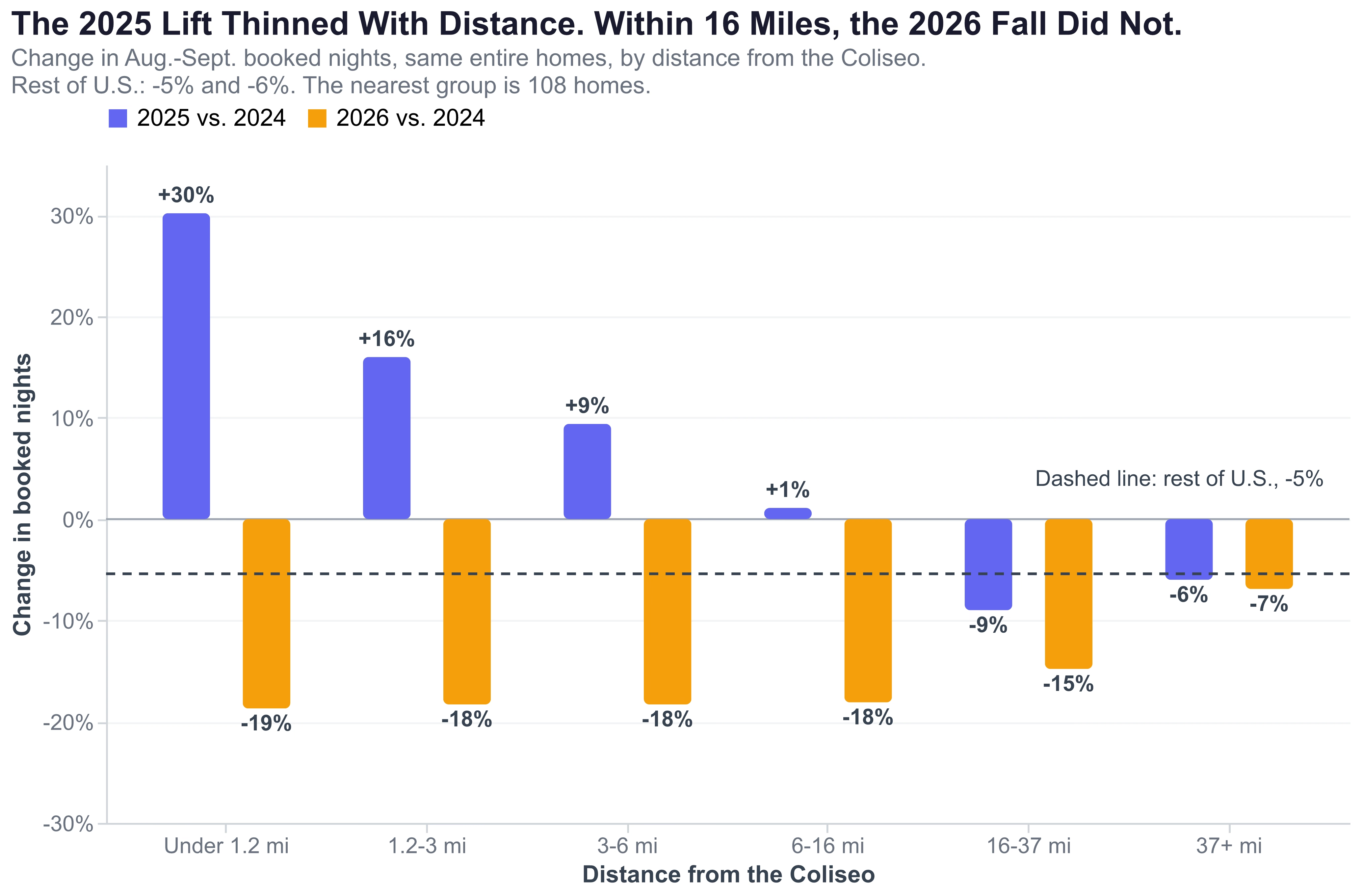
The gain thinned with distance from the Coliseo and was gone past about 16 miles. The nearest group, just 108 homes, rose 30%.
Airbnb's account reaches farther. News is My Business, relaying the company's data a year ago, said the surge "extended tourism spending to smaller towns and rural areas far from San Juan's usual hotel zones."
Far from San Juan, the same homes show no measurable lift against the U.S. Outside the metro, homes added in the prior year took about 18% of entire-home nights in those months, so newcomers may be part of what Airbnb saw.
Airbnb's headline number is an impact figure, which usually counts wider spending than host pay. Airbnb has since said hosts earned more than $458 million in all of last year, and AirROI's data show about $144 million booked across every room type on the island from July through September, at asking prices.
Other estimates run from $177 million in a University of Puerto Rico study to $733 million from Gaither International, Rolling Stone said last December. "The methodological approaches vary by study, which causes the estimates to vary," the first study's author, Indira Luciano Montalvo, told the magazine.
Below the 2024 line
Inside 16 miles of the Coliseo, the lift ran from 30% to almost nothing, yet every group finished at least 18% below 2024. The shortfall shrinks only farther out, reaching about the U.S. rate beyond 37 miles. So it doesn't track the residency's lift, and it is centered on the San Juan area.
In August and September nights, Santurce rose most among San Juan's districts, fell most and still finished closest to 2024.
| Area | 2025 vs. 2024 | 2026 vs. 2025 | 2026 vs. 2024 |
|---|---|---|---|
| All metro San Juan | +16% | -29% | -18% |
| Condado-Ocean Park | +17% | -30% | -17% |
| Isla Verde-Punta Las Marías | +13% | -30% | -21% |
| Hato Rey-Río Piedras | +13% | -28% | -19% |
| Old San Juan | +9% | -25% | -18% |
| Santurce | +31% | -35% | -15% |
| East (to Fajardo) | -5% | -13% | -17% |
| West (Aguadilla, Rincón) | -7% | +2% | -5% |
| St. Thomas and St. John | -8% | -26% | -32% |
| Rest of U.S. | -5% | -1% | -6% |
Old San Juan, the district that fell least from last year, also held up best in AirROI's year-long look at Puerto Rico homes.
Nearly three in four metro homes booked fewer nights than a year earlier, against fewer than half elsewhere in the U.S.
Size offered no shelter, with every bedroom count at least 16% below 2024 and homes with four or more bedrooms never rising.
The median fell 12 nights from a year earlier, out of 61 on the calendar. That is about $2,400 at asking prices.
Established homes around Aguadilla and Rincón finished in line with the national dip.
The east as a whole, from eastern Carolina to Fajardo, never got a lift and still finished almost as far below 2024 as San Juan.
On St. Thomas and St. John, with no residency to lose but a declared drought of their own, established homes finished farthest below 2024.
October 2025 was already soft across the island, with established metro homes 13% under 2024. They beat the U.S. pace again that November. This October sits only a little under that low point but 16% under 2024, against 4% for the U.S.
Asking rates for August through October trailed the rest of the U.S. by about 4.5 points at the median. Occupancy for those months, the share of open nights booked, fell from 47% to 36%, against about 45% elsewhere in the U.S.
A drought, an airline, more homes
The return to the 2024 level is arithmetic. The rest has suspects and no proof. From January through April these homes beat the U.S. pace against that year. They slipped in May and have trailed it since.
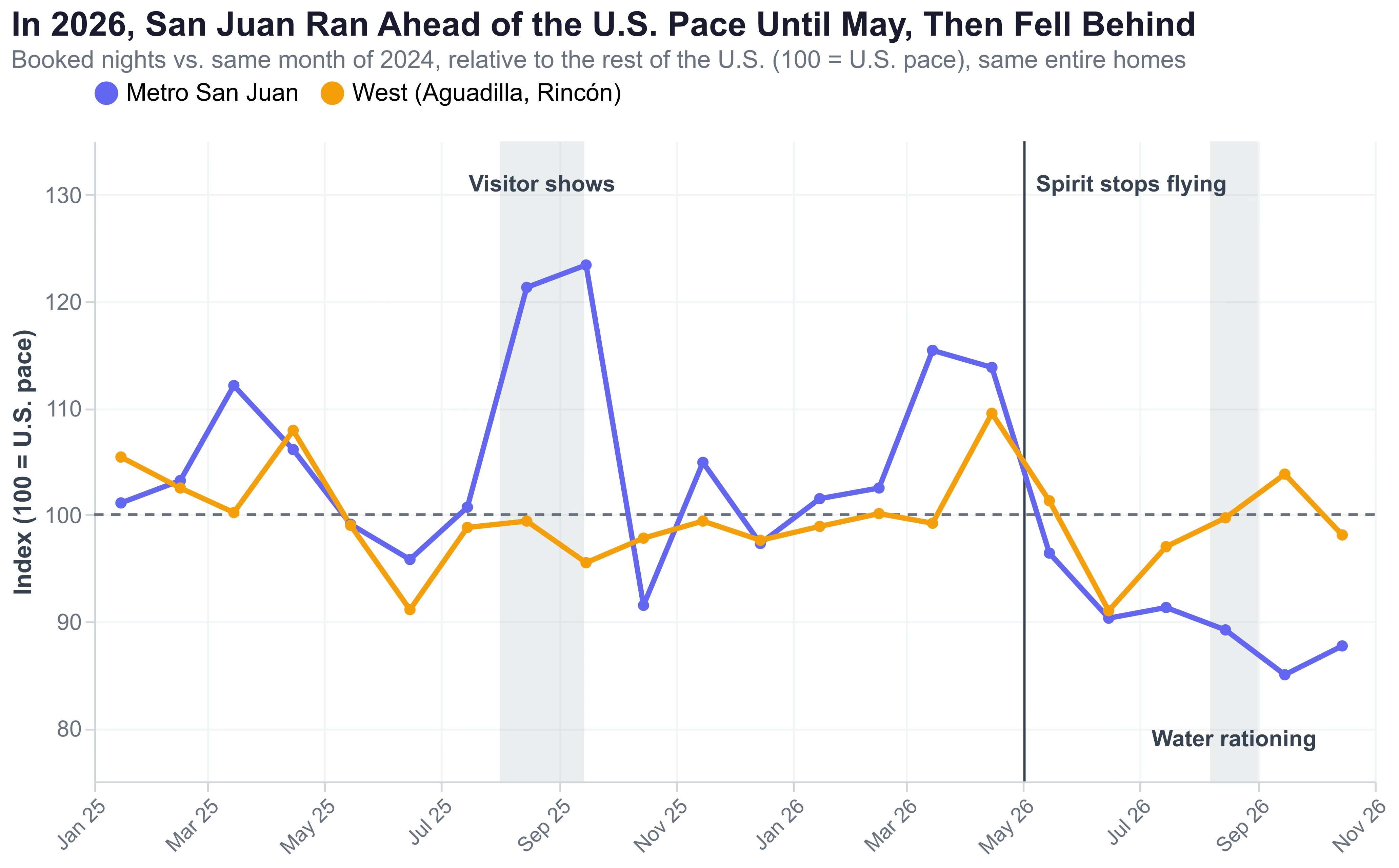
Spirit Airlines stopped flying in early May, the month the slide began. Discover's October report calls the closure "the largest drag on arrivals," with 246,000 fewer passengers through September. But San Juan's arrivals were already lower from January through April, when these homes ran ahead. And San Juan's September arrivals rose while these homes stayed about 15% below 2024.
A series of aqueduct failures in June cut service to more than 100,000 metro-area customers, and July was San Juan's driest month on record. From early August, rotating cuts hit more than 180,000 customers in San Juan and neighboring towns. The governor paused them at the start of September, and later that month the water authority said none were running.
"If you're having trouble sleeping at 4 am, you check the faucet," Norma Peña, who lives in a central San Juan condo building, told NPR in August.
In mid-August letters carried by Metro Puerto Rico, Airbnb told officials that hosts faced cancellations and refunds and asked for aid.
From last year, metro homes fell most and eastern homes less while western homes rose slightly, though some towns outside the cuts also trailed. The shortfall also opened before the cuts, and October was still about as far under.
"If you're in a large resort, if you're staying with a chain, the effect on you is marginal," Emilio Pantojas, a University of Puerto Rico researcher, told USA TODAY in August.
Total metro nights fell about 16% from last year while U.S. totals and those around Aguadilla and Rincón rose, so newcomers can't explain all of the established homes' fall.
Against 2024 they matter more. Homes created since September of that year are 45% of active homes in the San Juan-Isla Verde core and took about the same share of its nights. The share of homes is 30% around Aguadilla and Rincón and 42% in the rest of the U.S., where established homes fell far less.
Discover's five-month pace report, September through January, has available listing nights in San Juan city slightly below last year on average.
The island's other number
Discover counts 6.4 million hotel and rental nights across the island through September, up about 4.5%. In September alone, its count had rental nights up 1% and hotel room nights down 6.5%.
"We aren't growing simply because everyone else is; rather, we are growing because other destinations have been declining," Laressa Morales, Discover's senior director of research, said in W Journal in October.
Its count takes in every hotel and home on the island over nine months. AirROI's figure follows established homes in one metro over two.
Rental nights on the books across the island ran 19% ahead of last year for November and 24% ahead for December as of mid-October, Discover's October report says.
The bill with no hearing
Two bills sit in the same House committee, and whichever moves would govern a market with more homes splitting the nights.
The Puerto Rico Hotel & Tourism Association will push for uniform regulation of short-term rentals, El Nuevo Día reported in late October.
"As is required of a hotel, the same should be required of what they call 'Airbnb,'" Ángel Rodríguez, owner of Parador Boquemar in Cabo Rojo, told The San Juan Daily Star in early October.
Hosts back House Bill 1518, filed last month and referred days later to the Tourism Committee. It would create one registry at the Tourism Company and send half of the 7% rental room tax to towns. René Acosta, president of the Viva Puerto Rico host alliance, said in News is My Business that hosts have asked for such rules for years.
"We are families, retirees and small business owners who live off receiving visitors in our towns," Glenda Sánchez Pérez, who leads a host group in the island's east, said in El Vocero in late October.
The rival, Senate Bill 238, would order every town to keep a registry and license hosts each year, on San Juan's model, and give towns one point of the tax. It passed the Senate 17-7 a year ago and has sat in the committee ever since.
The legislature's records list no hearing on the House bill since its referral. The session is set by statute to end Nov. 17, unless extended. One bill would give towns half the room tax and make the Tourism Company a Condado owner's only registry; the other would give them one point of it and take San Juan's yearly license to every town.
About the data: Booked nights on Airbnb for entire homes, excluding monthly-minimum rentals, listed since before 2024 and still live in October 2026. Metro San Juan runs along the north coast from Levittown to Isla Verde, by map coordinates. Rates are asking prices.
Frequently Asked Questions
CoStar's account has 31 shows: every Friday through Sunday at the Coliseo in San Juan from July 11 to Sept. 14, 2025, and a locals-only show on Sept. 20. The first nine were open to island residents only. El Nuevo Día's count of 30 ran through Sept. 14.
No study has divided the decline. Among homes listed since before 2024, a little under half of the fall from last year only returned them to their 2024 level. Spirit Airlines' closure on May 2, summer water rationing and new listings are the suspects for the rest, and each matches only part of the calendar or the map.
It can be, though only the gross is easy to measure. The median entire home listed all year grossed $27,589 on Airbnb in the year through September 2026, before fees, running costs and any mortgage. The breakdown by town and size is in AirROI's look at whether Airbnb is profitable in Puerto Rico.
Filed Oct. 15, it would put every host in one registry at the Tourism Company, apply the same rules in all municipalities and send half of the 7% rental room tax to towns through the municipal revenue center, CRIM. Senate Bill 238, the rival, would order every town to keep a registry and issue yearly licenses. As of Nov. 4, 2026, the House bill sat in the Tourism Committee with no hearing listed.