A 75% Occupancy Rule Fails Four in Five U.S. Airbnb Homes That Out-Earn Neighbors

The 75% occupancy floor in a lender's rule for screening Airbnb purchases would turn away most of the U.S. homes that earn the most in their neighborhoods.
The typical U.S. entire home booked 42% of the nights it was open to guests in the year through August, according to AirROI, a short-term-rental data firm, which tracked about 677,000 working entire-home Airbnb listings, those open to guests at least half the year and booked recently. By that yardstick, a good Airbnb occupancy rate, one that beats three in four homes, starts at 58%. Only about 7% reached 75%.
Those figures count only the nights a host left open. Measured against every night of the year, the typical home booked 39%. CoStar's figures show that U.S. hotels, which are open every night of the year, filled 62% of their rooms in 2025.
The gap reaches beyond hosts. Buyers use rules of thumb to judge which houses to buy, and lenders to decide which to finance, and they are doing so as hosts reprice.
Since mid-September, most U.S. hosts pay Airbnb a single 15.5% service fee, which Chief Financial Officer Ellie Mertz said on the company's August earnings call puts "a kind of downward pressure on pricing."
Park Place Finance, a lender that finances investment properties, laid out the 75-55 rule in an April post. A short-term rental, it said, "should achieve at least 75% occupancy at a rate no less than 55% of the market average nightly rate to be considered viable."
Graded against a year of bookings, the rule passes about 7% of working entire homes that have at least 30 comparable homes nearby, meaning homes in the same small area and size group.
The price half barely matters: almost every home charges at least 55% of what similar homes nearby typically get, so in practice the rule works as an occupancy screen.
Neither full-time nor professional hosting makes the 75% bar common. Homes open at least 300 nights a year reached it at the same rate as all working homes, and fewer than one in 20 professionally managed homes did. Even among Superhosts, about one in 12 did.
Homes that pass the rule do earn more. More than nine in ten out-earned the local median for their size, and their median revenue ran about 60% above it.
Yet of the homes in the top quarter by revenue among comparable homes nearby, four in five fell short of 75% occupancy over the year. Their median was 61%.
Homes booked on roughly three in five of their open nights, well short of the rule, still earned about 30% more than the local median.
Lenders say the caution is deliberate. RCN Capital, a nationwide lender on rental properties, wrote in July that short-term rentals "have more variability in occupancy due to seasonality and local regulations, leading many lenders to take a more conservative approach to income assumptions."
Park Place makes a similar case. A property that pencils out only at near-full occupancy and peak rates, its post says, is "a much riskier collateral position" than one that works at the rule's thresholds.
Same label, different math
The 75-55 label means something else to Sean Rakidzich, an Airbnb operator and coach. In a May post, Rakidzich called it a pricing discipline: "hold 75% of your calendar nights at your target average daily rate without discounting," with a floor under every night.
Park Place's formula is far looser than its thresholds. Multiplying the two gives a revenue bar worth about 41% of a year booked at the market rate, and nearly half of all the homes tested cleared it.
The post does allow for exceptions. In "urban cores," Park Place writes, "average occupancy routinely runs above 80%," and the rule "may be unnecessarily conservative."
In the dense city cores of places like Nashville, Chicago and New Orleans, the typical entire home booked just under half its open nights. About 6% reached 80%.
What good looks like, by market
In no kind of market does the typical home come near the rule's line. Even in city cores, where homes fill the most nights, the top tenth starts around 76%, and it starts lower everywhere else.
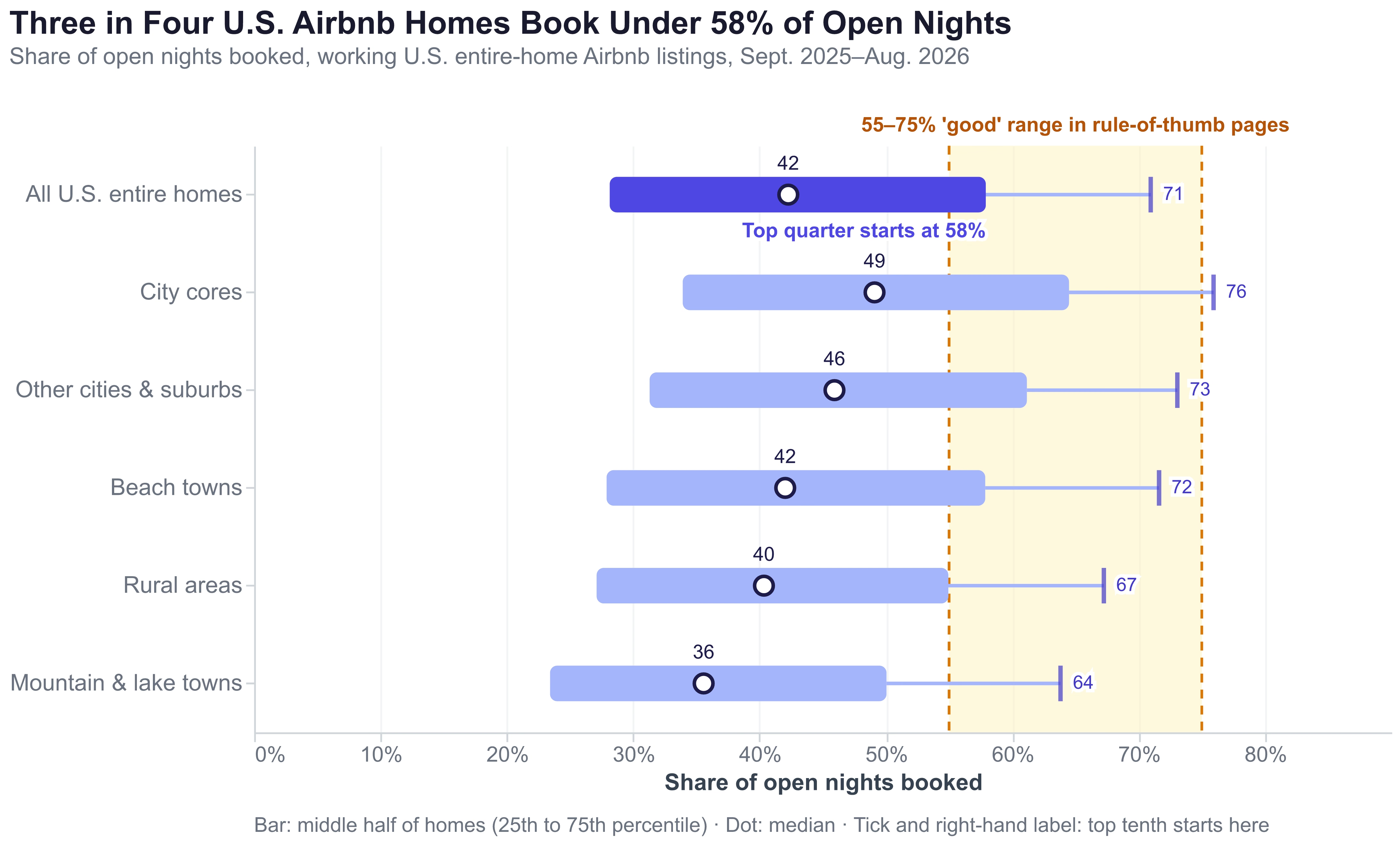
What counts as good depends on place and size. In the table, the top-quarter line for each kind of market runs from 50% in mountain and lake towns to 64% in city cores, and it falls as homes get bigger.
| Home type | Typical home | Top quarter starts | Top tenth starts |
|---|---|---|---|
| All U.S. entire homes | 42% | 58% | 71% |
| City cores | 49% | 64% | 76% |
| Other cities and suburbs | 46% | 61% | 73% |
| Beach towns | 42% | 58% | 72% |
| Rural areas | 40% | 55% | 67% |
| Mountain and lake towns | 36% | 50% | 64% |
| Studio or one bedroom | 45% | 62% | 75% |
| Two bedrooms | 43% | 59% | 72% |
| Three bedrooms | 41% | 56% | 68% |
| Four or more bedrooms | 40% | 54% | 67% |
| Private room (for comparison) | 35% | 52% | 68% |
A two-bedroom home in a beach town such as Destin or Myrtle Beach joins its group's top quarter at 59%. A house with four or more bedrooms in a mountain or lake town such as Gatlinburg or Big Bear gets there at 48%.
A studio or one-bedroom in a city core at 50% sits just below the middle of its group.
Rakidzich's occupancy scale, on the same website, also sits above the data. "Below 50%: Your listing has a problem," it reads. More than three in five working U.S. entire homes fell below that line.
The scale calls 65% to 75% the "market average for most competitive markets." Even in city cores, about a quarter of entire homes reached 65%, against about one in six nationally.
Avery Carl, who runs The Short Term Shop, a brokerage that specializes in short-term rentals, and self-manages a portfolio of them, told CNBC in August that two identical homes in the same neighborhood can generate "wildly different income numbers" depending on how they are managed.
The fullest homes still earned more
Rakidzich also warns about the opposite failure. "If you are above 85% occupancy consistently, you are losing money," his occupancy page says, and it tells hosts to raise prices until occupancy drops.
The year's bookings don't show that penalty. Among homes with enough neighbors to compare, revenue rose with every step up in occupancy. Homes booked on 85% or more of their open nights earned the most of any group, about 3% more than the next-fullest group. They charged about 5% less per night than comparable homes nearby, as Rakidzich's underpricing warning would predict. The comparison shows what those homes earned at the prices their hosts chose, not what they would have earned at higher ones.
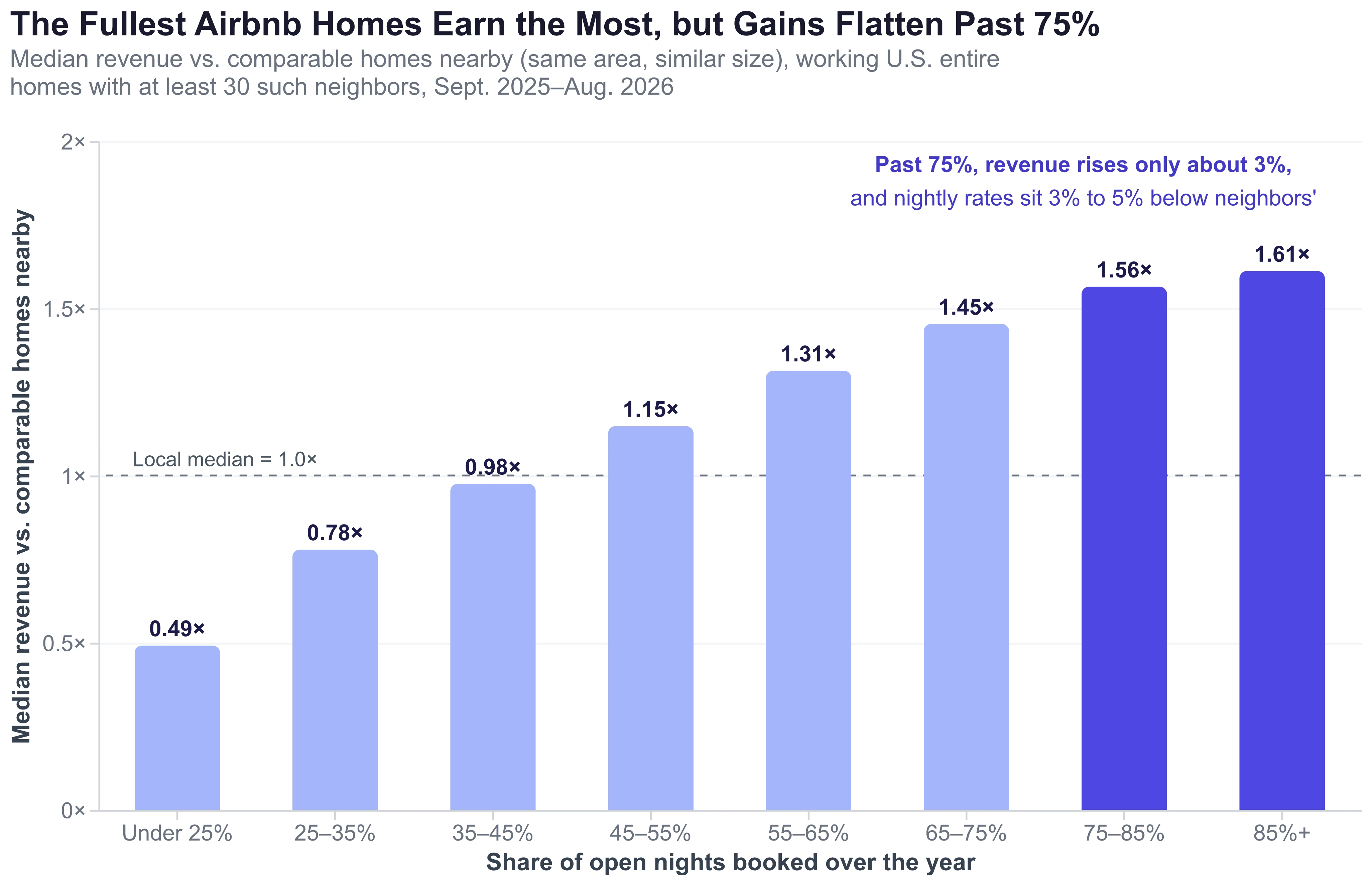
The flattening differs by place. In city cores, the two fullest groups earned the same. In mountain and lake towns, the fullest homes kept pulling ahead.
Airbnb argues that hosts who price more competitively make more money, a view at odds with coaches who preach rate protection. "The best thing we can do is show hosts that if they were at a better price for listings, then they will make more money," Chief Executive Brian Chesky said on the August earnings call, adding that the company is "essentially building an entirely new pricing model."
The 80/20 rule, read two ways
Hosts trade a second rule with two meanings. Uplisting, which sells property-management software, says in a January guide that "about 80% of bookings or revenue usually comes from 20% of listings."
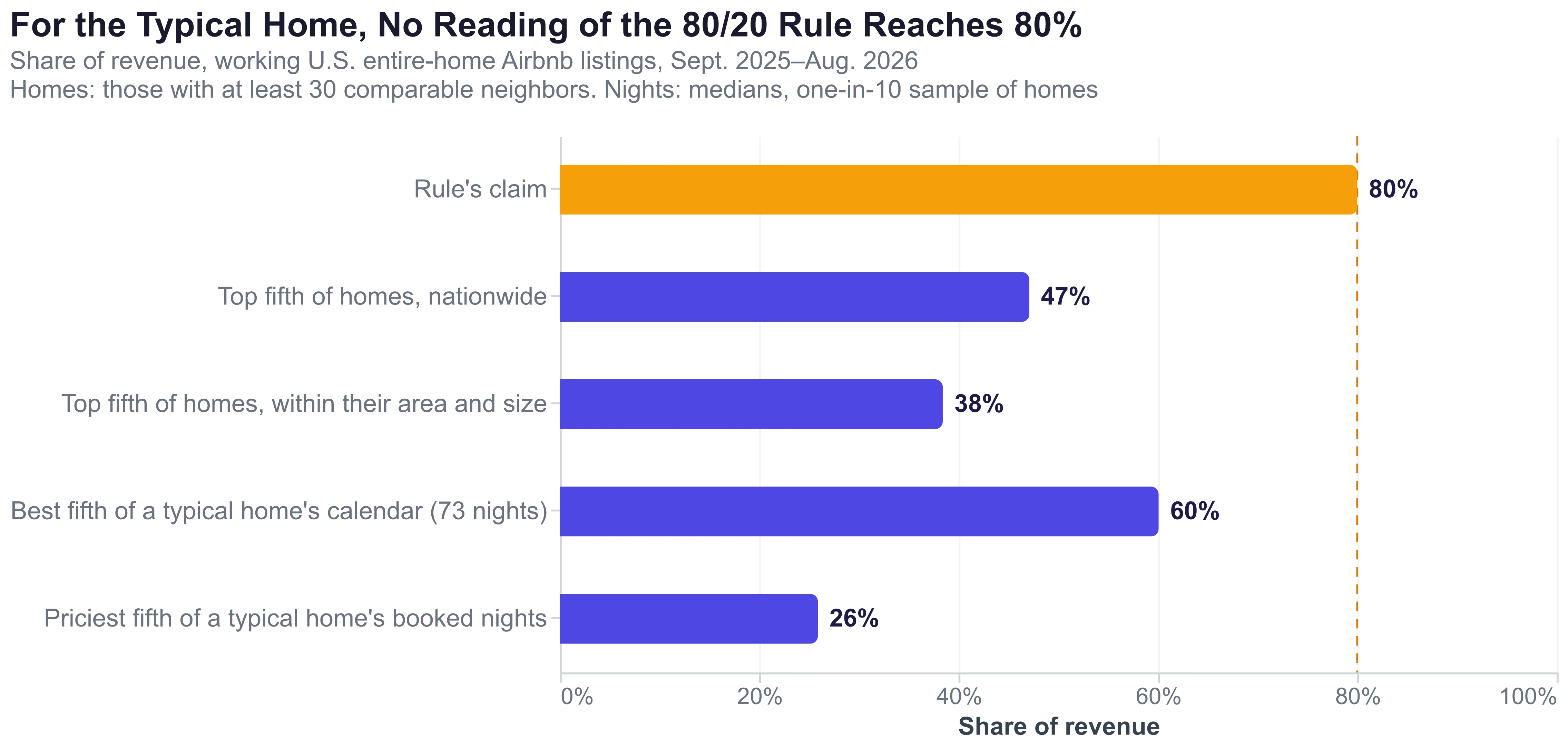
Among homes with enough comparable neighbors to rank, the top fifth earned 47% of revenue nationwide, and 38% when ranked only against similar homes in the same area. Part of the national gap is size: across all working homes, the typical home with four or more bedrooms took in nearly three times as much over the year as a studio or one-bedroom.
In the same May post, Rakidzich reads the rule inside a single listing: "roughly 80% of your revenue comes from 20% of your nights, usually peak weekends and holidays."
In a sample of one in every ten working homes, the priciest fifth of a typical home's booked nights brought in about a quarter of its nightly revenue, and no home reached four-fifths on that count. Counting a fifth of the whole calendar instead, the typical home's 73 best nights brought in about 60%.
A lender's warning to buyers
Chris Dickey, who rents out and self-manages a three-bedroom house in Moab, Utah, told CNBC in August that "there are a lot of amateur Airbnb owners who fail to fully do their homework before buying an STR property."
Park Place's post makes a similar point. "If the numbers only work at higher occupancy or higher rates, you're underwriting on optimism rather than investment discipline," it says.
The post still sets the bar at 75%.
About the data: Working homes: U.S. entire homes listed all year, minimum stay under 28 nights, open 180+ nights, booked 30+ nights including one in the past 90 days. Market types group nearby listings by density and beach, lake, ski, cabin and apartment shares.
Frequently Asked Questions
The label covers two different rules. Park Place Finance, a lender, uses it to screen purchases: a home should book at least three-quarters of its nights at a rate no lower than 55% of the market average, while coach Sean Rakidzich uses it for pricing, holding three-quarters of calendar nights at a target rate with a hard discount floor. About 7% of working U.S. entire homes with enough comparable neighbors to test met the lender's version in the year through August 2026.
It holds that a fifth of something brings in four-fifths of the money, either a fifth of listings or a fifth of a home's nights. Across U.S. entire homes with enough comparable neighbors to rank, the top fifth took in 47% of revenue in the year through August 2026. Within a typical home, the priciest fifth of booked nights brought in about a quarter of nightly revenue, and even its best fifth of calendar nights brought in about 60%, short of four-fifths either way.
Usually, yes: more than three in five working U.S. entire homes book fewer than half of the nights they are open. In a mountain or lake town, 50% sits right at the top-quarter line, while for a studio or one-bedroom in a dense city core it falls just below the middle. Whether it pays depends on the home's costs and its break-even occupancy.
U.S. entire homes listed for five to seven months booked a median of about 31% of their open nights in the year through August 2026. Established homes held to a similar, looser activity test booked about 40%, a little under the benchmark for year-round homes.