Local Airbnb rules2026 17 sources cited
Is Airbnb Legal in Ann Arbor? 2026 Rules, Permits & Taxes
Airbnb is legal in Ann Arbor with a $500-a-year city license; in residential zones only a host's principal residence qualifies. Council directed a six-month pause on new licenses on July 20, 2026.1,8,9,10
From 16 official sources and 1 Airbnb help page. Not legal advice.
The short answer
Ann Arbor Airbnb Rules in Brief
- License required for every unit: $500 per unit per year, renewed annually; review takes up to 21 business days.
- Residential zones: principal residence only (the owner, or a tenant with the owner's permission); no accessory dwelling units.
- The license number and maximum occupancy must appear in every ad; occupancy is 4 people plus their children, or 6 in multiple-family and mixed-use zones.
- Fine of up to $500 plus costs, and each day is a separate violation; Airbnb collects Michigan's 6% use tax.
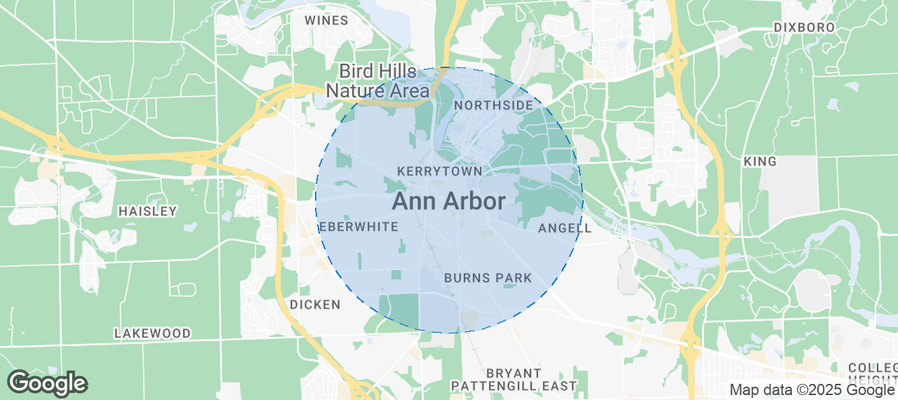 Browse the live Ann Arbor Airbnb market See Every Ann Arbor Listing
Revenue, occupancy and nightly rates are in the Ann Arbor Airbnb market report .
At a glance
Ann Arbor Airbnb Rules at a Glance
- License required
- Yes
- Taxes on a stay
- 6%
- Fine for hosting without a permit
- Up to $500
- Listings showing a permit number
- 0%
- Latest rule change
- Jul 20, 2026
Listing figures: AirROI, 12 months to September 2026. A number on a listing doesn't prove the permit or license is valid, and a missing one doesn't prove there is none.
The rules in brief
The rules an Ann Arbor host meets first, each linked to the ordinance, statute or official page it comes from. Details and exceptions follow below.
| Topic | Rule |
|---|---|
| Permit | License required for every short-term rental1,8 |
| Who can host | Residential zones: principal residence only8 |
| Where | Rentals the host does not live in: mixed-use zones only1,2,9 |
| Minimum stay | Stays of 30 consecutive days or less9 |
| Guests | Occupancy: 4 people plus children, or 6 in multi-family9 |
| Listing display | License number and occupancy in every ad1,8 |
| Safety | Inspections for non-principal rentals only9,11 |
| Neighbors | Two contact persons1 |
Your home
Can You Host an Airbnb in Ann Arbor? It Depends on the Home
Whether you can host in Ann Arbor turns on whose home it is and whether you live there.
Your own home, rented whole while you're away
Allowed with conditionsAllowed with a Principal Residence Whole House license at $500 a year, backed by a sworn statement that the home is your principal residence. The home is not inspected, and new applications are the ones a pending pause would affect.1,8,9,12
A second home or investment property in a residential zone
Not allowedNot licensable. In zones starting with R only principal residences can apply, and non-principal rentals are issued licenses only in mixed-use districts; commercial rentals established before March 1, 2021 may continue as a legal nonconforming use.1,8,9
An accessory dwelling unit (ADU)
Not allowedAccessory dwelling units cannot be used as short-term rentals, and any application found to be for one is denied.8
Permit
Do You Need a Permit for Airbnb in Ann Arbor?
Yes. Short-term rental hosts in Ann Arbor need the short-term rental license from the City of Ann Arbor Rental Housing Services (Building, Rental and Inspection Services). It costs $500 in the first year ($500 per unit for the first year and again at each annual renewal; a rental the host does not live in also pays the city's rental inspection fees for its Certificate of Compliance.) and $500 a year to renew.1,8,9,10
- Who needs it
- Every owner or permanent resident who rents a dwelling unit for 30 consecutive days or less, with one license for each unit.1,8,9,10
- Issued by
- City of Ann Arbor Rental Housing Services (Building, Rental and Inspection Services)
- Valid for
- One year from the date of issuance, renewed every year; the sworn statement of principal residency is renewed within 30 days of each anniversary. The license cannot be transferred to another person or address.
- Processing
- Review can take up to 21 business days.
- On listings
- The number must appear on every listing
- Platform checks
- The ordinance requires the license number and maximum occupancy in every advertisement; the city's licensing pages describe no verification step run by the booking platforms.
Fees
| Fee | Amount |
|---|---|
| STR licensePaid in advance through the city's STREAM portal before review starts; not refunded if the application is denied. The fee covers police, treasury, customer service and rental review, and the certificate to post on site. | $500 |
Who qualifies
- Issued only to the owner or the permanent resident of the property; companies and other third parties cannot apply
- In residential zones (zones starting with R) only a principal residence qualifies, backed by a sworn statement of principal residency
- A tenant can hold the license only if the tenant lives there as a permanent resident (lease longer than 30 days) and has the owner's permission
- A home the host does not live in can be licensed only in a mixed-use zoning district, and needs a valid Certificate of Compliance first
- Accessory dwelling units cannot be used as short-term rentals and applications for them are denied
How to apply
- Check the zoning: in residential zones only a principal residence can apply; for any other home check the city's Unified Development Code short-term rental use table for permitted zones.
- For a home the owner does not live in, first obtain a Certificate of Compliance through Rental Housing Services in STREAM.
- Apply and pay online in the city's STREAM portal under the license tab: choose short term rental license, then Principal or Non-Principal property.
- Upload the Sworn Statement of Principal Residency with a principal-residence application, and give two contact persons.
- Wait for review, which can take up to 21 business days, then include the license number and maximum occupancy in every advertisement.
Applications go through the official application page .
Permit rules
- No statewide license
- Michigan has no statewide short-term rental license or registry, so Ann Arbor's city license is the only permit a host needs for hosting itself.15
- License required for every short-term rental
- Short-term rentals are prohibited in Ann Arbor unless the city has issued a license for the unit; the requirement has applied since Chapter 97 took effect on March 1, 2021.1,8 In force since March 1, 2021
- One license per unit
- A property with several units for rent needs a separate license, and a separate $500 fee, for each unit.8
- Annual renewal and sworn statement
- Each license is renewed every year, one year from the date of issuance, and the licensee files a new sworn statement of principal residency within 30 days of the anniversary.1,8 In force since March 1, 2021
- License cannot be transferred
- The license cannot be transferred or assigned to another person or address, and it authorizes only the person named on it.1 In force since March 1, 2021
- License number and occupancy in every ad
- Every advertisement for a short-term rental must show the license number and the maximum occupancy permitted in the unit.1,8 In force since March 1, 2021
- Pause on new licenses directed, not yet in force
- On July 20, 2026 City Council directed the city attorney to prepare an ordinance for a six-month moratorium on new licenses while renewals for compliant rentals continue; the pause takes effect only if council later adopts that ordinance.12 Applies to: New license applications
Who can host
Who Can Host an Airbnb in Ann Arbor, and Where
Michigan state law applies on top of Ann Arbor's own rules: the Michigan short-term rental regulations page covers the state license and what cities and counties can and can't regulate.
- Owner or permanent resident only
- The city issues a license only to the owner or the permanent resident of the property, and only one license per dwelling unit.1 In force since March 1, 2021
- Residential zones: principal residence only
- In residential zoning districts (zones starting with R) only a principal residence can be licensed, and the host uploads a sworn statement of principal residency with the application.8 Applies to: Residential zones · In force since March 1, 2021
- What counts as a principal residence
- The city looks at factors such as whether the home has a Principal Residence Exemption for property tax, where the resident votes, and the address on the resident's driver's license, tax returns and bills.9
- Tell the city if the home stops being your residence
- The sworn statement obliges the host to notify Rental Housing Services promptly if the dwelling ceases to be the host's principal residence.10 Applies to: Principal-residence licenses
- Rentals the host does not live in: mixed-use zones only
- Licenses for non-principal-residence (commercial) short-term rentals are issued only in mixed-use zoning districts, and these rentals need a Certificate of Compliance and are subject to inspection under the Housing Code.1,2,9 Applies to: Non-principal rentals · In force since March 1, 2021
- Commercial rentals established before March 1, 2021
- A commercial short-term rental established before March 1, 2021 may continue as a legal nonconforming use, even in a residential zoning district.9 Applies to: Pre-2021 commercial rentals · In force since May 23, 2021
- Accessory dwelling units excluded
- Accessory dwelling units cannot be used as short-term rentals, and an application found to be for one is denied.8
- Management companies cannot apply
- Third-party companies cannot apply for a license under any circumstances; the permanent resident or owner must hold it, and a tenant needs the owner's permission.8
Operating rules
Operating Rules for Ann Arbor Short-Term Rentals
- Stays of 30 consecutive days or less
- A short-term rental is a dwelling unit where guests stay up to 30 consecutive days; longer leases fall under the rental housing registration instead.9 In force since March 1, 2021
- Occupancy: 4 people plus children, or 6 in multi-family
- Zoning allows up to 4 persons plus their children in any district and up to 6 persons in multiple-family and mixed-use districts, unless a Certificate of Compliance sets a lower number.9
- Guests may sleep only in habitable areas
- A host may not rent a unit in a way that requires a person to sleep in an area that is not habitable under the Housing Code.1 In force since March 1, 2021
- Inspections for non-principal rentals only
- Non-principal (commercial) rentals are inspected periodically under the Housing Code, about every 30 months, while principal-residence rentals are not inspected.9,11
- Two contact persons
- The application names two contact persons responsible for the unit, and for a principal-residence rental at least one is the permanent resident.1 In force since March 1, 2021
Taxes
How Much Are Airbnb Taxes in Ann Arbor?
6% Michigan use tax on the nightly price and cleaning fee, collected by Airbnb; Washtenaw County's 5% accommodation excise tax is separate, is not collected by Airbnb and exempts bed and breakfasts.
- Median nightly rate, booked nights
- $255
- Taxes on that night (6%)
- $15
- Guest pays, before Airbnb and cleaning fees
- $270
| Tax | Rate | Collected by |
|---|---|---|
| Michigan use tax on lodging 6% of the listing price including any cleaning fee, for stays of 30 nights or fewer | 6%13,17 | Airbnb |
| Washtenaw County accommodation excise tax 5% of the total charge for accommodations, owed by people in the business of providing rooms to transient guests (stays under 30 consecutive days); bed and breakfasts are exempt | 5%14 | Host |
At Ann Arbor's median booked rate of $255 a night, the taxes collected on a booking come to about $15 a night.
What the host still handles
- The Ann Arbor STR license for each unit, and a Certificate of Compliance for a rental the host does not live in
- A Michigan Treasury use tax account for stays booked outside Airbnb, where the rooms are furnished to the public as a commercial business
- A Washtenaw County accommodation excise tax account with the county Finance Department, with a monthly report by the 15th, where the host is not exempt as a bed and breakfast13,14,17
Fines
How to Avoid Airbnb Fines in Ann Arbor
Fines in Ann Arbor fall on hosting without the short-term rental license, or outside the rules above. With it in hand and the rules followed, none of the fines below apply.
- Operating without a license or breaking Chapter 97 is a civil infraction with a fine of up to $500 plus costs, and each day of violation is a separate violation.1
- A rental that fails to keep a valid license is ticketed for each day in violation, and short-term rental and certified rental licenses can be revoked.8
- A license can be suspended or revoked for a violation of the chapter, a false statement on the application, operation outside the license terms, or a public nuisance.1
- Washtenaw County accommodation tax: a violation is a misdemeanor with a fine up to $100 or up to 90 days in jail, plus a penalty of 5% of the unpaid tax per month, up to 25%.14
Changes
What's Changed in Ann Arbor's Airbnb Rules
No change was scheduled when the rules were checked on October 17, 2026; the most recent are listed first.
- July 20, 2026Council directs a six-month pause on new licenses and a review of the rules
Resolution R-26-301 directs the city attorney to prepare an ordinance for a six-month moratorium on new short-term rental licenses, allowing renewals for compliant rentals, and directs the city administrator to study the rules and recommend changes. The pause itself is not in force until council adopts that ordinance.12
- June 2, 2026 Not in forceHouse bills would create a rental registry and clarify the ban on total bans
House Bills 6026 and 6027 of 2026 would create a short-term rental registry and database and clarify the Zoning Enabling Act's prohibition on a total ban of short-term rentals; both are in the Government Operations Committee.6,7
- May 20, 2026 Not in forceSenate bill would let local governments tax rentals
Senate Bill 983 of 2026 would create a new act allowing local units of government to levy an excise tax on rentals of accommodations; it sits in the Regulatory Affairs Committee.5
- May 23, 2021Zoning code adds short-term rental uses
Ordinance ORD-21-12 added short-term rentals to the Unified Development Code use table, permitting non-principal rentals in mixed-use districts, and added the nonconforming-use rule for pre-2021 commercial rentals.3
- May 16, 2021Chapter 97 definitions and zone rules amended
Ordinance ORD-21-13 reworded the definitions and the location rules in sections 7:651 and 7:654; non-principal rentals stay limited to mixed-use districts and principal residences to residential and mixed-use districts.2
- March 1, 2021License requirement takes effect
Chapter 97 took effect on March 1, 2021: short-term rentals are prohibited without a city license.1
- September 8, 2020Council adopts the short-term rental ordinance
City Council adopted Chapter 97 (Short-Term Rentals), Ordinance ORD-20-24, creating the license, an annual fee set by council resolution, advertising rules and a civil fine of up to $500.1
Earnings
What Could an Ann Arbor Short-Term Rental Earn?
The rules shape the numbers: a license that costs $500 in the first year, a maximum of 4 guests and taxes of 6% that Airbnb adds to guests' bills. For a specific address, the Airbnb profit calculator estimates revenue, occupancy and nightly rate from comparable listings, so you can test the numbers before applying.
FAQ
Ann Arbor Airbnb Rules: Frequently Asked Questions
Is Airbnb legal in Ann Arbor?
Do I need a permit for Airbnb in Ann Arbor?
How much is the Ann Arbor short-term rental license?
The license costs $500 per unit per year, paid in advance and not refunded if the application is denied. It is renewed every year.8
Can I rent a home I don't live in on Airbnb in Ann Arbor?
Can I rent out an accessory dwelling unit or backyard cottage?
No. Accessory dwelling units are prohibited from being used as short-term rentals, and an application found to be for one is denied.8
Can a tenant list an apartment on Airbnb in Ann Arbor?
Is Ann Arbor pausing new short-term rental licenses?
Council voted on July 20, 2026 to direct the city attorney to prepare an ordinance for a six-month moratorium on new licenses, with renewals continuing for compliant rentals. The pause takes effect only if council adopts that ordinance.12
Does Airbnb collect hotel or occupancy tax in Ann Arbor?
Airbnb collects Michigan's 6% use tax on stays of 30 nights or fewer, including the cleaning fee. Its Michigan page lists no Ann Arbor city tax and no Washtenaw County tax, and hosts remain responsible for all other tax obligations.17
What is the total lodging tax on an Ann Arbor Airbnb stay?
What is the fine for hosting without a license in Ann Arbor?
Do I have to put my license number on my Airbnb listing in Ann Arbor?
How many guests can stay at an Ann Arbor short-term rental?
How many Ann Arbor Airbnbs are registered?
In AirROI's listing data, 0% of the 562 Ann Arbor Airbnb listings active in the 12 months to September 2026 displayed a permit, license or registration number. A number on a listing shows the host entered one; it doesn't confirm the permit is valid.
How much does an Airbnb make in Ann Arbor?
The average Ann Arbor listing earned $42,900 in the 12 months to September 2026, according to AirROI, averaged across every active listing including those booked for only part of the year. The Ann Arbor Airbnb market report breaks it down by month, property size and neighborhood.
Method
How These Rules Were Checked
Each rule on this page was checked in October 2026 against the official source cited beside it: the ordinance or statute, the permit office's own pages and the tax authority. Airbnb's help pages are cited on their own only for what Airbnb itself does, such as the taxes it collects and the permit checks it runs, and otherwise only beside an official source; news reports only for when a change was announced. Rules that could not be confirmed on an official page are left out.
Rules change with council votes, court rulings and new state laws, so the page is rechecked every three months and whenever a scheduled change takes effect. It summarizes the rules for information and is not legal advice; the City of Ann Arbor Rental Housing Services has the final word on any application.
Listing figures come from AirROI's tracking of 562 active Ann Arbor Airbnb listings over the 12 months to September 2026.
Sources
Sources
Each rule above links to the source it comes from. Official ordinances, statutes and government pages come first, then Airbnb's own help pages.
- 1. File 20-1042: Ordinance ORD-20-24, Chapter 97 (Short-Term Rentals) · City of Ann Arbor City Council (Legistar)
- 2. Ordinance ORD-21-13: amendments to sections 7:651 and 7:654 of Chapter 97 · City of Ann Arbor City Council (Legistar)
- 3. UDC Short-Term Rental Permitted Use Table (Table 5.15-1) · City of Ann Arbor Planning
- 4. 16 CFR Part 464 - Rule on Unfair or Deceptive Fees · Electronic Code of Federal Regulations
- 5. Senate Bill 983 of 2026 · Michigan Legislature
- 6. House Bill 6026 of 2026 · Michigan Legislature
- 7. House Bill 6027 of 2026 · Michigan Legislature
- 8. Short-Term Rentals · City of Ann Arbor Planning
- 9. Guide to Short-Term Rentals (revised 5/13/2024) · City of Ann Arbor Rental Housing Services
- 10. Sworn Statement of Principal Residency (revised 5/14/2024) · City of Ann Arbor Rental Housing Services
- 11. Rental Housing Services · City of Ann Arbor Building, Rental and Inspection Services
- 12. File 26-1231: Resolution R-26-301 to Direct the City Attorney to Prepare a Moratorium on Short-term Rentals · City of Ann Arbor City Council (Legistar)
- 13. Use Tax · Michigan Department of Treasury
- 14. Washtenaw County Accommodation Tax Ordinance (fifth amendment, effective June 1, 2022) · Washtenaw County Board of Commissioners
- 15. Study On Feasibility of Implementing Tax on Short Term Rentals (June 24, 2025) · Detroit City Council Legislative Policy Division
- 16. The Rule on Unfair or Deceptive Fees: Frequently Asked Questions · Federal Trade Commission
- 17. Occupancy tax collection and remittance by Airbnb in Michigan · Airbnb Help Center