Airbnb Terms of Service April 20 2026: AI Evidence Ban & Host Lockout Deadline

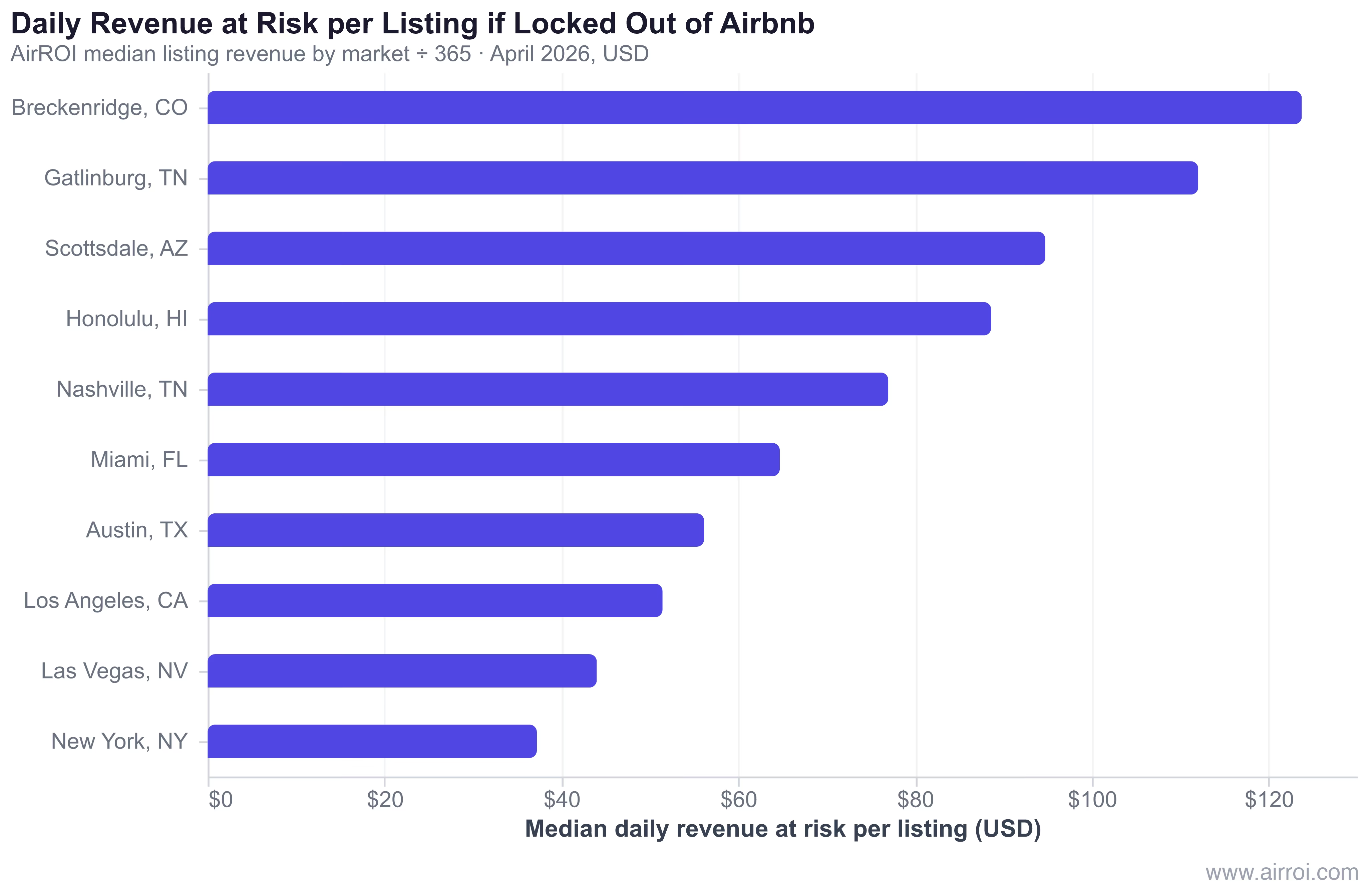
Airbnb's terms of service April 20 2026 update forces every account created before February 5, 2026 to re-accept the new terms by April 20 or lose access to bookings, payouts, and host tools. For a median Breckenridge, Colorado listing, each day of that lockout costs $123.77 in forgone revenue; for Gatlinburg, Tennessee, it is $112.05 a day; for Scottsdale, Arizona, $94.75 — numbers drawn from current AirROI market data on annualized listing revenue. The rewrite also delivers the most consequential policy change Airbnb has shipped in years: a formal ban on AI-generated evidence in damage claims, triggered by a Manhattan superhost case in which up to $16,000 in fabricated AirCover damages were unmasked by a guest who spotted the same coffee-table crack in different positions across different photos.
This is the definitive host-side walkthrough: what the April 20 deadline actually does to your account, every material change buried in the new Terms of Service and Host Damage Protection Terms, and a four-step action plan you can run before the lockout window opens.
Note: The April 20, 2026 deadline is fixed by Airbnb. If you are reading this on or after April 20, log into the Airbnb dashboard immediately, accept both the Terms of Service and the Privacy Policy, then work through the remediation steps below.
What the April 20 Airbnb Lockout Actually Does
On April 20, 2026, every Airbnb account created before February 5, 2026 that has not re-accepted the updated Terms of Service loses access to three critical functions: accepting new booking requests, receiving future payouts, and using host tools — including the calendar, pricing, and messaging dashboard. Existing confirmed reservations may still be honored, but the listing is otherwise frozen for new business until both the updated Terms and the Privacy Policy are acknowledged.
According to Airbnb Help Article 2877, existing users cannot accept the new terms early — the acceptance prompt will not appear until on or after April 20. This matters because it creates a single-day execution window for the entire pre-February 2026 host base. Every active host will see the prompt the next time they open the app or log into airbnb.com after the deadline, and every active host is running the same clock.
The financial exposure scales with market ADR. Ski and cabin markets carry the highest daily revenue at risk per listing because their median annualized revenue is highest. Party destinations and urban core markets sit in the middle. Dense, heavily regulated markets like New York City have the lowest per-listing exposure because the median annual revenue there is compressed by Local Law 18's host-present rules.
| Market | Active Listings | Median Annual Revenue | Daily Revenue at Risk per Listing | 7-Day Lockout Exposure |
|---|---|---|---|---|
| Breckenridge, CO | 3,228 | $45,174 | $123.77 | $866 |
| Gatlinburg, TN | 3,864 | $40,899 | $112.05 | $784 |
| Scottsdale, AZ | 4,720 | $34,582 | $94.75 | $663 |
| Honolulu, HI | 5,982 | $32,350 | $88.63 | $620 |
| Nashville, TN | 2,352 | $28,103 | $76.99 | $539 |
| Miami, FL | 9,110 | $23,622 | $64.72 | $453 |
| Austin, TX | 9,978 | $20,498 | $56.16 | $393 |
| Los Angeles, CA | 11,363 | $18,782 | $51.46 | $360 |
| Las Vegas, NV | 3,839 | $16,066 | $44.02 | $308 |
| New York, NY | 12,403 | $13,595 | $37.24 | $261 |
Source: AirROI market_summary queries, trailing twelve months, USD, April 2026.
A single-listing Gatlinburg operator who misses the prompt for seven days walks away from $784 in expected revenue. A five-cabin operator in the same market gives up $3,922. Multi-market investors compound the exposure across the portfolio. The operational takeaway is blunt: the April 20 deadline is a multi-step project, not a one-minute checkbox, and the work needs to happen before the prompt appears. For market-level exposure modeling, AirROI Atlas lets hosts filter by market, bedroom count, and revenue percentile to estimate their own per-listing downside.
Change #1: AI-Generated Evidence Is Now Banned in Damage Claims
The headline change in Airbnb's updated Host Damage Protection Terms is a formal ban on AI-generated evidence in damage claims. The terms introduce a new concept — "Legitimate and Verifiable Evidence" — and state explicitly that any evidence submitted in support of a claim must not include AI-generated content. This applies to photos, receipts, and supporting documentation from both hosts and guests.
The policy did not appear in a vacuum. In August 2025, a London-based academic guest booked a Manhattan one-bedroom for a two-and-a-half month stay and left after seven weeks. The host, a superhost, filed an AirCover damage claim alleging up to $16,000 in damages: a cracked wooden coffee table, a urine-stained mattress, a broken robot vacuum, and damage to a sofa, microwave, TV, and air conditioner. Airbnb initially sided with the host and demanded $7,000 from the guest. The guest, while reviewing the photos, noticed something that should have ended the claim immediately:
"These inconsistencies are simply not possible in genuine, unedited photographs of the same object."
The crack in the coffee table appeared with different patterns and in different positions across different images — a physical impossibility for a real object photographed from multiple angles, but a signature flaw of AI image generation. Diffusion models generate statistically probable images rather than rendering the same object from different viewpoints; they lack object permanence. After the Guardian began asking questions, Airbnb reversed course within five days, refunded the guest in full, warned the host that a repeat would result in a ban, and announced an internal review of its investigative protocols. The case was documented by Vice, Fox Business, and Frommer's.
The problem is not isolated. Airbnb's own research found that nearly two-thirds of British respondents struggle to distinguish AI-generated property images from real ones, and more than a third mistake fakes for genuine photos. Layer that detection failure on top of cheap, widely available inpainting tools, and the old evidence standards were untenable. For related coverage of how Airbnb's own AI systems are already reshaping host listings, see our analysis of Airbnb's 2026 AI listing badges.
What this means for your damage-claim protocol. The hosts who will come out ahead under the new rules are the ones who build a legitimate-evidence pipeline now:
- Submit only original unaltered camera files — never pass photos through enhancement, upscaling, "auto-fix," or AI-cleanup tools, because those operations inject synthetic pixels
- Build a timestamped walkthrough video of every room, every cabinet, and every high-value item for each listing, re-shot quarterly and after major refurbishments
- Pair visual evidence with dated receipts for every appliance and furnishing, plus a quote from a licensed professional for any repair or remediation
- File claims within Airbnb's 14-day window and the 24-hour guest-contact rule, which remain in force on top of the new evidence standard
Change #2: The Return to AAA Arbitration in the US
Airbnb's updated Terms of Service designate the American Arbitration Association (AAA) as the primary dispute resolution provider for US users, with the former primary provider, ADR Services (Alternative Dispute Resolution Services), now offered as a secondary option. All arbitration proceedings remain confidential under the updated terms, and a new class action waiver has been extended to Canadian users as well. The full language lives in Section 22 of the Airbnb Terms of Service.
The practical reason AAA matters: AAA has specific consumer arbitration rules that include fee caps for individuals, which makes a solo host complaint viable rather than prohibitively expensive. A host on r/airbnb_hosts walked through the sequence in October 2025 after filing over a retaliatory review:
"Follow the Terms of Service and send a Pre-Dispute Notice to Airbnb. ADR is $400+ to file, and it has been snaggy trying to get a refund. AAA is closer to $225, paid at time of filing, which may be recovered in the event of winning your complaint. My advice: go straight to AAA. It is much more consumer friendly."
The host had first sent the required Pre-Dispute Notice to Airbnb's legal representatives in Sacramento, received a brief dismissal through the messaging app, and filed with ADR — which declined to take the case because the complainant was an individual consumer, not a corporate counterparty. AAA then accepted the same filing. For hosts pursuing disputes over wrongful deactivations, withheld payouts, or retaliatory reviews, the new primary-provider language removes an institutional speed bump that had previously steered individuals toward the more expensive and less consumer-friendly path. The Traverse Legal arbitration guide lays out the full procedural sequence.
Dispute documentation remains the job of the host, and the new AAA framing rhymes with the AI evidence ban from the previous section: whether you are pursuing AirCover, challenging a deactivation, or defending a damage claim, the quality of your contemporaneous records determines the outcome.
Change #3: Rewritten Smoke Odor Standards
Airbnb's updated Host Damage Protection Terms include rewritten and clarified evidence requirements for smoke-odor claims, standardizing what qualifies as a valid claim and what remediation is eligible for reimbursement. The language is designed to resolve the exact ambiguity that has been generating the highest-engagement host complaints on Reddit — and the kind of dispute hosts have watched play out for the wrong side.
The viral r/airbnb_hosts thread "$7k refund to guest over low battery smoke alarm" captured 1,463 upvotes and 689 comments late last year. A guest abused the old system by sending Airbnb customer service a video of a smoke alarm's low-battery chirp, claimed it was a safety issue, and extracted a $7,000 refund plus an early checkout. The host's response, which sat near the top of the subreddit for days:
"The low battery alert was for the battery backup, the smoke alarm was still hardwired to the home receiving power and would fully function in a real fire. I provided documentation from the smoke alarm manufacturer to airbnb and they refuse to refund me the lost income. This sets a horrible precedence for people to abuse the system."
The new smoke-odor language cuts both ways. Hosts filing smoke damage claims now need to meet a standardized evidence bar — likely including professional remediation invoices and defined odor-detection documentation — and guests cannot trivially claim "smoke safety issues" without a concrete basis. The rule is bidirectional, and evidence must also meet the Legitimate and Verifiable Evidence standard from the previous section.
Which markets are most exposed. AirROI data identifies two tiers of high-exposure markets. The first tier is ski and cabin markets, where indoor smoking in enclosed cabins has historically generated the highest-value claims. The second tier is party-destination urban markets, where cannabis and tobacco claims are most common.
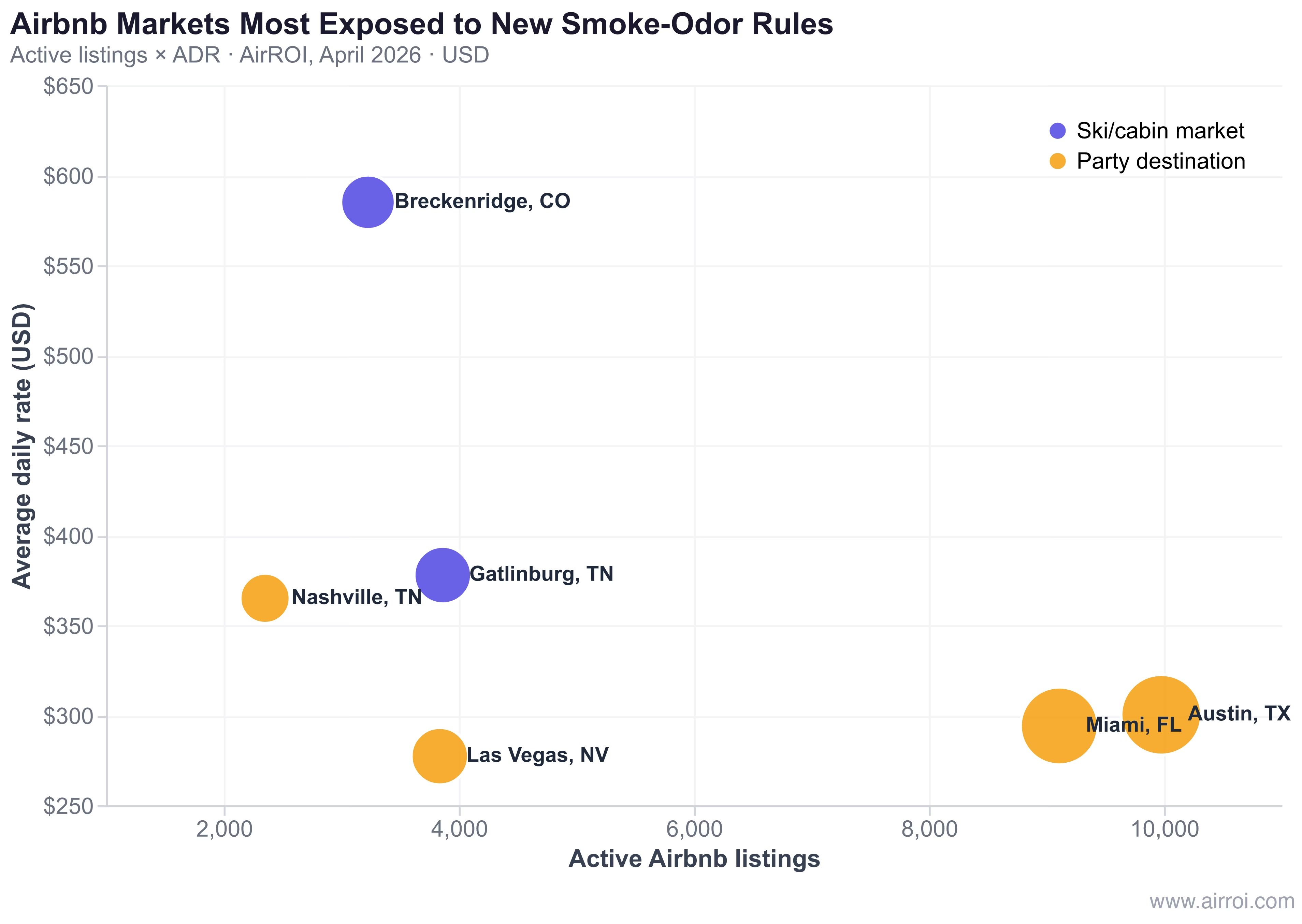
Gatlinburg, Tennessee's 3,864 listings at a $377.90 ADR and Breckenridge, Colorado's 3,228 listings at $585.00 ADR sit in the ski-cabin tier. Miami's 9,110 listings at $294.10 ADR, Las Vegas's 3,839 listings at $277.30 ADR, Austin's 9,978 listings at $300.30 ADR, and Nashville's 2,352 listings at $365.00 ADR round out the high-exposure party-destination tier. Hosts in any of these markets should update their house rules before April 20:
- Add explicit no-smoking language naming cigarettes, vapes, and cannabis with a penalty amount referenced
- Require any smoke-damage remediation be performed by a licensed cleaning or HVAC professional who issues a dated invoice
- State in the house rules that damage disputes will be documented with original timestamped files, not enhanced images
Change #4: The New Consumables Definition
Airbnb's updated Host Damage Protection Terms add a formal definition of "Consumables" covering toiletries, cleaning supplies, and kitchen staples — and make clear these items are generally ineligible for damage claims. The updated terms also refresh stain-eligibility standards for household linens. Practically, this means hosts cannot file AirCover claims when guests finish the shampoo, burn through the coffee pods, or use up the dish soap. The change cleans up a common source of dispute noise that has been clogging Airbnb's investigative queue for years.
The rule clarifies what AirCover does cover: actual property. The viral r/airbnb_hosts thread "Stolen pots and pans" and its sequel accumulated roughly 1,210 combined upvotes and 396 combined comments, telling the story of a chef-host who outfitted a Colorado ski condo with an $800 HexClad pot set and found, a month later, that a guest had swapped the set for cheap stainless steel replacements during six back-to-back bookings. The host had no kitchen-cabinet walkthrough footage and could not identify which guest had done it. Under the new terms, that is a legitimate claim category — the pots are property, not consumables — but without the Legitimate and Verifiable Evidence to prove which booking generated the loss, it is a claim that still goes nowhere.
House rules action for the consumables rule:
- Publish a named consumables list (coffee, shampoo, conditioner, body wash, dish soap, paper towels) guests are explicitly welcome to use so expectations are set at check-in
- Explicitly enumerate the items that are property, not consumables, and are subject to damage fees if removed or replaced
- Store the house rules update in the Airbnb listing house-rules field and repeat it in the welcome message for every booking
Change #5: Airbnb's 800+ Ranking Signals, Now Formally Disclosed
The updated Terms of Service add formal transparency language around Airbnb's recommendation system, documenting for the first time in the host terms that the platform's search ranking model evaluates more than 800 signals. At the 2025 Airbnb Professional Host Summit, Airbnb's product team confirmed that listings are ranked based on "the likelihood of being booked by the specific guest and leading to a 5-star review," with booking conversion rate identified as the single most important ranking signal.
Signals fall into five broad categories: host behavior (response rate, response time, cancellation history), listing quality (photos, description completeness, amenity count), pricing (competitive ADR within the market), guest experience history (ratings, review sentiment, complaint rate), and contextual factors (the guest's search patterns, filters, and trip type). Airbnb's 2025 BiListing research, which blends text and image data to understand listings more deeply, sits beneath this new transparency layer. For the revenue consequences of where your listing sits on the review distribution, see our analysis of the Airbnb rating revenue cliff.
The transparency push lands in a tense moment for hosts who feel the algorithm is already too autonomous. The viral r/airbnb_hosts thread "AISlopBNB" accumulated 722 upvotes and 85 comments on a host complaint about Airbnb automatically attaching a prominent "spacious" badge to a small studio apartment listing:
"A fraction of a percent of people in 9 years wrote spacious in their review and Airbnb the trash AI slop company has decided to make that objectively false tidbit the first thing people see on the listing because it's 'guest experience.'"
The host had explicitly disclosed in the listing text that the studio was not spacious and warned guests over 6'3" they would be uncomfortable. Airbnb's response: "The badge indicating the listing is spacious reflects how the previous guests have perceived it. The system automatically detected this feedback from the prior guest. Seeing as this is guest experience it will not be removed." The formal transparency language in the new Terms of Service gives hosts documented ground to stand on the next time they file a dispute over an auto-generated tag.
The tension is hard to miss: Airbnb is drawing a hard line on third-party AI evidence in damage claims while baking generative AI into search, discovery, and host tools, per CEO Brian Chesky's February 2026 TechCrunch interview. The lesson for hosts: expect more AI-related rule changes in 2026, and document everything your listing does and does not say — because the algorithm is reading both sides of the page.
Your Action Plan Before April 20
Every active Airbnb host should run the following four-step audit before April 20 and open the host dashboard the moment the prompt appears. The plan is short on purpose: the terms are finite, the deadline is real, and the work is concrete.
Step 1 — Before April 20: audit your account hygiene
- Verify your login email, two-factor authentication, and payout method are current and attached to a bank account you actively monitor
- Confirm the email address on file goes to an inbox you check daily — Airbnb's compliance notifications land there
- Take a screenshot of your current listing settings as a dated baseline so you can verify nothing silently changes through the upgrade
- Verify your listing photos are original camera files — if you have ever run them through an AI upscaler or auto-enhance filter, re-upload the originals
Step 2 — Before April 20: update your house rules
- Add explicit no-smoking language (no cigarettes, no vapes, no cannabis) with a penalty amount referenced
- Publish a named consumables list (coffee, toiletries, cleaning supplies) guests are welcome to use
- Add an evidence protocol clause stating that damage disputes will be documented with original timestamped files, not AI-enhanced images
- Reference professional remediation requirements for smoke-damage claims
Step 3 — Before April 20: build your legitimate-evidence protocol
- Record a timestamped walkthrough video of every room, every cabinet, every high-value item in each listing
- Store the footage in dated cloud folders with automatic retention and an obvious file-naming convention (
listing-id_yyyy-mm-dd_walkthrough.mp4) - Keep dated receipts for every appliance, furnishing, and replacement item in a single cloud folder or binder
- Establish a pre-check-in and post-check-out photo routine for your cleaning crew that covers kitchen cabinets, closets, and drawers — not just surfaces
Step 4 — April 20: accept the new terms within 24 hours
- Log into airbnb.com or the Airbnb app
- The TOS acceptance prompt loads before any host tool appears — accept both the Terms of Service and the Privacy Policy (two separate acknowledgments)
- Verify the calendar, messaging, and pricing dashboards load afterwards
- Log into each additional host account on the same device separately — multi-property operators managing multiple accounts need to accept on each one
For operators running a portfolio across multiple markets, the action plan has to run on every listing before April 20. For smaller hosts, the work is an evening. Either way, starting early is the cheapest path to a zero-lockout outcome.
Frequently Asked Questions
Airbnb's updated Host Damage Protection Terms define Legitimate and Verifiable Evidence as authentic photos, receipts, and documentation, with a formal exclusion that the evidence must not include AI-generated content. Practically, this means original unaltered camera files, dated receipts, and timestamped walkthrough videos are acceptable, while enhanced, retouched, upscaled, or synthetic images are not.
Airbnb designated the American Arbitration Association (AAA) as the primary US dispute resolution provider because AAA offers specific consumer arbitration rules with fee caps that make individual complaints viable. Host walkthroughs on r/airbnb_hosts confirm the practical difference: AAA charges roughly $225 to file an individual consumer case (recoverable on win), compared with $400-plus at the former primary provider ADR.
Airbnb's updated Host Damage Protection Terms rewrite the evidence requirements for smoke-odor claims, standardizing what qualifies as a valid claim and what remediation is eligible for reimbursement. The language is designed to resolve ambiguous situations like the viral r/airbnb_hosts thread where a guest received a $7,000 refund over a low-battery smoke alarm chirp. Hosts in ski-cabin and party-destination markets like Breckenridge, Gatlinburg, Miami, and Las Vegas should update house rules and lean on professional remediation documentation.
Lockout exposure depends on the market. AirROI data shows median daily revenue at risk ranges from $37.24 in New York City to $123.77 in Breckenridge, Colorado, with Gatlinburg at $112.05 and Scottsdale at $94.75. A seven-day lockout for a five-listing Gatlinburg operator represents roughly $3,922 in forgone revenue before any guest-facing cancellation damage.