
Coachella 2026 Airbnb Cancellation Crisis: The Data Behind the Chaos

The average Indio Airbnb is asking $1,200 a night for Coachella Weekend 2. In early May, the same listings rent for $573. That $627 nightly spread — a 109% premium — explains the entire coachella 2026 airbnb cancellation crisis in a single number. Airbnb's standard 25% host cancellation fee costs roughly $412 on a typical 3-night reservation. The rebook profit at current market rates pays back more than $1,700. The crisis isn't random host misbehavior. It's arbitrage.
As I write this on the Friday of Coachella Weekend 1, TikTok influencer Sophie Rain is already the viral anchor of the story — her $29,000 booking cancelled days before check-in, rebooked at $83,375. Hollywood Reporter, KESQ, Yahoo Travel and AOL are all covering the fallout. Airbnb's spokesperson said the company is "not seeing a notable uptick in cancellations over Coachella weekend." The news is about the drama. This article is about the forward-pacing data from five Coachella Valley markets — Palm Springs, Palm Desert, Indio, La Quinta, and Coachella city — that makes the drama inevitable.
Airbnb Says One Thing. The ADR Data Says Another.
The coachella airbnb price gouging 2026 story broke on April 8 when KESQ reported that Coachella attendees were finding their Airbnb reservations cancelled days before check-in. One host claimed the City of Palm Desert had sent a letter forcing them to cancel due to a weekend-rental ordinance. The City of Palm Desert denied it directly:
"The City of Palm Desert allows short-term rentals, including on weekends and during special events such as festival season, and there is no restriction prohibiting weekend rentals. All short-term rental operators must obtain and maintain a valid permit issued by the City." — City of Palm Desert, statement to KESQ, April 8, 2026
One Reddit user in r/AirBnB captured the ground reality better than any press release could:
"Our host cancelled on us TODAY because they changed their mind. We checked Vrbo, Poppy, even considered renting an apartment for a short-term lease as long as it is within our price range of $2,600-$3,000. EVERYTHING out there is either unavailable for the days we need or $25,000 - $100,000, which is clearly unfathomable." — r/AirBnB post from April 2, 2026 (thread link, 21 upvotes, 47 comments)
The same thread reported that Airbnb customer support offered $200, then $300, then $500, eventually capping at $1,000 in rebooking credit. The replacement market was 5-25x that. To understand why, you have to look at the actual pacing data for the Coachella Valley. That's where the story gets mathematical.
Indio Asking Rates Jump 109% for Coachella Weekend 2
AirROI's forward pacing data shows Indio and La Quinta Airbnb asking rates more than double during Coachella Weekend 2. Those two markets, which sit closest to the Empire Polo Club festival grounds, produce the largest coachella airbnb ADR spike in the valley. The smaller established market (Palm Springs, ~4,206 active listings) spikes much less. The closer the listing is to the festival, the higher the premium — and the stronger the cancellation incentive.
I pulled forward pacing data for all five Coachella Valley markets on the Friday morning of Weekend 1 (April 11, 2026). Each market returns daily asking rates (the current listing price on available inventory) and booked rates (what already-confirmed bookings actually locked in at). The table below shows the Weekend 2 average (Friday April 17 through Sunday April 19) next to an early-May non-weekend baseline — the cleanest "normal April pricing" proxy the calendar offers.
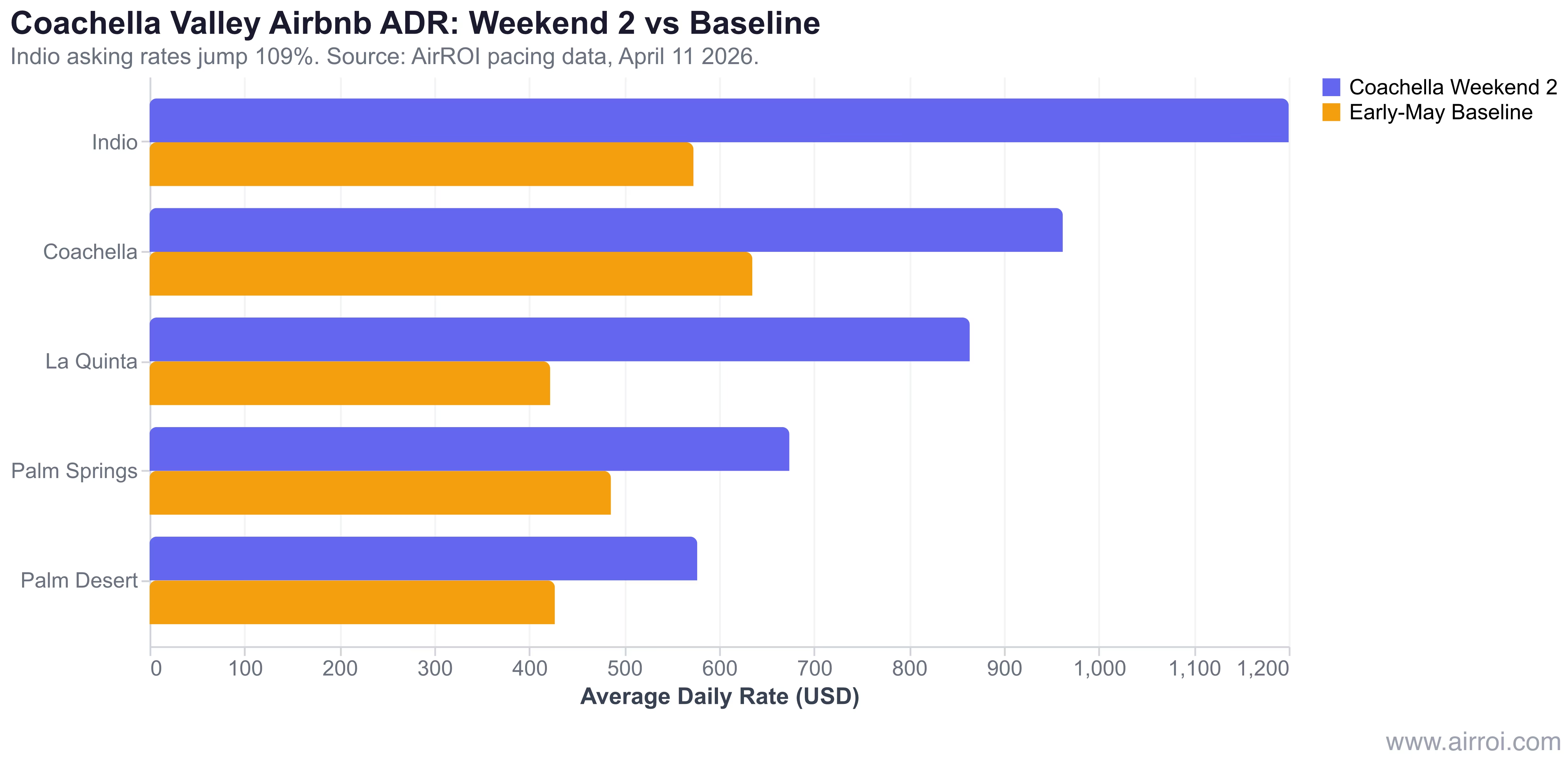
| Market | W2 Asking ADR | W2 Booked ADR | Baseline ADR | Spread ($) | Spread (%) | Fill Rate (Apr 17) |
|---|---|---|---|---|---|---|
| Indio | $1,200 | $1,026 | $573 | +$627 | +109% | 1.46x |
| La Quinta | $864 | $718 | $422 | +$442 | +105% | 2.14x |
| Coachella (city) | $962 | $1,030 | $635 | +$327 | +51% | 2.06x |
| Palm Desert | $577 | $476 | $427 | +$150 | +35% | 1.20x |
| Palm Springs | $674 | $641 | $486 | +$188 | +32% | 1.36x |
Source: AirROI airroi_market_future_pacing, pulled April 11, 2026. Baseline = average of early-May non-weekend nights. Fill rate = booked count ÷ available listings on that date. Values above 1.0 indicate a supply-constrained market.
Two things jump out of this table. First, fill rate. A fill rate of 1.46 in Indio on Friday April 17 means there are 46% more confirmed bookings than there are currently-available listings. In La Quinta, the Friday fill rate hits 2.14x — more than twice as many confirmed stays as there are listings still on the market. That's the supply constraint Sophie Rain and the r/AirBnB poster ran into: there is essentially nothing left to rebook at rational prices.
Second, the smallest spread belongs to the largest market. Palm Springs, with 4,206 active listings and a mature professional-manager layer, produces a 32% Weekend 2 premium — roughly what you'd expect from a normal April high-demand weekend. Indio, with only 1,956 listings and a much thinner pro-manager presence, produces a 109% premium because individual hosts set prices by hand, and the current hand is holding a royal flush.
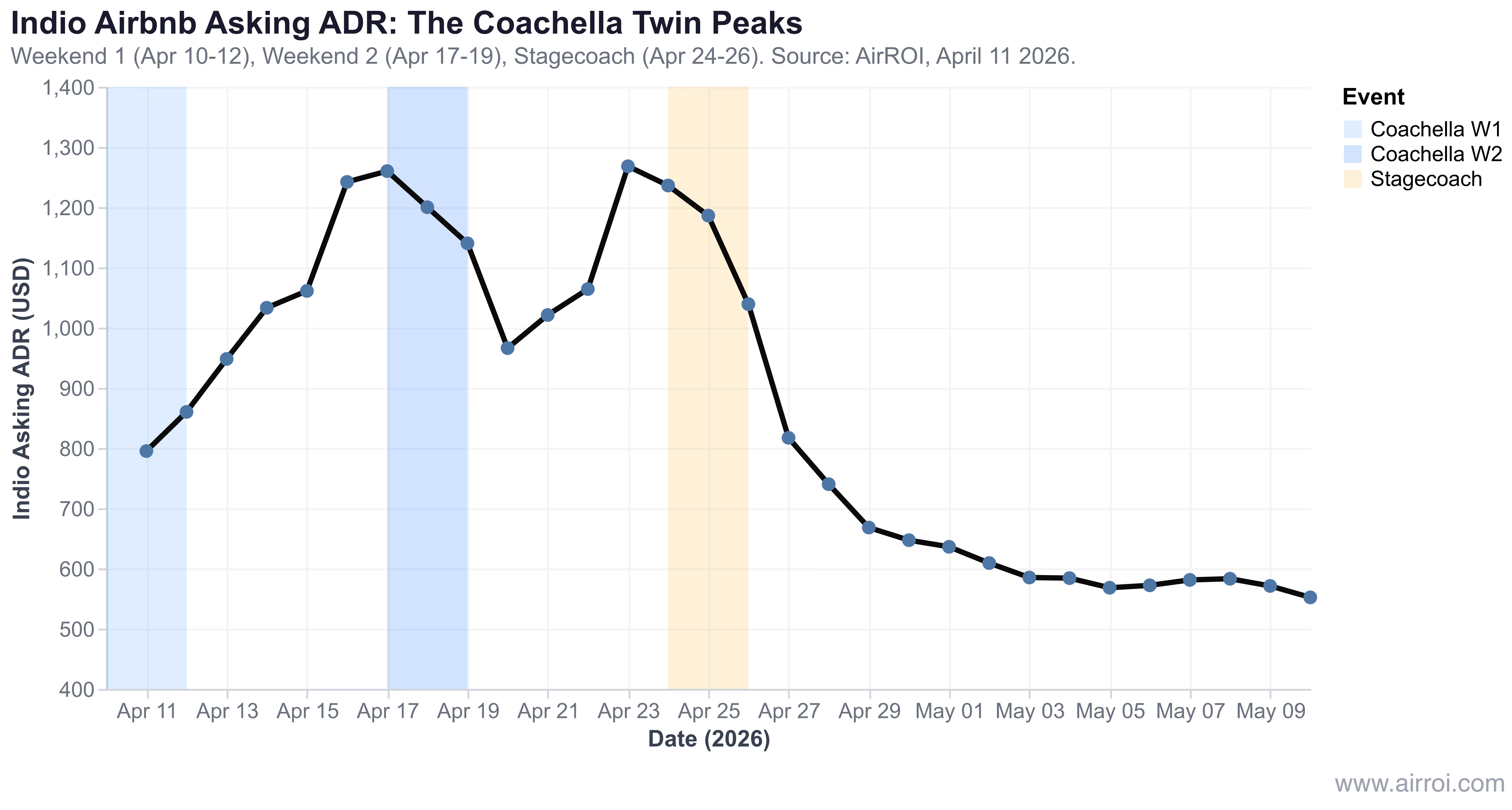
The pacing curve above shows why this is structural, not a one-weekend anomaly. Indio's asking ADR runs in the $560-$640 range through early May, then spikes to $1,260 on Friday April 17 — the peak of Coachella Weekend 2. A second peak hits April 24-26 for Stagecoach country festival. Three weekends capture roughly 70% of the month's total revenue. For an Indio host, those three weekends are the year. Everything else is maintenance.
The $1,717 Reason Hosts Are Cancelling
On a typical 3-night Indio stay booked months ago at normal-ish rates, cancelling and rebooking nets roughly $1,717 — a 104% profit on the original booking value. This is the line-item math that makes the airbnb cancellation fee loophole work. Airbnb's Help Center Article 990 defines three fee brackets based on how close the cancellation is to check-in:
| Time before check-in | Host cancellation fee | Minimum |
|---|---|---|
| 48 hours or less (or after check-in) | 50% of reservation amount | $50 |
| 48 hours to 30 days | 25% of reservation amount | $50 |
| More than 30 days | 10% of reservation amount | $50 |
Take a concrete example. An Indio host confirmed a 3-night booking (April 17-19) in October 2025 for $550 a night — roughly the market rate at the time. Base total: $1,650. As April 2026 approaches, AirROI pacing data shows the current asking rate for those same nights is $1,260. The host is sitting on a 13-days-out cancellation, which drops them in the 25% penalty bracket:
| Line Item | Value |
|---|---|
| Original 3-night booking (3 × $550) | $1,650 |
| Cancellation penalty (25% of reservation amount) | –$412.50 |
| Rebook at current market asking rate (3 × $1,260) | +$3,780 |
| Net profit from cancel-and-rebook vs honoring the booking | +$1,717.50 |
That $1,717 is the thin wedge between "most hosts will never cancel" and "the rational action is cancel-and-rebook." And this isn't even the worst case. Even in the harshest 50%-penalty bracket (within 48 hours of check-in), the math still works: $3,780 rebook minus $825 penalty minus the original $1,650 locked in = +$1,305 net gain. Cancelling is positive-expected-value at every penalty tier, for every 3-night stay in Indio, as long as the rebook is achievable. And with a 1.46x fill rate, the rebook is essentially guaranteed.
The same math carries in La Quinta. A host who locked in $450 a night ($1,350 total) sees the current ask at $864, meaning a rebook at $2,592. After the 25% penalty of $337.50, the net gain is $904.50 — a 67% profit on the original booking. La Quinta's fill rate of 2.14x means the displaced demand is already lining up. Even Palm Springs, with its muted 32% spread, can deliver modest gains on cancellation-arbitrage for any host pricing below the current $641 booked rate.
What this doesn't cover is the full accounting. Hosts also lose reviews, risk Superhost status, eat the friction of handling the cancellation, and absorb the psychological cost of telling a guest "sorry, I can't honor this." Whether those soft costs outweigh $1,717 depends entirely on the host's business model and reputation equity.
Why Airbnb's Deterrents Fail at Peak Events
Airbnb's three deterrents — cancellation fees, calendar blocks, and a ban on relisting at higher prices — were sized for 10-20% ADR volatility, not 100%+ festival spikes. The spokesperson statement describes deterrents designed for normal booking churn. The data describes an entirely different pricing environment. Here's how each deterrent stacks up against the reality AirROI's pacing data measures:
| Deterrent | How Airbnb describes it | What the data shows |
|---|---|---|
| Cancellation fee (10%/25%/50%) | Meaningful financial penalty that makes cancellation irrational | Covered 4-10x by the rebook spread in Indio and La Quinta — cancelling is positive-EV at every bracket |
| Calendar blocks | Host can't re-book the cancelled dates on Airbnb | Hosts rebook on Vrbo, Whimstay, Poppy, or direct channels — the ~50% of STR supply that lives off Airbnb stays fully fungible |
| Ban on re-listing at a higher price | Host can't immediately relist the same unit on Airbnb at a markup | Rule only applies within Airbnb; cross-platform relisting is unconstrained, and enforcement depends on a literal same-listing-ID republish |
Source: Airbnb Help Center Article 990, AirROI market pacing data, cross-platform discussion in r/AirBnB and r/airbnb_hosts.
Three structural gaps follow from this. First, the penalty doesn't scale with the spike. A 25% penalty on a $1,650 booking is $412.50. A 25% penalty on a $5,000 booking would be $1,250. The old penalty was sized against a market where rebooking at $2,000 was a great outcome; the new market rebooks at $3,780, and the fee structure never caught up. Dynamic cancellation penalties tied to current market ADR would close this gap instantly.
Second, cross-platform leakage is the bigger hole. A host who cancels on Airbnb and relists on Vrbo or Whimstay faces no Airbnb-enforceable consequence beyond the one-time penalty. The "ban on re-listing at a higher price" is platform-local. Until STR platforms coordinate or regulators require cross-platform relisting transparency, this gap stays open — and Coachella is the single cleanest test case on the calendar.
The Honest-Host Tax
Honest hosts who priced correctly months ago are absorbing the reputational damage of the cancellation crisis without capturing any of the upside. Consider a Palm Springs Superhost who set Coachella Weekend 2 rates back in August 2025 at $650 a night using disciplined forward pricing. She locked in $1,950 in base revenue on a 3-night stay. AirROI's data shows the current Palm Springs W2 asking rate is $674 — only $24 above her original price. Her booking is already near-optimal. She has nothing to gain from cancelling and everything to lose.
She's also losing something she didn't create. Every "my Coachella Airbnb got cancelled" tweet degrades guest trust across the entire valley's short-term rental stock, including hers. Her listing benefits from no upside (rate was locked months ago) and absorbs all of the brand damage. Airbnb's spokesperson said "festival-goers trust Airbnb for their Coachella stays because we offer options that fit all budgets and reliability." Reliability is exactly what she delivered and exactly what the cancellation crisis broke on her behalf.
What Guests Should Do for Coachella 2027
Book with verified Superhosts and assume a 1.5-2x replacement cost buffer. The 2026 crisis made clear that early booking doesn't guarantee the host will honor the rate. Sophie Rain booked early and still paid the $83,375 rebook. Here's the practical playbook for the 2027 festival window:
- Filter for Superhost status only. Airbnb's Superhost program requires a <1% cancellation rate over the trailing 12 months, 90%+ response rate, 4.8+ average rating, and 10+ trips per year. Hosts who qualify have actual skin in the game.
- Require 50+ reviews and a multi-year track record. A listing that went live in February 2026 has no reputation cost to protect. A listing with 150 reviews across three years has a meaningful one.
- Screenshot the confirmed reservation with price on the day of booking. If the host later tries to renegotiate or cancel, you have documentation for Airbnb's customer service escalation.
- Book direct with professional management where possible. Companies with multi-unit portfolios in the Coachella Valley have brand reputation and legal exposure that individual hosts don't. They are less likely to take the one-event arbitrage bet.
- Budget 1.5-2x your booking price as a replacement buffer. AirROI data shows Indio's average booking lead time is 56 days on normal dates, but Coachella bookings skew much earlier. Locking in 9-12 months ahead minimizes the penalty bracket the host would fall into if they cancel — but doesn't eliminate it.
- Consider staying in Palm Springs instead of Indio. The price spread is smaller (+32% vs +109%), the listing inventory is 2x larger, and the cancellation incentive for hosts is proportionally weaker.
What Legitimate Hosts Should Do for Coachella 2027
Price the 2027 Coachella window 9 months in advance using AirROI pacing data, lock in the revenue, and honor every booking. The cancel-and-rebook economics are real and they're tempting, but the math on Superhost revenue lift and repeat bookings runs in the opposite direction at a 12-month horizon. Here's the framework:
- Set Coachella-week rates off current forward pacing, not last year's actuals. A host who looked at 2025 Indio April data and locked in $550/night for 2026 left more than $4,000 in per-weekend revenue on the table. Use the pacing curve as it develops — AirROI data refreshes continuously, so you can reprice in June, July, and August as 2027 demand materializes.
- Enforce a 4-night minimum stay for festival weeks. Indio's trailing average length of stay is 3.9 nights, so a 4-night floor captures the full weekend plus arrival day without alienating festival-going guests.
- Raise the security deposit for festival weeks. Damage risk is the one legitimate reason to be cautious about event weekends, and a $1,500-$3,000 deposit with clear check-out inspection rules is much more defensible than a last-minute cancellation.
- Use data-driven dynamic pricing. AirROI's forward pacing data and tools like data-driven dynamic pricing playbooks let you move rates with the market before the 9-month lock-in window rather than reacting at 13 days out.
- Protect Superhost status as a capital asset. The 50-60% annual revenue lift Superhosts earn over non-Superhosts exceeds the one-event arbitrage gain on any Coachella stay. Cancelling to capture 2026 means losing 2027-2029.
Frequently Asked Questions
Because AirROI pacing data shows Indio and La Quinta asking rates for Coachella Weekend 2 more than double the normal April baseline — Indio is up 109% to $1,200 a night and La Quinta is up 105% to $864. The rebook premium on a 3-night stay dwarfs Airbnb's 25% mid-window cancellation penalty, so cancelling and relisting is a rational profit-maximizing move for hosts who don't value Superhost status.
AirROI pacing data shows an average Indio listing can ask $1,200 a night during Coachella Weekend 2, versus a trailing-twelve-month ADR of $665. A single 3-night Coachella stay can therefore generate $3,600 in revenue — roughly 5% of annual revenue earned in 0.8% of the year. La Quinta hosts capture similar concentration with W2 asking rates averaging $864.
Airbnb's policy technically bans relisting the same reservation at a higher price on Airbnb after a host-initiated cancellation. However, the rule does not prevent hosts from listing on Vrbo, Whimstay, or direct channels, which is where much of the Coachella rebooking is happening. Airbnb's host cancellation fee ranges from 10% (30+ days out) to 50% (within 48 hours) per Help Center Article 990.
Airbnb charges 50% of the reservation amount if a host cancels within 48 hours of check-in or after check-in, 25% if cancelled 48 hours to 30 days before check-in, and 10% if cancelled 30+ days out, with a $50 minimum fee. These penalties were sized for routine cancellation volatility, not the 100%+ ADR spikes that AirROI measures during Coachella weekends.
Book with verified Superhosts who have 50+ reviews and a multi-year track record, take screenshots of every confirmed reservation, avoid brand-new listings for mega-event weekends, and consider booking direct with professional managers where available. Even early booking does not eliminate cancellation risk — Sophie Rain's $29,000 reservation was cancelled days before check-in — so budget a 1.5-2x replacement buffer.