
Average Transaction Value (ATV)

Key Takeaways
- ATV = Total Gross Revenue ÷ Number of Reservations
- Captures the full booking value: nightly rate × nights stayed, plus cleaning fees and any extra charges
- A rising ATV signals better booking quality — longer stays, higher rates, or stronger ancillary revenue
- Directly driven by ADR, ALOS, and fee structure; improving any one of them lifts ATV
- Enables straightforward revenue forecasting: ATV × expected monthly reservations = projected gross revenue
How to Calculate ATV
Formula:
ATV = Total Gross Revenue ÷ Number of Reservations
Example:
A listing generated $7,800 in gross revenue from 6 reservations in a given month:
ATV = $7,800 ÷ 6 = $1,300 per reservation
Decomposing the drivers:
| Component | Per-Booking Calculation | Per-Booking Value |
|---|---|---|
| Nightly rate (ADR) | $195 × 5.8 nights | $1,131 |
| Cleaning fee | Flat | $130 |
| Extra fees | Pet fee + extras | $39 |
| ATV | $1,300 |
ATV vs. ADR: Why the Distinction Matters
ADR and ATV are not interchangeable. ADR tells you how much you earn per booked night; ATV tells you how much you earn per booking. A market with a lower ADR but longer average stays can easily produce a higher ATV than a market with a premium nightly rate and short weekend stays.
| Scenario | ADR | ALOS | Cleaning Fee | ATV |
|---|---|---|---|---|
| Weekend escape | $350 | 2 nights | $150 | $850 |
| Week-long beach | $280 | 7 nights | $175 | $2,135 |
| Mid-term stay | $175 | 21 nights | $200 | $3,875 |
The week-long beach scenario delivers more than double the per-booking revenue of the weekend escape at 80% of the nightly rate — purely because ALOS is 3.5× longer.
ATV by Market: Real Data
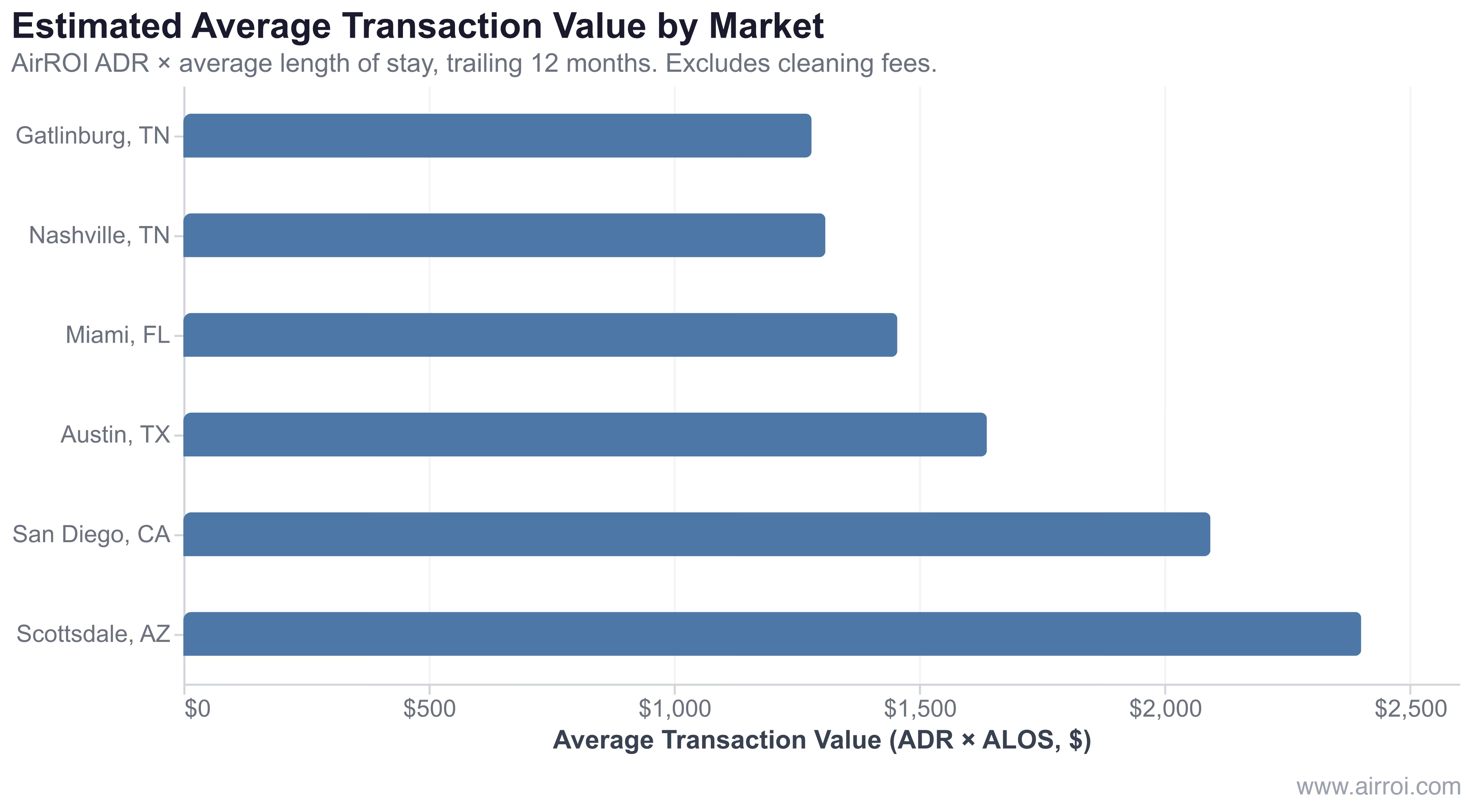
In AirROI's analysis of 40,336 active listings across six US markets, the per-reservation nightly component (ADR × ALOS) ranges from roughly $1,280 in Gatlinburg to $2,400 in Scottsdale. These figures exclude cleaning fees and ancillary charges, so actual ATV at the property level runs higher.
| Market | ADR | ALOS (nights) | ATV Nightly Component | Active Listings |
|---|---|---|---|---|
| Scottsdale, AZ | $421.1 | 5.7 | $2,400 | 4,310 |
| San Diego, CA | $394.9 | 5.3 | $2,093 | 9,560 |
| Austin, TX | $297.7 | 5.5 | $1,638 | 8,774 |
| Miami, FL | $291.0 | 5.0 | $1,455 | 7,905 |
| Nashville, TN | $353.6 | 3.7 | $1,308 | 6,165 |
| Gatlinburg, TN | $376.5 | 3.4 | $1,280 | 3,622 |
Nashville and Gatlinburg both carry ADRs above $350 yet land at the bottom of this ATV ranking because their stays average only 3.4–3.7 nights — a weekend-trip dynamic. Scottsdale's $2,400 per-reservation nightly figure is driven by a 5.7-night average stay combined with a $421 ADR, not by extreme rates alone.
The ATV spread across markets reveals a counterintuitive truth: chasing the highest ADR is often less effective than engineering longer minimum stays, because stay length multiplies every dollar of rate into the final booking total.
Why ATV Matters for STR Operators
- Revenue forecasting: ATV × projected monthly reservations = gross revenue target. A property with $1,600 ATV that books 8 times per month generates $12,800 — precision that ADR alone cannot provide.
- Operational efficiency: Higher ATV with fewer reservations means fewer turnovers, lower cleaning frequency, and less guest communication overhead per revenue dollar. A host earning $4,000 from two bookings does the same cleaning work as one earning $4,000 from five short stays — at lower cost.
- Channel benchmarking: Comparing ATV across Airbnb, Vrbo, and direct booking channels shows which platform attracts higher-value guests, independent of occupancy rate differences.
- Pricing strategy validation: If ADR rises but ATV stays flat, guests are booking fewer nights — a signal that higher rates are deterring the longer stays that drive booking value.
How to Increase ATV
- Set strategic minimum nights: A 3-night minimum replaces two-night stays with three-night bookings, adding one full ADR to every reservation without any additional marketing spend. Adjust seasonally — tighter minimums during peak demand periods, looser during fill seasons.
- Deploy length-of-stay discounts: A 10–15% weekly discount at $300 ADR still produces an ATV of $1,890 for a 7-night stay versus $600 for a 2-night stay at full rate — a 215% increase in per-booking revenue. Our dynamic pricing guide covers exactly how to structure these tiers.
- Optimize ancillary fees: Cleaning fees, pet fees, early check-in, and late checkout all add directly to ATV. A $150 cleaning fee on a 2-night booking raises that ATV by 25%; on a 7-night booking it adds only 8% — making longer stays more fee-efficient for guests and naturally self-selecting for them.
- Target high-value guest segments: Families booking vacation weeks, remote workers on monthly stays, and group travelers for special events produce significantly higher ATV than solo weekend guests. Listing copy, photography, and amenity investments should reflect the guest type who books the longest and spends the most.
- Monitor ATV alongside ADR and occupancy: The most common trap is optimizing ADR in isolation. AirROI's pricing data consistently shows that operators who track ATV alongside ADR catch booking-length erosion before it compounds into a revenue problem.
Frequently Asked Questions
Average Transaction Value (ATV) is the mean revenue generated per reservation. It is calculated by dividing total gross revenue by the number of reservations. ATV captures the combined effect of nightly rate, length of stay, and additional fees on each booking's total value.
Divide your total gross revenue by the number of reservations in the period. For example, if you earned $12,000 from 10 reservations in a month, your ATV is $1,200. This means each booking generates an average of $1,200 in revenue.
ADR measures revenue per booked night, while ATV measures revenue per reservation. ATV accounts for the full booking value including length of stay, cleaning fees, and additional charges. A listing with a $150 ADR and 4-night ALOS with a $120 cleaning fee has an ATV of $720.
Markets with high ADR and moderate-to-long stays produce the highest ATV. AirROI data shows Scottsdale, AZ and San Diego, CA lead on an ADR × ALOS basis, with per-reservation nightly revenue exceeding $2,000 before fees — driven by premium nightly rates rather than by longer stays.
Longer stays directly increase ATV by multiplying the nightly rate across more nights. A listing with a $200 ADR and a 3-night stay has a nightly-component ATV of $600; at 7 nights it rises to $1,400. Length-of-stay discounts can reduce ADR slightly while still raising total ATV — and they cut cleaning frequency, improving net margin.