
Net Revenue

Key Takeaways
- Net Revenue = Gross Revenue − All Operating Expenses
- Net margin for STRs typically ranges from 25% to 45% of gross revenue, depending on management style and financing
- Self-managed, unlevered properties can reach 55–75% margins; professionally managed, mortgaged properties compress to 10–30%
- Gross revenue alone is misleading — two properties with identical top-line income can deliver drastically different net results
- Net revenue is the foundation for calculating cash-on-cash return, GOPPAR, and cap rate
How to Calculate Net Revenue
Formula:
Net Revenue = Gross Revenue − Total Operating Expenses
The calculation is straightforward; the discipline is in capturing every expense. A sample monthly breakdown for a professionally managed property with a mortgage:
| Line Item | Monthly Amount |
|---|---|
| Gross Revenue | $6,500 |
| Platform fees (3%) | −$195 |
| Cleaning costs | −$720 |
| Property management (20%) | −$1,300 |
| Utilities | −$250 |
| Insurance | −$150 |
| Maintenance / supplies | −$200 |
| Mortgage (P&I) | −$1,400 |
| Property taxes | −$300 |
| Net Revenue | $1,985 |
Net Revenue Margin = $1,985 ÷ $6,500 = 30.5%
Gross Revenue vs Net Revenue: Why the Gap Matters
A property generating $50,000 in annual gross revenue sounds compelling. But the final net depends entirely on cost structure:
| Scenario | Gross Revenue | Total Expenses | Net Revenue | Net Margin |
|---|---|---|---|---|
| Self-managed, no mortgage | $50,000 | $15,000 | $35,000 | 70% |
| Self-managed, with mortgage | $50,000 | $28,000 | $22,000 | 44% |
| Pro-managed, no mortgage | $50,000 | $26,000 | $24,000 | 48% |
| Pro-managed, with mortgage | $50,000 | $40,000 | $10,000 | 20% |
The 50-point gap between the best and worst scenario on the same gross revenue is the core reason investors focus on net — not top-line — performance.
STR Annual Revenue by Market
Before you can project net revenue, you need a reliable gross revenue baseline. AirROI's trailing-12-month data across 35,301 active listings in six US markets shows the range is substantial:
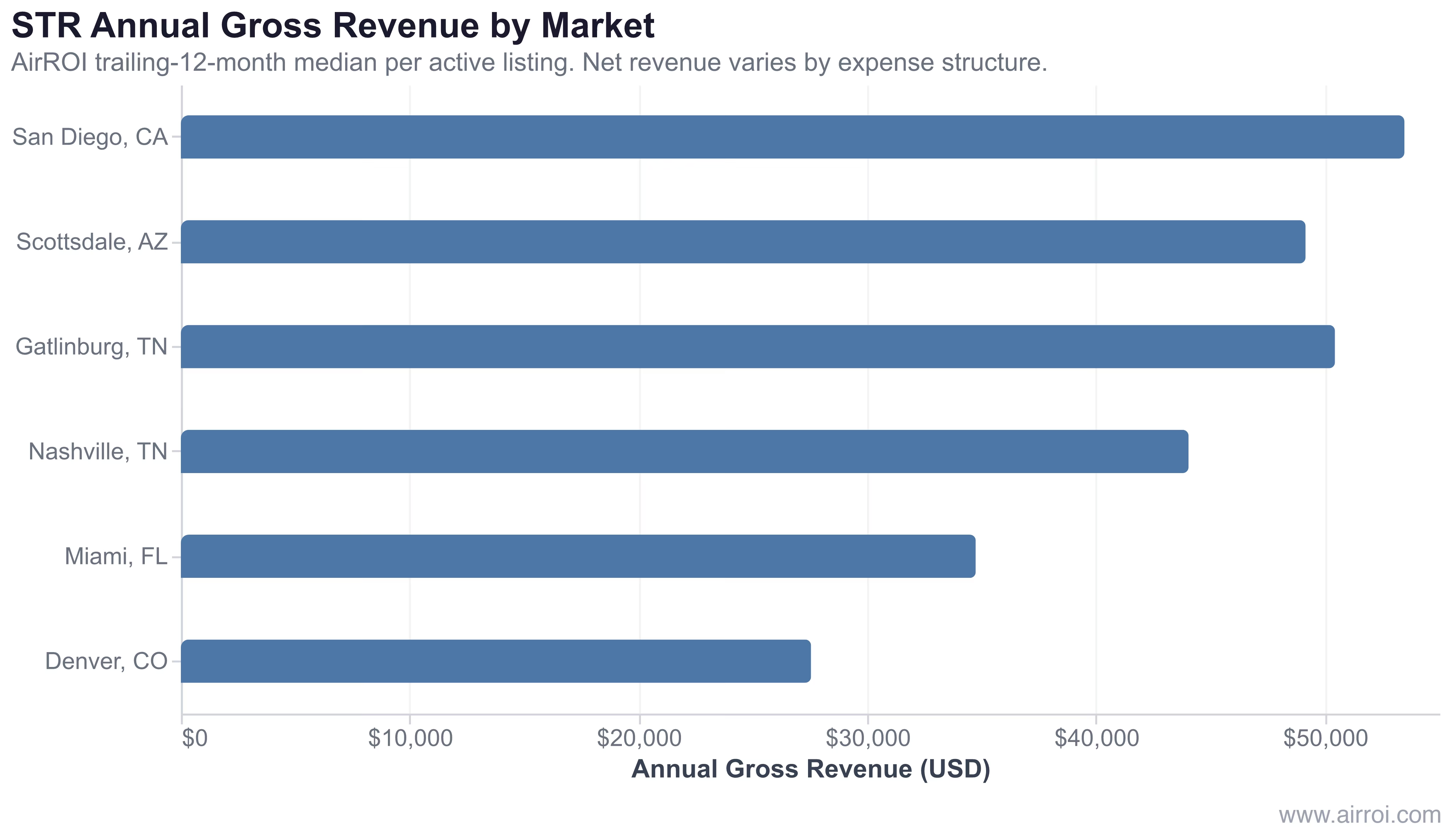
In AirROI's analysis of 35,301 active listings across San Diego, Scottsdale, Gatlinburg, Nashville, Miami, and Denver, median annual gross revenue ranges from $27,540 in Denver to $53,472 in San Diego. Applying a 35% net margin — typical for a self-managed property with a mortgage — translates those figures to net revenues between roughly $9,600 and $18,700 per year. A 45% margin (self-managed, strong cost control) raises the San Diego ceiling to about $24,100.
| Market | Median Gross Revenue | Net @ 35% margin | Net @ 45% margin |
|---|---|---|---|
| San Diego, CA | $53,472 | $18,715 | $24,062 |
| Gatlinburg, TN | $50,438 | $17,653 | $22,697 |
| Scottsdale, AZ | $49,153 | $17,204 | $22,119 |
| Nashville, TN | $44,039 | $15,414 | $19,818 |
| Miami, FL | $34,738 | $12,158 | $15,632 |
| Denver, CO | $27,540 | $9,639 | $12,393 |
Source: AirROI trailing-12-month medians per active listing, May 2026. Net revenue estimates apply illustrative margins — actual results depend on individual expense structure.
The spread between a 35% and 45% net margin in San Diego is $5,300 per year — equivalent to about one extra booking per month. Expense discipline is an underappreciated revenue lever.
Net Revenue Margin Benchmarks
| Management Style | Typical Net Margin | Notes |
|---|---|---|
| Self-managed, no mortgage | 55–75% | Highest margins, most time investment |
| Self-managed, with mortgage | 30–45% | Mortgage is typically the largest single expense |
| Pro-managed, no mortgage | 35–55% | Management fee reduces margin by 15–25 points |
| Pro-managed, with mortgage | 10–30% | Lowest margins, most passive |
Why Net Revenue Matters for STR Investors
True profitability. Gross revenue looks impressive on dashboards, but net revenue determines whether a property covers its costs, services debt, and generates a return worth the capital deployed.
Expense trajectory. Tracking net revenue monthly exposes cost creep before it becomes material. If gross revenue grows 8% year-over-year but net margin compresses from 38% to 30%, operating costs are outpacing income — a signal to renegotiate vendor contracts or adjust pricing.
How to Improve Net Revenue
Diversify booking channels. Platform fees compound across every booking. Direct booking channels eliminate the 3% host fee and reduce dependency on algorithm changes. According to Airbnb's host fee schedule (airbnb.com), standard host fees run 3% of the booking subtotal, but split-fee structures in some markets can push host-side costs higher.
Renegotiate management contracts. Property management fees of 15–25% are standard but negotiable, especially for multi-property owners or hosts with strong performance metrics. A 5-point fee reduction on a $50,000 gross-revenue property adds $2,500 directly to net revenue.
Frequently Asked Questions
Common deductions include platform fees (Airbnb's 3% host fee), cleaning costs, property management fees (typically 15–25%), maintenance and repairs, insurance, utilities, mortgage principal and interest, property taxes, and income taxes. The specific deductions depend on your ownership and management structure.
Subtract all operating expenses from your gross revenue. For example, if your gross revenue is $6,000 per month and total expenses are $3,800 (including platform fees, cleaning, management, mortgage, and utilities), your net revenue is $2,200 — a 36.7% net margin.
A healthy net revenue margin for a short-term rental typically falls between 25% and 45% of gross revenue. Self-managed properties without a mortgage can reach 55–75%, while professionally managed, mortgaged properties compress to 10–30%. Market-level gross revenue varies widely: AirROI data shows trailing-12-month medians ranging from $27,540 in Denver to $53,472 in San Diego.
Gross revenue is the total booked income before any deductions — the headline number on your dashboard. Net revenue subtracts every operating cost (cleaning, management, platform fees, insurance, mortgage, taxes) to reveal actual take-home profit. A property generating $50,000 gross with a 35% net margin delivers $17,500 in net revenue.
Investors use net revenue — not gross — to calculate cash-on-cash return, cap rate, and net operating income. Two properties in the same market can have identical gross revenue but dramatically different net margins depending on management style, financing, and expense discipline. Net revenue is the number that determines whether a deal actually works.