
GOPPAR (Gross Operating Profit Per Available Room)

Key Takeaways
- GOPPAR = Gross Operating Profit ÷ Total Available Room-Nights
- Goes beyond RevPAR by netting out all operating expenses before measuring per-night output
- Two properties with identical RevPAR can have very different GOPPAR when their cost structures differ
- Excludes debt service, income taxes, and depreciation — isolating operational performance from financing decisions
- The definitive benchmark for comparing profitability across properties, markets, or management models
How to Calculate GOPPAR
Formula:
GOPPAR = Gross Operating Profit ÷ Total Available Room-Nights
Where: Gross Operating Profit (GOP) = Total Revenue − Operating Expenses
Example — monthly calculation:
| Line Item | Amount |
|---|---|
| Gross Revenue | $6,200 |
| Less: Platform fees (3%) | −$186 |
| Less: Cleaning costs | −$780 |
| Less: Property management (20%) | −$1,240 |
| Less: Utilities | −$220 |
| Less: Supplies & maintenance | −$175 |
| Less: Insurance | −$140 |
| Gross Operating Profit | $3,459 |
| Total Available Nights | 30 |
| GOPPAR | $115.30 |
Compare this to RevPAR ($6,200 ÷ 30 = $206.67). The $91.37 gap between the two figures represents operating costs per available night — the hidden cost layer that RevPAR cannot see.
GOPPAR by Market: Real STR Data
GOPPAR differs dramatically across markets because operating costs track local ADR, management rates, and labor costs. Using AirROI's trailing-12-month revenue data with a 55% GOP margin applied — a standard industry benchmark for a professionally managed STR — implied GOPPAR across six US markets shows a clear spread driven by both revenue and cost structure.
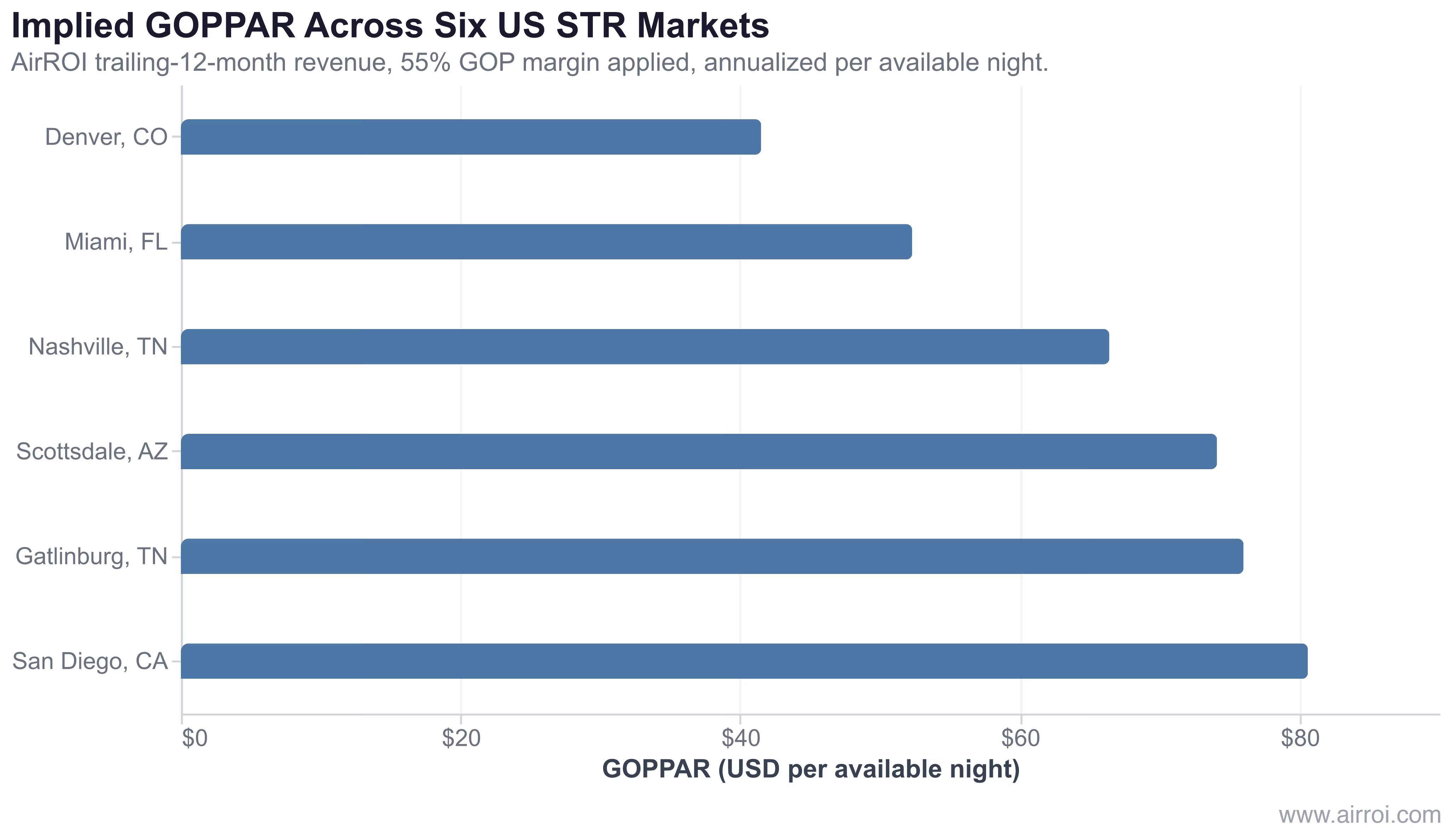
In AirROI's analysis of 35,301 active listings across San Diego, Gatlinburg, Scottsdale, Nashville, Miami, and Denver, median implied GOPPAR ranges from $41.50 per available night in Denver to $80.60 in San Diego:
| Market | Median Annual Revenue | Implied GOPPAR/night |
|---|---|---|
| San Diego, CA | $53,472 | $80.60 |
| Gatlinburg, TN | $50,438 | $76.00 |
| Scottsdale, AZ | $49,153 | $74.10 |
| Nashville, TN | $44,039 | $66.40 |
| Miami, FL | $34,738 | $52.30 |
| Denver, CO | $27,540 | $41.50 |
RevPAR tells you which market earns the most per night. GOPPAR tells you which market profits the most — and the ranking is rarely identical once operating costs enter the picture.
GOPPAR vs. RevPAR: Which Metric Matters More?
| Metric | What It Measures | Includes Costs? | Best Used For |
|---|---|---|---|
| RevPAR | Revenue per available night | No | Market benchmarking, pricing optimization |
| GOPPAR | Profit per available night | Yes | Investment comparison, operational efficiency |
A concrete example: Property A in an urban market posts RevPAR of $220 but carries $120 in operating costs per available night, yielding GOPPAR of $100. Property C in a vacation market posts RevPAR of $180 but only $60 in operating costs, yielding GOPPAR of $120. Property C is the better operating investment despite losing the RevPAR comparison by $40.
Why GOPPAR Matters for STR Investors
True profitability measurement. GOPPAR is the only top-line metric that captures both revenue performance and cost discipline simultaneously. Two properties with identical RevPAR have identical earning power — but wildly different economic outcomes if their expense structures diverge. GOPPAR surfaces that difference immediately.
Expense discipline. Tracking GOPPAR monthly alongside RevPAR reveals cost creep before it compounds. If RevPAR holds flat but GOPPAR declines, operating expenses are growing. That signal is invisible when looking at revenue metrics alone.
How to Improve Your GOPPAR
Negotiate vendor rates as the portfolio scales. Cleaning, maintenance, and linen service unit costs fall predictably as volume increases. A host managing five properties in the same zip code can typically negotiate 15–25% lower per-clean rates than a single-property host.
Frequently Asked Questions
GOPPAR stands for Gross Operating Profit Per Available Room. It measures the operating profit generated per available room-night after deducting all operating expenses — cleaning, platform fees, management, utilities, supplies, and insurance — but before debt service, income taxes, and depreciation. It is a more complete profitability metric than RevPAR because it accounts for costs, not just revenue.
GOPPAR = Gross Operating Profit ÷ Total Available Room-Nights. Gross Operating Profit equals total revenue minus all operating expenses. For example, a listing generating $6,200 in monthly revenue with $2,741 in operating expenses yields a GOP of $3,459, and with 30 available nights, a GOPPAR of $115.30 per night.
RevPAR measures revenue per available night and ignores costs entirely. GOPPAR deducts all operating expenses first, so it reflects actual profit per available night. A property with high RevPAR but heavy expense loads — urban luxury units with frequent turnovers, for example — can have a GOPPAR far below a simpler, lower-ADR property with lean operations.
GOPPAR varies widely by market and property type. Using AirROI trailing-12-month revenue data and a 55% GOP margin, implied GOPPAR ranges from roughly $42 per available night in Denver to $81 in San Diego across 35,301 active listings. Top-performing individual properties in high-ADR markets routinely exceed $120–$150 per night.
Hosts improve GOPPAR by growing revenue faster than costs — through ADR optimization, occupancy management, and dynamic pricing — while compressing per-turnover expenses by encouraging longer stays, negotiating vendor rates, and automating check-in and messaging. Each dollar cut from operating expenses flows directly to GOPPAR.