Local Airbnb rules2026 17 sources cited
Is Airbnb Legal in Louisville? 2026 Rules, Permits & Taxes
Short-term rentals are legal in Louisville with a $250 yearly city registration; second homes in residential zones also need a conditional use permit, and Airbnb collects the 15.5% lodging tax.2,3,6,7
From 15 official sources and 2 Airbnb help pages. Not legal advice.
The short answer
Louisville Airbnb Rules in Brief
- Register every property each year with the Office of Planning for $250 and show the registration number in the listing.
- Owner-occupied primary residences in residential zones need the registration only; other homes in residential zones need a conditional use permit ($200 pre-application plus $560 or $1,260) and a 600-foot gap from other permitted rentals.
- Lodging taxes total 15.5% (6% sales tax, 1% state transient room tax, 8.5% Louisville), and Airbnb collects them.
- Fines run from $125 to $1,000 per offense, and each day can count as a separate offense.
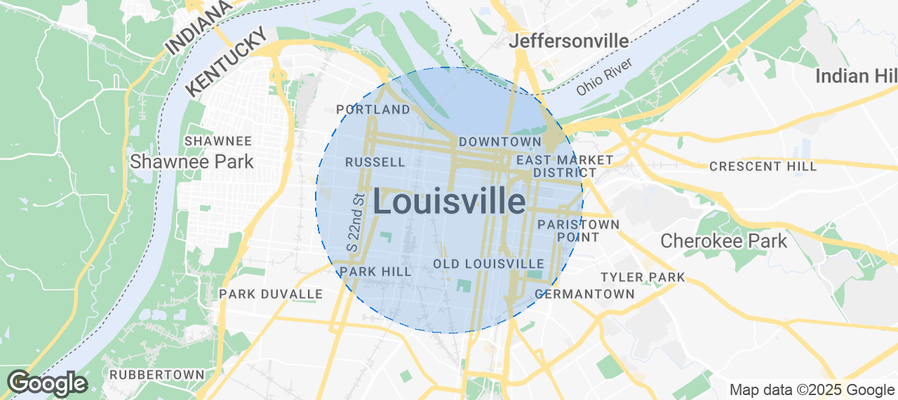 Browse the live Louisville Airbnb market See Every Louisville Listing
Revenue, occupancy and nightly rates are in the Louisville Airbnb market report .
At a glance
Louisville Airbnb Rules at a Glance
- Permit required
- Yes
- Taxes on a stay
- 15.5%
- Fine for hosting without a permit
- $1,000
- Listings showing a permit number
- 84%
- Latest rule change
- Sep 28, 2023
Listing figures: AirROI, 12 months to September 2026. A number on a listing doesn't prove the permit or license is valid, and a missing one doesn't prove there is none.
The rules in brief
The rules a Louisville host meets first, each linked to the ordinance, statute or official page it comes from. Details and exceptions follow below.
| Topic | Rule |
|---|---|
| Permit | Annual registration, $250 per property2,6 |
| Who can host | Owner's primary residence: registration only6 |
| Where | Second homes in residential zones need a conditional use permit6,16 |
| Building rules | Multi-family buildings are generally barred7 |
| Minimum stay | Rules apply to stays under 30 nights6,16 |
| Guests | Guests: two per bedroom plus two3 |
| Listing display | Registration number in every listing2,3,6 |
| Platforms | Platforms remove invalid listings within ten business days2,3 |
| Safety | Smoke, carbon monoxide and fire safety2,3 |
| Neighbors | Emergency contact within 25 miles3,7 |
Your home
Can You Host an Airbnb in Louisville? It Depends on the Home
Whether you can host in Louisville turns on whose home it is and whether you live there.
Your own home (primary residence), rented whole while you're away
AllowedAllowed in a residential zone with the $250 annual registration and two documents proving the home is your primary residence. In Old Louisville and Limerick a conditional use permit is also required, and a lease, HOA rules or deed restrictions can still bar it.6
A second home or investment property in a residential zone
Allowed with conditionsNeeds a conditional use permit ($200 pre-application plus $1,260, public hearing, typically 4 to 5 months) as well as the $250 registration, and must be at least 600 feet from another permitted rental. The board can deny it.6,16
A home in a commercial or other non-residential zone
Allowed with conditionsLikely allowed with the annual registration alone, approved administratively. Industrial and planned development zones are likely prohibited, so check the zoning on the city's eligibility map first.6
A condo or apartment in a multi-family building
Allowed with conditionsGenerally prohibited in a multi-family building unless it is zoned CR, CN, C1, C2, C3, OR3, OTF or EZ1. A condominium that is the owner's primary residence can seek a conditional use permit, which needs the condominium association's approval.3,7
A home in one of the nine suburban cities with no rules
Not allowedAnchorage, Douglass Hills, Graymoor-Devondale, Hurstbourne, Indian Hills, Jeffersontown, Prospect, Shively and St. Regis Park do not permit short-term rentals.6
Permit
Do You Need a Permit for Airbnb in Louisville?
Yes. Short-term rental hosts in Louisville need the short-term rental annual registration from the Louisville Metro Office of Planning; conditional use permits are decided by the Board of Zoning Adjustment. It costs $250 in the first year (An owner living in the home pays $250 a year for the registration. A second home that needs a conditional use permit pays $250 plus $200 and $1,260, $1,710 in the first year, then $250 a year to renew.) and $250 a year to renew.2,3,6,7
- Who needs it
- Every host renting a dwelling, or part of one, for fewer than 30 consecutive days in Louisville Metro, whichever platform or channel is used. Hosts also register with the Louisville Metro Revenue Commission for tax.2,3,6,7
- Issued by
- Louisville Metro Office of Planning; conditional use permits are decided by the Board of Zoning Adjustment
- Valid for
- A registration expires one year after it is issued and is renewed every year. A renewal application is accepted from 30 days before expiry, a late renewal is treated as a new application, and a change of host or owner voids the registration.
- Processing
- A registration-only application is approved administratively; a conditional use permit typically takes 4 to 5 months, depending on circumstances and the hearing docket.
- On listings
- The number must appear on every listing
- Platform checks
- The Director of Planning can ask a platform to remove a listing whose registration number is invalid, expired or revoked, and the platform must remove it within ten business days of the notice.
Fees
| Fee | Amount |
|---|---|
| Annual registrationNonrefundable fee for each property, paid with the registration form and renewed every year. | $250 |
| Conditional use permit pre-applicationRequired first, with a staff conference and a neighborhood meeting. | $200 |
| Conditional use permit application (owner occupied)Formal application fee where the owner lives in the home. | $560 |
| Conditional use permit application (non-owner occupied)Formal application fee for a rental that is not the owner's residence. | $1,260 |
Who qualifies
- Owner who lives in the home as a primary residence in a residential or office-residential zone: annual registration only, approved administratively, with two documents proving residency
- Home that is not the owner's primary residence in a residential or office-residential zone: conditional use permit and annual registration
- Old Louisville and Limerick neighborhoods: conditional use permit and annual registration even for an owner's primary residence
- Non-residential zones: registration only; industrial and planned development zones are likely prohibited
- Multi-family buildings are generally prohibited unless the zoning is CR, CN, C1, C2, C3, OR3, OTF or EZ1
- Lease terms, homeowner association rules and deed restrictions still apply on top of the city's rules
How to apply
- Check the address on the city's interactive eligibility map, confirm the zoning, and confirm the home is in Louisville Metro and not one of the nine suburban cities with no rules.
- Register with the Louisville Metro Revenue Commission to get a Tax Reporting Number; a host does this once for several rentals.
- If the zoning requires a conditional use permit, file a $200 pre-application (staff conference and neighborhood meeting), then the formal application ($560 owner occupied, $1,260 non-owner occupied) and attend the public hearing of the Board of Zoning Adjustment.
- Submit the annual registration form to the Office of Planning with the $250 fee, the tax number and, for a primary residence, two documents proving residency; after a permit is approved, register within 30 days.
- Put the registration number in every listing, post the host and emergency-contact details inside the home, and renew each year.
Applications go through the official application page .
Permit rules
- Annual registration, $250 per property
- Every short-term rental must be registered each year with the Office of Planning, for a $250 fee per property, after the host gets a Tax Reporting Number from the Revenue Commission.2,6 In force since September 28, 2023
- Registration lasts one year
- A registration is valid for one year from the date it is issued and must be renewed on a new form. A renewal is accepted from 30 days before expiry, and a change of host or owner ends the existing registration.2,7
- Conditional use permit costs and timeline
- A conditional use permit costs a $200 pre-application fee plus $560 (owner occupied) or $1,260 (non-owner occupied), and the city says the process typically takes 4 to 5 months.6
- Public hearing, then register within 30 days
- The formal application goes to a public hearing before the Board of Zoning Adjustment. If the permit is approved, the rental must be registered with the Revenue Commission and the Office of Planning within 30 days.6
Who can host
Who Can Host an Airbnb in Louisville, and Where
Kentucky state law applies on top of Louisville's own rules: the Kentucky short-term rental regulations page covers the state license and what cities and counties can and can't regulate.
- Owner's primary residence: registration only
- An owner who lives in the home as a primary residence in a residential or office-residential zone can usually operate with the annual registration alone, which is approved administratively.6
- Two documents prove primary residency
- A registration claiming a primary residence needs at least two supporting documents, a Kentucky-issued identification card plus a voter registration card, vehicle registration or tax record. In some cases the owner must show six months of residence before applying.6
- Second homes in residential zones need a conditional use permit
- A short-term rental that is not the owner's primary residence in a residential or office-residential zone is allowed only with a conditional use permit and the annual registration. The permit is discretionary and decided by a public board.6,16
- Old Louisville and Limerick need a permit even for a primary residence
- In the Old Louisville and Limerick neighborhoods an owner's primary residence also needs a conditional use permit as well as the annual registration.6 Applies to: Old Louisville and Limerick
- Non-residential zones: registration only
- A property in a non-residential zone is likely allowed to operate with the annual registration alone, approved administratively.6
- Industrial and planned development zones are likely barred
- A short-term rental in an industrial zone or a planned development district is likely prohibited.6
- 600 feet from another permitted rental
- To win a conditional use permit, a short-term rental must be at least 600 feet from another rental that received a conditional use permit.6
- Multi-family buildings are generally barred
- A short-term rental in a multi-family building is generally prohibited unless the zoning is CR, CN, C1, C2, C3, OR3, OTF or EZ1.7
- Condominiums need association approval
- A conditional use permit application for a condominium unit must include evidence that the condominium association has approved short-term rental of that unit; the unit must be the host owner's primary residence.3 Applies to: Condominiums
- Leases, HOA rules and deeds still apply
- Louisville's rules do not override leases, homeowner association bylaws, covenants or deed restrictions that prohibit subletting or short-term rental use, although the city does not enforce those agreements itself.6
- The owner is the primary host
- Unless a conditional use permit says otherwise, the owner must act as the primary host and the main contact for the city, neighbors and guests; co-hosts and property managers may assist.3
- Nine Jefferson County cities do not permit rentals
- Anchorage, Douglass Hills, Graymoor-Devondale, Hurstbourne, Indian Hills, Jeffersontown, Prospect, Shively and St. Regis Park have adopted no short-term rental rules, so rentals there are not permitted; Lyndon, Middletown and St. Matthews have their own rules.6 Applies to: Jefferson County cities
Operating rules
Operating Rules for Louisville Short-Term Rentals
- Rules apply to stays under 30 nights
- Louisville Metro defines a short-term rental as a dwelling rented or leased for fewer than 30 consecutive days, so stays of 30 nights or more fall outside the registration rules.6,16
- Guests: two per bedroom plus two
- No more people may stay than two times the number of bedrooms plus two, or two times the bedrooms plus six on a lot of more than two acres, with a cap of 12 guests over age 16 where the formula allows more.3
- One booking at a time
- A dwelling may have only a single short-term rental contract at a time, and a guest's stay is capped at 29 consecutive days.2,3
- Smoke, carbon monoxide and fire safety
- Each rental needs smoke alarms to the city standard, a working carbon monoxide detector, a charged fire extinguisher on each habitable floor, an emergency escape opening in every sleeping room and a posted evacuation plan.2,3
- Emergency contact within 25 miles
- The registration names the host and an emergency contact who must be within 25 miles of the rental while it is rented; the contact details and maximum guest numbers must be posted inside the home, and the host answers for guest behavior at any hour.3,7
- Revoked registrations bar a new one for a year
- The city can revoke a registration after repeated substantiated complaints or violations within 12 months, and an owner or host whose registration is revoked cannot register again for one calendar year.2,3
- Accessory dwelling units: permit needed
- A new accessory dwelling unit cannot be used as a short-term rental without a conditional use permit.15 Applies to: Accessory dwelling units
Taxes
How Much Are Airbnb Taxes in Louisville?
About 15.5% on the nightly price and fees for stays of 29 nights or fewer: 6% sales tax, 1% state transient room tax and 8.5% Louisville Metro transient room tax.
15.5% in all
How the 15.5% on a Louisville stay splits between the taxes in the table below
- Louisville Metro transient room tax 8.5%
- Kentucky sales tax 6%
- Kentucky state transient room tax 1%
- Median nightly rate, booked nights
- $195
- Taxes on that night (15.5%)
- $30
- Guest pays, before Airbnb and cleaning fees
- $225
| Tax | Rate | Collected by |
|---|---|---|
| Kentucky sales tax 6% of the listing price, including cleaning fees, for stays of 29 nights or fewer | 6%5,17 | Airbnb |
| Kentucky state transient room tax 1% of the listing price, including cleaning and guest fees, for stays of 29 nights or fewer | 1%1,4,17 | Airbnb |
| Louisville Metro transient room tax 8.5% of the total rent, including cleaning and guest fees, for stays of 29 nights or fewer | 8.5%8,9,17 | Airbnb |
At Louisville's median booked rate of $195 a night, the taxes collected on a booking come to about $30 a night.
What the host still handles
- A Tax Reporting Number with the Louisville Metro Revenue Commission, required of every host whatever the booking method, with an annual Occupational License Net Profit Tax return on rental income
- A Louisville transient room tax account and monthly returns, only for rent received directly rather than through Airbnb or another registered platform
- A Kentucky Department of Revenue transient room tax account, only if some rent is received directly; a host booking only through Airbnb or VRBO needs none1,4,5,8,9,10,17
Fines
How to Avoid Airbnb Fines in Louisville
Fines in Louisville fall on hosting without the short-term rental annual registration, or outside the rules above. With it in hand and the rules followed, none of the fines below apply.
- Operating a short-term rental without a registration draws a civil fine of $125 for a first offense, $250 for a second, $500 for a third and $1,000 for a fourth or later offense. Each day may be considered a separate offense.3,6
- Advertising an unregistered short-term rental on a platform draws an additional fine of $125 per day.3,6
- After a registration is revoked, the owner or host cannot register again for one calendar year, and a new registration is not issued for a property cited in the prior 12 months.2,3
- Late Louisville transient room tax carries a 5% penalty on the unpaid amount, plus simple interest of 12% a year.8,9
Changes
What's Changed in Louisville's Airbnb Rules
No change was scheduled when the rules were checked on October 17, 2026; the most recent are listed first.
- April 15, 2026 Lapsed
- September 28, 2023
- July 1, 2023Revenue Commission transient tax regulations and e-filing
The Louisville Metro Revenue Commission's Transient Room Tax Regulations took effect on July 1, 2023, with returns filed electronically through its portal.8
- January 1, 2023
Listing data
What Louisville's Listings Show
AirROI, a short-term-rental data firm, counted 2,190 active Airbnb listings in Louisville over the 12 months to September 2026. 84% of them displayed a permit, license or registration number.
Minimum stay set on Louisville listings
Share of active listings by the shortest stay they accept
Minimum stay in numbers
| Shortest stay accepted | Share of listings |
|---|---|
| 1 night | 36% |
| 2 nights | 41% |
| 3 nights | 8% |
| 4–6 nights | 2% |
| 7–29 nights | 4% |
| 30+ nights | 9% |
What officials report
- 1,213
- Short-term rental registrations opened in the past 12 months · as of October 17, 2026Louisville Metro's open data layer lists 1,213 short-term rental registrations opened between October 2025 and October 15, 2026; registrations last one year, and the layer holds 1,226 records in all.11
- 506
- Short-term rental conditional use permits with approved status · as of October 7, 2026Of 1,218 conditional use permit records, 506 are approved (484 approved and 22 approved as host owner occupied), 96 were denied, 72 were revoked and 5 await a hearing.12
Earnings
What Could a Louisville Short-Term Rental Earn?
The rules shape the numbers: a permit that costs $250 in the first year, a maximum of 12 guests and taxes of 15.5% that Airbnb adds to guests' bills. For a specific address, the short-term rental calculator estimates revenue, occupancy and nightly rate from comparable listings, so you can test the numbers before applying.
FAQ
Louisville Airbnb Rules: Frequently Asked Questions
Is Airbnb legal in Louisville?
Yes. Short-term rentals of fewer than 30 nights are legal in Louisville Metro if the property is registered every year with the Office of Planning; owners hosting in their primary residence in a residential zone need only the registration, while other homes in residential zones also need a conditional use permit.6,16
Do I need a permit for Airbnb in Louisville?
How much is the Louisville short-term rental registration?
Can I rent a home I don't live in?
Does Airbnb collect hotel tax in Louisville?
What is the total lodging tax on an Airbnb stay in Louisville?
What is the fine for an illegal Airbnb in Louisville?
Is there a limit on how many nights I can host in Louisville?
Do I need to show a registration number on my Airbnb listing in Louisville?
Are Airbnbs allowed in Jeffersontown, St. Matthews and other suburbs?
It depends on the suburb. Nine cities, including Jeffersontown, Prospect and Shively, have no short-term rental rules and so do not permit them, while Lyndon, Middletown and St. Matthews have their own regulations.6
Can I run an Airbnb from an apartment or condo in Louisville?
Do I need a Louisville business license or tax registration to host?
How many Louisville Airbnbs are registered?
Short-term rental registrations opened in the past 12 months: 1,213 as of October 17, 202611. In AirROI's listing data, 84% of the 2,190 Louisville Airbnb listings active in the 12 months to September 2026 displayed a permit, license or registration number. A number on a listing shows the host entered one; it doesn't confirm the permit is valid.
How much does an Airbnb make in Louisville?
The average Louisville listing earned $31,200 in the 12 months to September 2026, according to AirROI, averaged across every active listing including those booked for only part of the year. The Louisville Airbnb market report breaks it down by month, property size and neighborhood.
Method
How These Rules Were Checked
Each rule on this page was checked in October 2026 against the official source cited beside it: the ordinance or statute, the permit office's own pages and the tax authority. Airbnb's help pages are cited on their own only for what Airbnb itself does, such as the taxes it collects and the permit checks it runs, and otherwise only beside an official source; news reports only for when a change was announced. Rules that could not be confirmed on an official page are left out. The Louisville Metro Planning and Revenue Commission pages were read from Internet Archive copies (the Planning page from August 2026), and the Louisville Metro Code of Ordinances on American Legal Publishing was read in a browser.
Rules change with council votes, court rulings and new state laws, so the page is rechecked every three months and whenever a scheduled change takes effect. It summarizes the rules for information and is not legal advice; the local authority has the final word on any application.
Listing figures come from AirROI's tracking of 2,190 active Louisville Airbnb listings over the 12 months to September 2026.
Sources
Sources
Each rule above links to the source it comes from. Official ordinances, statutes and government pages come first, then Airbnb's own help pages.
- 1. KRS 142.400 Statewide transient room tax -- Rate -- Exclusions from tax · Kentucky Legislative Research Commission
- 2. Louisville Metro Code of Ordinances, Chapter 115: Short Term Rentals (sections 115.515 to 115.522) · Louisville/Jefferson County Metro Government (American Legal Publishing)
- 3. Ordinance amending the Land Development Code and LMCO Chapter 115 relating to short term rentals (as amended September 14, 2023) · Louisville Metro Council
- 4. Transient Room Tax · Kentucky Department of Revenue
- 5. Transient Room Tax (Tax Answers) · Kentucky Department of Revenue
- 6. Short Term Rental Information · Louisville Metro Office of Planning
- 7. Short Term Rental Annual Registration Form (October 2025) · Louisville Metro Office of Planning
- 8. Transient Room Tax · Louisville Metro Revenue Commission
- 9. TR1M Transient Room Tax Electronic Form Instructions, Tax Year 2025 · Louisville Metro Revenue Commission
- 10. Tourism Improvement District Assessment (TID) · Louisville Metro Revenue Commission
- 11. Short term rental registration (open data feature service) · Louisville Metro Government (LOJIC open data)
- 12. Louisville Metro KY - Short Term Rental Conditional Use Permits (open data feature service) · Louisville Metro Government (LOJIC open data)
- 13. 26RS SB 9 (AN ACT relating to housing districts) · Kentucky Legislative Research Commission
- 14. 2026 Regular Session Legislative Record · Kentucky Legislative Research Commission
- 15. Accessory Dwelling Units (ADU) · Louisville Metro Office of Planning
- 16. Louisville, KY · Airbnb Help Center
- 17. Occupancy tax collection and remittance by Airbnb in Kentucky · Airbnb Help Center