Maui Vacation Rental Ban: Bill 9 Condos Fill 49% of Airbnb Nights

The Maui vacation rental ban ends short-term rentals in the apartment-zoned condos on the Minatoya list, with the last legal night at the end of 2028 in West Maui and the end of 2030 everywhere else. Those condos are the island's budget rentals. In South and West Maui they filled 49% of booked Airbnb nights over the past year, at lower nightly rates than the condos that get to keep renting.
Using AirROI's data, we matched 7,774 active South and West Maui Airbnb listings to the county's list by building name and location, and followed them through August 2026. The list condos rent at a median $364 a night, $94 below other condos. Eight months after Bill 9 was signed, the condos' share of listings has not moved (44.3% then, 44.7% now), and the exemption fight turns out to be over nearly half of them.
Bill 9 Ends Condo Vacation Rentals After 2028 in West Maui and 2030 Elsewhere
The ordinance's own findings give the reason: the county is in a housing crisis, and "The August 2023 Maui Wildfires magnified that crisis when more than 5,400 households were destroyed, displacing 12,000 people." The buildings that relied on the repealed exception are what owners call the Minatoya list. The table below shows what the ordinance and the county's own documents say.
| Rule | What it says | Source |
|---|---|---|
| What changes | Transient vacation rentals are no longer a permitted use in apartment-district buildings that relied on the old exception | Ordinance 5909, §19.12.020 |
| Who is affected | 104 properties with 7,167 vacation rental units on the county's list dated June 27, 2024; 6,208 units were operating as short-term rentals as of May 29, 2024 | County list; County release |
| Last legal day | Dec 31, 2028 (West Maui community plan area); Dec 31, 2030 (rest of the county) | Ordinance 5909, §19.12.070(B) |
| Must cease | Jan 1, 2029 (West Maui); Jan 1, 2031 (rest of the county) | Ordinance 5909, §19.12.070(B) |
| Exempt | "Validly existing time share units, uses permitted and operating within the terms of a variance, and uses otherwise permitted by law" | Ordinance 5909, §19.12.070(C) |
| Still allowed | Hotel-zoned property, bed and breakfast permits, short-term rental home permits, conditional permits | Ordinance 5909, §19.37.010(A) |
| Owner notice | Director of finance to notify affected owners by March 1, 2026; parcel list to the Council by March 15, 2026, updated yearly through March 15, 2030 | Ordinance 5909, §19.12.070(D), (F) |
| Way to keep renting | Rezoning to the H-3 or H-4 hotel districts, created by Ordinance 6008, effective June 22, 2026 | Resolution 26-110, Exhibit 1 |
The Council passed Bill 9 5-3, as reported by Maui Now, and Mayor Richard Bissen signed it on December 15, 2025, giving the county's reason in the signing release:
"Today, transient vacation rentals make up 21% of Maui County's overall housing stock — more than any other county in Hawaiʻi." — Mayor Richard Bissen, County of Maui release, Dec 15, 2025
The Phased-Out Condos Fill Half of South and West Maui's Airbnb Nights
Minatoya-list condos are 45% of the active entire-home Airbnb listings in South and West Maui, and they fill a larger share of the nights than their numbers suggest. Over September 2025 through August 2026, 3,471 of 7,774 listings matched a building on the list. Those listings booked 479,574 of the area's 979,859 nights, or 48.9%, and took in $219.4 million of $566.4 million in revenue, or 38.7%.
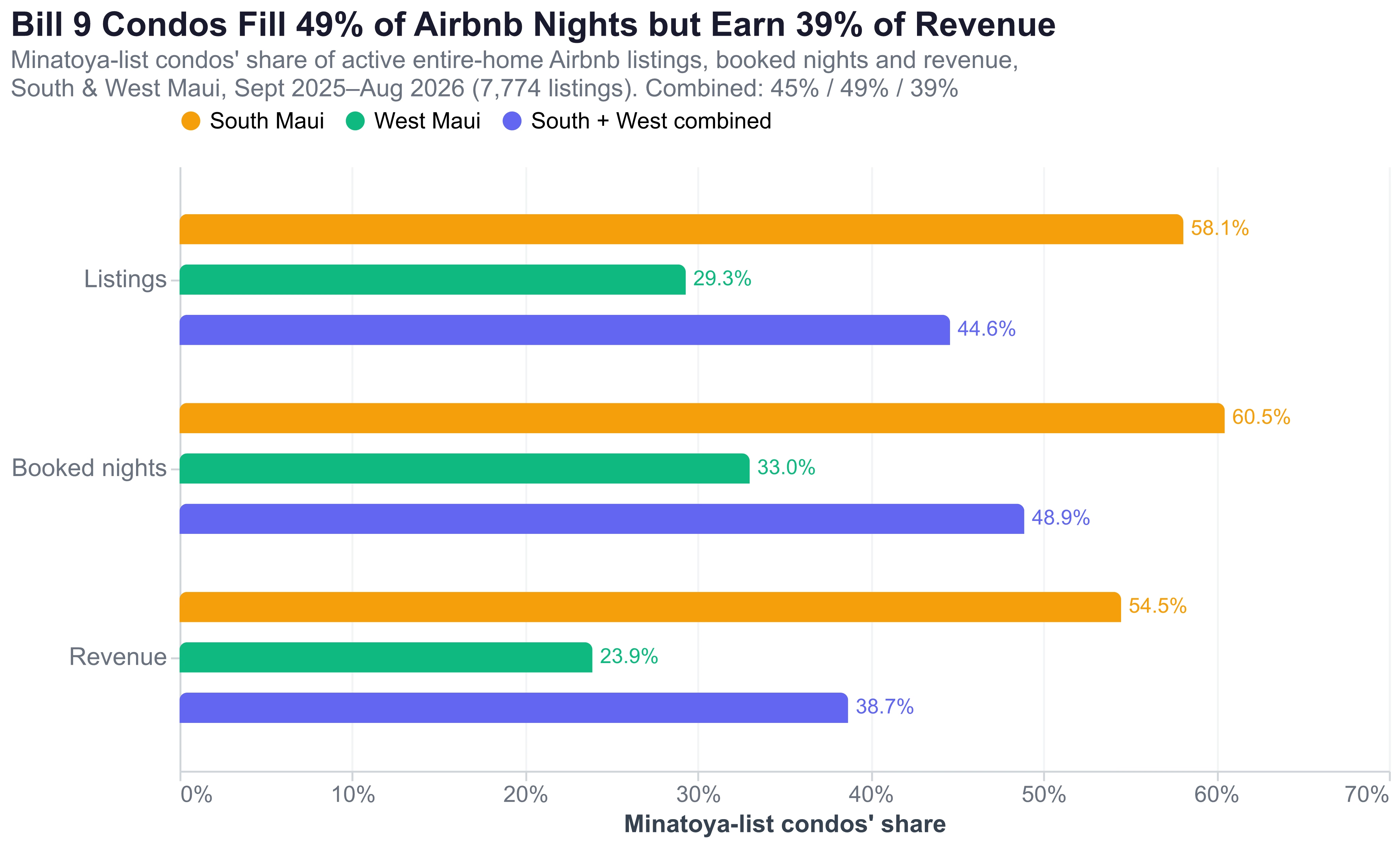
That pattern, more nights than listings and less revenue than nights, is the signature of a budget tier. Guests book these condos often and pay less for each night. The other 55% of listings, outside the list, are untouched by Bill 9.
South Maui carries most of the exposure. Look at the listing column first: well over half of South Maui's Airbnb supply sits in list buildings, against less than a third in West Maui.
| South Maui | West Maui | South + West | |
|---|---|---|---|
| Minatoya-list listings | 2,411 of 4,152 | 1,060 of 3,622 | 3,471 of 7,774 |
| Share of listings | 58.1% | 29.3% | 44.6% |
| Share of booked nights | 60.5% | 33.0% | 48.9% |
| Share of revenue | 54.5% ($149.7M of $274.5M) | 23.9% ($69.8M of $291.9M) | 38.7% ($219.4M of $566.4M) |
| Median nightly rate, list condos | $357 | $386 | $364 |
| Median nightly rate, other listings (condos and homes) | $397 | $565 | $475 |
The county's December release puts about 60% of Minatoya units in South Maui, alongside 2,700+ rentals that stay, which squares with our 58.1%. If nothing is rezoned, South Maui loses 58% of its Airbnb listings and 61% of its booked nights; West Maui loses 29% and 33%. The 44.6% here is a 12-month share; the 44.3% and 44.7% figures below are monthly snapshots.
They Rent for $94 Less a Night, and the Gap Widens With Size
The median Minatoya-list listing books at $364 a night, against $458 for other condos in the same two regions. The gap is small in studios and one-bedrooms and grows with every bedroom.
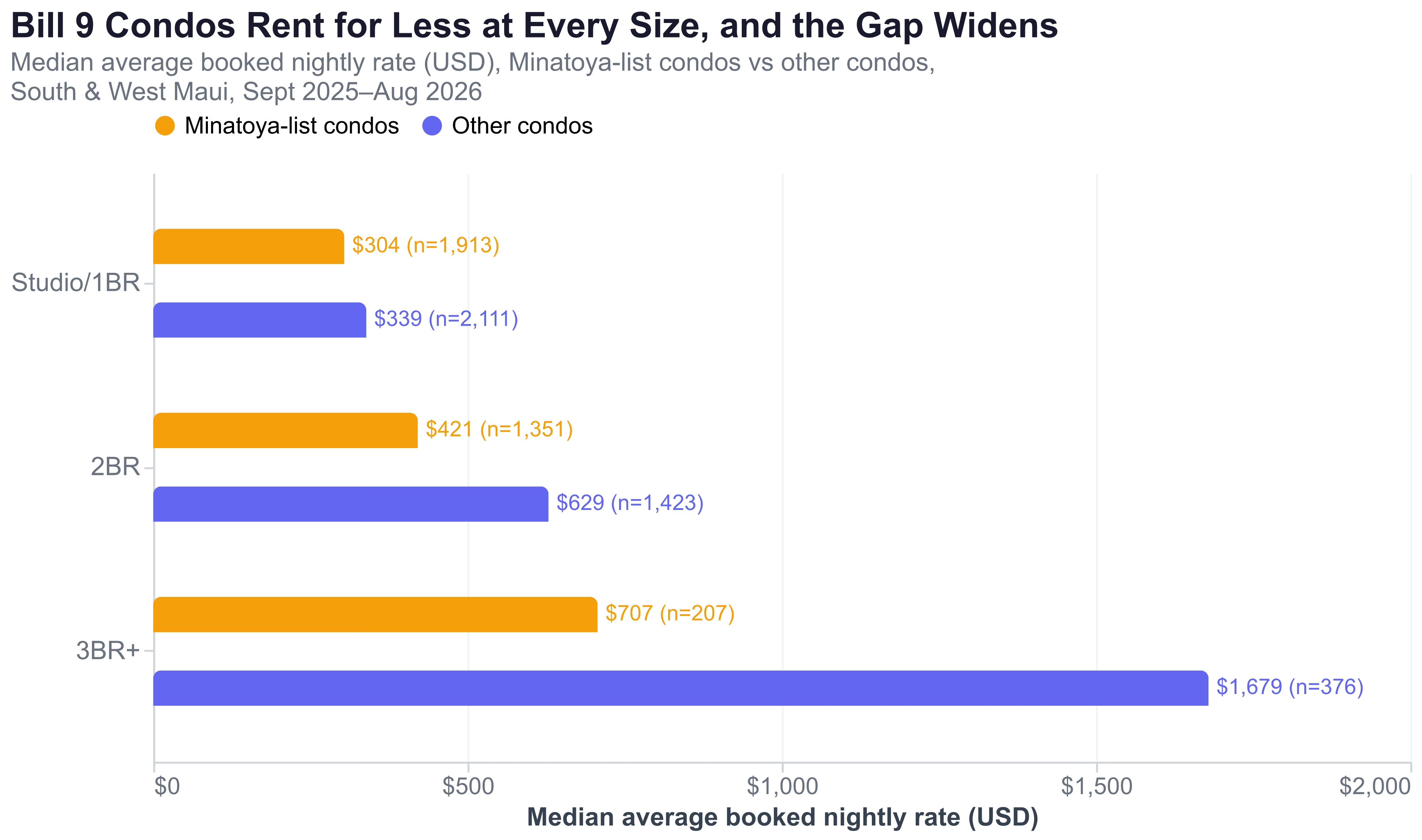
At two bedrooms the list condos rent for $421 against $629. At three bedrooms and up, $707 against $1,679. List condos also book more nights: the median list listing booked 122 nights over the year against 87 for other condos, and earned $51,210 against $51,341.
At the extremes, the extra nights more than cover the lower rate. The median studio or one-bedroom on the list earned $42,940 against $38,868, and the median three-bedroom $147,604 against $135,043. Only at two bedrooms do the condos that stay come out ahead, $65,774 to $57,596. The list condos still take a smaller share of revenue because the rest of the market carries a high-priced tail: 376 three-plus-bedroom condos at a median $1,679 a night (against 207 on the list), plus 393 houses and villas.
One likely reason is age. Every property on the county list was built between 1935 and 1994, because the old exception covered only apartment buildings approved by April 20, 1989. The condos that keep renting include newer resorts built under hotel zoning: Honua Kai (2009), Wailea Beach Villas (2002), Hoolei (2007) and Kapalua Bay (2009).
On the Honokōwai–Kāʻanapali coast, the difference is one building to the next. Papakea, a 364-unit complex built in 1977 and listed in Resolution 26-111 (not among the five the commission endorsed, per the Star-Advertiser's report), rents its one-bedrooms at a median $383 a night; they booked 83 nights and earned $38,835 over the year (29 listings). One-bedrooms at Honua Kai, hotel-zoned, rent for $786, booked 57 nights and earned $49,692 (77 listings). Papakea fills more nights at half the rate.
Kīhei complicates the picture. Kamaole Sands, the largest property on the list at 440 units, built in 1983, rents one-bedrooms at a median $304 and booked 94 nights (60 listings). Up the same road, hotel-zoned Kihei Akahi, built in 1977, gets $275 and booked 76 nights (37 listings). Here the zoning line does not track price at all; the ban removes the busier building and leaves its cheaper neighbor.
Opponents of the ban read the price gap as the point of the policy:
"By wiping out the condo rentals (the Minatoya list), the county is effectively killing the competition for the luxury resorts." — u/indescription, r/maui, thread "Where we're headed..." (114 upvotes)
Our data supports the first half of that: the phased-out condos are the cheaper tier. Whether resorts gain from their exit is not something we measure.
Eight Months After Bill 9, Owners Haven't Pulled Listings
Minatoya-list condos made up 44.3% of active entire-home listings in South and West Maui in December 2025, the month Bill 9 was signed, and 44.7% in August 2026. In every month since January 2024, the share has stayed between 43.9% and 45.7%.
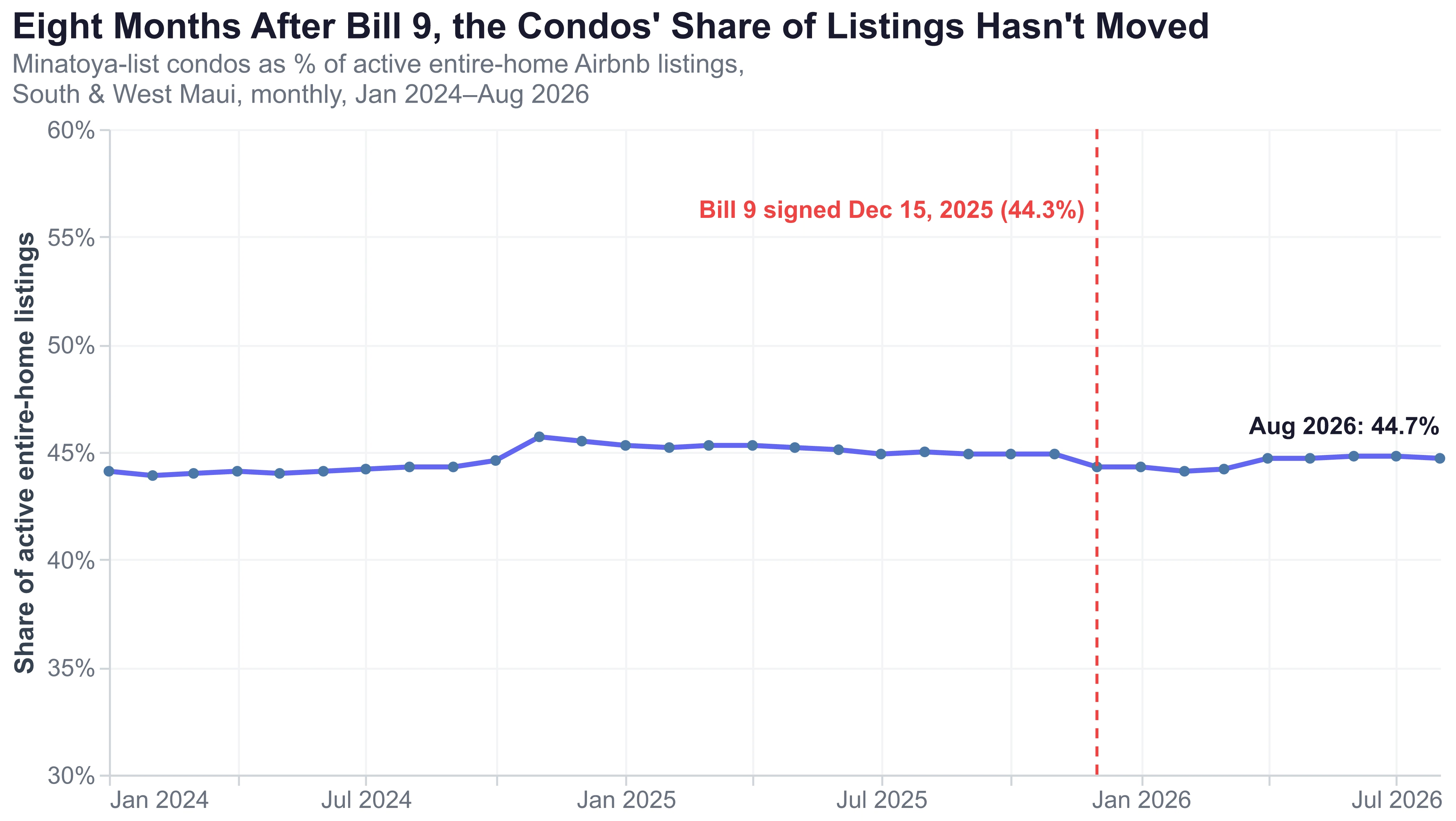
The count tells the same story: 3,443 active list listings in December 2025 and 3,476 in August 2026. Revenue is the only early signal, and it is small: list-condo revenue grew about 2 points slower than other listings in both regions. From January through August 2026, list condos in South Maui took in $94.0 million, up 5.8% from $88.9 million a year earlier, against 7.8% for other South Maui listings. In West Maui, list condos rose 18.3% from $37.7 million to $44.6 million, against 20.2%.
Owners have not moved to monthly rentals either. Counting every active list listing, including those our sample leaves out for long minimum stays, only 11 now require stays of 28 nights or more, down from 22 in December 2025.
The behavior follows from the ordinance. The use stays legal until the last day of 2028 or 2030, so an owner who keeps renting keeps full earnings for more than two years. The H-3 and H-4 rezoning path is open, and owners at Kāʻanapali Royal filed suit over Bill 9 in December 2025, according to the complaint posted by Courthouse News. For some owners the loss shows up in the value of the unit instead:
"We've lost $50,000 and are now upside down on our mortgage." — u/cranberrysauce6, r/maui, thread "Where we're headed..." (24 upvotes)
The Commission's Version Spares 3% of These Listings; the Council's Would Spare 43%
The Council's exemption proposal covered nearly half of the affected Airbnb supply; the Planning Commission's recommendation covers a sliver. For this comparison the base switches from South and West Maui to all of Maui island, including Hāna and Pāʻia, where we matched 3,532 active Airbnb listings to properties on the county list. Of those, 1,513 (43%) sit in the 48 properties named in Resolutions 26-110 and 26-111, and 114 (3%) are in the 5 properties the commission endorsed.
The table shows how much of the matched supply each version would keep; compare the first two rows.
| Group | Matched Airbnb listings | Share of 3,532 | Median revenue, past 12 months |
|---|---|---|---|
| In the 48 properties the Council's resolutions proposed | 1,513 | 43% | $49,189 |
| Of those, in the 5 the commission endorsed | 114 | 3% | $62,724 |
| Of those, in the 43 recommended for denial | 1,399 | 40% | $47,780 |
| On the list but in neither resolution | 2,019 | 57% | $53,046 |
The listings the commission turned down earn a median $47,780 a year. The 57% in neither resolution, including Kīhei's Maui Vista (280 units, one-bedrooms at a median $251 that booked 138 nights), have no exemption path yet.
The commission's vote is a recommendation. The Star-Advertiser reported that "the County Council still may approve exemptions not endorsed by the commission by a two-thirds vote," and that Greg Pfost of the Planning Department said more applications may come, "including 32 properties that the Council has been considering based on their proximity to the shoreline." Housing advocates opposed the whole package:
"This is an absolute slap in the face." — Nara Boone, Maui Housing Hui, testifying against the exemptions, as reported by the Honolulu Star-Advertiser, Sept 23, 2026
Whether the Council Overrides the Planning Commission
The commission's vote is only a recommendation. The Council can still approve exemptions the commission did not endorse, but it needs a two-thirds vote to do it, and until it acts, owners in the rejected buildings don't know whether Bill 9 will end their rentals or let them continue.
If the Council follows the commission, the exemption fight shrinks to the handful of buildings the commission backed, and the 40% of matched list listings in the rejected properties face the same phase-out as the rest of the list. If a two-thirds majority overrides it, those listings, Papakea's one-bedrooms among them, escape Bill 9. Neither outcome reaches the 57% of list listings in neither resolution, Maui Vista in Kīhei among them, which have no exemption path yet.
Frequently Asked Questions
Under Ordinance 5909, condos on the Minatoya list in the West Maui community plan area may keep renting short-term through December 31, 2028 and must stop on January 1, 2029. Everywhere else in Maui County, the use may continue through December 31, 2030 and must cease on January 1, 2031. Some explainers still show 2025 or 2026 dates from the 2024 proposal; those are out of date.
Check the county's apartment-district short-term occupancy list, which names 104 properties with 7,167 vacation rental units, by complex name or tax map key. Complexes on the county's separate non-apartment list, such as hotel-zoned Honua Kai or Kihei Akahi, are not affected by Bill 9. The county treats the list as informational, so confirm your parcel with the Planning Department before you rely on it.
The Honolulu Star-Advertiser reported that on September 22, 2026 the commission voted 6-2 to recommend denying hotel-zoning exemptions for all but 5 of the 48 properties proposed, backing only those with a combined 397 units. The vote is a recommendation. The Star-Advertiser also reported that the County Council can still approve exemptions the commission did not endorse by a two-thirds vote.
No. Bill 9 removes short-term rentals only from apartment-zoned buildings on the Minatoya list. Hotel-zoned condos, permitted short-term rental homes, bed and breakfasts, timeshare units and uses operating under a variance continue. In South and West Maui, 55% of active entire-home Airbnb listings sit outside the list.
No. Minatoya-list condos made up 44.3% of active entire-home Airbnb listings in South and West Maui in December 2025, when Bill 9 was signed, and 44.7% in August 2026. Counting all active list listings, only 11 now require stays of 28 nights or more, down from 22 in December 2025, so owners have not moved to monthly rentals either.