World Cup 2026 Airbnb Data Report: Rates, Pacing, and Match-Day Premiums Across All 16 Host Cities

Airbnb rates across the 16 FIFA World Cup 2026 host cities have more than doubled — from $216 to $450 average daily rate — compared to the same June 11 through July 19 window one year ago. That is the headline, but it is not the story.
Live data hub: The consolidated tournament dataset — refreshed every Monday through July 19, 2026, with sortable tables, the match-day premium heatmap, and per-city profiles — lives at World Cup 2026 Short-Term Rental Data.
The story is that the doubling is a mirage composed of two very different numbers. Guests who already booked their World Cup stays locked in a +48% premium over 2025 rates. Hosts asking for whatever remains on the shelf are demanding a +146% premium — roughly 2.5x last year. That 98-percentage-point gap between what the market has demonstrated it will pay and what hosts are currently asking is the single most important signal in the World Cup 2026 short-term rental market, and it means the next 37 days will separate the hosts who captured the tournament from those who priced themselves out of it.
This report synthesizes three proprietary AirROI datasets across approximately 16,000 Airbnb listings — the 1,000 closest qualifying properties to each of the 16 host stadiums — to deliver the most comprehensive, data-backed analysis of World Cup 2026 accommodation pricing published to date. We cover year-over-year rate comparisons, forward booking pace by city, match-day rate premiums for every game in the group stage, the overpricing gap that threatens Tier 3 markets, the 5x rate spread between the cheapest and most expensive host cities, and specific pricing guidance for hosts and travelers entering the final booking window.
The big picture: rates doubled, but the split matters
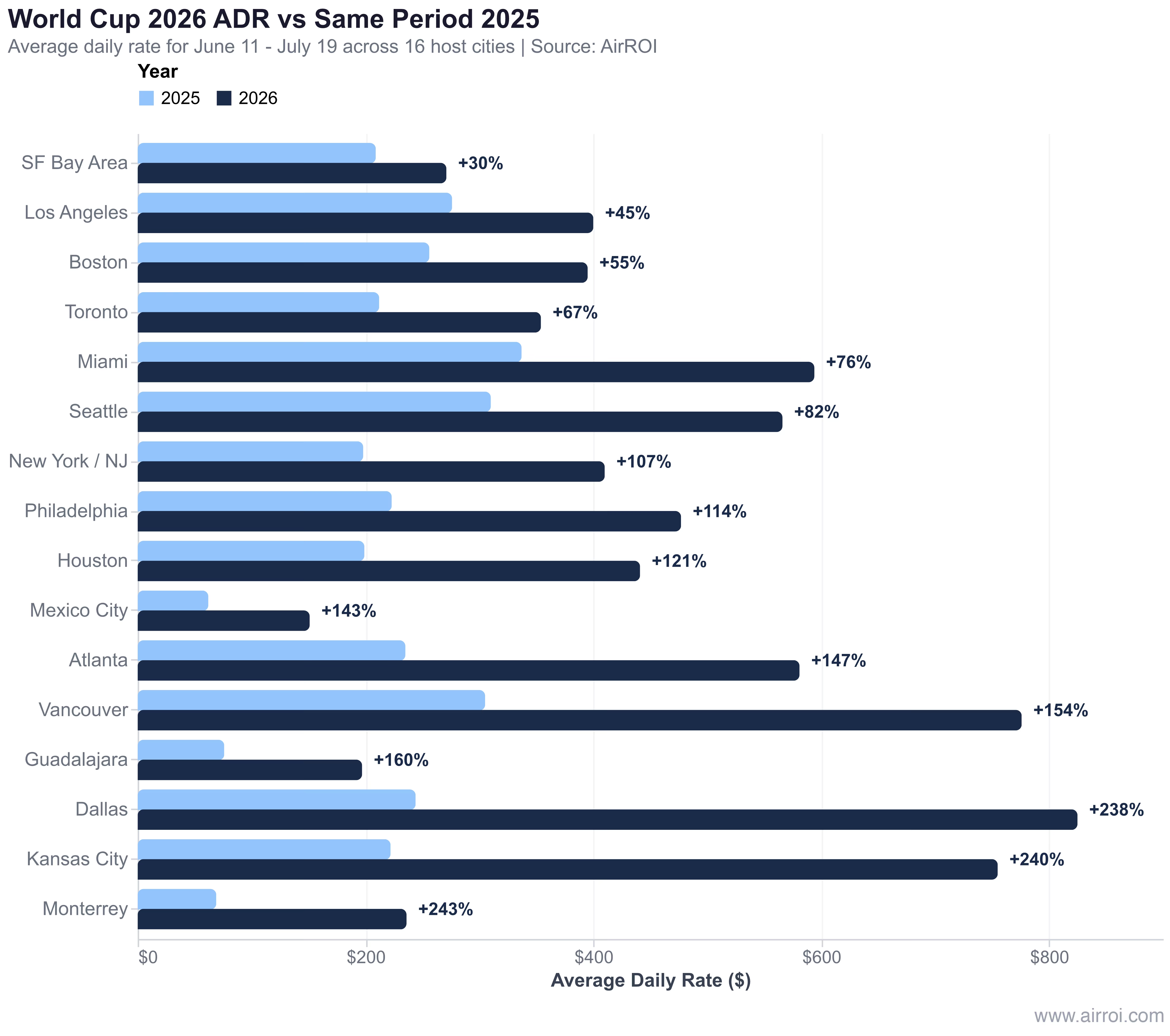
The year-over-year comparison uses each listing's own posted daily rates for the identical 39-night window — June 11 to July 19 — in 2025 versus 2026. Seasonality is controlled by construction. The 2025 figures are realized (actual market rates), while 2026 figures are current forward-looking rates. This makes the rate comparisons valid and the occupancy comparisons invalid (2025 occupancy is realized; 2026 is still filling).
Regional aggregations
| Region | Cities | 2025 ADR | 2026 ADR | ADR Change | Booked Rate Change | Available Rate Change |
|---|---|---|---|---|---|---|
| USA | 11 | $246 | $499 | +102% | +40% | +135% |
| Mexico | 3 | $69 | $194 | +184% | +118% | +203% |
| Canada | 2 | $256 | $556 | +117% | +50% | +155% |
| All 16 | 16 | $216 | $450 | +109% | +48% | +146% |
Mexico shows the largest percentage lift (+184%) because its 2025 baseline is low ($69 ADR). In absolute dollar terms, US and Canadian cities moved more: US ADR climbed by $253 per night on average versus $125 for Mexico.
The critical column is the gap between booked rate change (+48%) and available rate change (+146%). Guests who booked early locked in moderate premiums. What is left on the shelf is priced at nearly 2.5x last year. This gap is the market's way of saying: the easy money has been claimed, and remaining inventory is testing the ceiling of willingness to pay.
City-level year-over-year
| City | Country | 2025 ADR | 2026 ADR | ADR Change | Booked Rate Change | Available Rate Change |
|---|---|---|---|---|---|---|
| Monterrey | Mexico | $69 | $236 | +243% | +150% | +270% |
| Kansas City | USA | $222 | $755 | +240% | +108% | +284% |
| Dallas | USA | $244 | $825 | +238% | +70% | +292% |
| Guadalajara | Mexico | $76 | $197 | +160% | +145% | +174% |
| Vancouver | Canada | $305 | $776 | +154% | +81% | +188% |
| Atlanta | USA | $235 | $581 | +147% | +58% | +169% |
| Mexico City | Mexico | $62 | $151 | +143% | +75% | +157% |
| Houston | USA | $199 | $441 | +121% | +35% | +147% |
| Philadelphia | USA | $223 | $477 | +114% | +58% | +139% |
| New York / NJ | USA | $198 | $410 | +107% | +43% | +139% |
| Seattle | USA | $310 | $566 | +83% | +51% | +103% |
| Miami | USA | $337 | $594 | +76% | +24% | +105% |
| Toronto | Canada | $212 | $354 | +67% | +18% | +92% |
| Boston | USA | $256 | $395 | +55% | +35% | +73% |
| Los Angeles | USA | $276 | $400 | +45% | +8% | +64% |
| SF Bay Area | USA | $209 | $271 | +30% | +2% | +55% |
Three city-level observations stand out.
Dallas and Kansas City have effectively tripled. Both markets jumped roughly +240% in ADR. These are mid-size metros with limited baseline STR supply, strong match schedules (Dallas hosts 5 group stage + 4 knockout matches), and hosts who have priced aggressively. But the gap between their booked rates (+70% and +108%) and their available rates (+292% and +284%) is the widest in the tournament, which we examine in detail in the overpricing section below.
SF Bay Area is barely participating. Booked rate up just +1.7% year-over-year — the World Cup has had almost no measurable impact on what San Francisco-area guests actually pay. The +30% ADR headline is entirely driven by inflated available-rate asks (+55%), not by realized bookings. Deep supply, modest match-day appeal (no marquee group-stage matchups at Levi's Stadium), and a robust hotel alternative keep the STR market flat.
Mexico's percentage lift is dramatic but the absolute rates remain low. Monterrey at +243% sounds extraordinary, but it means going from $69 to $236 — still less than half the US city average. The Mexico story is less about host windfall and more about traveler value, as we detail later.
City-by-city ranking: who is selling and who is stalling
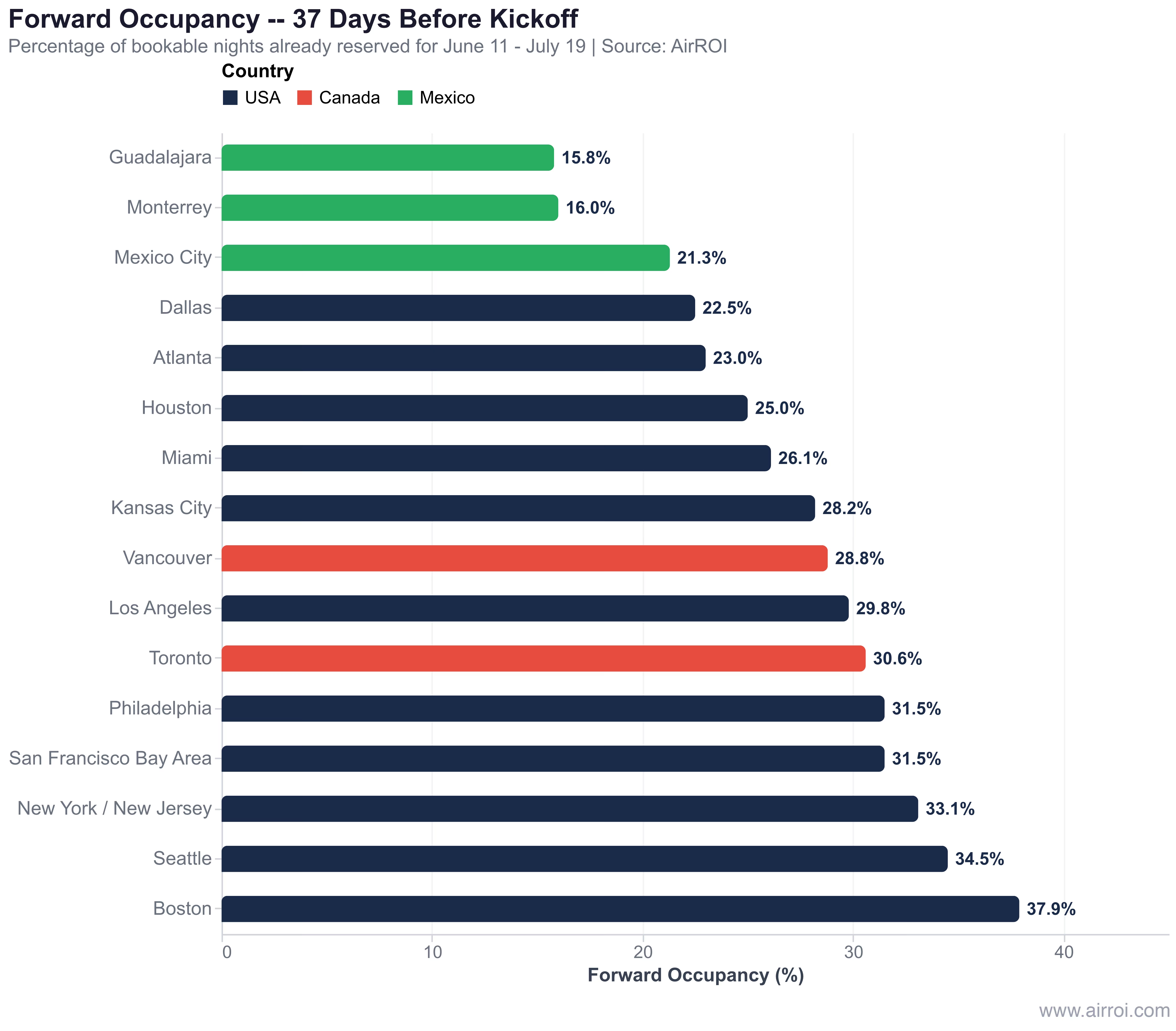
Forward booking pace — the percentage of bookable nights already reserved as of May 5, 2026 — separates the 16 cities into three tiers.
The master scorecard
| Rank | City | Country | Listings | Fwd Occ% | Booked Rate | Available Rate | Gap% | Premium vs TTM | Avg Lead Time |
|---|---|---|---|---|---|---|---|---|---|
| 1 | Boston | USA | 2,029 | 37.9% | $354 | $421 | +19% | +49% | 144d |
| 2 | Seattle | USA | 1,362 | 34.5% | $473 | $616 | +30% | +93% | 160d |
| 3 | New York / NJ | USA | 1,384 | 33.1% | $283 | $473 | +67% | +50% | 146d |
| 4 | SF Bay Area | USA | 1,536 | 31.5% | $227 | $292 | +29% | +18% | 118d |
| 5 | Philadelphia | USA | 1,157 | 31.5% | $353 | $534 | +51% | +78% | 159d |
| 6 | Toronto | Canada | 1,131 | 30.6% | $251 | $402 | +60% | +30% | 125d |
| 7 | Los Angeles | USA | 1,863 | 29.8% | $304 | $441 | +45% | +20% | 119d |
| 8 | Vancouver | Canada | 1,034 | 28.8% | $554 | $868 | +57% | +112% | 148d |
| 9 | Kansas City | USA | 1,264 | 28.2% | $454 | $874 | +93% | +115% | 158d |
| 10 | Miami | USA | 1,077 | 26.1% | $438 | $651 | +49% | +30% | 141d |
| 11 | Houston | USA | 1,244 | 25.0% | $266 | $499 | +88% | +34% | 138d |
| 12 | Atlanta | USA | 1,451 | 23.0% | $366 | $646 | +76% | +63% | 154d |
| 13 | Dallas | USA | 1,002 | 22.5% | $418 | $944 | +126% | +78% | 145d |
| 14 | Mexico City | Mexico | 1,331 | 21.3% | $107 | $163 | +53% | +61% | 144d |
| 15 | Monterrey | Mexico | 1,318 | 16.0% | $177 | $247 | +40% | +139% | 153d |
| 16 | Guadalajara | Mexico | 1,135 | 15.8% | $196 | $197 | +1% | +144% | 147d |
Tier 1: 30%+ forward occupancy (Boston, Seattle, NYC, SF, Philly, Toronto)
These six cities are international gateways where the World Cup coincides with strong baseline summer demand. Boston leads at 37.9% — already higher than its trailing-twelve-month occupancy rate of 62.9% would predict at this lead time. The booked-to-available gap in this tier is moderate (19-67%), meaning the pricing delta between what has sold and what is left is manageable. These hosts can hold rates confidently.
SF Bay Area is the anomaly within the tier. It ranks 4th in forward occupancy (31.5%) but has the lowest rate premium versus its trailing-twelve-month average (+18%) and the lowest booked-to-available gap (+29%). San Francisco is filling at essentially normal summer rates, with the World Cup providing only a marginal lift. If you are a host in the Bay Area, the tournament is not your pricing event — summer seasonality is.
Tier 2: 25-30% forward occupancy (LA, Vancouver, KC, Miami)
Momentum is building but the window is narrowing. Kansas City stands out for its internal contradiction: 28.2% forward occupancy (respectable) paired with a +93% booked-to-available gap (aggressive). KC guests who already booked paid $454/night; hosts are asking $874 for what remains. That is a large bet that late-arriving demand will pay nearly double what early demand accepted. Vancouver shows a similar pattern at +57% gap, but its $554 booked rate already represents a substantial premium.
Tier 3: Below 25% (Houston, Atlanta, Dallas, Mexico City, Monterrey, Guadalajara)
These cities have the most inventory remaining (75-84% available) and the most aggressive pricing on that inventory. Dallas is the extreme case: 22.5% forward occupancy with a $944 average available rate — that is +126% above the $418 booked rate, the widest gap in the tournament. Either a surge of late demand materializes at $944/night, or Dallas hosts face significant last-minute discounting.
The three Mexican cities sit at the bottom of the occupancy ranking (15.8-21.3%) but for a different structural reason: international travelers to Mexico tend to book later, and the domestic Mexican market may accelerate sharply once group-stage matchups become imminent. The 15% Guadalajara figure should not be read as failure — it should be read as a market that has not yet entered its primary booking window.
Match-day rate premiums: where supply cracks
This is the dataset nobody else has. For every day from June 11 to July 19, AirROI pulled the market-wide average rate in 2026 and compared it to the same day-of-week in 2025. The result is a daily rate premium curve that reveals how individual match days amplify (or fail to amplify) the tournament-wide lift.
The heatmap above shows group stage dates only (June 11 through June 27). Each cell represents one city on one day. The color intensity maps to the rate premium versus the same day-of-week in 2025 — darker cells indicate higher premiums. Match-day cells display the matchup and the premium percentage; non-match-day cells show just the premium.
The match-day premium table
| City | GS Matches | Avg Match-Day Premium | Avg Non-Match Premium | Match-Day Lift |
|---|---|---|---|---|
| Monterrey | 3 | +349% | +231% | +118pp |
| Guadalajara | 4 | +230% | +149% | +81pp |
| Houston | 5 | +165% | +112% | +53pp |
| Kansas City | 4 | +279% | +234% | +44pp |
| Vancouver | 5 | +191% | +148% | +43pp |
| Mexico City | 3 | +179% | +139% | +39pp |
| Dallas | 5 | +269% | +234% | +35pp |
| Seattle | 4 | +107% | +79% | +28pp |
| Philadelphia | 5 | +134% | +107% | +27pp |
| Toronto | 5 | +89% | +63% | +26pp |
| SF Bay Area | 5 | +43% | +28% | +15pp |
| Atlanta | 5 | +159% | +144% | +14pp |
| Boston | 5 | +61% | +54% | +7pp |
| Los Angeles | 5 | +49% | +44% | +6pp |
| Miami | 4 | +81% | +77% | +4pp |
| New York / NJ | 5 | +107% | +108% | -1pp |
The "Match-Day Lift" column is the gap between match-day and non-match-day premiums, measured in percentage points. It isolates how much additional pricing power a specific match generates beyond the tournament's ambient lift.
Three patterns emerge
Small supply pools create match-day explosions. Monterrey's three group-stage matches average +349% versus 2025 — but its non-match days still run +231%. The match-day lift of +118 percentage points means that an individual match in Monterrey pushes rates roughly $90 higher per night beyond the already-elevated baseline. Sweden vs Tunisia on June 14 hits +387%, the single highest group-stage premium in the tournament. Guadalajara and Kansas City follow the same pattern: limited supply amplifies date-specific demand spikes.
Big metros show zero match-day lift. New York / New Jersey — home of MetLife Stadium and the July 19 Final — has a match-day premium of +107% and a non-match-day premium of +108%. The match-day lift is literally negative one percentage point. Rates around MetLife are uniformly elevated regardless of whether a match is scheduled that day. Miami (+4pp), Los Angeles (+6pp), and Boston (+7pp) are similar. Deep supply pools absorb match-day demand without price spikes — the tournament lifts the entire period equally.
The highest individual match premiums cluster in knockout rounds. While the group stage generates substantial premiums, knockout rounds escalate further: Dallas Round of 16 at +310% ($949/night vs $231 in 2025), Kansas City Round of 32 at +313% ($842 vs $204), and Kansas City Round of 16 at +290% ($905 vs $232). The NYC Final, despite MetLife's supply depth, still commands +131%. Scarcity increases as the tournament narrows, and hosts with knockout-round dates on their calendar hold the most valuable inventory remaining.
The highest-premium individual matches
| Match | Date | City | 2026 Rate | 2025 Rate | Premium |
|---|---|---|---|---|---|
| SWE vs TUN | Jun 14 | Monterrey | $320 | $66 | +387% |
| RSA vs KOR | Jun 24 | Monterrey | $325 | $69 | +369% |
| TUN vs JPN | Jun 20 | Monterrey | $328 | $71 | +362% |
| R32-B | Jun 29 | Kansas City | $842 | $204 | +313% |
| R16-C | Jul 5 | Dallas | $949 | $231 | +310% |
| R32-A | Jun 29 | Dallas | $916 | $232 | +295% |
| R16-A | Jul 4 | Kansas City | $905 | $232 | +290% |
| COL vs COD | Jun 23 | Guadalajara | $279 | $73 | +281% |
| ARG vs ALG | Jun 16 | Kansas City | $801 | $212 | +278% |
| ARG vs AUT | Jun 22 | Dallas | $864 | $233 | +271% |
The Argentina factor is visible: ARG vs ALG in Kansas City (+278%) and ARG vs AUT in Dallas (+271%) rank among the steepest premiums. Host-nation matches in Mexico also drive elevated demand: MEX vs KOR in Guadalajara (+253%) and MEX vs RSA in Mexico City (+173%).
The overpricing signal: booked rate versus available rate
This is the analysis that should inform every pricing decision between now and June 11. The gap between what guests have already committed to pay (the booked rate) and what hosts are asking for remaining inventory (the available rate) is the market's overpricing indicator.
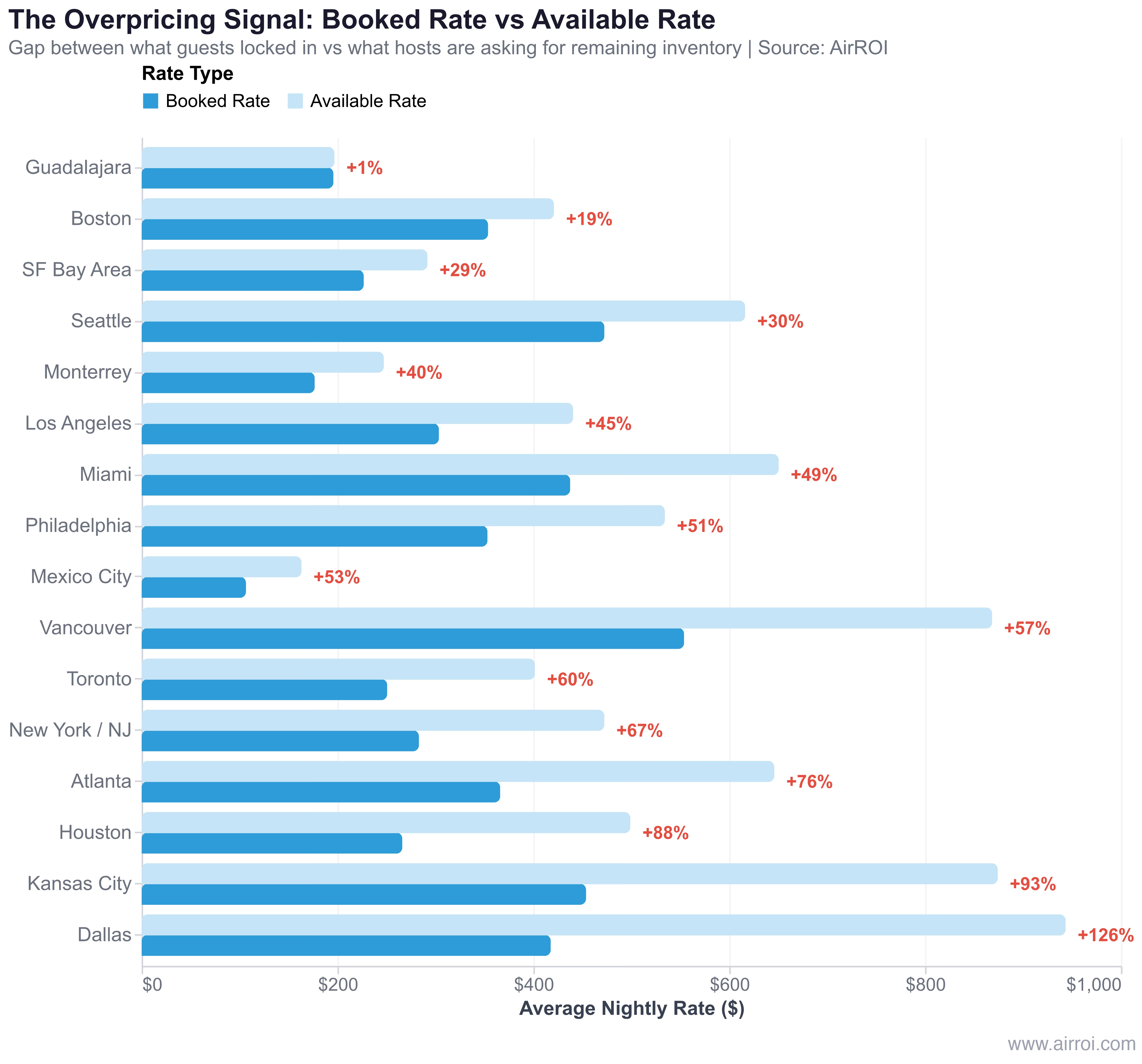
The gap table
| City | Booked Rate | Available Rate | Gap % | Risk Level |
|---|---|---|---|---|
| Dallas | $418 | $944 | +126% | High |
| Kansas City | $454 | $874 | +93% | High |
| Houston | $266 | $499 | +88% | High |
| Atlanta | $366 | $646 | +76% | Moderate |
| New York / NJ | $283 | $473 | +67% | Moderate |
| Toronto | $251 | $402 | +60% | Moderate |
| Vancouver | $554 | $868 | +57% | Moderate |
| Mexico City | $107 | $163 | +53% | Moderate |
| Philadelphia | $353 | $534 | +51% | Moderate |
| Miami | $438 | $651 | +49% | Moderate |
| Los Angeles | $304 | $441 | +45% | Low |
| Monterrey | $177 | $247 | +40% | Low |
| Seattle | $473 | $616 | +30% | Low |
| SF Bay Area | $227 | $292 | +29% | Low |
| Boston | $354 | $421 | +19% | Low |
| Guadalajara | $196 | $197 | +1% | Negligible |
Dallas is the most overexposed market in the tournament. Hosts there are asking $944/night for remaining inventory — 126% above the $418 that guests have actually paid. With only 22.5% of bookable nights reserved, 77.5% of Dallas inventory is sitting at prices dramatically above demonstrated willingness to pay. Either Dallas draws a wave of late premium demand (possible, given its strong knockout schedule), or hosts will need to reprice significantly in the final weeks.
Kansas City (+93%) and Houston (+88%) face similar dynamics — high available-rate asks, modest forward occupancy, and a widening gap between what has sold and what has not.
Guadalajara is the opposite extreme. Its booked rate ($196) and available rate ($197) are essentially identical — a gap of just 1%. This means Guadalajara hosts have not differentiated pricing between sold and unsold inventory. It could indicate rational pricing (available inventory is priced at market-clearing levels) or it could indicate that hosts have not yet adjusted to tournament demand. Given Guadalajara's 15.8% forward occupancy, the latter interpretation may be more accurate.
Boston's narrow 19% gap is the healthiest signal in the tournament. At 37.9% forward occupancy with only a $67 spread between booked ($354) and available ($421) rates, Boston's market is clearing inventory at prices close to what guests are willing to pay. Supply and demand are approximately in balance.
The Mexico arbitrage: 5x rate spread, 28x budget range
The three Mexican host cities represent a fundamentally different pricing tier. Their average booked rate of $152/night is 2.3x below the US average ($350) and 2.6x below the Canadian average ($391). For travelers optimizing on cost, the Mexico path is not a compromise — it is a rational market-clearing decision.
| Metric | Mexico Avg | USA Avg | Canada Avg | Spread |
|---|---|---|---|---|
| Booked Rate | $152 | $350 | $391 | 2.6x |
| Available Rate | $204 | $563 | $628 | 3.1x |
| ADR | $194 | $499 | $556 | 2.9x |
| Lowest P25 | $49 (CDMX) | $94 (SF) | $125 (TOR) | 2.6x |
The full budget range across the tournament spans from $49/night (Mexico City 25th percentile available rate) to $1,403/night (Dallas 75th percentile available rate) — a 28x spread. A fan attending Mexico vs South Africa at Estadio Azteca and a fan attending Netherlands vs Japan at AT&T Stadium are shopping in the same tournament but in radically different markets.
For budget-conscious travelers, the math is straightforward. A 7-night stay in Mexico City at the median available rate ($90/night) costs $630. The same 7 nights in Dallas at the median available rate ($615/night) costs $4,305 — a $3,675 difference that covers multiple round-trip flights between the two cities.
What fans shopping today will pay: the available-inventory price guide
The table below shows 25th, 50th, and 75th percentile nightly rates for inventory that is still available as of May 5, 2026. These are the actual prices a traveler will encounter when searching for a World Cup Airbnb today.
| City | P25 (Budget) | P50 (Mid-Range) | P75 (Premium) |
|---|---|---|---|
| Dallas | $207 | $615 | $1,403 |
| Kansas City | $240 | $589 | $1,235 |
| Vancouver | $318 | $651 | $1,151 |
| Miami | $136 | $368 | $893 |
| Atlanta | $232 | $454 | $821 |
| Seattle | $248 | $494 | $820 |
| Philadelphia | $170 | $346 | $692 |
| Houston | $153 | $296 | $609 |
| Los Angeles | $145 | $277 | $541 |
| Toronto | $125 | $255 | $535 |
| New York / NJ | $151 | $287 | $528 |
| Boston | $147 | $309 | $528 |
| SF Bay Area | $94 | $183 | $349 |
| Monterrey | $68 | $131 | $313 |
| Guadalajara | $58 | $108 | $222 |
| Mexico City | $49 | $90 | $170 |
The cheapest US option is SF Bay Area at $94/night (P25). That is a studio or shared-room listing in the South Bay corridor near Levi's Stadium. For a full entire-home listing at a reasonable price point, SF's P50 of $183 is still the lowest in the US tier and less than the P25 in Dallas, Kansas City, or Atlanta.
Budget travelers should watch the P25 column closely over the next three weeks. As hosts with unsold inventory begin to capitulate on pricing, these floor rates will define where the real deals emerge. Markets with the widest booked-to-available gaps (Dallas, Kansas City, Houston) have the most room to compress downward.
Booking velocity: who booked early and who is still shopping
Average booking lead times across the 16 cities range from 118 to 160 days — roughly 3x to 5x the typical 30-60 day STR booking window. The World Cup has pulled reservations dramatically forward, but the pattern varies by city.
| City | Avg Lead Time | Recent 30d Bookings% | Signal |
|---|---|---|---|
| Seattle | 160d | 13.7% | Earliest bookers, demand locked in |
| Philadelphia | 159d | 15.8% | Early, committed demand |
| Kansas City | 158d | 16.4% | Early movers, high rates |
| Atlanta | 154d | 18.3% | Moderate pace |
| Monterrey | 153d | 21.4% | Late domestic wave incoming |
| Vancouver | 148d | 20.4% | Mixed international/domestic |
| Guadalajara | 147d | 15.0% | Slow but may accelerate |
| New York / NJ | 146d | 17.0% | Steady demand |
| Dallas | 145d | 15.9% | Early movers at high prices |
| Boston | 144d | 17.3% | Consistent fill |
| Mexico City | 144d | 20.0% | International arrivals building |
| Miami | 141d | 18.5% | Moderate pace |
| Houston | 138d | 16.9% | Slower fill |
| Toronto | 125d | 21.5% | Later booking window |
| Los Angeles | 119d | 25.8% | Latest bookers, price-sensitive |
| SF Bay Area | 118d | 20.1% | Shortest lead, near-normal booking |
Los Angeles is the late-booking outlier. With 25.8% of its bookings made in the last 30 days and the shortest average lead time among US cities (119 days), LA's demand is arriving late and likely price-sensitive. This aligns with SF Bay Area (118 days, 20.1% recent), and both California cities share the same structural dynamic: deep supply, robust hotel alternatives, and a traveler base that does not need to book 5 months ahead to secure a room.
Seattle is the opposite. Only 13.7% of its bookings came in the last 30 days, and its 160-day average lead time is the longest in the tournament. Seattle demand was committed early, at premium rates ($473 booked rate), by planners who locked in before prices climbed further. Seattle's remaining inventory at $616 available rate is still moving — its 34.5% forward occupancy is second-highest — but the late-arriving demand profile suggests the easy fill has been captured.
The 30-day booking percentage is the signal to watch for the final sprint. Cities with high recent-booking shares (LA at 25.8%, Toronto at 21.5%, Monterrey at 21.4%) are still in their active booking window. Cities with low recent shares (Seattle at 13.7%, Guadalajara at 15.0%, Dallas at 15.9%) may have already saturated their natural demand at current prices and need pricing adjustments to reaccelerate.
The host playbook: tier-by-tier pricing guidance
Tier 1 cities (30%+ occupancy: Boston, Seattle, NYC, SF, Philly, Toronto)
Hold rates. Demand has validated your pricing. Your booked-to-available gap is moderate (19-67%), meaning the market is clearing at levels close to your ask. Focus on minimum-stay optimization — 3-night minimums on match-day weekends, 2-night minimums on midweek — to maximize revenue per available night rather than chasing higher ADR.
Tier 2 cities (25-30% occupancy: LA, Vancouver, KC, Miami)
Hold match-day pricing, soften midweek. Your forward occupancy is building but the gap is widening. Consider reducing non-match-day, midweek rates by 10-15% to capture the price-sensitive demand still shopping. Keep premium pricing on match-day weekends — especially knockout dates if your city hosts them. Vancouver and KC should watch the 21-day mark (May 21) as a decision point for deeper discounts on unfilled inventory.
Tier 3 cities (below 25%: Houston, Atlanta, Dallas, Mexico City, Monterrey, Guadalajara)
Reprice now. The gap between booked and available rates in this tier (40-126%) is a flashing indicator of overpricing. Dallas at $944 available rate is 126% above its $418 booked rate — that spread has not generated demand commensurate with the ask. Reduce available rates by 15-25% immediately, targeting the P50 level as your new floor. A $615 median (Dallas P50) is still a +152% premium over 2025 — substantial — but far more likely to clear than $944.
Five specific actions for the final 37 days
- Review your minimum-stay rules. If you require 7+ nights, you are excluding the 60%+ of World Cup travelers booking 3-5 night match clusters. Reduce minimums to 2-3 nights for the tournament window.
- Open gap nights. If you have a 2-night gap between reservations, drop the rate on those gap nights by 20-30% to fill them rather than leaving them empty.
- Price knockout dates separately. If your city hosts Round of 32, Round of 16, or later knockout matches, those dates command 30-50% premiums above your group-stage rates. Do not average them.
- Watch the 21-day mark (May 21). Bookings that have not materialized by 21 days before arrival have a steep probability drop-off. If your occupancy has not moved by May 21, cut rates aggressively.
- Do not anchor to your neighbor. The booked-to-available gap analysis shows that "market rate" in your market may be significantly above demonstrated willingness to pay. Anchor your pricing to your own booked rate, not the surrounding listings' available rates.
The traveler playbook: where the value is
Best value cities (cost per match experience)
Mexico City delivers the highest value. At $90/night (median available) with 3 group-stage matches including the tournament opener (Mexico vs South Africa at Estadio Azteca on June 11), a 5-night stay covering 2-3 matches costs approximately $450 in accommodation. The same 5 nights in Dallas around AT&T Stadium costs $3,075 at the median.
The five cheapest cities by median available rate: Mexico City ($90), Guadalajara ($108), Monterrey ($131), SF Bay Area ($183), Toronto ($255).
Premium traps to avoid
Dallas (P50 at $615, P75 at $1,403) and Kansas City (P50 at $589, P75 at $1,235) have the steepest rate distributions. Unless you specifically need to attend a match at AT&T Stadium or Arrowhead Stadium, the $600+ median rate in these markets is the tournament's worst value proposition. Consider attending a different group-stage match in a lower-cost city — the football is the same quality regardless of venue.
The 21-day window
The single most important date for travelers is May 21, 2026 — exactly 21 days before the June 11 opener. STR booking data consistently shows that hosts begin discounting unsold inventory aggressively inside the 21-day window. In markets with 15-25% forward occupancy (all of Tier 3), expect rate reductions of 15-30% between May 21 and June 7. If you can tolerate the risk of reduced selection, waiting until late May will save you significant dollars in Dallas, Houston, Atlanta, and the three Mexican cities.
Hotel versus Airbnb
How this compares to non-World Cup markets
Methodology
Data source: AirROI's database of Airbnb listings, analyzed May 5, 2026. Approximately 16,000 listings across 16 host cities (1,000 closest qualifying listings per stadium). Qualifying criteria: trailing-twelve-month revenue > $0, trailing-twelve-month occupancy > 20%.
YoY comparison: Same listings, same 39-night window (June 11 to July 19), same-DOW alignment. 2025 data is realized (actual rates and bookings). 2026 data is current forward-looking rates and bookings. Rate comparisons are valid; occupancy/demand comparisons between years are not, because 2025 is complete and 2026 is still filling.
Match-day premiums: Daily average rates in 2026 compared to the corresponding day-of-week in 2025. Match schedules sourced from the official FIFA 2026 fixture list. A "match day" is any date where at least one match is scheduled at that city's stadium.
Forward occupancy: Booked nights divided by total bookable day-slots (listings multiplied by 39 nights), excluding blocked/unavailable nights, as of the analysis date.
Rate percentiles: Calculated across available (unsold) inventory only. P25 represents the budget tier, P50 the mid-range, P75 the premium tier.
Frequently Asked Questions
Average daily rates across all 16 host cities have more than doubled, rising from $216 in 2025 to $450 in 2026 for the same June 11 to July 19 window — a +109% increase. The increase is not uniform: Dallas and Kansas City have tripled (+238% and +240%), while SF Bay Area is up only +30%. The booked rate (what guests actually locked in) is up +48%, while the available rate (what hosts are asking for remaining inventory) is up +146%.
Boston leads all 16 host cities with 37.9% forward occupancy as of May 5, 2026 — 37 days before kickoff. Seattle follows at 34.5%, then New York/NJ at 33.1%. The Mexican cities trail significantly: Guadalajara at 15.8%, Monterrey at 16.0%, and Mexico City at 21.3%.
Mexico City is the cheapest host city with a booked ADR of $107/night and available inventory starting at $49/night (25th percentile). Guadalajara ($196 booked, $58 P25) and Monterrey ($177 booked, $68 P25) are also significantly cheaper than any US or Canadian city. The cheapest US option is SF Bay Area at $94/night for budget listings.
Monterrey has the highest average match-day premium at +349% versus the same day-of-week in 2025. Individual match days in Monterrey spike as high as +387% (Sweden vs Tunisia on June 14). In the US, Kansas City (+279%) and Dallas (+269%) show the steepest match-day premiums. Large metros like NYC (+107%), LA (+49%), and SF (+43%) show minimal match-day spikes because deep supply absorbs the demand.
Average booking lead times range from 118 to 160 days across the 16 cities — roughly 3x to 5x the typical 30-60 day STR booking window. Seattle has the longest average lead time at 160 days (earliest planners), while SF Bay Area has the shortest at 118 days. Only 13.7-25.8% of bookings were made in the last 30 days, meaning the majority of reservations were locked in months ago.
No — 62% to 84% of bookable Airbnb nights remain available across all 16 cities as of May 5, 2026. However, remaining inventory is priced at a steep premium: available rates average $497/night across all cities versus $332 for already-booked rooms. Budget options still exist — Mexico City has listings from $49/night and SF Bay Area from $94/night — but they are thinning rapidly in high-demand cities like Boston and Seattle.
Dallas (+238% ADR) and Kansas City (+240% ADR) show the steepest price increases for three structural reasons: limited baseline STR supply creates scarcity pressure, strong match schedules (Dallas hosts 5 group stage + 4 knockout matches including a Round of 16), and aggressive host pricing on remaining inventory. Dallas shows the widest booked-to-available rate gap at +126%, meaning hosts are asking $944/night for unsold inventory versus $418 that guests have actually locked in.
The booked-to-available rate gap measures the difference between what guests have already paid (booked rate) and what hosts are asking for remaining inventory (available rate). Across all 16 cities, booked rates are up +48% YoY while available rates are up +146% — a 98 percentage point gap. This signals potential overpricing: hosts with unsold inventory are asking roughly 2.5x last year's rates, well above demonstrated willingness to pay. Dallas (+126%), Kansas City (+93%), and Houston (+88%) face the highest overpricing risk.
It depends on your city's tier. Tier 1 cities (Boston, Seattle, NYC, SF, Philadelphia, Toronto) with 30%+ forward occupancy should hold current rates — demand has validated the pricing. Tier 2 cities (LA, Vancouver, KC, Miami) at 25-30% should hold premium pricing for match-day weekends but consider 10-15% reductions on midweek non-match nights. Tier 3 cities (Houston, Atlanta, Dallas, Mexico) below 25% occupancy should reduce available rates by 15-25% now.
The contrast is stark. World Cup host cities average 26.8% forward occupancy with ADR up +109% YoY. Non-World Cup US markets show beach markets at 48-57% fill (their normal seasonal pace), urban non-host metros at 8-24%, and Sun Belt cities under 8%. The tournament is concentrating demand and pricing power entirely in the 16 host cities — the other 95% of US markets are running a normal summer.