
Revenue Management

Key Takeaways
- Revenue management is a holistic discipline that goes beyond dynamic pricing to include stay rules, channel strategy, and demand forecasting
- RevPAR (revenue per available night) is the north-star metric for measuring revenue management success — it captures both rate and occupancy in a single number
- Balancing ADR and occupancy rate is the central challenge: maximizing one at the expense of the other leaves revenue on the table
- AirROI data shows RevPAR ranging from $129.8 in Austin to $212.2 in San Diego — a 64% spread driven primarily by rate strategy and market demand, not just property type
- Even single-listing hosts benefit from applying core revenue management principles to their pricing calendar and minimum-stay settings
Core Revenue Management Strategies
Revenue management for short-term rentals operates across several interconnected levers:
1. Dynamic Rate Optimization
2. Minimum Stay Management
Strategic minimum stay rules protect high-value periods and reduce turnover costs:
- Peak periods: Higher minimums (3–7 nights) prevent single-night bookings that block lucrative multi-night stays
- Shoulder periods: Moderate minimums (2–3 nights) balance booking pace against cleaning costs
- Gap filling: Drop minimums to 1 night when orphan days appear between bookings — those nights would otherwise go unsold
3. Channel Distribution
Optimizing which platforms carry your listing and at what rates:
- OTA mix: Listing on Airbnb, Vrbo, and Booking.com captures different guest demographics and reduces concentration risk
- Direct bookings: Cutting OTA commission (typically 15–20%) through a direct booking site raises effective ADR on the same gross rate
- Rate strategy by channel: Some operators maintain rate parity across OTAs while offering a direct-booking discount to shift repeat guests off-platform
4. Demand Forecasting
Using historical data and forward-looking signals to anticipate demand shifts:
- Local event calendars and booking pace — markets like Nashville see lead times averaging 54.8 days, meaning demand signals arrive nearly two months in advance
- Year-over-year seasonal patterns extracted from occupancy trend data
- Supply changes: new listings entering a market compress occupancy; listings exiting create upward pricing opportunities
RevPAR by Market — The Revenue Management Benchmark
RevPAR is the output that all revenue management decisions ultimately drive. In AirROI's analysis of 45,343 active listings across seven US markets, RevPAR spreads are wide — and they map directly to how disciplined operators in each market manage their rate and availability strategy.
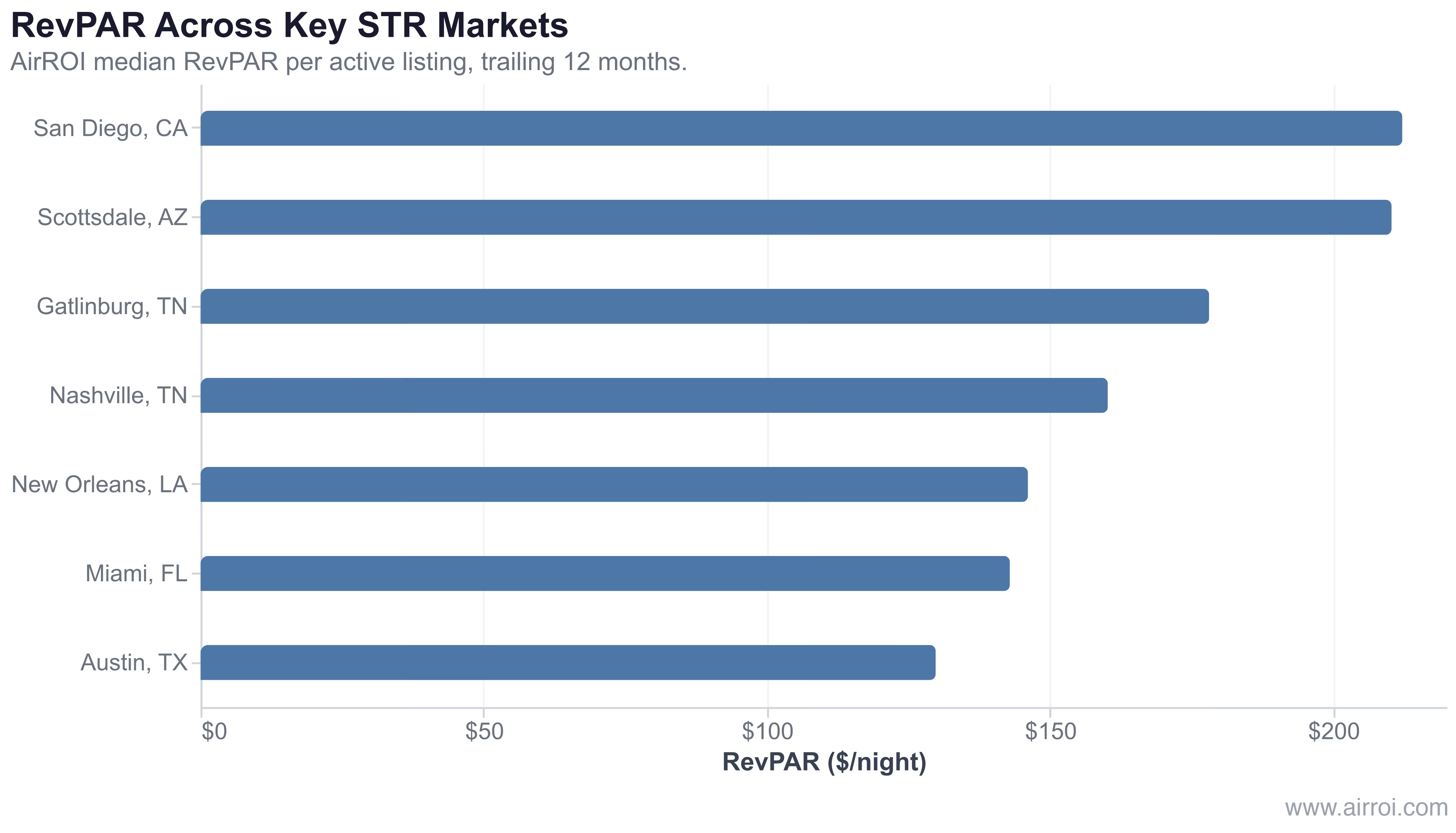
San Diego ($212.2) and Scottsdale ($210.3) lead because operators in those markets achieve high ADR without sacrificing occupancy — both markets clear 49–53% occupancy despite ADRs above $394. Austin ($129.8) sits at the low end not because of poor demand but because elevated supply (8,774 active listings) and lower ADR discipline compress the per-night yield.
RevPAR is the single number that tells you whether your revenue management strategy is working — not occupancy, not ADR, but the product of how well you're balancing both across every available night.
Revenue Management KPIs
| Metric | Formula | What It Tells You |
|---|---|---|
| RevPAR | Revenue ÷ Available Nights | Overall revenue efficiency (north-star metric) |
| ADR | Revenue ÷ Booked Nights | Average rate achieved per sold night |
| Occupancy Rate | Booked Nights ÷ Available Nights | Percentage of nights sold |
| Booking Pace | Reservations per time period | Forward demand indicator |
| Gap Night Rate | Orphan nights ÷ Total available | Measures minimum-stay leakage |
Why Revenue Management Matters for STR Investors
- Maximizes total income: A 10% improvement in rate discipline can add thousands of dollars annually without changing the property or adding listings
- Balances competing objectives: Revenue management provides a framework for the ADR-vs-occupancy tradeoff every host faces — the answer shifts by season and market
- Reduces revenue leakage: Orphan nights, underpriced peak dates, and over-reliance on a single OTA are common revenue leaks that a documented strategy addresses systematically
- Supports investment decisions: Understanding a market's RevPAR potential drives better property acquisition decisions — markets with RevPAR above $175 deliver materially stronger cash flow. The STR investment analysis framework shows how to layer RevPAR benchmarks into acquisition underwriting
- Scales with your portfolio: A documented revenue strategy can be delegated or automated, enabling portfolio growth without proportional time investment. Professional operators build repeatable systems precisely because intuition-based pricing doesn't scale
Practical Revenue Management Tips
- Track RevPAR as your primary metric — it naturally balances rate and occupancy in a single number, making it immune to the trap of celebrating high occupancy at a low rate
- Review your comp set monthly — use market data from tools or APIs to benchmark your ADR and occupancy against comparable listings; a 10% ADR gap vs. comps is worth more investigation than a 5-point occupancy gap
- Adjust minimum stays seasonally — a rigid 3-night minimum year-round leaves revenue on the table during slow periods and may be too short during peaks
- Audit your calendar for orphan nights — single-night gaps between bookings are the most common form of revenue leakage; proactively lower minimums or offer targeted last-minute discounts on those nights
- Pair data tools with strategy — dynamic pricing in the booking window is most effective when the underlying strategy (base rates, seasonality bands, minimum stays) is already sound; automation amplifies good decisions and bad ones equally
Frequently Asked Questions
Revenue management in short-term rentals is the strategic practice of optimizing pricing, minimum stay requirements, distribution channels, and availability to maximize total income from a rental property. It combines data analysis, demand forecasting, and dynamic rate adjustments to ensure every available night generates the highest possible revenue.
Dynamic pricing is one tactic within the broader discipline of revenue management. Revenue management encompasses the full strategy including pricing, minimum stay rules, channel distribution, gap night management, seasonal planning, and ancillary revenue. Dynamic pricing specifically refers to the automated adjustment of nightly rates based on real-time demand and market data.
The primary KPIs are RevPAR (revenue per available night), ADR (average daily rate), and occupancy rate. Track RevPAR as your north-star metric because it balances rate and occupancy. Compare your metrics against market benchmarks using data tools, and monitor trends month-over-month and year-over-year to evaluate whether your strategy is improving performance.
RevPAR targets vary significantly by market. AirROI data shows trailing-12-month medians ranging from $129.8 in Austin to $212.2 in San Diego across major US markets. A well-managed listing typically outperforms the market median by 15-25% through disciplined rate strategy, minimum-stay optimization, and gap-night management.
Minimum stay rules are a critical lever in revenue management. During peak periods, longer minimums (3-7 nights) prevent single-night bookings that block high-value multi-night stays. During slow periods, dropping to 1-night minimums fills orphan gaps between bookings. Calibrating minimums to seasonal demand patterns is one of the fastest ways to improve RevPAR without changing your base rate.