
Short-Term Rental Bonus Depreciation 2026: The Airbnb Tax Loophole

A $450,000 Joshua Tree Airbnb can generate roughly $99,800 in first-year depreciation in 2026 — versus about $13,100 under ordinary straight-line rules. The difference is one law and one study. Short-term rental bonus depreciation returned to 100% under the 2025 One Big Beautiful Bill Act (OBBBA), and paired with the long-standing airbnb tax loophole — the rule that treats a rental averaging 7-day-or-shorter stays as a business rather than a passive investment — it lets a materially participating owner deduct a large share of a property's cost against ordinary W-2 or business income in the year the property is placed in service.
This guide explains exactly how the three rules stack, who qualifies in 2026, and where the strategy breaks — grounded in live AirROI market data so the numbers reflect genuine rentals, not paper shelters. It also corrects two things loose guides get wrong: nonpassive treatment does not force you onto Schedule C or self-employment tax, and the accelerated deduction does not all come back at 25% when you sell.
This is not tax advice. Tax outcomes depend on your income, your participation, and your specific facts. Every dollar figure below is an illustration with stated assumptions, not a promise. Consult a qualified CPA and commission an engineering-based cost segregation study before acting on anything here.
100% Bonus Depreciation Is Back — Permanently — for 2026
That phase-down is what makes 2026 pivotal. Under the prior Tax Cuts and Jobs Act schedule, bonus depreciation was falling 20 points a year — 40% in 2025, 20% in 2026, and 0% in 2027. The OBBBA erased that ramp. As accounting firm BDO summarized in its analysis of the law, the act "permanently reinstates 100% bonus depreciation" for qualifying property, removing the expiration date entirely.
Two details matter for short-term rental (STR) investors. First, the allowance covers tangible property with a MACRS recovery period of 20 years or less — which is precisely the 5-, 7-, and 15-year property a cost segregation study carves out of a building. Second, it applies to used property, not just new construction. An existing house you buy and convert to an Airbnb qualifies, as long as it is new to you and placed in service — ready and available to rent — after the January 19, 2025 cutoff. For a 2026 acquisition, that means listing it by December 31, 2026.
How the Short-Term Rental Loophole Actually Works
The "loophole" is not a loophole and it is not new — it is a decades-old distinction in the passive-activity rules that most rentals fail and short-term rentals can pass. Under IRC Section 469, rental real estate is automatically passive, and passive losses can only offset passive income — not your salary. The $25,000 special allowance that lets some landlords deduct rental losses phases out completely above $150,000 of income, which is exactly the income band where this strategy would otherwise matter most.
Short-term rentals escape that trap through the definition of a "rental activity." Treasury Regulation Section 1.469-1T(e)(3)(ii)(A) states that an activity is not a rental activity for the year if "the average period of customer use" is seven days or less. A property that clears that bar is treated as a non-rental trade or business, so it is judged by the general material participation tests rather than being locked into passive status. When you materially participate, the resulting losses are nonpassive and can offset W-2 or business income. This is the mechanism behind the phrase "how to offset W2 income with airbnb," and it is grounded in the regulation, not a gray area.
Material participation: the two tests STR owners actually use
For a W-2 owner, the realistic path is Treasury Regulation Section 1.469-5T's Test 3: participate more than 100 hours and more than any other single individual. That "more than anyone else" clause is what trips up owners who hand everything to a full-service manager — if your cleaner or co-host logs more hours than you, you fail. Test 1 (500+ hours) also works and does not require you to out-hour everyone, but 500 hours is nearly ten hours a week on one property.
Qualifying hours include guest communication, pricing and calendar management, coordinating turnovers, vendor and maintenance oversight, bookkeeping, and market research. The IRS expects a contemporaneous log — dated entries recorded as the work happens, not reconstructed at audit. Retroactive logs carry little weight.
Schedule E vs. Schedule C: the nuance that saves 15.3%
Being nonpassive does not mean you owe self-employment tax. This is the single most common point of confusion, and it matters for short-term rental tax deductions 2026 Schedule C vs E planning. Section 469 (the passive-loss test) and Section 1402 (the self-employment-tax test) are separate. A short-term rental offering only standard services — Wi-Fi, linens, a stocked kitchen, cleaning between guests — is reported on Schedule E and pays no self-employment tax, even when its losses are nonpassive. Only substantial services comparable to a hotel or bed-and-breakfast (daily housekeeping during the stay, meals, concierge, guided tours) reclassify the activity to Schedule C, where the 15.3% self-employment tax applies. Most self-managed Airbnbs stay on Schedule E and keep both benefits: nonpassive losses and no SE tax.
Cost Segregation + 100% Bonus Depreciation: The Math
Cost segregation is the study that turns a slow 27.5-year deduction into a same-year one. By default, residential rental property depreciates straight-line over 27.5 years, so a $360,000 building throws off only about $13,100 a year. A cost segregation study — an engineering-based analysis — reclassifies components of the building into shorter MACRS lives, where bonus depreciation can expense them immediately:
- 5-year property: appliances, carpeting, cabinetry, furnishings, decorative lighting, window treatments
- 7-year property: certain furniture and specialized fixtures
- 15-year property: landscaping, fencing, driveways, walkways, pools, and other land improvements
A worked example on a real market
Take the affordable end of the range — a $450,000 Joshua Tree, California short-term rental. AirROI's trailing-twelve-month data shows Joshua Tree averaging a 2.8-night length of stay and about $49,200 in annual revenue, so the property clears the seven-day gateway naturally and earns like a genuine rental. Here is the year-one picture, with every assumption labeled:
| Line item | Amount | Assumption |
|---|---|---|
| Purchase price | $450,000 | Representative STR price (Joshua Tree listings ~$430K–$450K, mid-2026) |
| Land (non-depreciable) | $90,000 | 20% of price |
| Depreciable basis | $360,000 | 80% of price |
| Reclassified by cost seg | $90,000 | 25% of basis into 5/7/15-year property |
| Year-one bonus depreciation | $90,000 | 100% of reclassified amount |
| Straight-line on the rest | $9,818 | $270,000 / 27.5 years |
| Total year-one depreciation | ~$99,800 | Bonus + straight-line |
| Straight-line only (no cost seg) | ~$13,100 | $360,000 / 27.5 years |
The property produces roughly $27,000 of net operating income after typical operating costs (assume operating expenses near 45% of revenue). Because year-one depreciation of ~$99,800 far exceeds that, it wipes out the rental's own taxable profit and creates a paper loss of about $72,800 — a nonpassive loss, since the owner materially participates. At an illustrative 35% marginal rate, the full deduction shelters roughly $34,900 of federal tax, provided the owner has enough active income to absorb the loss. That is the entire strategy in one property: positive cash flow and a large paper loss in the same year, because depreciation is a non-cash deduction.
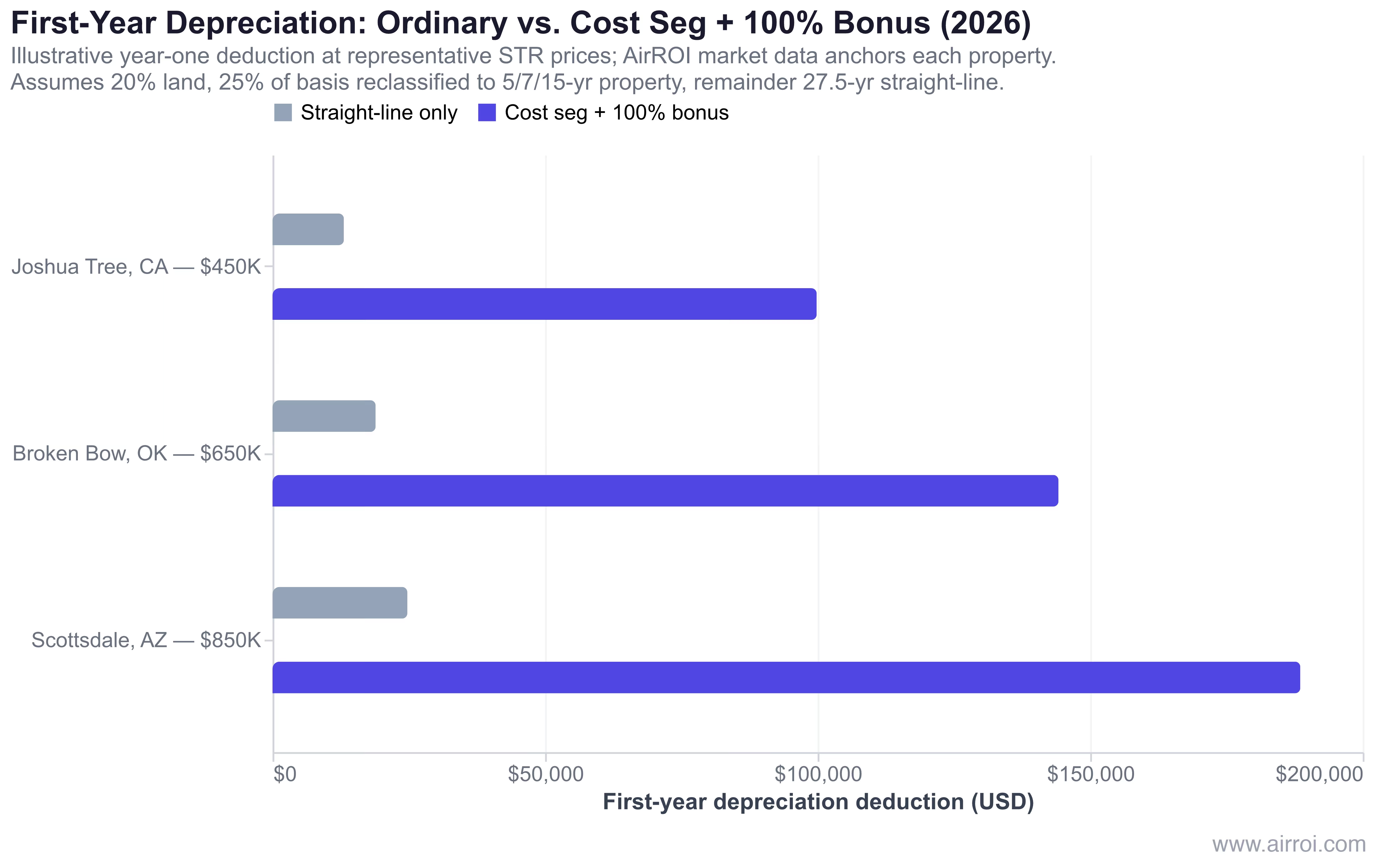
What the Deduction Looks Like on Real 2026 Markets
The benefit scales with basis, so the same strategy produces very different numbers across markets — and all three markets below average under seven nights, so they qualify without any gymnastics. The table uses live AirROI revenue and length-of-stay data, with the same labeled assumptions as the Joshua Tree example (20% land, 25% of basis reclassified, remainder straight-line).
| Market | Repr. price | Depreciable basis | Cost-seg reclass (100% bonus) | + straight-line | Total year-one deduction | Straight-line only | AirROI annual revenue | Avg. stay |
|---|---|---|---|---|---|---|---|---|
| Joshua Tree, CA | $450,000 | $360,000 | $90,000 | $9,818 | ~$99,800 | ~$13,100 | $49,212 | 2.8 nights |
| Broken Bow, OK | $650,000 | $520,000 | $130,000 | $14,182 | ~$144,200 | ~$18,900 | $52,256 | 2.6 nights |
| Scottsdale, AZ | $850,000 | $680,000 | $170,000 | $18,545 | ~$188,500 | ~$24,700 | $53,547 | 5.9 nights |
Broken Bow, Oklahoma is the market most investors underestimate. Its Hochatown cabin corridor is a mature STR economy where cabins with land list around $768,000, and the market averages just 2.6-night stays across roughly 3,000 active listings — a textbook seven-day-rule qualifier hiding in a state few associate with vacation rentals. Scottsdale sits at the expensive end, where an $850,000 home produces a year-one deduction near $188,500, about 7.6 times the ordinary straight-line figure.
The 2026 Fine Print: Recapture, Schedule C, and 1099-K
Accelerated depreciation is a deferral, not free money — and the reclassified slice comes back at ordinary rates, not the 25% many investors assume. This is where loose guides mislead. When you sell, depreciation is recaptured, and the rate depends on the property class:
| At sale | 5/7-year cost-seg property | 27.5-year structure |
|---|---|---|
| Tax section | Section 1245 (personal property) | Section 1250 (real property) |
| Examples | Furnishings, appliances, cabinetry, fixtures | Building shell, roof, foundation |
| Recapture treatment | Ordinary income, up to 37% | Unrecaptured Section 1250 gain, max 25% |
The 5- and 7-year components a cost segregation study accelerates are Section 1245 property, recaptured as ordinary income up to the depreciation claimed — potentially 37% at the top bracket, not the 25% that applies only to the straight-line structure. The real edge, then, is not rate arbitrage but time value — a deduction today is worth more than the recapture tax years later — plus the option to defer recapture entirely through a 1031 like-kind exchange into a replacement property.
Who Should — and Shouldn't — Use This in 2026
This strategy fits a narrow, specific taxpayer: a high W-2 or business earner who can genuinely, provably run a short-stay rental. The ideal candidate has meaningful active income to shelter, buys in a market that naturally averages seven-day-or-shorter stays, self-manages enough to pass Test 3, and keeps a contemporaneous hour log. For that person, 2026 is arguably the most favorable year on record to buy: 100% bonus depreciation is permanent, cost segregation is cheap relative to the deduction it unlocks, and used homes qualify.
It is a poor fit for several others. A passive investor who outsources everything to a property manager will fail material participation and see the losses locked as passive. An owner with no active income to offset gains little from a paper loss. Someone buying in a market with long average stays may not clear the seven-day rule at all. And anyone tempted to manufacture participation hours is buying audit risk, not tax savings — the IRS scrutinizes hour logs precisely because the payoff is large.
The mechanics are powerful and fully legal when the facts are real. They are also unforgiving of shortcuts: a missing log, an over-outsourced operation, or a market that averages nine-night stays can turn the entire benefit off. Treat the tax outcome as a consequence of running a real short-term rental well, not as the reason to buy one — and route the specifics through a CPA and a licensed cost-seg engineer before you file.
Frequently Asked Questions
Yes. The One Big Beautiful Bill Act permanently restored 100% bonus depreciation for qualifying property acquired and placed in service after January 19, 2025. Without the law, the 2026 rate would have fallen to 20% on the way to zero. The 100% rate applies to property with a MACRS recovery period of 20 years or less, including used property, so an existing home converted to a short-term rental qualifies.
Potentially, if two conditions hold: the rental's average stay is 7 days or less, and you materially participate in running it. Together those make the losses nonpassive under IRC Section 469, so they can offset active income like W-2 wages. You also need enough active income to absorb the loss and documented participation hours; a CPA should confirm your specific facts before you rely on it.
No, not automatically. Being nonpassive for loss purposes (Section 469) and being subject to self-employment tax (Section 1402) are separate tests. A short-term rental that provides only standard services (Wi-Fi, linens, cleaning between guests) is reported on Schedule E with no self-employment tax, even when the losses are nonpassive. Only substantial hotel-like services (daily housekeeping, meals, concierge) push the activity to Schedule C and the 15.3% self-employment tax.
It is recaptured, and not all at the same rate. The 5- and 7-year components a cost segregation study reclassifies are Section 1245 property, recaptured as ordinary income up to the depreciation taken, at rates up to 37%. The 27.5-year structure is unrecaptured Section 1250 gain, taxed at a maximum of 25%. A 1031 like-kind exchange can defer both, and the time value of money still favors accelerating the deduction.
Only if your gross payouts exceed $20,000 and you have more than 200 transactions. The One Big Beautiful Bill Act reverted the Form 1099-K reporting threshold from the planned $600 back to $20,000 and 200 transactions, and both bars must be cleared. Your rental income is taxable whether or not a form is issued, so report it regardless.