Local Airbnb rules2026 14 sources cited
Is Airbnb Legal in Sacramento? 2026 Rules, Permits & Taxes
Short-term rentals are legal in Sacramento with a $260 city permit: no night cap if you live there, 90 days if it is not your primary residence, six guests at most, and 14.33% to 17% in hotel tax and district assessments.6,7,8
From 13 official sources and 1 Airbnb help page, checked October 17, 2026. Not legal advice.
The short answer
Sacramento Airbnb Rules in Brief
- Permit from the City Revenue Division: $260 to apply, $250 to renew, valid one year, plus a $50 annual business tax.
- Live in the home (184 days a year or more) and there is no night cap; a home that is not your primary residence is limited to 90 days.
- Six guests at most, no weddings or events, and the permit number goes in every listing.
- Hotel tax of 12% plus district assessments of 1% and 1.33% to 4.00%, which Airbnb collects; civil penalties run $250 to $25,000 a day.
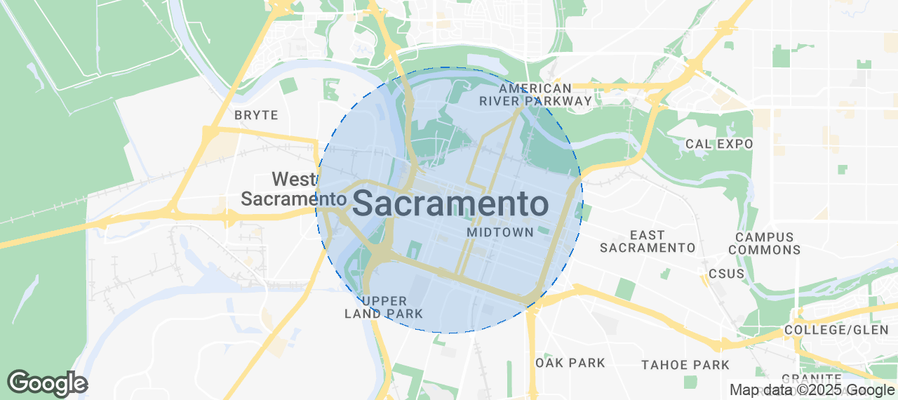 Browse the live Sacramento Airbnb market See Every Sacramento Listing
Revenue, occupancy and nightly rates are in the Sacramento Airbnb market report .
At a glance
Sacramento Airbnb Rules at a Glance
- Permit required
- Yes
- Yearly night cap
- 90 nights
- Fine for hosting without a permit
- $25,000
- Listings showing a permit number
- 64%
- Latest rule change
- Aug 1, 2026
Listing figures: AirROI, 12 months to October 2026. A number on a listing doesn't prove the permit or license is valid, and a missing one doesn't prove there is none.
The rules in brief
The rules a Sacramento host meets first, each linked to the ordinance, statute or official page it comes from. Details and exceptions follow below.
| Topic | Rule |
|---|---|
| Permit | A permit is required for every short-term rental2,8 |
| Who can host | Owners, lessees and similar holders can apply8 |
| Where | One dwelling unit per lot unless you live in the city8 |
| Building rules | Property owner consent7,8 |
| Night cap | 90 days if it is not your primary residence3,6,8 |
| Minimum stay | After 90 days, stays must be 31 nights or longer6 |
| Guests | Six people at most7,8 |
| Listing display | Permit number must be in every advertisement8 |
| Platforms | Platforms may not take a fee without a permit8 |
| Safety | Post the permit in each sleeping room8 |
| Neighbors | No exterior signs8 |
Your home
Can You Host an Airbnb in Sacramento? It Depends on the Home
Whether you can host in Sacramento turns on whose home it is and whether you live there.
A second home or investment property you don't live in
Allowed with conditionsAllowed with the permit for a total of 90 days, then only stays of 31 days or more. The host also needs a property manager within 30 miles and sends the city a rental register each quarter. A proposed ordinance would end permits for homes the owner does not live in.6,8,10
An accessory dwelling unit (ADU) on your lot
Allowed with conditionsPermitted, but an ADU is a separate dwelling unit that cannot be claimed as the host's primary residence, so it is limited to 90 days of rental a year.8
A unit in an apartment building with several homes
Allowed with conditionsAllowed only with a conditional use permit in the R-4, R-4A, R-5, OB, OB-2, OB-3, SC, C-2, C-3, C-4, M-1, M-1(S), M-2, M-2(S), MRD, M-T and HC zones; only three such permits have been approved since July 2020.8
Permit
Do You Need a Permit for Airbnb in Sacramento?
Yes. Short-term rental hosts in Sacramento need the short-term rental permit from the City of Sacramento, Revenue Division (Department of Finance). It costs $310 in the first year (A one-home host pays $260 for the permit plus the $50 annual business tax in the first year (about $310), then $250 plus $50 a year to renew (about $300), before hotel tax.) and $300 a year to renew.6,7,8
- Who needs it
- Every host who rents a home or part of a home for 30 days or less, whether or not they live there.6,7,8
- Issued by
- City of Sacramento, Revenue Division (Department of Finance)
- Valid for
- One year from the date the permit is issued; it cannot be transferred, and a renewal must be filed at least 30 days before it expires.
- On listings
- The number must appear on every listing
- Platform checks
- A hosting platform may not accept a fee for a booking unless the host has a valid city-issued permit, and the city is considering a rule that would also have platforms report permit numbers and nights booked.
Fees
| Fee | Amount |
|---|---|
| New permit applicationPaid with the application; the fee is not refundable. | $260 |
| Permit renewalFiled at least 30 days before the permit expires. | $250 |
| Late renewal assessmentAdded when a renewal is filed less than 30 days before expiry. | $50 |
| Business operations tax (hotel)Annual business tax charged to short-term rental operators, paid to the Revenue Division. | $50 |
Who qualifies
- An owner, lessee or holder of a similar interest in the dwelling unit may apply; a tenant needs the property owner's signed consent
- The home counts as a primary residence only if the host lives in it at least 184 days a calendar year; otherwise rentals are capped at 90 days
- No more than one dwelling unit on a lot may be rented unless the host's primary residence is in the city
- Homes under HOA rules or CC&Rs must comply with them, and a copy goes in with the application
- In multi-unit buildings, a conditional use permit is also needed in the R-4, R-4A, R-5, OB, OB-2, OB-3, SC, C-2, C-3, C-4, M-1, M-1(S), M-2, M-2(S), MRD, M-T and HC zones
How to apply
- Check the property's zoning and tourism marketing district zone in the city's Land Information Lookup app, and collect any HOA rules or CC&Rs.
- Hold an active business operations tax account with the Revenue Division ($50 a year) and register for transient occupancy tax in the city's online portal.
- Submit the short-term rental permit application through the city's Public Permit Portal (or the fillable PDF) with the rental listing URL, a responsible property manager and, if you are not the owner, the property owner consent form.
- Pay the $260 fee; once the permit is issued the city notifies every owner within 200 feet.
- Put the permit number in every listing and post a copy of the permit in each room where guests sleep.
Applications go through the City of Sacramento, Revenue Division (Department of Finance) application portal .
Permit rules
- A permit is required for every short-term rental
- No one may operate a short-term rental (a stay of 30 days or less) in Sacramento unless a city permit is in effect for that dwelling unit, and the host must show it on request to a peace officer or city inspector.2,8 In force since February 18, 2016
- Permit number must be in every advertisement
- Everyone operating a short-term rental must show the city permit number in any advertisement for the rental, including Airbnb listings.8
- One-year permit, renewed 30 days ahead
- A permit lasts one year from issue unless suspended or revoked, and a renewal application is due at least 30 days before it expires, with a late assessment after that.7,8 In force since February 18, 2016
- Platforms may not take a fee without a permit
- A hosting platform such as Airbnb may not accept a fee for a booking unless the host has a valid city-issued permit, and the platform is treated as the operator for collecting and remitting the 12% hotel tax.8 Applies to: Booking platforms · In force since 2020
- Advertised price must include mandatory fees
- Since July 1, 2024, California's Honest Pricing Law (SB 478) bars a host or platform from advertising a short-term rental price that leaves out mandatory fees; government taxes and fees may be listed separately.12 In force since July 1, 2024
Who can host
Who Can Host an Airbnb in Sacramento, and Where
California state law applies on top of Sacramento's own rules: the California short-term rental regulations page covers the state license and what cities and counties can and can't regulate.
- Owners, lessees and similar holders can apply
- An owner, a lessee or the holder of a similar interest in the home may apply for the permit, but nobody may operate a short-term rental without the property owner's consent. The permit cannot be transferred.8
- Property owner consent
- A tenant who hosts must have the property owner's consent, which the owner confirms on the city's property owner consent form submitted with the application.7,8 Applies to: Tenants · In force since February 18, 2016
- Primary residence means 184 days a year
- A home is the host's primary residence if the host lives in it at least 184 days during the calendar year.8
- One dwelling unit per lot unless you live in the city
- No one may run short-term rentals in more than one dwelling unit on the same lot unless their primary residence is in the city.8
- Apartment buildings need a conditional use permit
- Short-term rentals in a multi-unit dwelling building are allowed only with a conditional use permit and only in the R-4, R-4A, R-5, OB, OB-2, OB-3, SC, C-2, C-3, C-4, M-1, M-1(S), M-2, M-2(S), MRD, M-T and HC zones. Only three such permits covering ten dwelling units have been approved since July 2020.8 Applies to: Multi-unit buildings · In force since July 2020
- An accessory dwelling unit cannot be your primary residence
- Because permits are issued by dwelling unit and an accessory dwelling unit (ADU) is a separate unit, a host cannot claim the ADU as their primary residence and a permit for the ADU is limited to 90 days of rental a year.8 Applies to: Accessory dwelling units
Operating rules
Operating Rules for Sacramento Short-Term Rentals
- No night cap in your primary residence
- A host renting out their primary residence has no limit on the number of rental days in a year.8,10 Applies to: Primary residence
- 90 days if it is not your primary residence
- A home that is not the host's primary residence can be rented for a total of 90 days; the code counts them over the one-year permit term, while the city's permit page describes the limit as 90 days a calendar year.3,6,8 Applies to: Second homes and other non-primary residences · In force since May 30, 2024
- After 90 days, stays must be 31 nights or longer
- Once a non-primary residence has been rented for 90 days, the host may rent it only for stays of 31 days or more until the following year.6 Applies to: Second homes and other non-primary residences
- Six people at most
- A permittee may rent to no more than six people per short-term rental, and no more than six per lot when the host's primary residence is on a different lot.7,8 In force since February 18, 2016
- Post the permit in each sleeping room
- A copy of the permit must be posted in a conspicuous place in each room where a guest is expected to sleep.8 In force since February 18, 2016
- No exterior signs
- A host may not put up any sign or writing visible from outside the home that says it is available for rent.8 In force since February 18, 2016
- No weddings, conferences or similar gatherings
- Conferences, weddings, fundraisers and similar gatherings are not allowed at a short-term rental.8 In force since February 18, 2016
- Neighbors within 200 feet are notified
- When a permit is issued, the city writes to every owner of property within 200 feet of the rental with its location and the permit holder's contact details.8 In force since February 18, 2016
- A responsible property manager is required
- The application names a property manager who responds to problems after hours. For a rental that is not the host's primary residence, the city requires a manager living within 30 miles who will respond quickly to complaints.7,8 In force since 2017
- Keep a guest register and send it quarterly if it is not your home
- Hosts keep a printed register of rental dates, guest numbers and rent for at least three years. A rental that is not the host's primary residence sends an updated register to the city each January, April, July and October.6,8 In force since 2017
- State law lets the city levy a hotel tax
- California law lets any city or county levy a transient occupancy tax on stays of up to 30 days; Sacramento charges 12%.4
Taxes
How Much Are Airbnb Taxes in Sacramento?
About 14.33% to 17% of the room price and cleaning fee: the 12% hotel tax, the 1% infrastructure district assessment and a 1.33% to 4.00% marketing district assessment that depends on the property's zone. Airbnb collects all three at booking.
| Tax | Rate | Collected by |
|---|---|---|
| Transient occupancy tax (hotel tax) 12% of the room price and cleaning fee on stays of 30 days or less | 12%6,9,14 | Airbnb |
| Sacramento Tourism Infrastructure District assessment 1% of gross room rent on short stays | 1%9,14 | Airbnb |
| Sacramento Tourism Marketing District assessment 1.33% to 4.00% of room rent by zone since August 1, 2026 (Zone 1 4.00%, Zone 2 3.33%, Zone 3 2.66%, Zone 4 1.33%) | —9,14 | Airbnb |
| Business operations tax (hotel) $50 a year, paid by the host to the Revenue Division | $50 a night6,8 | Host |
What the host still handles
- A city short-term rental permit from the Revenue Division ($260 new, $250 renewal)
- A business operations tax account with the City of Sacramento ($50 a year)
- A transient occupancy tax account in the city's online portal, to report the hotel tax and the district assessments monthly, including on bookings made outside Airbnb6,8,9,14
Fines
How to Avoid Airbnb Fines in Sacramento
Fines in Sacramento fall on hosting without the short-term rental permit, or outside the rules above. With it in hand and the rules followed, none of the fines below apply.
- Civil penalties of $250 to $25,000 for each day a violation of the short-term rental chapter continues, on top of criminal sanctions, administrative penalties and a nuisance abatement action by the city attorney.2,8
- Violations are also subject to criminal sanctions and administrative penalties under chapter 1.28 of the City Code, and the city council sets administrative penalty amounts by resolution.8
- The city can suspend, revoke or condition a permit for a violation, and a permit application can be denied if the dwelling's permit was denied or revoked within the previous two years.8
- A renewal filed late carries a $50 late renewal assessment fee.7
Changes
What's Changed in Sacramento's Airbnb Rules
No change was scheduled when the rules were checked on October 17, 2026; the most recent are listed first.
- August 1, 2026Tourism Marketing District assessment rises
After a committee vote on May 20, 2026, the Sacramento Tourism Marketing District assessment became 4.00%, 3.33%, 2.66% or 1.33% of room rent depending on the zone, effective August 1, 2026.9
- March 12, 2026 Not in forceOrdinance to limit permits to owner-occupied properties goes to the Planning and Design Commission
The draft ordinance would require the rental to be on the same lot as its owner's primary residence, allow one permit per owner, count an accessory dwelling unit as a primary residence, limit permits to lots with four or fewer homes and require platforms to report permit numbers, addresses and days booked. As of October 17, 2026 the city's permit page and the City Code still carry the current rules, so the draft has not been adopted.1,8
- October 13, 2025California lets cities require platform reporting (SB 346)
SB 346, the Short-Term Rental Facilitator Act of 2025, was approved by the Governor on October 13, 2025. It lets a city require platforms to report each rental's address and to show the local permit number in listings; it does not apply in Sacramento until the city adopts an ordinance.5
- June 24, 2025City committee backs a primary-residence rule
The Law and Legislation Committee directed staff to draft an ordinance removing non-primary-residence rentals, limiting permits to property owners, and requiring platforms to send the city permit numbers and booking days.10
- May 30, 202490-day limit counted over the permit term; platforms collect district assessments
Ordinance 2024-0007 (adopted April 30, 2024) made the 90-day limit apply over the term of the permit and added the rule that platforms collect the tourism district assessments on the host's behalf.3
- February 18, 2016Short-term rental permit created
City Council adopted Ordinance 2016-0004 on January 19, 2016, adding chapter 5.114 to the City Code; it took effect on February 18, 2016 and created the permit, the six-guest limit and the 90-day cap for non-primary residences.2
Listing data
What Sacramento's Listings Show
AirROI, a short-term-rental data firm, counted 1,200 active Airbnb listings in Sacramento over the 12 months to October 2026. 64% of them displayed a permit, license or registration number.
Minimum stay set on Sacramento listings
Share of active listings by the shortest stay they accept
Minimum stay in numbers
| Shortest stay accepted | Share of listings |
|---|---|
| 1 night | 33% |
| 2 nights | 27% |
| 3 nights | 7% |
| 4–6 nights | 5% |
| 7–29 nights | 10% |
| 30+ nights | 19% |
What officials report
- 533
- Active short-term rental permits · as of October 2026The city's open data portal lists 533 active permits: 439 active, 54 about to expire and 40 pending renewal.11
- 547
- Permits issued in 2024 · as of 2024The city issued 547 short-term rental permits in 2024; 324 of them (59%) were for homes that are not the host's primary residence.10
- 3
- Conditional use permits for multi-unit buildings · as of March 2026Only three conditional use permits, covering ten dwelling units, have been approved for short-term rentals in multi-unit buildings since July 2020.8
Earnings
What Could a Sacramento Short-Term Rental Earn?
The rules shape the numbers: a permit that costs $310 in the first year and a cap of 90 nights a year. For a specific address, the Airbnb profit calculator estimates revenue, occupancy and nightly rate from comparable listings, so you can test the numbers before applying.
FAQ
Sacramento Airbnb Rules: Frequently Asked Questions
Is Airbnb legal in Sacramento?
Do I need a permit for Airbnb in Sacramento?
How much is the Sacramento short-term rental permit?
Can I rent a home I don't live in on Airbnb in Sacramento?
Is there a limit on how many nights I can host in Sacramento?
How many guests can stay at a Sacramento short-term rental?
No more than six people per short-term rental, and weddings, conferences, fundraisers and similar gatherings are not allowed.8
Does Airbnb collect hotel tax in Sacramento?
What is the total tax on an Airbnb stay in Sacramento?
What is the fine for an illegal Airbnb in Sacramento?
Civil penalties run from $250 to $25,000 for each day a violation continues, and the city can add criminal sanctions, administrative penalties and revoke the permit.8
Do I need to show my permit number on my Airbnb listing in Sacramento?
Yes. The city permit number must appear in any advertisement for the rental, and a copy of the permit must be posted in each room where guests sleep.8
Can I use an accessory dwelling unit (ADU) as an Airbnb in Sacramento?
Yes with a permit, but an ADU cannot count as your primary residence, so it is limited to 90 days of rental a year under the current rules.8
Will Sacramento's short-term rental rules change?
How many Sacramento Airbnbs are registered?
Active short-term rental permits: 533 as of October 202611. In AirROI's listing data, 64% of the 1,200 Sacramento Airbnb listings active in the 12 months to October 2026 displayed a permit, license or registration number. A number on a listing shows the host entered one; it doesn't confirm the permit is valid.
How much does an Airbnb make in Sacramento?
The average Sacramento listing earned $21,100 in the 12 months to October 2026, according to AirROI, averaged across every active listing including those booked for only part of the year. The Sacramento Airbnb market report breaks it down by month, property size and neighborhood.
Method
How These Rules Were Checked
Each rule on this page was checked in October 2026 against the official source cited beside it: the ordinance or statute, the permit office's own pages and the tax authority. Airbnb's help pages are cited on their own only for what Airbnb itself does, such as the taxes it collects and the permit checks it runs, and otherwise only beside an official source; news reports only for when a change was announced. Rules that could not be confirmed on an official page are left out. The American Legal Publishing code library (Sacramento City Code chapter 5.114) was read in a browser because the site blocks scripts.
Rules change with council votes, court rulings and new state laws, so the page is rechecked every three months and whenever a scheduled change takes effect. It summarizes the rules for information and is not legal advice; the local authority has the final word on any application.
Listing figures come from AirROI's tracking of 1,200 active Sacramento Airbnb listings over the 12 months to October 2026.
Sources
Sources
Each rule above links to the source it comes from. Official ordinances, statutes and government pages come first, then Airbnb's own help pages.
- 1. Sacramento City Code, Chapter 5.114 Short-Term Rentals (code current through Supplement No. 4 and Ordinance 2026-0022, passed September 15, 2026) · American Legal Publishing for the City of Sacramento
- 2. Ordinance No. 2016-0004 (adding Chapter 5.114 Short-Term Rentals), adopted January 19, 2016 · City of Sacramento
- 3. Ordinance 2024-0007 (amending Sections 5.114.010 and 5.114.210, adding Section 5.114.410), adopted April 30, 2024 · City of Sacramento
- 4. California Revenue and Taxation Code section 7280 - Occupancy taxes · California Legislative Information
- 5. SB 346 - Local agencies: transient occupancy taxes: short-term rental facilitator · California Legislative Information
- 6. Short Term Vacation Rentals · City of Sacramento Revenue Division
- 7. Short-Term Rental Permit Application (fillable form, with permit fees) · City of Sacramento Revenue Division
- 8. Planning and Design Commission Report, File ID 2025-01885 (with City Code chapter 5.114 and the draft amending ordinance), March 12, 2026 · City of Sacramento
- 9. Transient Occupancy Tax (with Tourism Marketing District and Tourism Infrastructure District fees) · City of Sacramento Revenue Division
- 10. Law and Legislation Committee Report, File ID 2025-01007: Regulation Changes, Short-term Rentals, June 24, 2025 · City of Sacramento
- 11. Active Short Term Rental Permits · City of Sacramento Open Data
- 12. SB 478 - Hidden Fees (Honest Pricing Law) · California Attorney General
- 13. Short-Term Rental Permits (unincorporated Sacramento County) · Sacramento County Planning and Environmental Review
- 14. Occupancy tax collection and remittance by Airbnb in California · Airbnb Help Center