Local Airbnb rules2026 16 sources cited
Is Airbnb Legal in Fort Worth? 2026 Rules, Permits & Taxes
Airbnb-style rentals are legal in Fort Worth only in mixed-use, commercial and industrial zones, with a $150 city registration and about 17% hotel tax; residential districts are off limits.1,6,7,9
From 15 official sources and 1 Airbnb help page, checked October 17, 2026. Not legal advice.
The short answer
Fort Worth Airbnb Rules in Brief
- Allowed only where zoning permits: mixed-use, most form-based, commercial and industrial districts; not residential districts A-#, AR, B, R1, R2, CR, C, D, UR.
- Annual city registration: $150 the first year, $100 to renew, and the registration number goes in every listing.
- Up to 2 guests per bedroom plus 2, never more than 12; no events; a local contact must reach the home within one hour.
- Hotel tax about 17% (6% state, 9% city, 2% venue); Airbnb collects only the state tax, so the host files the city tax monthly.
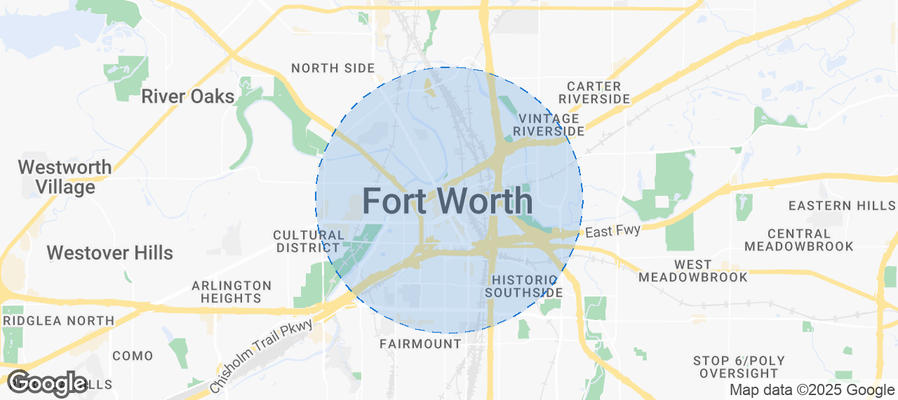 Browse the live Fort Worth Airbnb market See Every Fort Worth Listing
Revenue, occupancy and nightly rates are in the Fort Worth Airbnb market report .
At a glance
Fort Worth Airbnb Rules at a Glance
- Registration required
- Yes
- Taxes on a stay
- 17%
- Fine for hosting without a permit
- Up to $2,000
- Listings showing a permit number
- 0%
- Latest rule change
- Aug 3, 2026
Listing figures: AirROI, 12 months to October 2026. A number on a listing doesn't prove the permit or license is valid, and a missing one doesn't prove there is none.
The rules in brief
The rules a Fort Worth host meets first, each linked to the ordinance, statute or official page it comes from. Details and exceptions follow below.
| Topic | Rule |
|---|---|
| Permit | Registration before you rent or advertise1 |
| Who can host | No owner-occupancy requirement1 |
| Where | Not allowed in residential districts6,10 |
| Building rules | HOA rules and deed restrictions still apply4 |
| Minimum stay | Covers stays of 1 to 29 nights1 |
| Guests | Two guests per bedroom plus two, maximum 121,9 |
| Listing display | Registration number in every advertisement1 |
| Platforms | Airbnb collects the 6% state hotel tax13,16 |
| Neighbors | Local contact on site within one hour1 |
Your home
Can You Host an Airbnb in Fort Worth? It Depends on the Home
Whether you can host in Fort Worth turns on whose home it is and whether you live there.
A house in a residential district (A-#, AR, B, R1, R2, CR, C, D, UR)
Not allowedNot allowed: zoning bars rentals under 30 days and the city will not register the property. The only route is a zoning change to Planned Development, which is not guaranteed, and the Second Court of Appeals upheld the ban on May 28, 2026.6,10,11
Permit
Do You Need a Permit for Airbnb in Fort Worth?
Yes. Short-term rental hosts in Fort Worth need the short-term rental registration from the City of Fort Worth, applied for and renewed online through the Localgov portal. It costs $150 in the first year (A one-home host pays $150 for the first year and $100 a year to renew, plus hotel tax on each stay.) and $100 a year to renew.1,6,7,9
- Who needs it
- Every owner who rents a dwelling, accessory dwelling or part of one for 1 to 29 nights, before using or advertising it; the home must be in a zoning district that allows short-term rentals.1,6,7,9
- Issued by
- City of Fort Worth, applied for and renewed online through the Localgov portal
- Valid for
- Expires on the last day of the month one year after issue; it is tied to one address and cannot be transferred.
- On listings
- The number must appear on every listing
- Platform checks
- The registration article puts the duty on the host: every advertisement must carry the current registration number, and the article sets no verification duty for hosting platforms.
Fees
| Fee | Amount |
|---|---|
| Initial registrationCharged when the first application is filed; a renewal filed after the registration has expired is treated as a new registration. | $150 |
| Annual renewalCharged when each renewal application is filed, which may be done from 30 days before expiry. | $100 |
Who qualifies
- The property must be in a district where zoning allows short-term rentals: all mixed-use and most form-based, commercial and industrial districts
- A zoning confirmation from the city's online Permit Assist Zoning tool, uploaded with the application
- A local responsible party who can reach the property within one hour; the owner may serve
- Owner occupancy is not required
How to apply
- Check the address in the city's Permit Assist Zoning tool and save the PDF showing a success message.
- Create an account on the Localgov portal (tax.localgov.org) and add the property.
- Submit the Hotel Occupancy Tax Registration for short-term rentals with the zoning PDF and the owner and local responsible party details, and pay the $150 fee.
- Download the approved registration, post a copy inside the front entrance and put the registration number in every listing.
- Renew each year for $100, starting 30 days before expiry, and file the monthly hotel tax return even when the amount is $0.
Applications go through the official application page .
Permit rules
- Zoning confirmation comes first
- Before registering, the owner runs the address through the city's Permit Assist Zoning tool and uploads the PDF with a success message to the registration application; a result of "prohibited at this location" means the property cannot be a short-term rental.6,7,9
- Registration before you rent or advertise
- An owner needs a valid, active registration from the city before using, allowing the use of or advertising a property as a short-term rental, and renting or advertising without one is unlawful.1 In force since February 28, 2023
- $150 to register, $100 a year to renew
- The first application costs $150 and each annual renewal $100; both are paid when the application is filed on Localgov.1,6,7 In force since February 28, 2023
- One-year registration, renewal from 30 days out
- A registration expires on the last day of the month one year after it is issued; a renewal may be filed from 30 days before expiry, and a renewal filed after expiry is treated as a new registration at the $150 fee.1 In force since February 28, 2023
- Registration cannot be transferred
- A registration belongs to one owner and address, so a buyer must apply for a new one, and trying to transfer or borrow a registration can lead to revocation.1 In force since February 28, 2023
- Registration number in every advertisement
- Every advertisement, on Airbnb, Vrbo, a personal website or in print, must include the current registration number assigned by the city, and using another property's number is unlawful.1 In force since February 28, 2023
- Post the registration inside the front entrance
- A copy of the approved registration, the first page of the approved application PDF from Localgov, must be posted in a conspicuous place inside the front entrance.1,9 In force since February 28, 2023
- Registration and tax filing run through Localgov
- Since January 5, 2024, hotel owners and short-term rental hosts register their property and file and pay hotel occupancy tax on the Localgov portal; short-term rentals renew the registration form every year.7 In force since January 5, 2024
Who can host
Who Can Host an Airbnb in Fort Worth, and Where
Texas state law applies on top of Fort Worth's own rules: the Texas short-term rental regulations page covers the state license and what cities and counties can and can't regulate.
- Not allowed in residential districts
- Short-term rentals are allowed in all mixed-use and most form-based, commercial and industrial districts and are not allowed in the residential districts A-#, AR, B, R1, R2, CR, C, D and UR. The city has treated stays under 30 days as a commercial use since its 2018 zoning amendment, and the 2023 registration ordinance did not change that.6,10
- Rezoning is the only route for a residential lot
- An owner in a residential district who wants to rent for under 30 days can apply for a zoning change to Planned Development (PD), which goes through a public hearing and is not guaranteed.6,10 Applies to: Residential districts
- No owner-occupancy requirement
- The registration article does not require the owner to live at the property; the owner names a local responsible party, who may be the owner or another individual.1 In force since February 28, 2023
- HOA rules and deed restrictions still apply
- Texas law leaves homeowners' associations and other private parties free to enforce their own rules and deed restrictions, so a subdivision's covenants can limit rentals even where the city allows them.4 In force since June 12, 2025
Operating rules
Operating Rules for Fort Worth Short-Term Rentals
- Covers stays of 1 to 29 nights
- The registration rules apply to rentals of at least one night and at most 29 consecutive days; the article sets no annual cap on nights, and an ongoing month-to-month tenancy is outside the definition.1 In force since February 28, 2023
- Local contact on site within one hour
- The local responsible party must be reachable in person or by phone whenever guests are on the premises, must be able to decide matters for the property and must be at the premises within one hour of a call from the city.1 In force since February 28, 2023
- Two guests per bedroom plus two, maximum 12
- No more than two persons per bedroom plus two additional persons may stay, never more than 12 including children, and only one group at a time may rent the property.1,9 In force since February 28, 2023
- No events or parties
- Advertising, promoting or allowing a special event such as a wedding, reunion, bachelor or bachelorette party or concert at the property is unlawful.1 In force since February 28, 2023
- Parking limited to off-street spaces
- The number of vehicles at the rental is limited to the available off-street parking spaces, and parking on unapproved surfaces or on public streets in breach of city rules is unlawful.1 In force since February 28, 2023
- City noise and trash rules apply
- The owner and guests must follow the city noise ordinance, and garbage, rubbish and recyclables must be placed out under the city's solid waste rules.1 In force since February 28, 2023
- Written host rules for guests
- The host gives guests a notice of the city rules that cover occupancy, parking, trash pickup, special events, noise and curfew times.1 In force since February 28, 2023
- Revocation and a one-year wait
- The city can revoke a registration after one or more citations in the previous 12 months, a false statement on the application, an unreported material change or a hotel tax failure; after a revoked registration no new one is issued for the premises for one year.1 In force since February 28, 2023
Taxes
How Much Are Airbnb Taxes in Fort Worth?
About 17% on the nightly price: 6% Texas state tax, 9% Fort Worth city tax and 2% convention center venue tax.
17% in all
How the 17% on a Fort Worth stay splits between the taxes in the table below
- Fort Worth city hotel occupancy tax 9%
- Texas state hotel occupancy tax 6%
- Fort Worth convention center venue hotel occupancy tax 2%
- Median nightly rate, booked nights
- $170
- Taxes on that night (17%)
- $29
- Guest pays, before Airbnb and cleaning fees
- $199
| Tax | Rate | Collected by |
|---|---|---|
| Texas state hotel occupancy tax 6% of the listing price, including the cleaning fee, on stays of 29 nights or less | 6%12,16 | Airbnb |
| Fort Worth city hotel occupancy tax 9% of the amount the guest pays for a room costing $2 or more per day; filed monthly on Localgov | 9%2,7,9 | Host |
| Fort Worth convention center venue hotel occupancy tax 2% of the amount the guest pays, on top of the 9% city tax, for stays since August 1, 2024 | 2%3 | Host |
At Fort Worth's median booked rate of $170 a night, the taxes collected on a booking come to about $29 a night.
What the host still handles
- The City of Fort Worth short-term rental registration and hotel occupancy tax account on the Localgov portal, renewed every year
- A monthly hotel occupancy tax return on Localgov, due by the 25th of the following month, filed even when no tax is owed
- The Texas Comptroller, only for bookings taken outside a platform that collects the state tax, such as a personal website2,3,9,12,14,16
Fines
How to Avoid Airbnb Fines in Fort Worth
Fines in Fort Worth fall on hosting without the short-term rental registration, or outside the rules above. With it in hand and the rules followed, none of the fines below apply.
- Violating the short-term rental article is a misdemeanor punishable by a fine of up to $500, or up to $2,000 where the charge alleges a culpable mental state and the offense governs fire safety, zoning or public health and sanitation; each day is a separate offense.1
- The city can revoke a registration, and a host whose registration is revoked cannot register the same premises for one year.1
- Hotel tax returns or payments not made by the 25th of the following month carry a 15% late penalty and interest of 10% per year, and failing to collect, report or remit the tax is a misdemeanor.2,7
Changes
What's Changed in Fort Worth's Airbnb Rules
No change was scheduled when the rules were checked on October 17, 2026; the most recent are listed first.
- August 3, 2026Petition for review filed in the Supreme Court of Texas
The court's docket shows a petition for review of the Modern Builders decision filed on August 3, 2026; the residential-district rule stays in force while it is pending.11
- May 28, 2026Court of Appeals upholds the 2018 and 2023 ordinances
The Second Court of Appeals in Fort Worth affirmed the trial court's judgment for the city in Modern Builders, LLC v. City of Fort Worth, holding that the owners have no vested right to short-term rentals in single-family districts and that the ordinances rationally serve a legitimate interest.10,11
- August 1, 20242% venue hotel tax added
After voters approved a convention center venue project on May 4, 2024, a 2% venue hotel occupancy tax applies to every occupancy on or after August 1, 2024, bringing the city rate to 11%.3
- January 5, 2024
- February 28, 2023Registration article takes effect
The code lists the short-term rental registration article as effective on February 28, 2023.1
- February 14, 2023City Council adopts the short-term rental registration ordinance
Ordinance 26005-02-2023 added Article XIII, Short-Term Rental Registration, to Chapter 7 of the city code, with the $150 and $100 fees, occupancy and conduct rules and penalties; it did not change the ban in residential districts.1,8,10
Earnings
What Could a Fort Worth Short-Term Rental Earn?
The rules shape the numbers: a registration that costs $150 in the first year and taxes of 17% added to guests' bills. For a specific address, the Airbnb income calculator estimates revenue, occupancy and nightly rate from comparable listings, so you can test the numbers before applying.
FAQ
Fort Worth Airbnb Rules: Frequently Asked Questions
Is Airbnb legal in Fort Worth?
Do I need a permit or registration for Airbnb in Fort Worth?
How much is the Fort Worth short-term rental registration?
Where in Fort Worth can I run a short-term rental?
Can I rent a home I don't live in?
Yes, where zoning allows it. The registration article does not require the owner to live there, but the owner must name a local responsible party who can be at the property within one hour.1
Can I get a residential property approved for short-term rental?
Does Airbnb collect hotel tax in Fort Worth?
What is the hotel tax on a Fort Worth Airbnb stay?
How many guests are allowed in a Fort Worth short-term rental?
Up to two persons per bedroom plus two more, and never more than 12 including children. Only one group may rent at a time, and events are prohibited.1
What is the fine for operating without registration in Fort Worth?
A violation is a misdemeanor with a fine of up to $500, or up to $2,000 for offenses that govern fire safety, zoning or public health when the charge alleges a culpable mental state. Each day is a separate offense, and the city can revoke a registration and bar a new one for a year.1
Do I have to put my registration number on my Airbnb listing?
When is Fort Worth hotel tax due?
How many Fort Worth Airbnbs are registered?
In AirROI's listing data, 0% of the 1,660 Fort Worth Airbnb listings active in the 12 months to October 2026 displayed a permit, license or registration number. A number on a listing shows the host entered one; it doesn't confirm the permit is valid.
How much does an Airbnb make in Fort Worth?
The average Fort Worth listing earned $29,100 in the 12 months to October 2026, according to AirROI, averaged across every active listing including those booked for only part of the year. The Fort Worth Airbnb market report breaks it down by month, property size and neighborhood.
Method
How These Rules Were Checked
Each rule on this page was checked in October 2026 against the official source cited beside it: the ordinance or statute, the permit office's own pages and the tax authority. Airbnb's help pages are cited on their own only for what Airbnb itself does, such as the taxes it collects and the permit checks it runs, and otherwise only beside an official source; news reports only for when a change was announced. Rules that could not be confirmed on an official page are left out. The City of Fort Worth website and the American Legal code library block scripted readers, so those pages were read in a browser; the city's PDFs were read from downloaded copies.
Rules change with council votes, court rulings and new state laws, so the page is rechecked every three months and whenever a scheduled change takes effect. It summarizes the rules for information and is not legal advice; the local authority has the final word on any application.
Listing figures come from AirROI's tracking of 1,660 active Fort Worth Airbnb listings over the 12 months to October 2026.
Sources
Sources
Each rule above links to the source it comes from. Official ordinances, statutes and government pages come first, then Airbnb's own help pages.
- 1. Fort Worth Code of Ordinances, Chapter 7, Article XIII: Short-Term Rental Registration · City of Fort Worth (American Legal Publishing)
- 2. Fort Worth Code of Ordinances, Chapter 32, Article II: Hotel Occupancy Tax · City of Fort Worth
- 3. Fort Worth Code of Ordinances, Section 32-31: Venue Hotel Occupancy Tax · City of Fort Worth (American Legal Publishing)
- 4. H.B. 2464, 89th Legislature (enrolled): authority of a municipality to regulate a home-based business · Texas Legislature
- 5. Texas Local Government Code, Chapter 54, Section 54.001 · Texas Legislature
- 6. Short-Term Rentals (STR) · City of Fort Worth
- 7. Localgov is now live: Hotel Occupancy Tax Registration & Remittance Requirements · City of Fort Worth
- 8. Ordinance No. 26005-02-2023 (short-term rental registration, adopted February 14, 2023) · City of Fort Worth
- 9. Localgov Taxpayer Training: Short-Term Rentals · City of Fort Worth
- 10. Modern Builders, LLC v. City of Fort Worth, No. 02-25-00275-CV (opinion, May 28, 2026) · Second Court of Appeals of Texas, Fort Worth
- 11. Case 02-25-00275-CV, Modern Builders, LLC v. City of Fort Worth (docket) · Texas Judicial Branch
- 12. Hotel Occupancy Tax · Texas Comptroller of Public Accounts
- 13. Hotel Occupancy Tax FAQs · Texas Comptroller of Public Accounts
- 14. Local Hotel Occupancy Tax Overview · Texas Comptroller of Public Accounts
- 15. Tarr v. Timberwood Park Owners Association, Inc., No. 16-1005 · Supreme Court of Texas
- 16. Occupancy tax collection and remittance by Airbnb in Texas · Airbnb Help Center