Local Airbnb rules2026 20 sources cited
Is Airbnb Legal in San Antonio? 2026 Rules, Permits & Taxes
Airbnb is legal in San Antonio with a city permit ($450 Type 1, $1,000 Type 2, 3 years, plus 8%). Type 2 rentals are capped at 12.5% of a block face. Hotel tax totals 16.75%; citations run up to $500 a day.3,9,10,11,12,18,20
From 18 official sources and 2 Airbnb help pages. Not legal advice.
The short answer
San Antonio Airbnb Rules in Brief
- A permit is required inside the city limits: $450 if the owner or operator lives there (Type 1) or $1,000 if not (Type 2), plus an 8% surcharge, for three years, from October 1, 2026.
- Type 2 rentals are limited to 12.5% of the homes on a block face; going over needs a Board of Adjustment special exception.
- Lodging tax is 16.75%: 6% state and 9% city, which Airbnb collects, plus 1.75% Bexar County, which the host reports and pays; a monthly report is due even at $0.
- Citations run up to $500 a day, and three confirmed citations in three years revoke the permit.
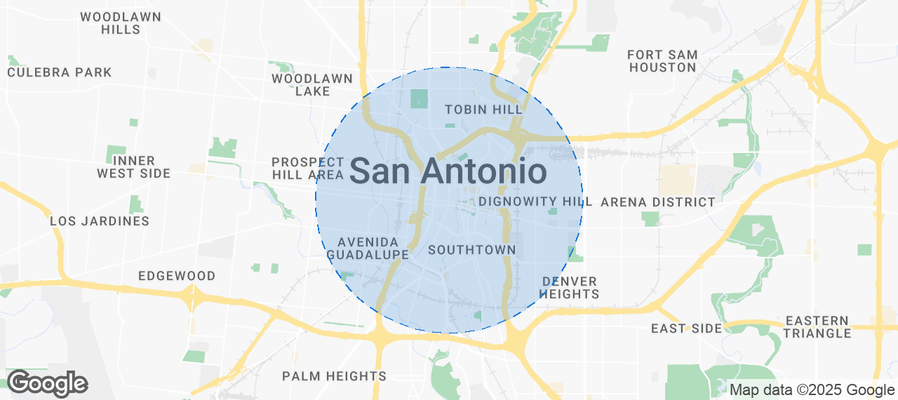 Browse the live San Antonio Airbnb market See Every San Antonio Listing
Revenue, occupancy and nightly rates are in the San Antonio Airbnb market report .
At a glance
San Antonio Airbnb Rules at a Glance
- Permit required
- Yes
- Taxes on a stay
- 16.75%
- Fine for hosting without a permit
- Up to $500
- Listings showing a permit number
- 65%
- Latest rule change
- Oct 1, 2026
Listing figures: AirROI, 12 months to September 2026. A number on a listing doesn't prove the permit or license is valid, and a missing one doesn't prove there is none.
The rules in brief
The rules a San Antonio host meets first, each linked to the ordinance, statute or official page it comes from. Details and exceptions follow below.
| Topic | Rule |
|---|---|
| Permit | Permit required for every unit3,11 |
| Who can host | Type 1: the owner or operator lives there3,12 |
| Where | Type 2 capped at 12.5% of a block face4,11,12 |
| Building rules | Lease, HOA and deed restrictions still apply1,3 |
| Minimum stay | Rentals under 30 nights are short-term rentals4 |
| Guests | Maximum guests set on the permit3,20 |
| Listing display | Permit number in every advertisement3,20 |
| Platforms | Platforms remove listings without a valid permit number3,15 |
| Safety | Fire extinguisher, detectors, escape openings, evacuation plan3 |
| Insurance | Liability insurance required3,20 |
| Neighbors | At least one off-street parking space3 |
Your home
Can You Host an Airbnb in San Antonio? It Depends on the Home
Whether you can host in San Antonio turns on whose home it is and whether you live there.
Your own home, rented whole while you're away
Allowed with conditionsAllowed with a Type 1 permit ($450 plus an 8% surcharge, three years) and no density limit, as long as it is your legal residence. You still need the permit number in the listing, a monthly hotel tax report and liability insurance.3,10,12
A room in your home with you present
Allowed with conditionsAllowed under a Type 1 permit if the owner is generally present and the guest room shares a full bathroom. The same safety, insurance and tax rules apply.3
A second home or investment property you don't live in
Allowed with conditionsAllowed with a Type 2 permit ($1,000 plus an 8% surcharge, three years) if the block face is under the 12.5% limit; otherwise a Board of Adjustment special exception is needed. The whole unit must be rented, and it cannot be an accessory dwelling unit.4,9,10,12
A home outside the city limits but in Bexar County
AllowedNo San Antonio permit is needed and Bexar County has no zoning outside city limits, but the owner must still register a hotel tax account and report and pay Bexar County's 1.75% tax each month. Other incorporated cities in the county set their own rules.8,12,18,20
Permit
Do You Need a Permit for Airbnb in San Antonio?
Yes. Short-term rental hosts in San Antonio need the short-term rental permit from the City of San Antonio Development Services Department. It costs $486 in the first year (A host who lives in the home pays $450 plus an 8% surcharge ($486) for a three-year Type 1 permit; a host who does not live there pays $1,000 plus 8% ($1,080) for a Type 2 permit. Renewal costs the same, and hotel tax is paid on top.) and $486 a year to renew.3,9,10,11,12,18,20
- Who needs it
- Every host renting a home, apartment, condominium or accessory dwelling for under 30 consecutive days inside the San Antonio city limits, with one permit per unit. Properties outside the city limits need no city permit but still need a hotel tax account.3,9,10,11,12,18,20
- Issued by
- City of San Antonio Development Services Department
- Valid for
- A permit lasts three years from the date of issue, covers one unit and cannot be transferred to another owner, operator, unit or location; renew before it expires, because a late renewal is treated as a new application.
- Processing
- Permits are issued within five business days once a complete application is received.
- On listings
- The number must appear on every listing
- Platform checks
- Platforms must require a permit number on every San Antonio listing, and the city can ask a platform to remove a listing that has no valid number; the platform then has ten business days to remove it.
Fees
| Fee | Amount |
|---|---|
| Type 1 permit (owner or operator lives on site)Application and renewal fee from June 14, 2024 through September 30, 2026. | $300 |
| Type 1 permit (owner or operator lives on site)Non-refundable fee for a three-year permit, plus an 8% surcharge ($486 in all); renewal costs the same. | $450 |
| Type 2 permit (nobody lives on site)Application and renewal fee from June 14, 2024 through September 30, 2026. | $450 |
| Type 2 permit (nobody lives on site)Non-refundable fee for a three-year permit, plus an 8% surcharge ($1,080 in all); renewal costs the same. | $1,000 |
| Board of Adjustment special exception (property with a homestead exemption)Needed only when a Type 2 rental would exceed the block-face limit; an 8% surcharge is added. | $460 |
| Board of Adjustment special exception (all other properties)Needed only when a Type 2 rental would exceed the block-face limit; an 8% surcharge is added. | $690 |
Who qualifies
- Inside the San Antonio city limits; a separate permit for each unit with cooking, sleeping and bathing facilities
- Type 1: the owner, or a tenant with the owner's written permission, lives on the property, shown by a homestead exemption or voter or vehicle registration; no density limit
- Type 2: nobody lives on the property; limited to 12.5% of homes on a block face and to renting the entire unit
- Zoning allows it: residential districts are allowed, but not C-3, L, I-1 or I-2
- A named 24-hour operator who is an individual, and at least one off-street parking space or a parking adjustment from the Board of Adjustment
- A property that received a City Housing Incentive cannot hold a Type 2 permit while the incentive lasts
How to apply
- Confirm the property is inside the San Antonio city limits and that its zoning allows rentals; for a Type 2 rental, check that the block face is under the 12.5% limit.
- Create an account on the city's BuildSA permit portal, choose Land Development, then Short Term Rental (STR) Application, and pick Type 1 or Type 2.
- Enter the owner and a 24-hour designated operator (an individual); a tenant uploads the owner's written permission, and an applicant who is not the owner uploads a notarized owner authorization.
- Upload a floor plan showing sleeping areas, the maximum number of guests, fire extinguishers and evacuation routes, plus the location of the off-street parking space.
- Pay the non-refundable fee with the 8% surcharge. The city issues the permit within five business days of a complete application, and a hotel tax taxpayer number is issued when a new application is approved.
- Put the permit number in every listing and report hotel tax every month using the taxpayer number.
Applications go through the City of San Antonio Development Services Department application portal .
Permit rules
- Permit required for every unit
- No short-term rental may operate inside San Antonio without a current permit, and each unit with cooking, sleeping and bathing facilities needs its own permit.3,11 In force since November 2018
- Three-year permit, not transferable
- Permits last three years and cannot be transferred to a new owner, operator, unit or location; the operator or 24-hour contact can be updated without a new application.3,9
- Permit number in every advertisement
- Every advertisement, on a platform or the host's own website, must include the short-term rental permit number in its description.3,20
- Platforms remove listings without a valid permit number
- Platforms must require a permit number on each San Antonio listing. When the city tells a platform that a listing has no number, or an invalid, expired or revoked one, the platform must remove it within ten business days.3,15 In force since June 13, 2024
- Airbnb remits the city tax; the county tax stays with the host
- Since March 2025, platforms that remit the state hotel tax, including Airbnb and Vrbo, send the city's 9% directly to San Antonio. Hosts still file a monthly report and pay Bexar County's 1.75% themselves, and pay the city tax on bookings from other platforms.15,16,17 In force since March 10, 2025
Who can host
Who Can Host an Airbnb in San Antonio, and Where
Texas state law applies on top of San Antonio's own rules: the Texas short-term rental regulations page covers the state license and what cities and counties can and can't regulate.
- City limits only; elsewhere in Bexar County just hotel tax
- The ordinance covers properties inside San Antonio. A rental outside the city limits but in Bexar County needs no city permit, but must still register a hotel tax account with the city's Finance Department.12,20
- Type 1: the owner or operator lives there
- A Type 1 permit is for a home where the owner, or a tenant with the owner's permission, makes it their legal residence, shown by a homestead exemption, voter registration, vehicle registration or similar proof. Type 1 rentals have no density limit.3,12 Applies to: Type 1 · In force since November 2018
- Type 1 may rent a room if the owner is present
- A Type 1 host can rent less than the whole home if the guest room shares a full bathroom and the owner is generally present at the property. A Type 2 rental must rent the entire unit.3 Applies to: Type 1 · In force since June 13, 2024
- Type 2: whole unit only
- A Type 2 permit covers a home where nobody lives; it may not be used to rent part of a dwelling unit, and Type 2 rentals may not operate in accessory dwelling units.3,12 Applies to: Type 2 · In force since June 13, 2024
- Accessory dwelling units only with an owner on site
- An owner who lives in the main house can get a Type 1 permit for an accessory dwelling unit with no density limit; a non-owner-occupied accessory dwelling unit cannot be a short-term rental.12 Applies to: Accessory dwelling units
- No Type 2 permit for homes with a city housing incentive
- A property that has received a City Housing Incentive cannot get a Type 2 permit while the owner is still eligible for that incentive.3 Applies to: Type 2 · In force since November 2018
- Type 2 capped at 12.5% of a block face
- Type 2 rentals in residential districts are limited to one-eighth (12.5%) of the single-family to fourplex homes on a block face, which is one side of a street between intersections. Fractions round down, but every block face may have at least one Type 2.4,11,12 Applies to: Type 2 · In force since November 2018
- Apartment buildings: one Type 2 up to 7 units, 12.5% from 8
- In a building or group of buildings with 5 to 7 units only one Type 2 rental is allowed by right; with 8 or more units the limit is 12.5% of the units on the property.4,12 Applies to: Type 2 · In force since November 2018
- Over the limit: Board of Adjustment special exception
- When the block-face limit is reached, a Type 2 applicant has 45 days to apply for a special exception from the Board of Adjustment, at $460 for a property with a homestead exemption or $690 for any other, plus an 8% surcharge. The city reports 87 cases heard since 2018, with 25% approved.9,12,16 Applies to: Type 2
- Not allowed in C-3, L, I-1 and I-2 districts
- Short-term rentals are allowed in residential and most other districts, but not in the C-3, L, I-1 and I-2 zoning districts. The city's One Stop map shows a property's zoning.9,20
- Lease, HOA and deed restrictions still apply
- The city permit gives no right to rent in violation of a lease, deed restriction or covenant, and the city does not enforce them. Texas law leaves homeowners' associations free to enforce their own rules, so check the recorded restrictions before applying.1,3
Operating rules
Operating Rules for San Antonio Short-Term Rentals
- Rentals under 30 nights are short-term rentals
- A short-term rental is the rental of all or part of a home, apartment, condominium or accessory dwelling for under 30 consecutive days and at least 12 hours; there is no separate minimum number of nights.4 In force since November 2018
- Monthly hotel tax report, even at zero
- The owner or operator files a hotel tax report every month, even when the unit was not rented or a platform collected the tax. Failing to report brings penalty and interest and can lead to permit revocation.3,14 In force since September 12, 2024
- Maximum guests set on the permit
- The permit lists a maximum number of guests, defined by the San Antonio Property Maintenance Code. Airbnb's city summary describes the limit as two adults per sleeping area, and a bedroom without a compliant exit cannot count as a sleeping area.3,20 In force since June 13, 2024
- Fire extinguisher, detectors, escape openings, evacuation plan
- Each rental needs a 5-pound 2A:10B:C extinguisher mounted within 75 feet of every part of the unit on each floor, working smoke and carbon monoxide detectors, an emergency escape opening in every sleeping area and a posted evacuation plan. Owners also obtain annual independent inspections of the extinguishers.3 In force since June 13, 2024
- Liability insurance required
- Hosts must carry an insurance policy sufficient for personal injury liability of guests; the ordinance sets no minimum amount.3,20
- At least one off-street parking space
- Each rental needs at least one off-street parking space that is not in the public right-of-way or on a yard. A property without one can ask the Board of Adjustment for a parking adjustment.3
- Quiet hours and a 63-decibel limit
- Quiet hours run 10 p.m. to 6 a.m. Sunday through Thursday and 11 p.m. to 6 a.m. Friday and Saturday, and noise may not exceed 63 decibels on residential property measured from the neighbor's land. Rentals with a pool, hot tub or patio post the quiet hours outdoors.3 In force since June 13, 2024
- No weddings or events; no food service
- A short-term rental in a residential district may not be used as a venue for weddings, events, restaurants or meeting halls, and the operator may not sell prepared food or drink to guests. Guests may not sleep outdoors, and outdoor sleeping spaces cannot be rented.3,4,20 In force since November 2018
- 24-hour contact who responds within one hour
- Every permit names a 24-hour contact who can respond to complaints. After a citation the operator or agent must try to reach the guests within one hour, and a second citation requires steps to prevent repeats.3
Taxes
How Much Are Airbnb Taxes in San Antonio?
16.75% on the nightly price and cleaning fee: 6% state and 9% city, which Airbnb collects (15%), plus 1.75% Bexar County, which the host reports and pays. State law caps the combined rate at 17%.
16.75% in all
How the 16.75% on a San Antonio stay splits between the taxes in the table below
- City of San Antonio hotel occupancy tax 9%
- Texas state hotel occupancy tax 6%
- Bexar County hotel occupancy tax 1.75%
- Median nightly rate, booked nights
- $170
- Taxes on that night (16.75%)
- $28
- Guest pays, before Airbnb and cleaning fees
- $198
| Tax | Rate | Collected by |
|---|---|---|
| Texas state hotel occupancy tax 6% of the listing price, including the cleaning fee, on stays of 29 nights or less | 6%5,19 | Airbnb |
| City of San Antonio hotel occupancy tax 9% of the listing price, including the cleaning fee: a 7% general tax plus 2% for the Convention Center expansion | 9%16,18,19,20 | Airbnb |
| Bexar County hotel occupancy tax 1.75% of the rental price; collected by the city for the county and paid by the host | 1.75%14,16,17,18 | Host |
At San Antonio's median booked rate of $170 a night, the taxes collected on a booking come to about $28 a night.
What the host still handles
- A City of San Antonio hotel tax account: the taxpayer number is issued when the short-term rental permit application is approved (or set up with the Finance Department first for a property outside the city limits). Report every month, even at $0, and pay the 1.75% Bexar County tax and the city tax on bookings outside Airbnb and Vrbo
- The Texas Comptroller, by sending Form AP-102 (Hotel Occupancy Tax Questionnaire) to the local field office, only for bookings taken outside a platform that collects the state tax (own website or non-collecting platforms); returns are due by the 20th of the month after each month, or quarter if qualified
- The city short-term rental permit from Development Services, which is separate from the tax account5,14,16,18,19
Fines
How to Avoid Airbnb Fines in San Antonio
Fines in San Antonio fall on hosting without the short-term rental permit, or outside the rules above. With it in hand and the rules followed, none of the fines below apply.
- Operating in violation of the ordinance: a citation of up to $500 for each day the property stays in violation after a 14-day notice. The ordinance sets fines of $200 to $500 per occurrence, treats each day as a separate offense, and makes a violation a Class C misdemeanor.3,13
- Revocation: a permit is revoked after three or more confirmed citations over three occasions within a rolling three-year period, and the owner cannot reapply for the same property for 12 months.3,15
- Criminal fine: a violation is a Class C misdemeanor punishable by $100 to $500, with each day a separate violation.3
- Listing removal: if a violation is not fixed after the 14-day notice, the city asks the platform to take the listing down, and the platform must act within ten business days.3,13
- Unpaid hotel tax: a 5% penalty, a further 5% a month later, and interest at 10% a year; the permit is revoked if the arrears are not paid within 90 days of a delinquency notice.3,14
- False documents: an application with false documentation is denied and the owner cannot apply again for that property for one year.3
- State hotel tax filed late on direct bookings: $50 for each late report, plus a percentage of the tax.5
Changes
What's Changed in San Antonio's Airbnb Rules
No change was scheduled when the rules were checked on October 17, 2026; the most recent are listed first.
- October 1, 2026
- September 17, 2026Council approves higher permit fees
On September 17, 2026 the City Council approved the cost of the short-term rental permit for the 2027 fiscal year.10
- March 10, 2025
- June 14, 2024
- June 13, 2024
- July 1, 2023Hotel tax number issued with each new permit
From July 1, 2023 a hotel tax taxpayer number is issued when a new short-term rental application is approved.10
- November 1, 2018
Listing data
What San Antonio's Listings Show
AirROI, a short-term-rental data firm, counted 5,400 active Airbnb listings in San Antonio over the 12 months to September 2026. 65% of them displayed a permit, license or registration number.
Minimum stay set on San Antonio listings
Share of active listings by the shortest stay they accept
Minimum stay in numbers
| Shortest stay accepted | Share of listings |
|---|---|
| 1 night | 36% |
| 2 nights | 38% |
| 3 nights | 8% |
| 4–6 nights | 3% |
| 7–29 nights | 7% |
| 30+ nights | 9% |
What officials report
- 3,339
- Active short-term rental permits · as of September 2025San Antonio reported 3,339 active permits in its fiscal year 2025 annual report, 23% Type 1 (owner-occupied) and 77% Type 2 (not occupied by the owner).16
- 7,815
- Permits issued since the ordinance began · as of September 2025The city has issued 7,815 permits since the ordinance took effect, including renewals, and has revoked 2,739 of them, 516 of them in fiscal year 2025.16
- 863
- Violations reported in fiscal year 2025 · as of September 2025Code Enforcement received 863 violation reports and ran 1,820 investigations in fiscal year 2025, finding a violation in 582 and none in 415.16
- 87
- Board of Adjustment special exceptions heard · as of September 2025Since the ordinance began the Board of Adjustment has heard 87 short-term rental special exception cases, with an approval rate of 25%.16
- $28.4 million
- Hotel tax collected from short-term rentals since 2020 · as of September 2025The Finance Department has collected $28,384,955 in hotel occupancy tax from short-term rentals through fiscal year 2025, including $9,572,089 in that year.16
Earnings
What Could a San Antonio Short-Term Rental Earn?
The rules shape the numbers: a permit that costs $486 in the first year and taxes of 16.75% added to guests' bills. For a specific address, the short-term rental calculator estimates revenue, occupancy and nightly rate from comparable listings, so you can test the numbers before applying.
FAQ
San Antonio Airbnb Rules: Frequently Asked Questions
Is Airbnb legal in San Antonio?
Do I need a permit for Airbnb in San Antonio?
How much is the San Antonio short-term rental permit?
Can I rent a home I don't live in?
What is the 12.5% block-face limit?
Does Airbnb collect hotel tax in San Antonio?
What is the total hotel tax on an Airbnb stay in San Antonio?
What is the fine for an illegal short-term rental in San Antonio?
How long does the permit last, and can I sell it with the house?
Do I have to put the permit number in my Airbnb listing?
Can my HOA ban short-term rentals in San Antonio?
Can I host parties or events at my San Antonio rental?
How many San Antonio Airbnbs are registered?
Active short-term rental permits: 3,339 as of September 202516. In AirROI's listing data, 65% of the 5,400 San Antonio Airbnb listings active in the 12 months to September 2026 displayed a permit, license or registration number. A number on a listing shows the host entered one; it doesn't confirm the permit is valid.
How much does an Airbnb make in San Antonio?
The average San Antonio listing earned $24,200 in the 12 months to September 2026, according to AirROI, averaged across every active listing including those booked for only part of the year. The San Antonio Airbnb market report breaks it down by month, property size and neighborhood.
Method
How These Rules Were Checked
Each rule on this page was checked in October 2026 against the official source cited beside it: the ordinance or statute, the permit office's own pages and the tax authority. Airbnb's help pages are cited on their own only for what Airbnb itself does, such as the taxes it collects and the permit checks it runs, and otherwise only beside an official source; news reports only for when a change was announced. Rules that could not be confirmed on an official page are left out. The sa.gov Short Term Rentals and Report an STR Violation pages were read from Internet Archive copies (November 2025), and the STR Permits page in a browser; the current fees were confirmed on the live permits page and in the city's September 2026 PDFs.
Rules change with council votes, court rulings and new state laws, so the page is rechecked every three months and whenever a scheduled change takes effect. It summarizes the rules for information and is not legal advice; the City of San Antonio Development Services Department has the final word on any application.
Listing figures come from AirROI's tracking of 5,400 active San Antonio Airbnb listings over the 12 months to September 2026.
Sources
Sources
Each rule above links to the source it comes from. Official ordinances, statutes and government pages come first, then Airbnb's own help pages.
- 1. H.B. 2464, 89th Legislature (enrolled): authority of a municipality to regulate a home-based business · Texas Legislature
- 2. Texas Local Government Code, Chapter 54, Section 54.001 · Texas Legislature
- 3. Ordinance 2024-06-13-0433, City Code Chapter 16, Article XXII, Short Term Rentals · City of San Antonio
- 4. Ordinance 2018-11-01-0858 (as passed): Short Term Rentals and Unified Development Code Sec. 35-374.01 · City of San Antonio
- 5. Hotel Occupancy Tax · Texas Comptroller of Public Accounts
- 6. Hotel Occupancy Tax FAQs · Texas Comptroller of Public Accounts
- 7. Local Hotel Occupancy Tax Overview · Texas Comptroller of Public Accounts
- 8. FAQ: How is my property zoned in the County? · Bexar County
- 9. STR Permits · City of San Antonio Development Services Department
- 10. Registering a Short-Term Rental Permit · City of San Antonio Development Services Department
- 11. Short Term Rentals: Application, Permits and Enforcement fact sheet (September 2026) · City of San Antonio Development Services Department
- 12. Current Short-Term Rental Ordinance · City of San Antonio Development Services Department
- 13. Report an STR Violation · City of San Antonio Development Services Department
- 14. Hotel Occupancy Tax: Short Term Rentals fact sheet · City of San Antonio Finance Department
- 15. Short Term Rentals: Updates to Current Ordinance fact sheet · City of San Antonio Development Services Department
- 16. Short Term Rentals Annual Report FY 2025 · City of San Antonio Development Services Department
- 17. Short-Term Rental Updates: Changes for San Antonio (March 6, 2025 webinar) · City of San Antonio Development Services Department and Avenu Insights & Analytics
- 18. Short Term Rentals (STR) · City of San Antonio Development Services Department
- 19. Occupancy tax collection and remittance by Airbnb in Texas · Airbnb Help Center
- 20. San Antonio, TX (short-term rental rules) · Airbnb Help Center