
AI Chatbot Hosts on Airbnb: The Revenue Math Behind the Ethics Debate

Every headline about AI chatbot hosts on Airbnb is asking the wrong question. The April 14, 2026 404 Media investigation into HostBuddy, Guesty ReplyAI, Hostaway, and Nowistay — capped by a guest tricking an AI into producing a French toast recipe — triggered a week of ethics-versus-authenticity commentary. It gave hosts nothing to decide with. The operational question is narrower and more answerable: does faster guest-message response actually pay, and does it pay enough to justify $15-30 per listing per month for an AI chat tool? AirROI's March 2026 data across 27,380 Superhost listings and 34,498 non-Superhost listings in nine diverse markets shows the median Superhost revenue premium is +51.5%, with a range from +19.0% in Barcelona to +84.3% in Los Angeles. That is the frame hosts actually need.
The Debate Every Outlet Is Having — And Why It Doesn't Help Hosts
The ethics frame is popular because it writes itself. 404 Media documented hosts outsourcing all guest communication to LLMs, Hostaway's public-facing stat that "more than 70%" of professional property managers now integrate AI in some form, and Nowistay's marketing claim that its product handles 90% of guest questions without human review. Stack those against Airbnb CEO Brian Chesky's public positioning — "People are lonelier, they're more divided than ever, and we think the antidote is travel and human connection" — and you have a neat narrative tension.
The problem: a host cannot action "is this ethical?" A host can action "does this change the P&L?" The ethics frame confuses platform positioning with host economics. Chesky's messaging is a marketing posture aimed at guests and brand; Airbnb's ranking algorithm, Superhost criteria, and search-placement rules are the actual economic surface hosts operate against. Those two surfaces are not the same surface.
Airbnb's own strategy confirms the gap. The company is baking AI into search, discovery, and support and has stated publicly that more than 30% of its customer service tickets are already handled by AI agents, with plans to push that figure much higher. The platform operator is automating its own response layer while its hosts weigh whether to do the same. The ethics debate misreads the situation. The real question is capacity — specifically, the 24-hour response-rate capacity that determines who clears the Superhost bar.
What Airbnb Actually Measures (and Rewards)
Airbnb's Superhost program is built on response rate, not response quality. The platform's Help Center article 430 defines response rate as "the percentage of new inquiries and reservation requests you responded to (by either accepting/pre-approving or declining) within 24 hours in the past 30 days." For Superhost qualification specifically, the same metric is calculated over a rolling 365-day window and must stay at or above 90%.
Two details matter for the revenue argument. First, the response-rate metric counts the fact of a reply within 24 hours — not its tone, not its authenticity, not whether the host or an AI wrote it. Second, Airbnb's own guidance elevates response rate above every other messaging metric: "It's most important to focus on your response rate, which impacts your Superhost status and search placement." Response time (average minutes to reply) is acknowledged as a secondary factor.
Superhost qualification runs on a quarterly cadence — evaluations in January, April, July, and October — with criteria of ≥90% response rate, 4.8+ overall rating, 10+ completed stays, and under 1% cancellation rate. Miss any threshold and the badge drops for the next quarter. The 365-day rolling window means the penalty carries for a full year of recovery.
The ranking consequences layer on top. Industry data cited by Aeve AI and Intellihost in 2026 shows listings with sub-one-hour response times convert at 1.0% versus 0.8% for slower responders — a 25% conversion advantage — and receive roughly 16% more daily impressions. Airbnb's own public reporting puts the Superhost earnings premium at approximately 22% above non-Superhosts, which aligns directionally with — though understates — what market-level data shows. Our earlier analysis of the Superhost premium broke down the same dynamic at a single-market level; what follows is the cross-market picture.
The Superhost Revenue Premium: 19% to 84% Across 9 Markets
The median Superhost revenue premium across nine markets is +51.5% in monthly revenue. That is the headline number. The dispersion around the median is where the strategic decision sits.
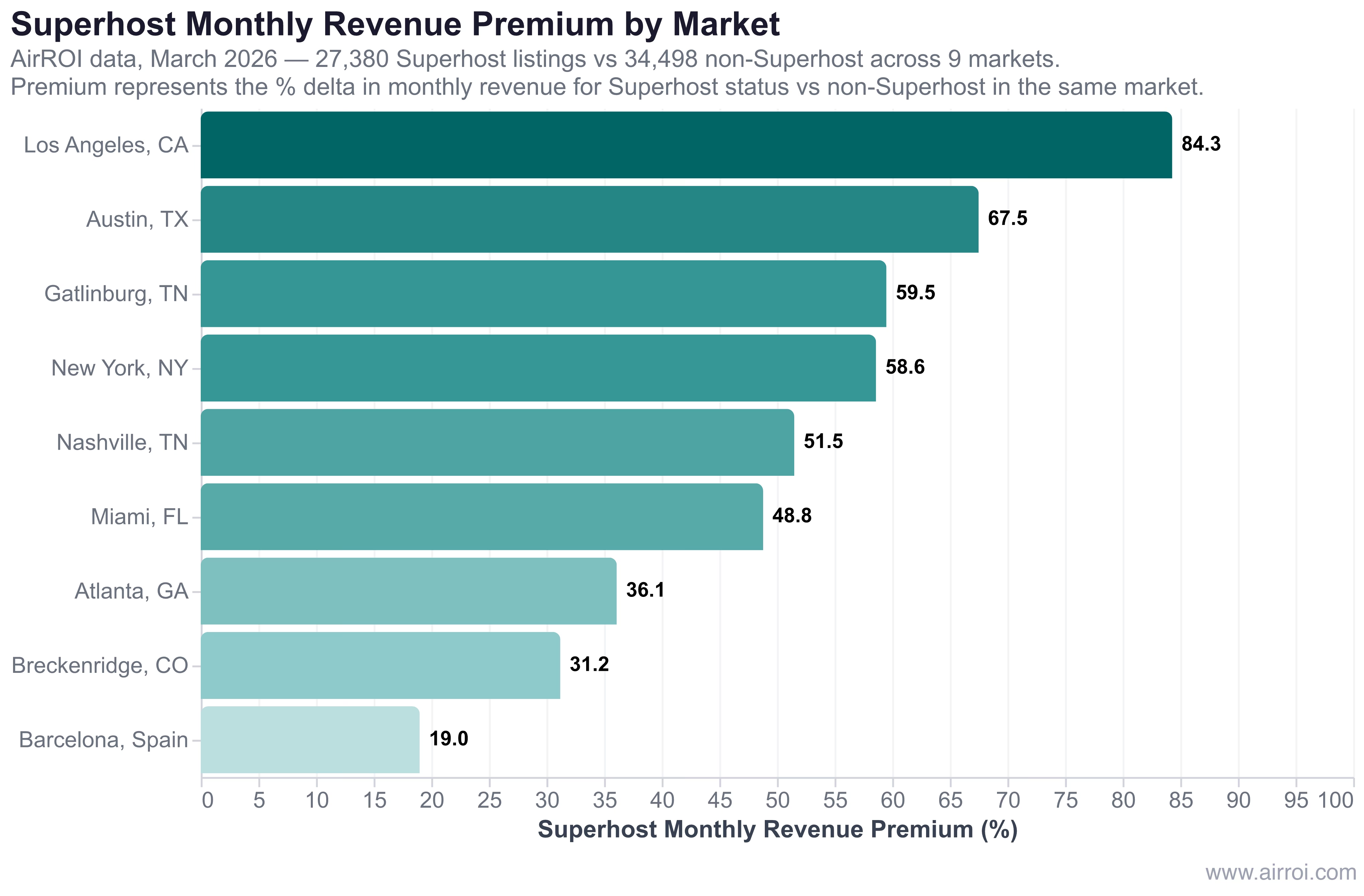
| Market | Superhost Listings | Superhost Monthly Revenue | Non-Superhost Monthly Revenue | Monthly Premium | Annualized Premium |
|---|---|---|---|---|---|
| Los Angeles, CA | 5,848 | $5,174 | $2,808 | +84.3% | +$28,392 |
| Austin, TX | 5,454 | $5,570 | $3,327 | +67.5% | +$26,916 |
| Gatlinburg, TN | 2,362 | $5,344 | $3,351 | +59.5% | +$23,916 |
| New York, NY | 5,065 | $3,430 | $2,162 | +58.6% | +$15,216 |
| Nashville, TN | 1,862 | $5,495 | $3,626 | +51.5% | +$22,428 |
| Miami, FL | 4,434 | $6,341 | $4,260 | +48.8% | +$24,972 |
| Atlanta, GA | 2,814 | $3,234 | $2,377 | +36.1% | +$10,284 |
| Breckenridge, CO | 1,509 | $11,256 | $8,582 | +31.2% | +$32,088 |
| Barcelona, Spain | 4,032 | $4,759 | $4,000 | +19.0% | +$9,108 |
Source: AirROI, March 2026 snapshot. All figures USD.
Three patterns deserve attention. Los Angeles is the extreme case — Superhost ADR sits 27% above non-Superhost ($340 vs $268) and occupancy runs 15 percentage points higher (48% vs 33%), compounding to an 84% monthly revenue gap. Gatlinburg is the inverse — Superhost ADR is nearly identical to non-Superhost ($373 vs $362, a 3.2% delta), but occupancy runs 17 points higher (47% vs 30%). In cabin markets, Superhost status does not unlock higher rates; it unlocks more booked nights.
Breckenridge shows what supply constraint looks like. ADR between Superhost and non-Superhost is nearly flat ($784 vs $756), and even total monthly revenue only diverges by 31%. When listing supply is capped by zoning, licensing, or physical scarcity, guests have fewer comparable alternatives and responsiveness becomes a weaker differentiator. Barcelona is the most extreme version: Spain's STR regulatory crackdown has truncated the effective supply pool, and the Superhost premium narrows to just +19% in monthly revenue.
The Superhost revenue premium is a function of market-level competition density, not a universal constant. The revenue math of an AI chat tool changes with the market you operate in.
The parallel between this premium and our professional-operator gap analysis, which found managed listings earning 46-113% more than unmanaged peers, suggests the Superhost badge is largely a proxy for operational discipline — including the discipline of hitting a 24-hour response window.
Where Responsiveness Moves the Needle Most
The Superhost premium scales with supply elasticity. In demand-saturated markets where guests have 50 comparable listings in a 10-mile ring, responsiveness decides which host converts the inquiry. In supply-constrained markets where guests have 5 comparable listings, they wait — and the responsiveness differentiator shrinks.
That is why Los Angeles (+84%) and Austin (+67%) sit at the top of the premium ranking. Both markets have elastic STR supply (5,848 LA Superhosts plus 4,471 non-Superhosts in one snapshot; 5,454 Austin Superhosts plus 3,868 non-Superhosts) and demand deep enough that the guest experience gap shows up in the revenue gap. Barcelona (+19%) and Breckenridge (+31%) sit at the bottom because the supply side is constrained — Barcelona by regulation, Breckenridge by zoning and physical geography.
Before subscribing to an AI chat tool, pull the market-level Superhost vs non-Superhost delta for your specific locality. A +84% LA premium and a +19% Barcelona premium translate into very different subscription economics. Use AirROI Atlas to run the query directly; the Superhost filter will show you the dollar gap at your market's current occupancy and ADR.
The AI-Chat Tool Cost-Benefit Math
At $15-30 per listing per month, AI chat tools cost 1-4% of the observed Superhost revenue premium in most analyzed markets. The breakeven threshold is trivially easy to clear. The real question is whether the tool actually closes the response-rate gap that matters.
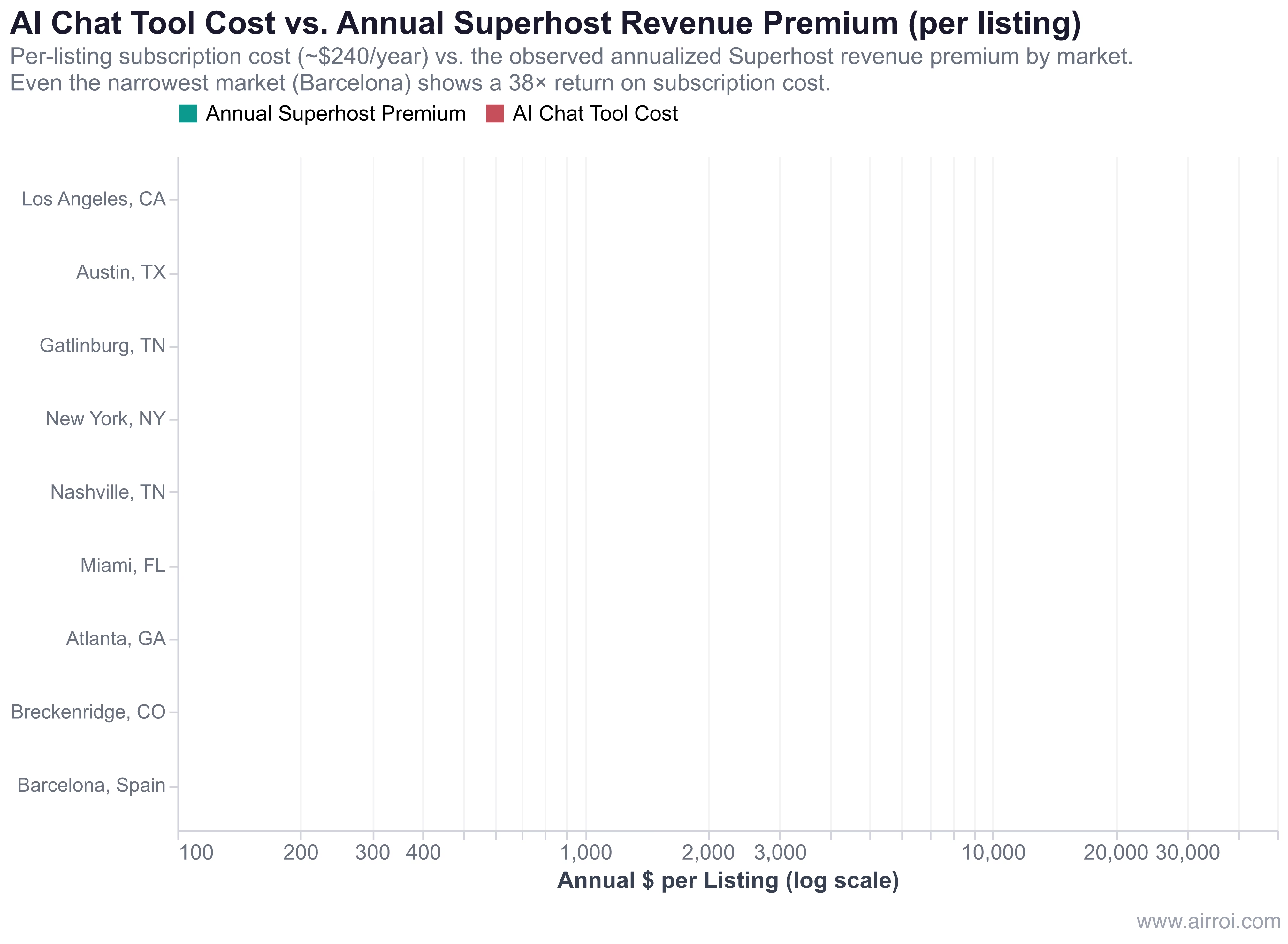
Vendor pricing sets the denominator. Nowistay publishes EUR 9 per property per month (roughly $9.70) as its base tier, which integrates with Hostaway, Guesty, and most major PMS platforms. HostBuddy markets itself as "Superhost-approved," bundles through the same PMS integrations, and prices in the $15-30 tier based on portfolio size. Hostaway sells an all-in property management system (including AI messaging) at $24-40 per listing per month. Annualized, the worst-case single-listing subscription is $480, and the typical case is closer to $240 per listing per year.
Now the numerator. At $240/year against a Nashville-median annualized Superhost premium of $22,428, the breakeven is a 1.1% realization of the observed premium. Even Barcelona's compressed +$9,108 premium clears at a 2.6% realization. Across the nine-market dataset, the worst-case recovery ratio is 38× the tool cost; the best case (Breckenridge) is 134× — though in the supply-constrained markets, the premium is narrower in percentage terms and recovery is harder to attribute to messaging alone.
The critical caveat: this math only works if the tool actually lifts your response rate from below 90% to 90%+. A host already at 96% does not get the full premium back — they were going to clear the bar anyway. Run your current response rate in the Airbnb dashboard before buying any subscription. If you are at 88-89%, the tool is the highest-leverage subscription you can buy; if you are at 94%+, the incremental lift is small and the subscription dollars are better spent on rate strategy or amenity upgrades.
The French Toast Problem — and What It Means for ROI
The French toast incident exposed a prompt-injection vulnerability, but the real ROI risk is narrower than the ethics discourse suggests. On April 14, a guest asked an AI-powered Airbnb host for a French toast recipe. The bot obliged: "I'd be happy to share a favorite recipe!" — and referenced specific property details, including the fact that the listing had two kitchens. The incident went viral and became the frame for every subsequent piece of AI-host coverage.
One documented real-world consequence is the cancelled booking. A guest quoted in 404 Media's reporting said: "Their initial booking confirmation mentioned they used AI... I ultimately ended up cancelling the booking as I was uncomfortable with it all." That is a measurable cost — one reservation lost, a potential review never earned — and it is the kind of risk worth modeling.
The risk stack, ordered by severity:
- Scope overreach (high severity, low frequency). An AI answering pricing negotiation, booking-date changes, or damage disputes. One AI-written pricing concession persists in the algorithm's perception of your rate floor; one AI-written dispute reply could violate evidence-handling norms under Airbnb's April 2026 ToS update on AI-generated evidence.
- Hallucinated FAQ answers (medium severity, medium frequency). The French toast case. The fix is a scope guardrail in the tool configuration plus a whitelist of tested answers for recurring questions.
- Guest disclosure reaction (variable severity, minority of guests). Some guests disengage; most do not notice. Voluntary disclosure in the listing description defuses the surprise reaction.
What AI chat should handle vs. what it must not:
| Task | Safe to Automate? | Notes |
|---|---|---|
| Check-in / WiFi / parking FAQs | Yes | Highest-volume, lowest-risk — the direct Superhost response-rate lever |
| Local recommendations | Mostly | Test for hallucination; keep a whitelist of verified answers |
| Booking date changes | No | Revenue-impacting; human review required |
| Damage disputes | Absolutely not | Evidence handling, ToS implications, possible Resolution Center exposure |
| Pricing negotiations | No | Each concession persists across future bookings via algorithm memory |
| Regulatory / tax questions | No | Misleading AI reply can violate local STR ordinances |
| Pre-booking "is your place OK for X" | With caution | Setting the wrong expectation → 1-star review → 365-day response-rate penalty |
One bad AI-driven review in the 365-day rolling Superhost window can drag your overall rating below 4.8 — and the cost of a rating drop is not hypothetical. Our rating-revenue cliff analysis found that a 0.2-star rating drop costs hosts roughly $9,267 per year in lost revenue. That is roughly 38× the annual cost of the AI chat tool itself. Containment framework matters more than tool selection.
Airbnb's Actual Policy Position
Airbnb permits AI messaging through approved software partners. It is not a terms-of-service violation. The platform's statement to 404 Media was explicit: "Hosts may enable on-platform messaging features... certain hosts can use third-party tools to support responses outside of a host's available hours."
Access is gated through the PMS layer. HostBuddy and Nowistay reach Airbnb messages via approved integrations with Hostaway, Guesty, OwnerRez, Hospitable, Hostify, and Beds24 — not through direct unauthorized API scraping, which would violate the host terms. For hosts, that means tool selection is primarily a PMS-compatibility decision, not a regulatory one.
Context matters: on April 20, 2026, Airbnb tightened its ToS to restrict AI-generated evidence in damage disputes and Resolution Center filings (covered in our ToS update analysis). The policy landscape is directional — AI is permitted on the guest-messaging side and restricted on the evidence/adjudication side. Tool configuration should reflect that asymmetry.
A Rational Decision Framework
The AI-chat subscription decision is a four-variable problem: current response rate, market-level premium, portfolio size, and risk posture. Run each one before subscribing.
1. Current response rate. Pull your Airbnb dashboard number for the last 365 days. If you are at 95%+, the incremental Superhost gain from automation is negligible — spend the $240/year on a dynamic-pricing improvement instead. If you are at 85-89%, an AI chat tool is probably the highest-leverage subscription you can buy for your listing.
2. Market-level premium. Look up your market's Superhost vs non-Superhost monthly revenue delta in AirROI Atlas. The nine-market table above gives you a range; your specific market may be wider or narrower. If the gap is above +40%, the tool is defensible across almost any portfolio size. If it is below +25%, the case weakens and the risk of a disclosure-driven cancellation starts to matter more.
3. Portfolio size.
- 1-4 listings — Start with Airbnb's native saved replies and scheduled auto-messages (free), then layer Nowistay or equivalent if response-rate data shows the gap persists.
- 5-20 listings — A PMS-integrated tool (HostBuddy via Hostaway or Guesty) is almost always defensible. This is the sweet spot where per-listing economics and operational complexity align.
- 20+ listings — Enterprise PMS with AI messaging (Hostaway's all-in plan, Guesty with ReplyAI) becomes table stakes. At this scale, the incremental listing subscription cost is a rounding error against a five- or six-figure monthly Superhost premium across the portfolio.
4. Risk posture. If you sell premium or luxury stays, voluntary disclosure is protective — price-sensitive guests book on rate, trust-sensitive guests book on transparency. If you run budget inventory in a high-volume market, automation risk is lower because the typical guest is less likely to notice or care about AI involvement.
Before subscribing, confirm three things: (a) the tool integrates with your existing PMS, (b) it supports scope guardrails so you can whitelist FAQ topics and block pricing/dispute messages, and (c) you can audit every AI reply in the first 30 days before trusting the configuration.
What AI Chat Tools Can't Replace
AI chat automates inquiries. It does not replace the judgment tasks that actually determine annual profitability. The list of what stays human is short but decisive: damage disputes, booking alterations, pricing negotiations, regulatory and tax questions, and pre-booking qualification for non-standard requests. Each of those decisions carries dollar stakes measured in hundreds to thousands of dollars per incident.
The 365-day rolling Superhost window compounds the stakes. One mishandled dispute that triggers a 4-star review drags the 365-day rolling rating — and the cost is measurable. The 0.2-star revenue cliff documented in our earlier analysis translates to roughly $9,267 per year in lost revenue for a typical listing. That is 38 times the annual cost of the AI chat tool itself. Containment wins over coverage: narrow the tool's scope aggressively, route anything consequential to a human, and treat the AI as a response-rate compliance layer — not a full replacement for host judgment.
This is also what separates the ethics debate from the operational decision. The ethics concern assumes hosts are replacing themselves. The ROI case shows why they should not — the parts of the job that actually drive the P&L are exactly the parts AI cannot safely touch.
The question was never ethics. It was operational ROI — and the numbers are decisive. In Los Angeles, a +$28,392 annual Superhost premium against $240/year of tool cost is a 118× recovery ratio. Even the narrowest market in our dataset (Barcelona) clears 38×. The decision collapses to a single precondition: does your current response rate sit below the 90% Superhost threshold, and is your market's Superhost premium wide enough to justify the subscription? For most single-listing hosts and all professional operators we analyzed, the answer is clearly yes. The caveat that the ethics debate missed is the one that actually matters — keep AI on the FAQ side of the line and keep humans on the disputes, pricing, and judgment side. That is the configuration that turns a $240/year subscription into real revenue.
Frequently Asked Questions
No. In its April 14, 2026 statement to 404 Media, Airbnb confirmed that certain hosts can use third-party tools to support responses outside of a host's available hours. The policy constraint is not on AI use itself; it governs how third-party tools access the platform, which is handled through Airbnb's approved software partner program.
AI guest messaging tools typically cost $9.70 to $40 per listing per month. Nowistay lists EUR 9/property/month (~$9.70), HostBuddy sits in the $15-30 tier, and Hostaway runs $24-40/listing/month as part of its full PMS bundle. Annualized, that is $120-$480 per listing, or roughly 1-4% of the Superhost revenue premium observed in most analyzed markets.
Airbnb requires a 90% response rate to new inquiries and reservation requests within 24 hours, calculated over a rolling 365-day window for Superhost qualification. Status is evaluated four times per year — in January, April, July, and October. Missing the bar in any evaluation window strips the badge for the next quarter.
Los Angeles leads at +84.3% monthly revenue for Superhosts, followed by Austin (+67.5%) and Gatlinburg (+59.5%) in AirROI's March 2026 data. Supply-constrained markets like Breckenridge (+31.2%) and regulation-capped ones like Barcelona (+19.0%) show compressed premiums, suggesting responsiveness acts as a differentiator primarily in markets where guests have many comparable alternatives.