LA Vacation Rental Ordinance 2026: What 5,500 New Airbnb Listings Mean for Hosts and Investors

The LA vacation rental ordinance 2026 would inject up to 5,500 new short-term rental listings into a market that currently holds 14,083 — a 39% supply increase that promises to solve a 320,000-visitor Olympic lodging gap while delivering $100 million in annual tax revenue to the city. The Budget & Finance Committee votes May 7. AirROI data across LA's submarkets reveals a more nuanced reality: existing hosts face 12-18% revenue dilution during non-event periods, new second-home entrants face a challenging 2.5-year window to achieve profitability, and the ordinance closes less than 5% of the lodging gap it claims to address.
This is the economic breakdown neither City Hall nor Airbnb's lobbying materials provide.
What LA's Vacation Rental Ordinance Actually Proposes
The Vacation Rental Ordinance (VRO) is a provision tucked into Mayor Karen Bass's $14.8 billion FY26-27 budget proposal that would temporarily suspend Los Angeles's primary-residence requirement for short-term rentals. If approved, owners of second homes and investment properties could list on Airbnb and VRBO through December 31, 2028 — a break from the city's 2018 Home-Sharing Ordinance (HSO) that restricts STR operation to the host's primary residence.
The proposal carries two components: the vacation rental expansion itself, and a separate provision allowing Airbnb to pre-pay a portion of the transient occupancy tax (TOT) it collects, generating upfront revenue for the city's budget shortfall.
According to the LA Times, the LA Planning Department estimates that passage would open up fewer than 5,500 new potential short-term rentals. The legislative timeline is compressed:
| Date | Action |
|---|---|
| April 2, 2026 | LA Planning Department rejects Airbnb-backed second-home proposal |
| April 15, 2026 | Planning reverses position, adopts Olympics-tied temporary version |
| April 20, 2026 | Mayor Bass includes VRO in FY26-27 budget proposal |
| April 29, 2026 | Budget & Finance Committee declines to strike VRO language |
| May 7, 2026 | Budget & Finance Committee reconsiders |
| May 12, 2026 | PLUM Committee hearing scheduled |
| May 21, 2026 | Full City Council vote expected |
"I have serious concerns about this happening through the budget process when it's already happening through the normal process." — Councilmember Katy Yaroslavsky, Budget & Finance Committee Chair
The procedural speed has drawn criticism. The Hotel Association of Los Angeles told LAist its president "learned of this issue for the first time while reviewing the proposed budget."
LA's Current STR Market by the Numbers
Before assessing the ordinance's impact, the baseline matters. AirROI tracks 14,083 active short-term rental listings across the City of Los Angeles. Here is the current market snapshot:
| Metric | LA City (Overall) | Santa Monica | Inglewood/SoFi Area |
|---|---|---|---|
| Active Listings | 14,083 | 1,024 | 442 |
| Average Daily Rate | $311.60 | $284.20 | $205.70 |
| Occupancy Rate | 48% | 55% | 47% |
| Median Annual Revenue | $30,001 | $35,438 | $19,804 |
| Avg. Booking Lead Time | 35.6 days | 37.5 days | 36.5 days |
| Avg. Length of Stay | 8.4 nights | 6.2 nights | 6.4 nights |
Source: AirROI market data, trailing twelve-month average as of May 2026
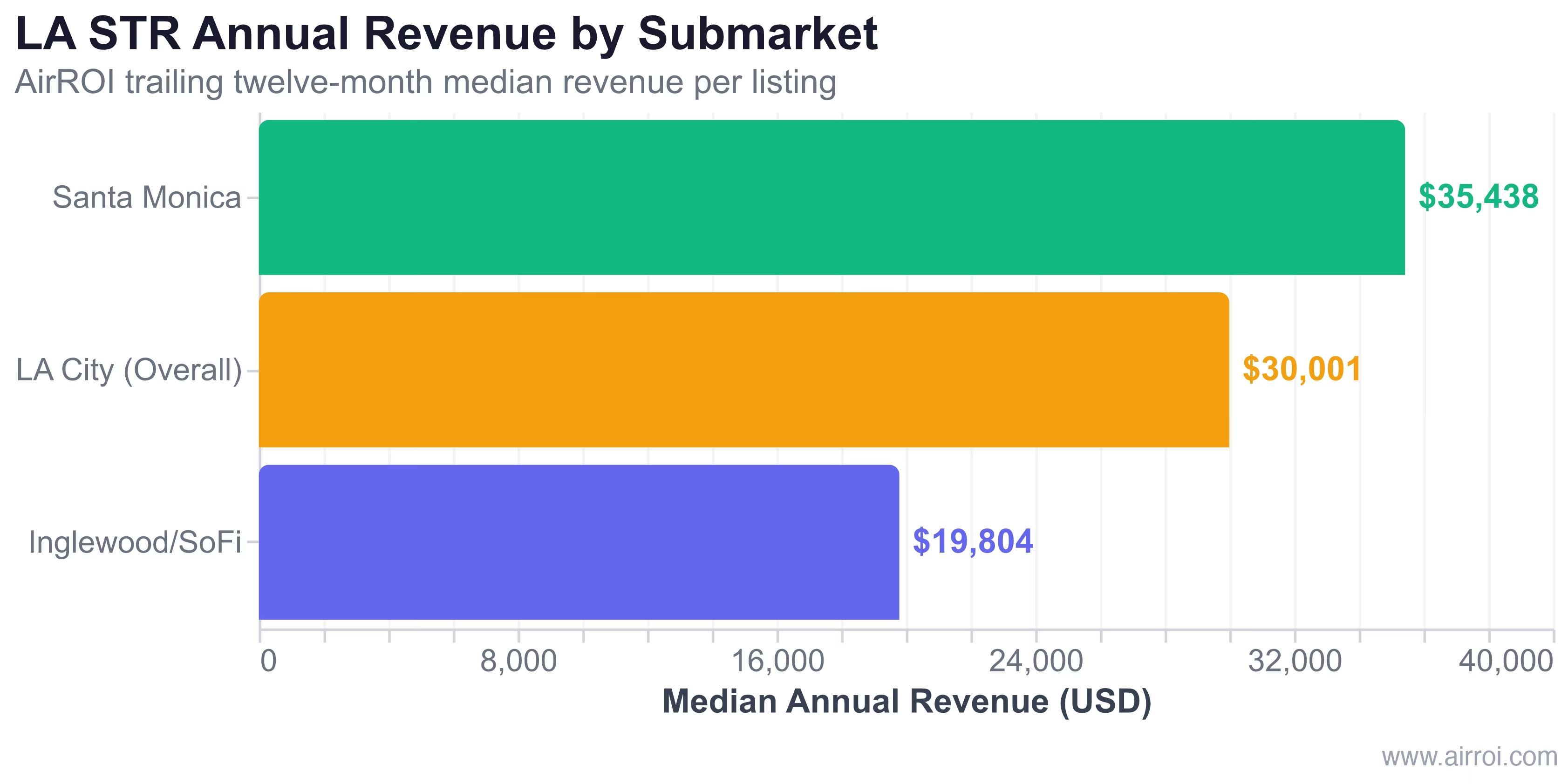
Context matters: before the 2018 Home-Sharing Ordinance took effect, Los Angeles had approximately 29,000 active STR listings. The primary-residence rule, 120-day cap, and enforcement through SB 346 (California's 2026 platform data-sharing law) compressed supply to the current 14,083. Yet according to LAist, an estimated 7,500 properties still operate illegally — generating zero TOT for the city.
The city currently collects $34.5 million annually in transient occupancy tax from short-term rentals, out of a total TOT projection of $313.5 million for fiscal year 2026-27. AirROI's host income analysis across 15 markets shows LA's $30,001 median places it in the upper-middle tier nationally — above Austin ($24,618) but below coastal resort markets like Sedona ($69,897).
Three Mega-Events in 30 Months — The Capacity Argument
The ordinance's stated rationale is visitor capacity for an unprecedented cluster of mega-events at SoFi Stadium in Inglewood:
- FIFA World Cup 2026: 8 matches (5 group stage, 3 knockout including a quarterfinal), June 11 - July 10, 2026. SoFi capacity: 70,000 per match.
- Super Bowl LXI: February 14, 2027 at SoFi Stadium. Super Bowl LVI (2022) generated $477 million in economic impact for the LA region.
- 2028 Summer Olympic and Paralympic Games: July 14 - July 30, 2028. Multiple venues across LA and Orange County.
A February 2026 Deloitte report commissioned by Airbnb projects a peak-day lodging shortfall of up to 320,000 visitors across 13 of 19 Olympic competition days. The report argues doubling STR capacity would close roughly 88% of that gap.
But the arithmetic undermines the claim. If 5,500 new listings enter at an average of 2.5 beds per unit, that adds approximately 13,750 nightly bed-spaces. Against a 320,000-visitor gap, that fills 4.3% of projected demand — not 88%. The Deloitte figure assumes a full doubling of regional capacity (LA + Orange County), which requires far more than the VRO's 5,500-unit ceiling.
As our April analysis of LA's Olympic capacity gap demonstrated, LA's 120-day annual cap means most primary-residence hosts burn their allocation before the July-August Olympic window. The VRO addresses this for second homes (which face no cap under the proposal), but the volume remains insufficient.
AirROI's World Cup 2026 pricing data shows the sharpest hosts in the SoFi/Inglewood ring posted only 2.0x their 2025 rates for the match window — the lowest multiplier of any US stadium zone, constrained by LA's abundant existing supply of 1,431 listings within 5 miles.
Supply Projections — Will 5,500 Listings Actually Materialize?
The Planning Department's "fewer than 5,500" estimate deserves scrutiny. It derives from a 2018 analysis of second-home housing stock in Los Angeles — before seven years of market changes, remote-work migration, and evolving owner preferences.
The Paris 2024 precedent offers a counterpoint. According to Rent Economics, Parisian listings doubled from roughly 30,000 to over 60,000 in the months preceding the Olympics — with no new ordinance required. Paris's existing framework allowed primary-residence hosts to self-activate, and Airbnb's promotional campaigns recruited first-time hosts aggressively.
LA's situation differs in three critical ways:
- Legislative approval required. Even if the council votes May 21, hosts need time to furnish, photograph, register, and list. The World Cup starts June 11 — only 20 days later.
- Registration infrastructure. LA's Home-Sharing registration system processes applications at municipal pace. A simultaneous wave of 5,500 new applications would stress an office accustomed to handling renewals.
- Conversion inertia. Not every second-home owner wants to enter hospitality. National data from NAHB estimates 4.6% of US housing stock are second homes. In LA, many second homes are already leased long-term — breaking a lease to pursue a 2.5-year STR window carries legal and financial friction.
Realistic first-year activation is likely 2,000-3,000 listings, reaching the full 5,500 only by mid-2027. Summer 2026 booking pace data shows the World Cup window is already underway from a demand perspective — too late for most new entrants to capture.
Revenue Dilution Risk for Existing Hosts
This is where existing LA hosts should pay close attention. A 39% supply increase into a market with fixed baseline demand produces measurable revenue compression.
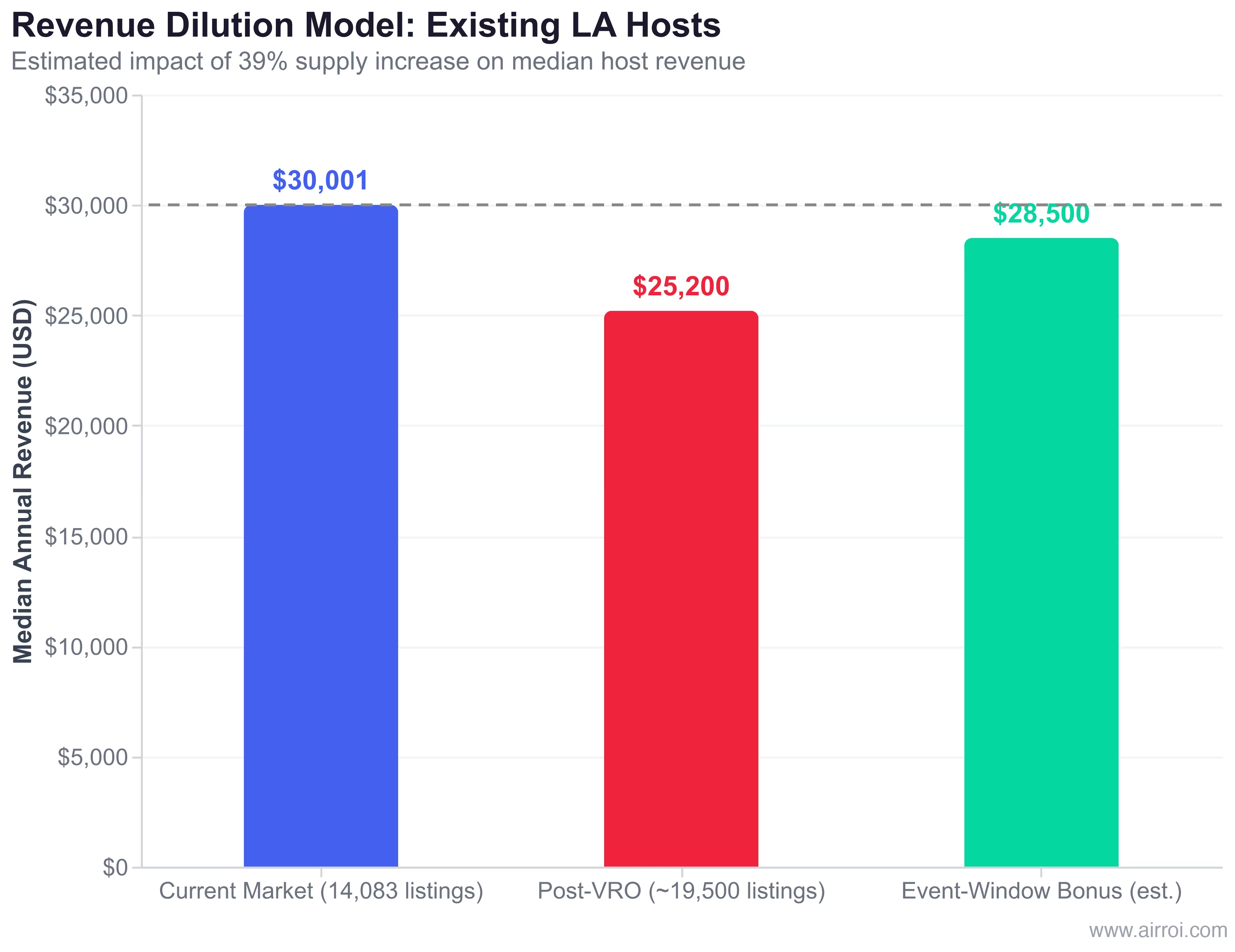
The Paris precedent quantifies this. When Paris listings doubled for the 2024 Olympics, occupancy dropped 18% year-over-year in July despite record visitor numbers. ADR surged 36% during the event window, but the occupancy dilution meant per-host revenue gains were modest — approximately EUR 2,000 for the entire Games period, according to Airbnb's own reporting.
Applied to LA at a more moderate 39% supply increase:
| Metric | Current | Post-VRO (modeled) | Change |
|---|---|---|---|
| Active Listings | 14,083 | ~19,500 | +39% |
| Occupancy Rate | 48% | 40-42% | -12% to -17% |
| ADR (non-event days) | $311.60 | $290-$305 | -2% to -7% |
| Median Annual Revenue | $30,001 | $25,000-$26,300 | -12% to -17% |
| Event-day ADR lift | Baseline | +40-100% (match days only) | Limited calendar days |
The critical nuance: event days represent a small fraction of the year. The World Cup occupies 30 days. The Super Bowl occupies a week. The Olympics occupy 17 days. That totals roughly 54 event days across 30 months — leaving approximately 860 non-event days where pure supply dilution operates without offsetting demand spikes.
"I didn't support vacation rentals when it was before us years ago because I feared it would take long-term housing units off the market. I'm still concerned about it." — Councilmember Bob Blumenfield, PLUM Committee Chair
Existing hosts with strong review profiles and Superhost status retain a competitive moat. AirROI data shows Superhosts in Los Angeles earn 84% more monthly revenue than non-Superhosts — a gap that new, reviewless second-home listings cannot close in their first year.
The Second-Home Investor's Revenue Math
For a second-home owner evaluating the opportunity, the calculus is tighter than marketing materials suggest.
Year-one revenue projection for a new LA listing:
New listings without reviews, algorithm history, or pricing experience typically achieve 20-40% below market median in their first year. For LA, that translates to:
| Scenario | Projected Year-1 Revenue | Comparison |
|---|---|---|
| Optimistic (20% below median) | $24,001 | Below long-term rental yield for most LA properties |
| Realistic (30% below median) | $21,001 | Well below LTR alternative |
| Conservative (40% below median) | $18,001 | Barely covers operating costs |
| Long-term rental alternative (3BR) | $28,800 - $38,400/year | Stable, no hospitality overhead |
Setup costs for converting a second home to STR-ready: furniture and staging ($3,000-$8,000), professional photography ($500-$1,000), registration and permits ($89+), initial cleaning and supply inventory ($500-$1,000). Total: $5,000-$15,000 before earning the first dollar.
The event-window premium scenario improves the math — but only for properties positioned near SoFi Stadium or Olympic venues:
- World Cup match-day rates in the Inglewood ring: 2.0x baseline (per AirROI data)
- Super Bowl week premium (based on 2022): 3-5x baseline rates
- Olympics window: historical precedent suggests 2-4x in venue-proximate areas
If a well-positioned second home captures 3 weeks of World Cup demand, Super Bowl week, and a full Olympics window at event premiums, the total event bonus could reach $15,000-$25,000 above steady-state performance across the 2.5-year window. That changes the calculus for venue-proximate properties — but not for homes in the Valley or San Fernando neighborhoods far from event activity.
The decision framework:
| Factor | STR via VRO Makes Sense | Stick with Long-Term Rental |
|---|---|---|
| Location | Within 5 miles of SoFi/Olympic venue | 10+ miles from event venues |
| Current status | Vacant or month-to-month tenant | Locked in annual lease |
| Setup budget | $5,000-$15,000 available | Minimal capital available |
| Risk tolerance | Comfortable with 48% occupancy | Need predictable monthly income |
| Time horizon | Can operate through Dec 2028 | Need income before June 2026 |
Who Opposes the Ordinance — And Why It May Not Pass
The VRO faces a coalition of opposition that spans labor, housing advocacy, the hotel industry, and skeptical council members.
Council opposition:
Councilmember Nithya Raman articulated the housing-crisis framing: "The idea that the City would entertain speculative tax prepayments tied to expanding short-term rentals, while we are in an acute housing affordability and availability crisis, needs to be properly vetted."
Labor and housing advocates:
UNITE HERE Local 11, representing hotel workers, opposes the ordinance directly. Co-president Kurt Petersen called it "just a ruse to build a larger short-term market, which means less housing for Angelenos." Housing justice organization SAJE and Better Neighbors LA jointly called on the PLUM Committee to reject the VRO. Noah Suarez-Sikes of Better Neighbors LA warned: "This is a Trojan horse — take it out before it starts harming working class people."
The hotel industry:
The Hotel Association of Los Angeles was blindsided — its president told reporters the industry "learned of this issue for the first time while reviewing the proposed budget," suggesting the proposal was developed without traditional stakeholder consultation.
Airbnb's political investment:
According to LAist, Airbnb is the third-largest spender in LA city elections in 2026. An Airbnb-funded committee spent $298,832 supporting a District 9 candidate. Justin Wesson, Airbnb's Senior Public Policy Manager in California, stated the company "is a committed partner to Los Angeles and its long-term prosperity."
The pro-expansion voice:
Stuart Waldman, president of the Valley Industry and Commerce Association, offered the counterargument: "Reasonable short-term rental rules are the practical solution to expand LA's accommodation capacity without the cost of new construction."
Assessment: The current council composition leans skeptical. Budget Committee Chair Yaroslavsky, PLUM Chair Blumenfield, and members Raman and Rodriguez have all voiced concerns. The ordinance needs a council majority to pass — and the opposition coalition (labor, hotels, housing advocates) has historically been effective at blocking STR expansion in LA.
What Existing Hosts and Investors Should Do Now
Regardless of whether the VRO passes, the market data points to actionable conclusions:
For existing LA hosts:
- Strengthen your competitive moat — Superhost status, review velocity, and professional photography become more valuable as supply increases
- Monitor summer booking pace and price event windows aggressively now, before new supply potentially enters
- Use AirROI Atlas to track your submarket's listing count and ADR trends in real time
For second-home owners considering entry:
- Do not furnish or invest until the May 21 council vote delivers a clear outcome
- If the VRO passes, properties within 5 miles of SoFi Stadium or Olympic venues have the strongest event-premium potential
- Use AirROI's calculator to model revenue at 30-40% below market median for a conservative first-year projection
- The 20-day gap between likely approval (May 21) and the World Cup opener (June 11) makes capturing the first event cycle nearly impossible for most new entrants
For all market participants:
- The ordinance's December 2028 sunset means this is a defined-duration market event, not a permanent structural change
- Paris 2024 demonstrated that event-driven supply surges produce temporary dilution followed by return to baseline once casual hosts deactivate
Frequently Asked Questions
The LA Planning Department estimates the ordinance would open up fewer than 5,500 new potential short-term rentals. This represents a 39% increase over LA's current 14,083 active listings — meaningful for existing host competition, but far short of closing the 320,000-visitor daily lodging gap projected for the 2028 Olympics.
AirROI models suggest existing hosts could see 12-18% revenue dilution during non-event periods. When Paris doubled its Airbnb supply for the 2024 Olympics, occupancy dropped 18% year-over-year in July. LA's 39% projected supply increase would produce a smaller but still material compression on the city's current 48% average occupancy rate.
No. LA's Home-Sharing Ordinance currently requires the listed property to be your primary residence — defined as where you live at least six months per year. The proposed Vacation Rental Ordinance would temporarily change this if approved by City Council, with a final vote expected May 21, 2026.
The ordinance includes a mandatory sunset clause of December 31, 2028. After that date, second homes and investment properties would revert to the existing primary-residence-only rule. The 2.5-year window covers three mega-events: World Cup 2026, Super Bowl LXI (2027), and the Summer Olympics (2028).