Six of the 10 Top Beach Towns for Airbnb Owners Limit New Nightly Rentals

The beach towns where a vacation rental earns the most, winter included, are often the hardest for a new owner to join. In top-ranked Key West, only homes already holding a license can rent nightly.
A typical two- or three-bedroom Key West home listed on Airbnb all year took in about $125,000 in bookings over the year through August, more than two and a half times the typical $47,200 across the beach towns ranked by AirROI, a short-term-rental data firm. The firm ranked 114 towns with at least 300 active whole-home listings.
Few newcomers can reach that income. Key West has barred unlicensed nightly rentals for more than two decades, so in practice a buyer gets in only by purchasing a home that already holds one of the city's transient licenses.
Oceanside, Calif., Fort Lauderdale, Princeville on Kauai and Folly Beach, S.C., complete the top five. The ranking weighs revenue, return on price, how often homes were booked, seasonality and whether new listings outpaced bookings.
Six of the top 10 limit new whole-home nightly rentals through license pools, caps or zoning. In this ranking, the other four, all in Broward County, Fla., take any new owner who registers or gets a permit: Fort Lauderdale, Pompano Beach, Deerfield Beach and Hollywood.
Florida law bars cities from banning vacation rentals or limiting how long or how often they rent, unless the rule was adopted on or before June 1, 2011.
That split matters to buyers, and to towns weighing tourist money against housing, because the lines are moving this fall. Folly Beach froze new rental licenses on Aug. 26, and Santa Barbara's council is scheduled to take up new rules on Oct. 6. Maui's County Council has yet to decide which condos escape a phase-out of vacation rentals.
Google's AI Overview, as of Oct. 1, says Panama City Beach, Fla., and Gulf Shores, Ala., "offer the highest yield and balanced entry costs for Airbnb beach investments."
On yield, the measure it names, the two grossed about 11% of a typical home's value over the year. Fort Walton Beach, Fla., grossed about 18% and Deerfield Beach about 16%. Gross yield here is a year's bookings against Zillow's typical home value, before mortgage, insurance, taxes, cleaning, management and condo assessments.
Overall the two rank 55th and 38th, in part because about half of each town's year arrives from May through July.
Revenue alone does not sort the top 10; the last column shows which of them a new buyer can still enter.
| Town | Typical 2–3BR revenue | Best 3 months' share of year | New whole-home nightly rentals |
|---|---|---|---|
| 1. Key West, Fla. | $125,000 | 33% | Licensed homes only |
| 2. Oceanside, Calif. | $83,300 | 41% | Coastal zone only, with permit |
| 3. Fort Lauderdale, Fla. | $61,100 | 34% | Open, with registration |
| 4. Princeville, Hawaii | $102,000 | 30% | Visitor district only |
| 5. Folly Beach, S.C. | $95,300 | 42% | Capped; new licenses frozen |
| 6. Santa Barbara, Calif. | $126,000 | 35% | Barred in single- and two-unit zones |
| 7. Pompano Beach, Fla. | $51,700 | 36% | Open, with permit |
| 8. Deerfield Beach, Fla. | $56,100 | 36% | Open, with registration |
| 9. Lincoln City, Ore. | $60,700 | 48% | Residential caps full |
| 10. Hollywood, Fla. | $60,100 | 36% | Open, with license |
Who can still buy in
Key West's code says the city means "to halt the use of residences for transient purposes in order to preserve the residential character of neighborhoods." Its licenses form a fixed pool, and one passes to a new owner when a licensed home sells.
The city recently declined to add to it. About 280 special licenses in Truman Annex, a gated neighborhood, expired in late December under a 20-year-old legal settlement. The city closed them instead of making them available to owners elsewhere.
"They've had a good deal for 20 years and now it's over," Mayor Dee Dee Henriquez said in mid-December, Keys Weekly reported.
Annex owners, who already rented monthly for part of the year, said they would do so year-round, as most of the city allows without a transient license. "We will simply rent monthly every month of the year instead of monthly six months out of the year," Michael Behmke, who chairs the Truman Annex Rental Property Owners, told the Key West Citizen in December.
Folly Beach, fifth, caps licenses for investor-owned rentals at 800, issued from a waitlist. After a Charleston County judge struck down the voter-approved cap in August, the council froze new licenses until a study of the cap ends or the freeze expires in 2027. On Sept. 15 it re-enacted the limit.
"Why don't you just leave us alone and let us do our thing, just like it was before the cap?" Phil King, a longtime resident who opposes the cap, asked during public comment at that meeting.
Santa Barbara has the highest typical revenue in the ranking but places sixth partly because its homes cost about $1.6 million; a year's bookings gross about 8% of their value. The city regulates short-term rentals as hotels and prohibits them in single- and two-unit residential zones. Its council is scheduled to introduce citywide rules on Oct. 6 that would allow them only inside a mapped license area, with one license per person.
At a June meeting of the council's Ordinance Committee, Councilwoman Kristen Sneddon weighed the hotel-tax revenue the city would give up. "This is about so much more than the TOT bottom line, and $2 million is really not a big enough number to be selling out our neighborhoods," she said.
Lincoln City, Ore., has the most seasonal year in the top 10, with 48% of its revenue in three months. It ranks ninth because its homes are cheaper: bookings gross about 13% of their value. The city allows short-term rentals in two residential zones, and both zones' caps are full; its commercial and mixed-use zones have no set cap. A Lincoln City license ends when the home is sold, while a Key West license goes with the house.
Two of the top five are open only in part. Oceanside has banned new whole-home short-term rentals outside its coastal zone since February 2024. Inside it they need a permit, and a proposed permit cap west of Coast Highway awaits state Coastal Commission approval. Princeville sits under Kauai rules that allow them only within the county's visitor destination areas.
On Maui, Kihei and Lahaina, 14th and 15th on the list, face the county's phase-out of vacation rentals in apartment-zoned condos. The county ordinance lets those rentals run through the last night of 2028 in West Maui, which includes Lahaina, and of 2030 elsewhere. Hotel-zoned condos are spared.
On Sept. 22, Maui's planning commission recommended against rezoning most of the 48 condo properties the County Council had proposed to spare from the phase-out. The council makes the final decision. "Short-term rental is the only thing that makes ownership here mathematically possible," Heidi Winslow, who owns a unit at Hale Mahina Beach Resort in West Maui, told the commission that day.
"It's like all of our work was for nothing," Council Chair Alice Lee said at the council's Sept. 29 meeting. Council Member Gabe Johnson argued there that the county could make up any lost tax revenue in other ways.
Florida's law keeps the Broward towns open to new rentals. Fort Lauderdale, Pompano Beach, Deerfield Beach and Hollywood register rentals and set safety rules, but none limits the number of licenses. Fort Lauderdale's commission on Sept. 15 approved a $1,000-a-day civil penalty for running a vacation rental without the city's certificate of compliance.
Summer towns earn in one season
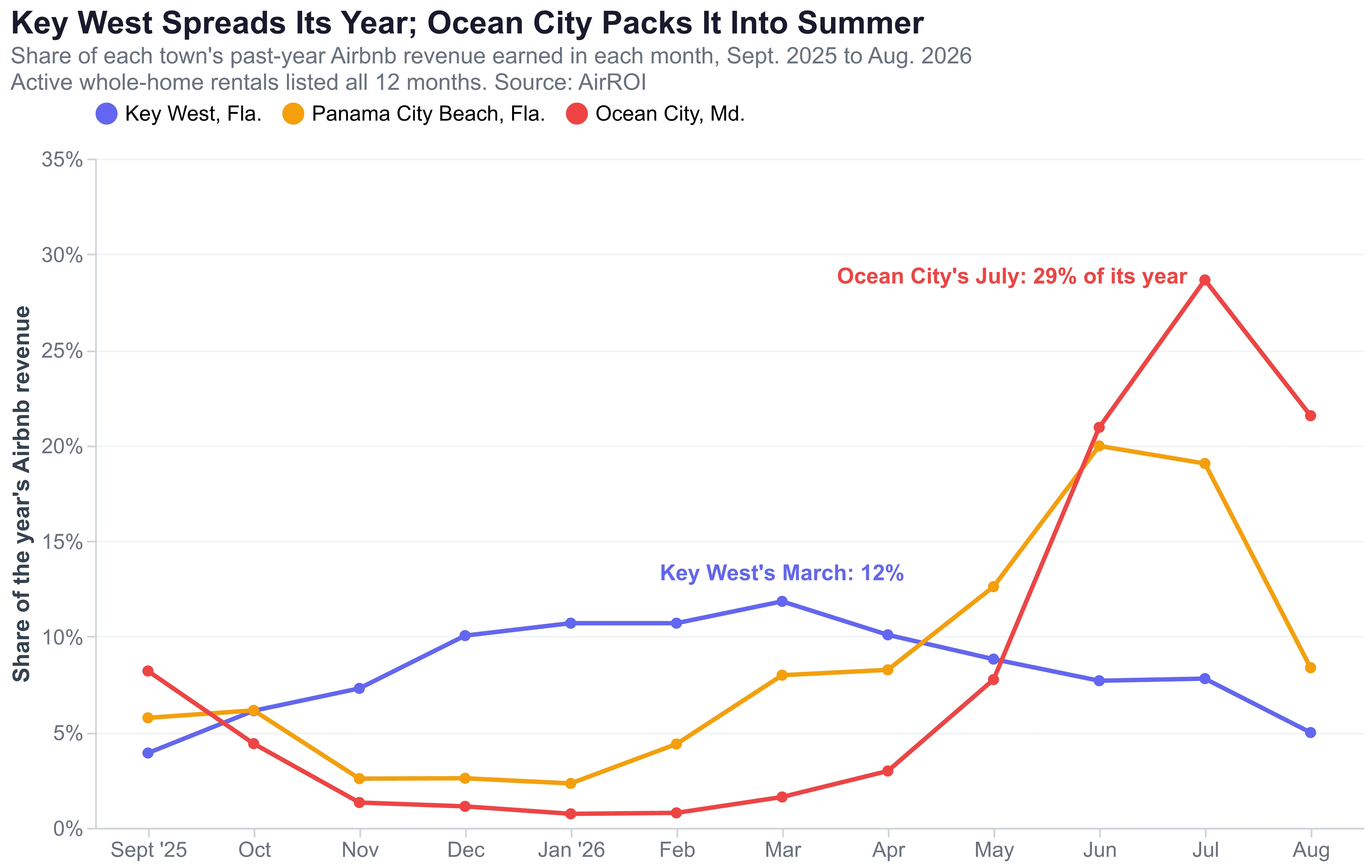
Seasonality is one of the ranking's five measures, and it splits the list sharply. In the Keys, Hawaii and the Broward towns, a town's three best months brought in about a third of its past-year Airbnb revenue. Mid-Atlantic and New England towns earned about two-thirds in June, July and August, and they fill 19 of the bottom 20 places.
They trailed on more than the calendar. Their typical two- or three-bedroom was booked on about a quarter of the nights it was open to guests. A year's bookings grossed about 6% of a typical home's value.
Ocean City, Md., the largest of those summer towns, ranks 101st. Its typical two- or three-bedroom was booked on fewer than a quarter of open nights, against nearly half in Key West. It earned 71% of its year in June through August and less than 3% from December through February.
Where the Gulf lands
The other Gulf favorites follow the same calendar as Panama City Beach and Gulf Shores: each earned about half its year in May, June and July.
They rank from 38th to 62nd. Most grossed 8% to 11% of a typical home's value; Fort Walton Beach is the exception. Myrtle Beach and Ocean City, Md., are shown for comparison.
| Town | Rank of 114 | Typical 2–3BR revenue | Gross yield |
|---|---|---|---|
| Gulf Shores, Ala. | 38 | $48,400 | 11% |
| Santa Rosa Beach, Fla. | 40 | $59,600 | 10% |
| Fort Walton Beach, Fla. | 50 | $48,300 | 18% |
| Panama City Beach, Fla. | 55 | $47,400 | 11% |
| Orange Beach, Ala. | 56 | $51,800 | 8% |
| Destin, Fla. | 62 | $52,500 | 9% |
| Myrtle Beach, S.C. | 86 | $35,000 | 13% |
| Ocean City, Md. | 101 | $35,700 | 7% |
Panama City Beach is the largest market in the ranking, with about 7,600 active whole-home listings, and one of the most crowded among major U.S. Airbnb markets. Griff Griffitts, president of the Panama City Beach Tourist Development Council, told PCB Life in late September: "We have a very strong [fall and] winter market." He said bed-tax collections for the 10 months through July were up 7%.
Bed-tax growth tracks how the town's tourism is trending; the calendar shows where an owner's year falls. December through February brought in about 9% of Panama City Beach's past-year Airbnb revenue.
Panama City Beach, Destin and Gulf Shores allow vacation rentals only in certain zoning districts, though none caps their number.
There was no wave of new listings. In Panama City Beach, Destin, Santa Rosa Beach, Miramar Beach, Gulf Shores and Orange Beach, the count of active whole-home rentals changed by less than a tenth either way. That held whether measured from July 2025 or August 2025.
Among homes listed in both years, the share of open nights booked rose about a point and a half in Gulf Shores. It slipped less than a point in Panama City Beach and Destin. Nationally, across about 576,000 homes listed in both years, it fell nearly 2 points.
The two fastest-growing towns on the list were still rebuilding. Active whole-home rentals in Sanibel, Fla., rose by more than three-quarters from about 200 a year earlier, and Fort Myers Beach's by more than a third.
Myrtle Beach, S.C., the second-largest market on the list, went the other way. Its listings rose whether measured from July 2025 or August 2025, while homes listed in both years lost nearly 3 points of booked share, more than the national drop.
Cheaper towns return more of the price
In the priciest third of the towns, where the typical home is worth about $1 million, a year's bookings came to about 6% of that value. In the cheapest third, around $370,000, they came to about 11%. Key West's figure is about 12%, though the licensed homes that can rent nightly may cost more than the typical one.
The pricier towns still take in more money, about $66,000 for a typical two- or three-bedroom against $43,000 in the cheapest third, but they return less of what a buyer pays. The same trade-off runs inland, in cheaper cities where workers, not tourists, fill rentals.
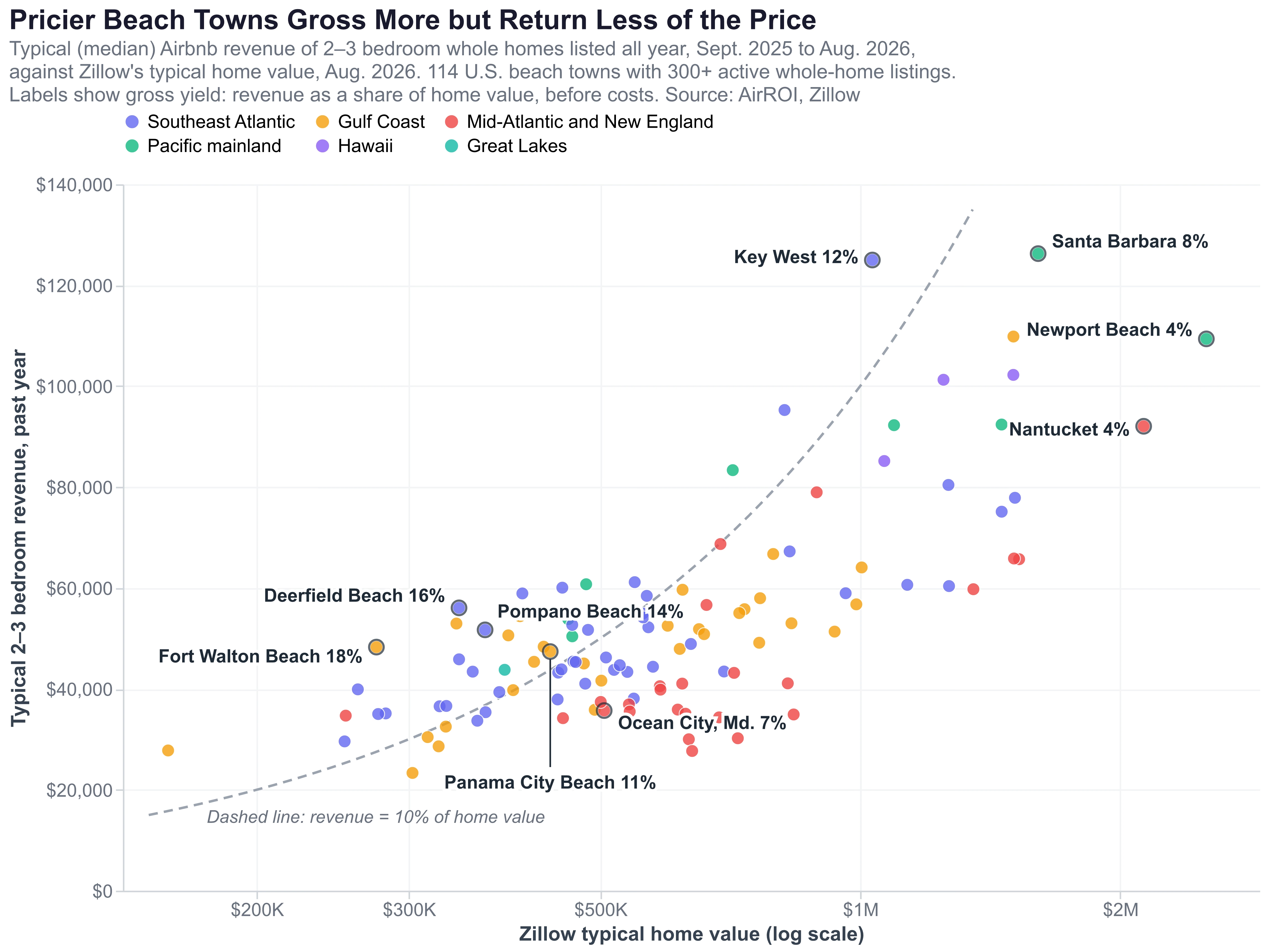
At the top of the price range, Newport Beach, Calif., and Nantucket, Mass., each grossed about 4% on typical homes worth more than $2 million.
Realtor.com's senior economist, Anthony Smith, says coastal buyers pay for scarcity. "You can't manufacture more coastline or more mountain," he said in releasing the site's June luxury housing report in July. Vacation homes make up 3.3% of the nation's housing stock, the report found, against 27% in the Key West–Key Largo area.
The cheaper end carries costs a gross yield leaves out, and Florida's rental law reaches city rules, not condo associations, which set their own terms for buyers. Laura Bustamante, a South Florida waterfront condo buyer, told WSVN in June that she paid about $17,500 up front toward an impact-window assessment to win her association's approval. Then, she said, she learned she still owed an upcoming assessment totaling $53,800 over 13 years.
"I never thought this would happen; this hit me like a rock," she said.
Insurance, another big Florida cost, may ease: rate filings now point lower. "I expect to see more aggressive rate cuts in the near future and going into 2027," Insurance Commissioner Mike Yaworsky said in a Sept. 22 release. His office put the average homeowners' rate request over the prior month at a 4.8% cut.
Homeowners had yet to feel relief this summer: in a University of North Florida poll taken in July, 55% saw no sign the insurance market was improving.
Owners on the Gulf and Atlantic coasts also carry hurricane exposure until the season ends Nov. 30.
Folly Beach's 800 licenses
Folly Beach has agreed to spend $50,000 on a study of its cap this winter. Mayor Chris Bizzell told The Post and Courier the council will hold public comment first, "so that we can identify some of these little more nuanced questions that we want to have looked at."
The council is expected to award the study at its Oct. 13 meeting. It is a first step toward deciding how the cap on the island's 800 investor licenses will work.
About the data: Revenue is the median for two- and three-bedroom whole homes listed all year, Sept. 2025–Aug. 2026, in towns with a Zillow value. Excluded: Santa Monica, which bans whole-home stays of 30 days or less, and Kailua (Oahu), where they need pre-1986 permits.
Frequently Asked Questions
Key West allows rentals shorter than a month only in homes holding a transient license, Santa Barbara bans them in single- and two-unit residential zones, Folly Beach caps investor licenses at 800 and has frozen new ones, and Lincoln City's residential-zone caps are full. Maui's Bill 9 ends vacation rentals in apartment-zoned condos after Dec. 31, 2028, in West Maui and after Dec. 31, 2030, in the rest of the county. Florida cities cannot ban vacation rentals unless the ban was adopted on or before June 1, 2011.
Across AirROI's ranking of U.S. beach towns, a typical two- or three-bedroom whole home listed on Airbnb all year booked about $47,200 over the year through August 2026. Santa Barbara, Calif., had the highest town figure, about $126,000, and Rockport, Texas, the lowest. That is revenue before mortgage, insurance, taxes, cleaning and management.
The Florida Keys, Broward County's beach towns and Hawaii's ranked towns earned about a third of their past-year Airbnb revenue in their best three months, and for several of them winter months were among the strongest. Mid-Atlantic and New England summer towns earned about two-thirds in June through August; Ocean City, Md., earned 71%.
Both land mid-table in the beach-town ranking, Panama City Beach 55th and Gulf Shores 38th, partly because about half of each town's year arrives from May through July. Their supply of rentals did not surge over the past year, and homes listed in both years held their bookings better than the national average. Both cities allow vacation rentals only in certain zoning districts, so a parcel's zoning decides whether it can be rented nightly.