Missouri SB 1066: The $2,655 STR Property Tax Trap Investors Just Dodged

A typical Branson short-term rental brings in $23,501 a year in gross Airbnb revenue. Until March 25, 2026, Missouri county assessors had the legal cover to erase $2,655 of that annually through a single administrative decision — flipping a residential single-family home to the 32% commercial assessment rate and triggering what Rep. Chris Brown called "almost a 70% increase in property taxes." Missouri SB 1066, which cleared the Senate 30-3 on March 25 with a companion House bill passing April 2, blocks that reclassification outright. For the 3,146 active Airbnb hosts in Branson and the 1,395 in Osage Beach and Lake Ozark, SB 1066 is not a tweak to the tax code — it is the difference between keeping and losing 10-20% of a property's entire annual STR revenue. This analysis uses AirROI data to quantify the exact dollar hit Missouri investors just avoided, walks through the mechanics of the loophole, and shows why investors in Tennessee, Florida, and Arizona should be watching Jefferson City closely.
Missouri SB 1066 in 30 seconds: What the Senate passed
The Missouri Senate voted 30-3 to pass SB 1066 on March 25, 2026, explicitly classifying single-family homes rented for fewer than 30 consecutive days as residential property for tax assessment purposes — capped at 15 properties per owner. Sen. Ben Brown (R-26) sponsored the bill, and the companion House measure HB 1768 passed the Missouri House on April 2, 2026. An earlier version, HB 1086, sponsored by Rep. Chris Brown (R-Kansas City), had already passed the House 118-34 in the prior session, giving SB 1066 unusually broad momentum heading into the mid-May session close.
The mechanics matter. SB 1066 amends Missouri's real property definitions under RSMo 137.016 so that the existence of state sales tax on short-term rental revenue does not, by itself, push a property into the commercial classification bucket. Assessors must now also consult the owner before attempting any reclassification. The 15-property cap is a deliberate compromise — it shields the typical hobbyist host and the small three-to-five-unit operator while preventing the residential rate from becoming a tax shelter for institutional landlords running 50-plus units.
Missouri's move is the most consequential STR tax-policy event of the 2026 state legislative season. The Columbia Missourian's coverage framed it as a homeowner-protection bill rather than an STR-industry win, and that framing matters politically: the bill passed with lopsided bipartisan support because it looks less like a favor to investors than a response to aggressive assessor behavior. The result is the same either way. Missouri just joined a growing pattern of states using statute to discipline local governments on STR policy — a pattern I covered in detail in our piece on state STR preemption trends.
The transient housing loophole, explained
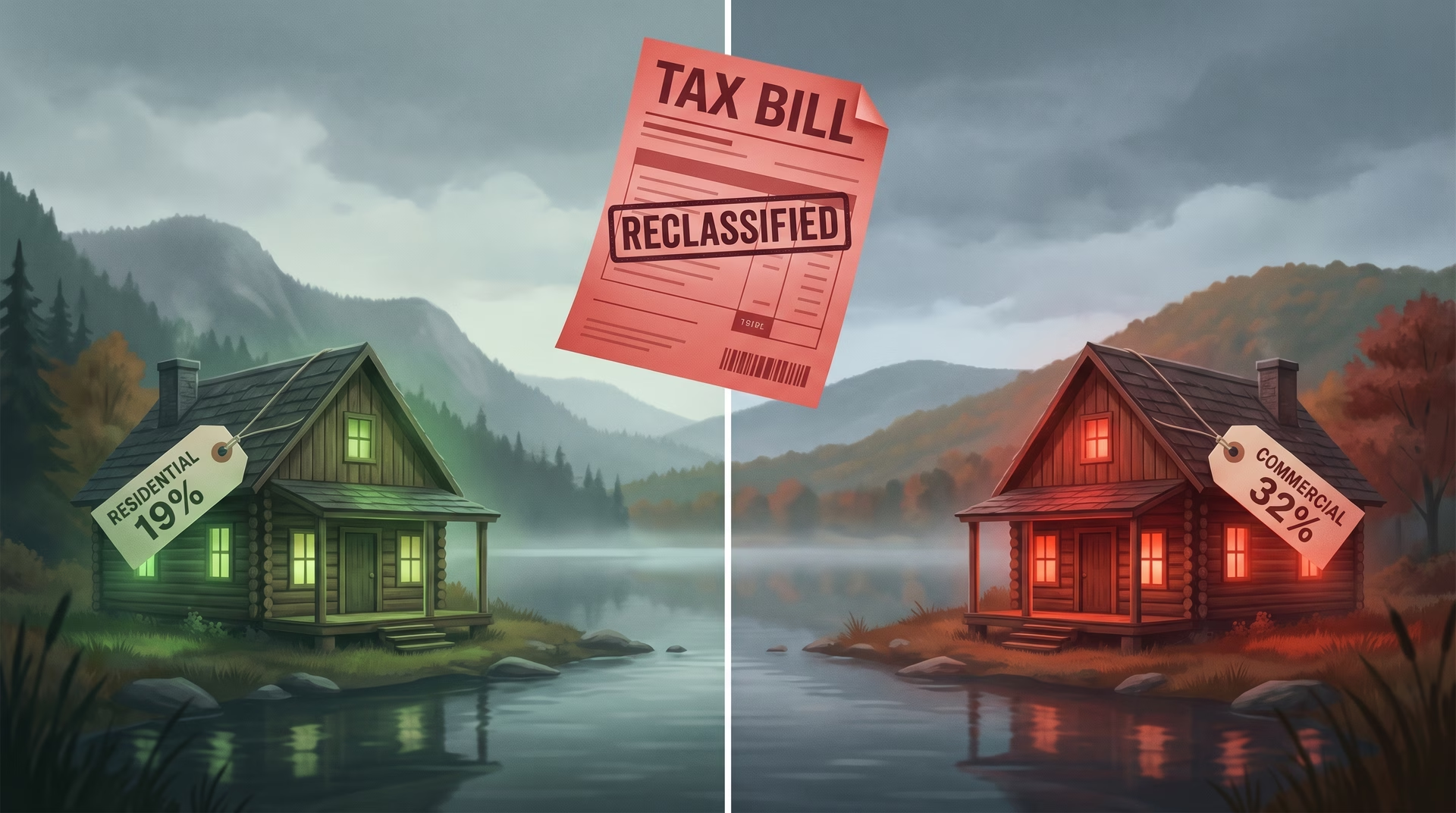
The loophole SB 1066 closes is a quirk of Missouri's classified property tax system. Under RSMo 137.115, Missouri assesses real property at three different ratios: 19% of true value for residential property, 12% for agricultural, and 32% for "all other" — which includes commercial, industrial, and utility real estate. The assessment ratio multiplied by the local mill levy produces the final tax bill. A home at the same market value, in the same county, under the same levy can owe 68% more in property tax based on nothing more than which bucket the assessor drops it into.
The commercial reclassification argument went like this: Missouri's residential definition under RSMo 137.016 excludes "transient housing facilities," and transient housing is defined by reference to the state sales tax. Since short-term Airbnb and Vrbo stays under 30 days generate state-taxable rental receipts, some assessors argued STRs fall outside the residential classification entirely — meaning they belong in the 32% bucket regardless of whether the physical structure is a single-family home with a mailbox and a front lawn. The Missouri State Tax Commission had upheld this reading in prior rulings, giving the argument just enough legal traction to be dangerous.
| Dimension | Residential (19%) | Commercial (32%) |
|---|---|---|
| Assessment ratio of market value | 19% | 32% |
| Assessed value on a $400,000 Branson SFH | $76,000 | $128,000 |
| Annual tax at Taney County effective rate 0.97% | ~$3,880 | ~$6,535 |
| Absolute annual tax increase | — | +$2,655 |
| Percent increase in tax bill | — | +68.4% |
| % of gross STR revenue consumed ($23,501) | 16.5% | 27.8% |
"Some county assessors have started changing the classification of these properties from residential to commercial without clear statutory authority or consistent criteria, resulting in an almost 70% increase in property taxes." — Rep. Chris Brown (R-Kansas City), HB 1086 sponsor, via KOMU News
The real-world consequence was not theoretical. The Missouri Vacation Home Alliance documented a St. Louis property whose annual tax bill jumped from $8,000 to $20,000 after a reclassification and revaluation — a 150% increase that pushed the home off the rental market entirely. MOVHA calculated the combined loss to the taxing jurisdictions at $31,000 per year from that single property: the $12,000 in incremental commercial tax was wiped out by the $19,000 in tourism-related sales and lodging tax revenue the home would have generated had it stayed in operation. That is the self-defeating economics that SB 1066 is designed to halt before it replicates across Missouri's STR markets.
Branson case study: Quantifying the $2,655 hit
AirROI's Branson market data frames the stakes precisely. The 3,146 active Branson listings generate a median $23,501 in gross annual revenue per property at a $258.80 average daily rate and 41% occupancy — a classic leisure market that depends on a short, intense summer booking window. Monthly revenue peaks at $5,518 in June and $5,810 in July, then collapses to $1,358 in January and $1,312 in February. Property taxes, unlike revenue, do not have a low season. They land in one annual bill that has to be paid regardless of whether Silver Dollar City had a good weekend.
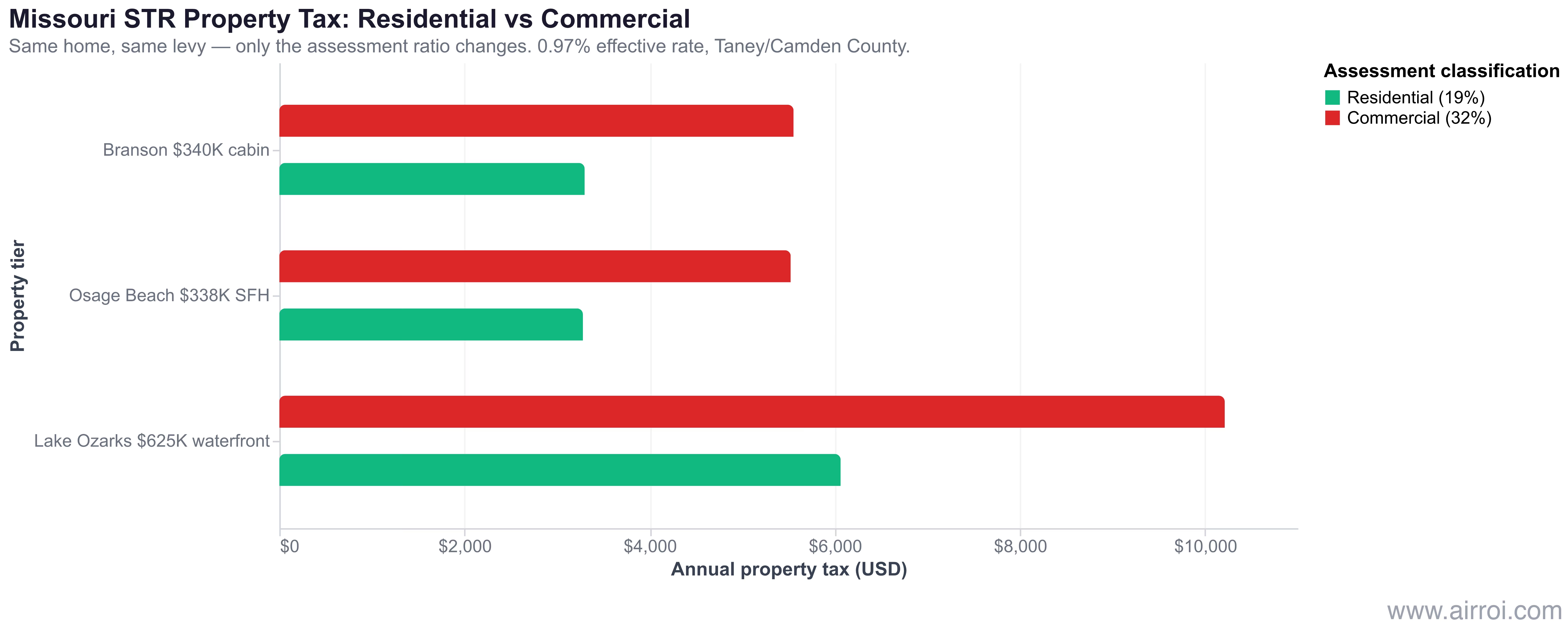
Consider a Branson investor who bought a 3-bedroom cabin in Taney County for $340,000 — near the current Zillow Branson housing median. At Taney County's 0.97% effective property tax rate (consistent with Missouri's statewide effective rates reported by the Missouri Independent), the annual residential property tax bill runs about $3,298. Under commercial reclassification, the same cabin's bill climbs to roughly $5,555 — a $2,257 annual increase, or 9.6% of the property's typical gross STR revenue erased in one line item.
Over a 10-year hold, that is roughly $22,570 in cumulative property tax the investor would have transferred to the county without SB 1066. To put that in perspective: the average Branson STR generates $23,501 in a full year. Commercial reclassification quietly levies the equivalent of an entire year's gross Airbnb revenue across every decade of ownership — without touching the nightly rate, the booking calendar, or the cleaning fee. Investors underwriting Branson deals against AirROI revenue estimates need to remember that property tax is a silent RevPAR killer, and the 68% delta between the residential and commercial assessment ratios is one of the biggest silent levers in the entire STR model. Readers modeling their own exposure can pull market metrics for any Missouri ZIP code through the AirROI Atlas.
The picture tightens when you look at what Branson investors actually make. The seasonal revenue curve means most hosts earn roughly $15,000 of their $23,501 gross revenue during the June-to-August peak. Strip out cleaning, supplies, platform fees, utilities, insurance, and debt service, and the net margin on a typical Branson cabin is often $6,000 to $10,000 per year. Commercial reclassification on its own consumes 22% to 38% of that net — enough to convert a profitable rental into a break-even asset. SB 1066 is not protecting windfall profits; it is protecting the already-thin net margins on Missouri's entry-level STR deals.
Lake of the Ozarks: Bigger homes, bigger exposure
The Lake of the Ozarks side of the Missouri STR market runs on a different economic profile than Branson — larger homes, higher nightly rates, and a heavier dependence on waterfront inventory. AirROI's numbers show 927 active Airbnb listings in Osage Beach generating $20,740 in median annual revenue at a $321.40 ADR, plus 468 active listings in Lake Ozark generating $19,515 at a $328.90 ADR. Together, the two cities represent the core of Missouri's second-largest STR market: 1,395 listings, roughly $28 million in combined gross revenue, and a median home price sitting between $325,000 and $400,000 for non-waterfront inventory and $625,000 for waterfront properties according to LakeExpo's market data.
Run the same math on a $625,000 Camden County waterfront home that a retired couple uses as an intermittent STR. At 19% residential assessment and a 0.97% effective tax rate, the annual bill lands near $6,063. Under commercial reclassification, the same home owes approximately $10,212 — a $4,149 increase. That delta equals 20% of the home's $20,740 gross STR revenue. For a part-time host who rents the waterfront property on summer weekends and holiday weeks, losing a full fifth of gross revenue to an assessment rule change would push the economics below break-even once HOA dues, dock fees, utilities, insurance, and cleaning are layered in. Many of these properties would delist entirely, which is exactly what MOVHA documented happening in the St. Louis case.
The pattern is worth noting because Lake of the Ozarks demonstrates why commercial reclassification is a percentage play that disproportionately punishes higher-value real estate. The 19-to-32 ratio jump is applied to true value in money, so a $625,000 waterfront home eats a tax increase 84% larger in absolute dollars than the same increase on a $340,000 cabin. The Missouri STR investors with the most at risk under reclassification were never the commercial operators; they were the retirees and second-home owners who bought one waterfront property because they wanted to own a lake house and could afford to offset carrying costs with summer rentals.
Osage Beach's July peak revenue of $7,532 per listing — more than a third of annual income concentrated in one month — compounds the pressure. Property tax landed in January doesn't care that the lake freezes. Without SB 1066, Lake of the Ozarks investors would be writing a check in the middle of the off-season that equaled roughly a full summer weekend's gross revenue.
How Jackson County previewed the fight in 2025
Jackson County's 2025 reassessment is the story that made SB 1066 politically inevitable, and it is the story every STR investor outside Missouri should read carefully. In early 2025, then-Jackson County Assessor Gail McCann Beatty began reclassifying identified short-term rental properties from Missouri's 19% residential rate to the 32% commercial rate — systematically, property by property, without new legislation or a voter mandate. AirROI data shows Kansas City's 1,443 active STR listings generating a median $16,757 each in annual revenue, which means more than 1,400 Missouri hosts were potentially exposed to an immediate 68% property tax hike simultaneously.
The backlash came fast. The Mid-America Association of Real Estate Investors and the Missouri Vacation Home Alliance organized host testimony at the June 9, 2025 Jackson County Legislature hearing, and Legislator Sean Smith introduced emergency Ordinance 5987 on June 18, 2025. The ordinance required the Jackson County Assessor to postpone reclassification until a countywide STR registration and reporting system could be stood up. In May, the Missouri State Tax Commission issued a formal assessment order that further constrained Jackson County's reassessment practices. By November 2025, voters went a step further: they approved a ballot question to make the Jackson County Assessor an elected position starting in 2028, stripping the County Executive of the appointing authority after years of disputed assessments. KCUR's election coverage framed it as an accountability response to years of escalating property tax fights.
The political pattern mirrors the revenue-extraction playbook I analyzed in our piece on the lodging tax diversion crisis. In both cases, local governments facing fiscal pressure treated short-term rentals as a soft target for new revenue — the difference is that lodging tax increases are visible and votable, while commercial reclassification can be done administratively without any legislative action at all. That's what made the Jackson County story so alarming to investors: there was no bill to lobby against, no city council vote to attend, no ballot measure to organize around. There was an assessor, a database query, and a stack of revised tax bills in the mail.
SB 1066 converts the ad hoc political save into statutory protection. Jackson County dodged a bullet because a small group of organized hosts happened to have the right legislative allies at the right moment. Every Missouri STR investor now gets the protection by default. That is the real policy upgrade — not the specific math of the 19%-to-32% jump, but the shift from "hope your county assessor is reasonable" to "state law makes the reclassification illegal."
Which states are still exposed?
Missouri's move leaves it as the only state with explicit statutory protection against STR commercial reclassification. The states with the largest STR tax bases and the most latitude for assessor-level reclassification all remain exposed — and the AirROI data makes the stakes visible in a way the policy coverage does not.
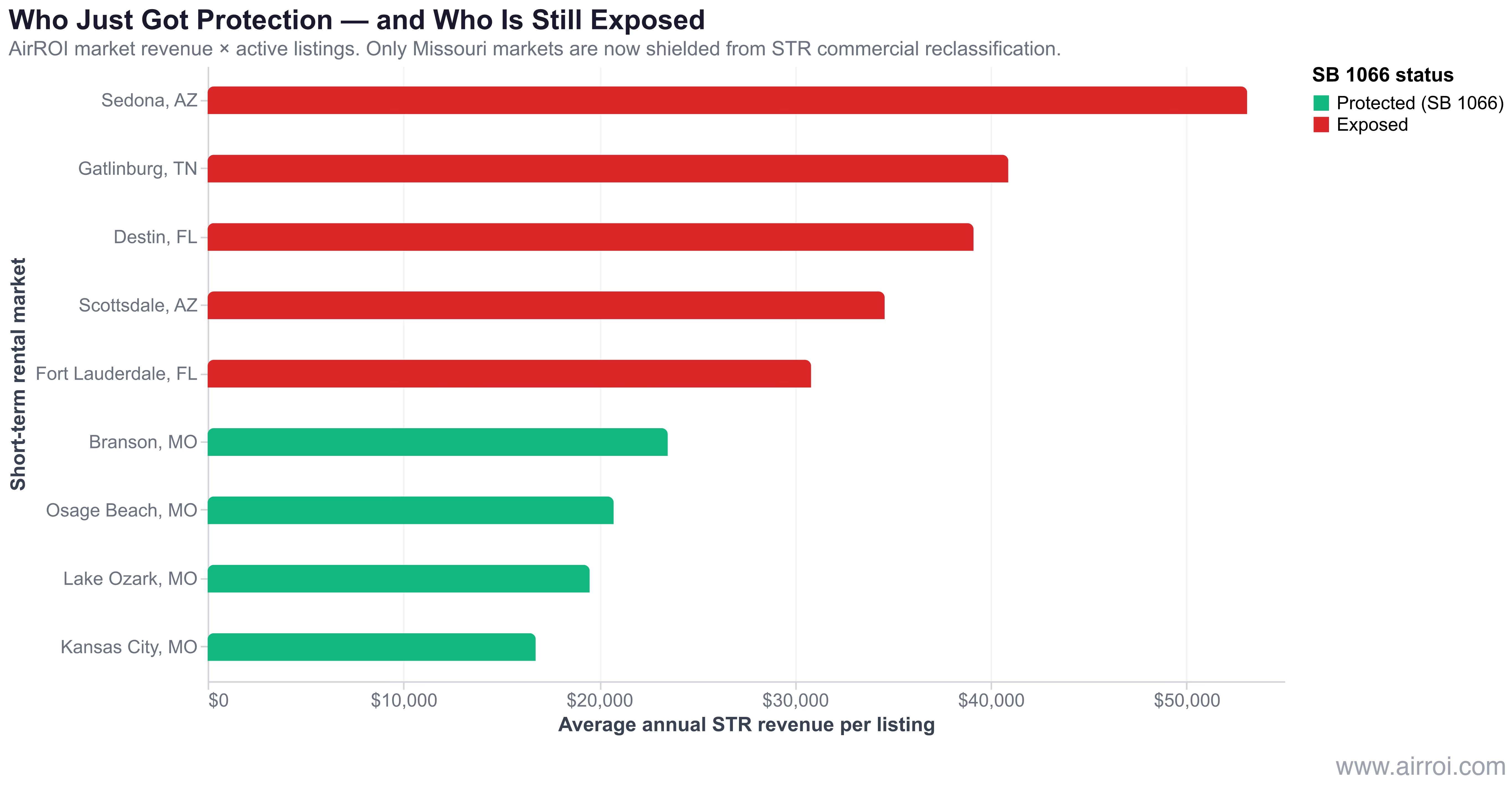
| Market | Active Listings | Avg Annual Revenue | SB 1066-Style Protection? |
|---|---|---|---|
| Branson, MO | 3,146 | $23,501 | Yes (SB 1066) |
| Osage Beach, MO | 927 | $20,740 | Yes (SB 1066) |
| Lake Ozark, MO | 468 | $19,515 | Yes (SB 1066) |
| Kansas City, MO | 1,443 | $16,757 | Yes (SB 1066) |
| Gatlinburg, TN | 3,864 | $40,899 | No |
| Destin, FL | 4,049 | $39,121 | No |
| Sedona, AZ | 1,802 | $53,100 | No |
| Scottsdale, AZ | 4,720 | $34,582 | No |
| Fort Lauderdale, FL | 4,018 | $30,823 | No |
Gatlinburg alone represents the largest single reclassification exposure in the United States. The market's 3,864 active listings generate $40,899 in median annual revenue — a combined gross base of roughly $158 million that a single Sevier County assessor decision could re-rate overnight. Tennessee's classified property tax system is different from Missouri's, but the underlying dynamic is identical: state statute gives local assessors discretion over classification, and local officials are under mounting fiscal pressure. Destin and Scottsdale are similar stories — large, mature STR markets where millions of dollars in annual tax revenue could be unlocked through a single administrative reclassification, with no state bill currently blocking the move.
Arizona and Ohio have active STR preemption bills in the 2026 session, according to Rent Responsibly's spring 2026 bill tracker. Those bills focus primarily on local zoning preemption rather than property tax classification, but they set up future legislative vehicles that could be amended to add Missouri-style protection. Sedona's exposure is particularly sharp — 1,802 listings generating $53,100 each in gross revenue makes it the highest-revenue STR market in the table, and Arizona has an active tradition of cities and counties experimenting with rental tax policy. A reclassification-style push in Yavapai or Coconino County would land on the most expensive rental real estate in the dataset.
The investor takeaway is straightforward: reclassification risk is not yet priced into ADR anywhere outside Missouri. The worst states for Airbnb investing analysis focuses mostly on regulatory friction and cost of entry, but property tax classification is the variable that can silently destroy returns without any warning sign showing up in the typical underwriting model. Until more states pass Missouri-style statutory language, it remains a tail risk that every STR investor in a high-revenue leisure market should be tracking.
The investor checklist: How to price reclassification risk before you buy
For investors active outside Missouri, here is the concrete pre-purchase process to avoid walking into a reclassification trap. None of these checks take more than an hour. All of them should happen before you sign an offer, not after.
1. Pull the property's current assessment classification from the county assessor's office. Every county in the United States publishes its property tax roll, and the classification is a line item on the record card. Verify it reads "residential" — not "commercial," "lodging," "transient," or anything that hints at a different rate. If the classification is ambiguous or the assessor's office has recently changed its policy, treat it as a red flag.
2. Search local ordinances and recent assessor bulletins for 'transient housing' or 'commercial lodging' language. This is how Jackson County's 2025 push started — not with a new law, but with the assessor reinterpreting existing statutory definitions. If you find that language in a recent bulletin or policy memo, assume reclassification risk is active in that county.
3. Look at the reassessment cycle history. How often does the county reassess? Have any STR properties been reclassified in the past three years? A county that has already tried and either succeeded or been reversed is more likely to try again. Counties with a clean record and no STR-specific assessment guidance are lower-risk.
4. Model a 60-70% worst-case tax hike into your underwriting spreadsheet. Every STR deal should have a downside scenario where the property tax line item is multiplied by 1.68x. If the deal still cash-flows under that scenario, you are pricing reclassification risk correctly. If it doesn't, you are taking on tail risk that the rest of your model has not accounted for. The AirROI revenue calculator is the simplest way to run this scenario against real market revenue benchmarks.
5. Prefer states with statutory protection. As of April 2026, Missouri is the only state with explicit statutory language blocking STR commercial reclassification, with Arizona and Ohio advancing adjacent preemption bills. Until more states pass Missouri-style language, concentrate portfolio exposure in states where reclassification risk is either statutorily blocked or genuinely low (no pending assessor activity, no county-level policy memos, no recent reassessment fights). Commercial operators with more than 15 properties need to pay particular attention to the SB 1066 cap — above the threshold, even Missouri no longer offers full protection.
One broader point: property tax reclassification is one of three main revenue levers local governments are using against STRs right now, alongside lodging tax increases and licensing caps. The other two are more visible and easier to lobby against, which is exactly why reclassification is the one that keeps catching investors off guard. Missouri's SB 1066 flips the default — from "prove your property should be residential" to "prove it shouldn't be." Every investor modeling STR deals in 2026 should want that default applied in their own state next.
Bottom line: The least-priced risk in STR investing just became the most visible
Missouri STR investors just avoided a property tax increase of roughly $2,655 per year on a typical Branson cabin and $4,149 per year on a typical Lake of the Ozarks waterfront home — exposures that would have consumed 10-20% of gross STR revenue per property on the 4,541 protected Missouri listings tracked by AirROI. SB 1066 is the first state law to close the commercial reclassification loophole explicitly, and the Jackson County 2025 backstory shows what happens when no such law exists: hosts are at the mercy of whichever county assessor is feeling most creative about revenue generation.
The broader lesson is that property tax is the STR variable nobody talks about until it moves. Most investor analysis focuses on ADR, occupancy, and RevPAR; most regulatory analysis focuses on permit caps and lodging tax rates. Commercial reclassification sits in the blind spot between the two, and it can silently erase more margin than either lever. Missouri just made it visible by writing statute around it. Investors in Tennessee, Florida, Arizona, and Georgia should be spending an hour with their county assessor's classification records before they sign their next STR offer — and watching Jefferson City's final passage of SB 1066 as a template for what their own state legislature needs to do next.
Frequently asked questions
What does Missouri SB 1066 actually do?
Missouri SB 1066 amends the state's real property definitions to explicitly classify single-family homes rented for fewer than 30 days as residential property, capped at 15 properties per owner. The bill passed the Missouri Senate 30-3 on March 25, 2026 and blocks county assessors from reclassifying short-term rentals as commercial property — a loophole Jackson County's assessor attempted to exploit in 2025.
How much would a commercial property tax reclassification cost a Missouri STR investor?
Commercial reclassification pushes Missouri's assessment ratio from 19% to 32%, which translates to roughly a 68% increase in the annual property tax bill. For a typical $340,000 Branson cabin, that is about $2,255 more per year in taxes — nearly 10% of the $23,501 in gross Airbnb revenue the typical Branson listing generates according to AirROI data. One St. Louis host reported their bill jumped from $8,000 to $20,000 annually after a reclassification plus revaluation.
What happened with Jackson County Missouri short-term rentals in 2025?
Jackson County Assessor Gail McCann Beatty reclassified identifiable STRs from the 19% residential rate to the 32% commercial rate in early 2025. After host backlash organized by the Missouri Vacation Home Alliance and MAREI, the Jackson County Legislature passed emergency Ordinance 5987 in June 2025 pausing reclassifications pending a countywide registration system. In November 2025, Jackson County voters approved a ballot question making the Assessor an elected position starting in 2028.
Is commercial property tax reclassification happening outside Missouri?
Yes. County assessors in Florida, Tennessee, Arizona, and Georgia have been exploring similar reclassifications as STR markets grow, and Arizona and Ohio have active preemption bills in 2026. Missouri's SB 1066 is the first bill to explicitly close the loophole at the state level. For reference, Gatlinburg TN hosts 3,864 active listings generating $40,899 each in annual revenue — a tax base that a single county decision could re-rate overnight.
Should I check my property's assessment classification before buying an STR?
Yes. Before closing on any short-term rental purchase, pull the property's current tax classification from the county assessor's office, check local ordinances for "transient housing" or "commercial lodging" language, and model a 60-70% worst-case tax hike into your underwriting. In states without statutory protection, a single assessor decision can add $2,500-$6,000 per year to carrying costs — a number your AirROI-powered revenue projection should always account for.