
Booking Lead Time

Booking lead time (also called booking window) is the number of days between when a guest makes a reservation and their scheduled check-in date. It is one of the most actionable demand signals available to a short-term rental host: knowing when your market books tells you precisely when to hold firm on rates, when to discount, and whether an unbooked date is a problem or simply hasn't entered its booking window yet.
Key Takeaways
- Booking Lead Time = Check-in Date − Reservation Date (measured in calendar days)
- AirROI data shows market averages ranging from 35 days in urban leisure markets to 58 days in vacation destinations — a gap that demands different pricing strategies
- Vacation and resort markets book 50–60% further in advance than urban markets; pricing rules built for one archetype will misfire in the other
- Lead time is only meaningful when read alongside pacing data — a booking deficit before the window opens is not equivalent to one inside it
- Shifts in your lead time curve year-over-year are early warning signals of demand softening or strengthening
How to Calculate Booking Lead Time
Formula:
Booking Lead Time = Check-in Date − Booking Date (in days)
Average Booking Lead Time = Sum of All Lead Times ÷ Number of Reservations
Example:
| Booking Date | Check-in Date | Lead Time |
|---|---|---|
| Jan 5 | Feb 14 | 40 days |
| Jan 12 | Jan 25 | 13 days |
| Jan 18 | Mar 8 | 49 days |
| Jan 22 | Feb 1 | 10 days |
| Jan 28 | Feb 22 | 25 days |
Average Booking Lead Time = (40 + 13 + 49 + 10 + 25) ÷ 5 = 27.4 days
This property's guests book roughly four weeks in advance on average — which means any date still open inside 14 days has likely missed its natural booking window and warrants a pricing response.
Booking Lead Time by Market — AirROI Data
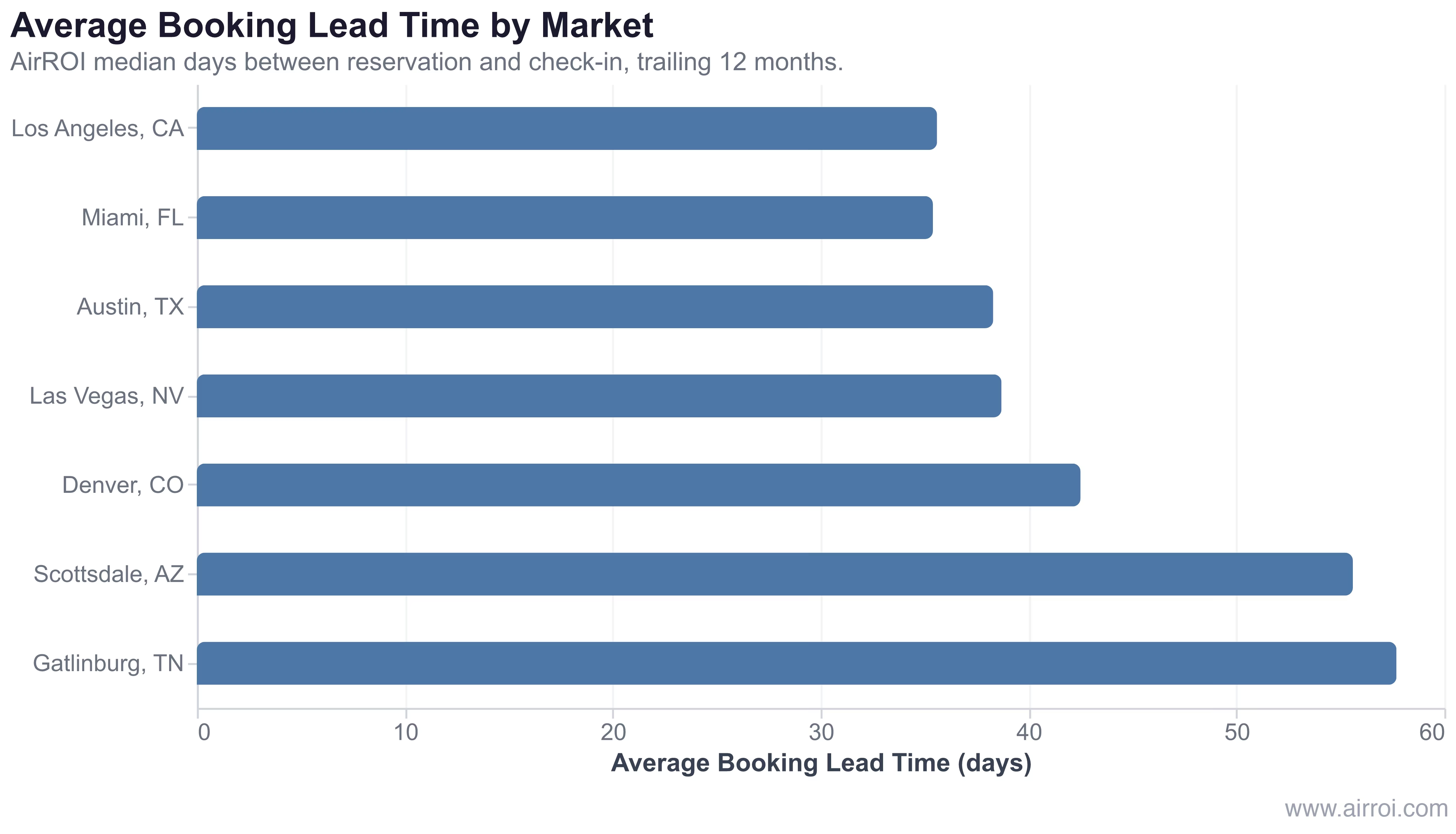
In AirROI's analysis of 46,638 active listings across these seven markets, Gatlinburg leads at 57.7 days while Miami and Los Angeles sit at 35.4 and 35.6 days respectively — a 22-day structural gap.
| Market | Avg Lead Time | Market Type | Active Listings |
|---|---|---|---|
| Gatlinburg, TN | 57.7 days | Vacation/mountain | 3,622 |
| Scottsdale, AZ | 55.6 days | Vacation/resort | 4,310 |
| Denver, CO | 42.5 days | Mid-size urban | 3,739 |
| Las Vegas, NV | 38.7 days | Entertainment/urban | 3,419 |
| Austin, TX | 38.3 days | Urban leisure | 8,774 |
| Miami, FL | 35.4 days | Urban beach | 7,905 |
| Los Angeles, CA | 35.6 days | Urban leisure | 10,134 |
A host using a 30-day discount trigger in Gatlinburg is leaving money on the table — that market's guests have typically already booked by then. The same rule in Los Angeles is actually slightly aggressive for a leisure-heavy market where 35-day lead times are the norm. Lead time benchmarks are market-specific, not universal.
Booking Lead Time Benchmarks by Market Type
These ranges reflect structural patterns rather than individual-listing outcomes:
| Market Type | Typical Lead Time | Notes |
|---|---|---|
| Urban business | 7–21 days | Corporate and consulting travel books late |
| Urban leisure | 21–40 days | Weekend getaways planned 3–5 weeks out |
| Beach/coastal vacation | 40–75 days | Summer travel locked in months ahead |
| Mountain/ski resort | 35–65 days | Winter season fills early; peak dates sooner |
| Events and holidays | 60–120+ days | New Year's, major festivals book very early |
| Rural/nature retreat | 25–50 days | Long weekend and shoulder-season travelers |
How to Use Booking Lead Time for Better Revenue
Build a lead time curve. Plot the distribution of when your bookings arrive relative to check-in (e.g., 90–61 days out, 60–31 days, 30–15 days, 14–0 days). Most properties show a bimodal pattern: an early-planner cluster and a late-decider cluster. Understanding both clusters tells you when each pricing tier should activate.
Frequently Asked Questions
Booking lead time (also called booking window) is the number of days between when a guest makes a reservation and when they check in. A booking made on January 1 for a February 15 check-in has a 45-day lead time.
Booking lead time varies significantly by market type. AirROI data shows urban leisure markets like Miami and Los Angeles averaging 35-36 days, while vacation-destination markets like Gatlinburg and Scottsdale reach 55-58 days. Events and holiday periods push lead times even higher.
Use lead time data to time your pricing adjustments. If your market typically books 40 days out, hold firm on rates until 21 days before check-in, then apply a measured discount if the date remains open. A booking that arrives earlier than your market average is a signal the night may be underpriced.
Vacation-destination guests plan trips months in advance and book early to secure preferred properties and lock in travel arrangements. Urban business and weekend-leisure travelers book closer to their trip because plans are more flexible. Gatlinburg's 57.7-day average versus Miami's 35.4-day average illustrates this structural difference.
Pacing measures how many nights are booked for a future period relative to the same period last year. Lead time tells you when those bookings typically arrive. Together they determine whether a booking deficit is alarming (the booking window has passed) or normal (most bookings haven't materialized yet).