
Length-of-Stay Discount

A length-of-stay (LOS) discount is a tiered pricing mechanism that reduces the per-night rate for guests who book longer stays — typically structured as a weekly discount (7+ nights) and a monthly discount (28+ nights). It works because the costs of a reservation are not linear: cleaning, restocking, guest communication, and platform fees are fixed per booking, so each additional night a guest stays costs the host almost nothing while adding to total revenue. Structuring discounts correctly converts that cost asymmetry into a durable competitive advantage.
Key Takeaways
- Length-of-stay discounts lower the nightly rate for weekly (7+ night) and monthly (28+ night) bookings, increasing total booking value
- Standard industry ranges: 10–20% weekly, 25–50% monthly
- Per-stay overhead (cleaning, turnover, re-stocking) is fixed regardless of stay length — each additional night has near-zero marginal cost
- LOS discounts eliminate orphan days that strand calendar gaps between short reservations
- Effective in all seasons, but especially powerful in off-season and shoulder season to convert low-demand nights into committed revenue
How Length-of-Stay Discounts Work
Airbnb and most OTAs let hosts set tiered discounts by stay length. The discount applies automatically at booking — guests see a lower effective rate, hosts see higher total revenue per reservation and lower per-booking cost.
| Stay Length | Discount | Effective Rate (at $200 base) | Total Revenue | Cleaning Events |
|---|---|---|---|---|
| 2 nights | None | $200/night | $400 | 1 |
| 7 nights | 15% weekly | $170/night | $1,190 | 1 |
| 14 nights | 15% weekly | $170/night | $2,380 | 1–2 |
| 28 nights | 35% monthly | $130/night | $3,640 | 1 |
Revenue comparison for one month (30 nights):
| Scenario | Bookings | Nights Booked | Gross Revenue | Cleaning Costs (at $120) | Net Revenue |
|---|---|---|---|---|---|
| Short stays (avg 3 nights) | 8 | 24 (6 orphan days) | $4,800 | $960 | $3,840 |
| Weekly stays (avg 7 nights) | 4 | 28 | $4,760 | $480 | $4,280 |
| One monthly stay | 1 | 28 | $3,640 | $120 | $3,520 |
The short-stay scenario produces the highest gross revenue — but also the highest cleaning overhead and 6 unbooked orphan days. After subtracting cleaning costs alone, the weekly-stay strategy generates more net revenue with half the operational load.
Average Length of Stay by Market
Not every market responds to LOS discounts the same way. Markets with a longer natural booking duration are already capturing multi-night guests; markets with very short average stays signal a guest mix that may resist long commitments regardless of discount depth.
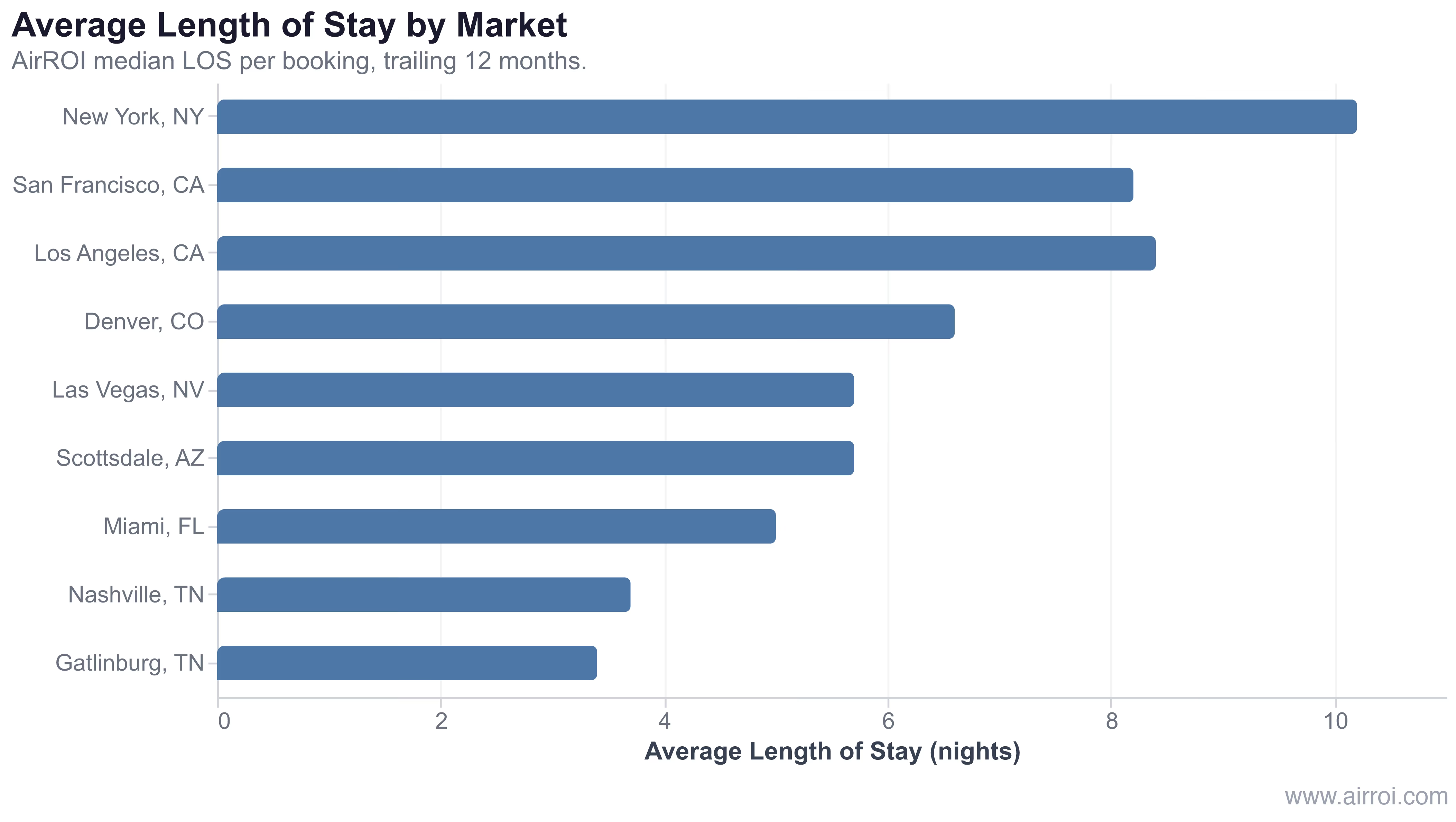
In AirROI's analysis of 55,117 active listings across nine US markets, average length of stay spans from 3.4 nights in Gatlinburg, TN to 10.2 nights in New York, NY — a 3× spread driven by guest type, regulatory minimum-night requirements, and market character.
| Market | Avg LOS (nights) | Active Listings | Implication for LOS Discounts |
|---|---|---|---|
| New York, NY | 10.2 | 11,468 | Long stays already the norm (driven by 25.8 min-night rules) |
| San Francisco, CA | 8.2 | 4,355 | Mid-length stays; weekly discounts reinforce behavior |
| Los Angeles, CA | 8.4 | 10,134 | Similar to SF; discounts can push 7-night fence-sitters |
| Denver, CO | 6.6 | 3,739 | Weekly discount sweet spot; monthly less common |
| Las Vegas, NV | 5.7 | 3,419 | Weekend-heavy; moderate LOS discounts advisable |
| Scottsdale, AZ | 5.7 | 4,310 | Seasonal peaks skew short; off-season monthly useful |
| Miami, FL | 5.0 | 7,905 | Short leisure stays; weekly discounts move the needle |
| Nashville, TN | 3.7 | 6,165 | Event-driven short stays; monthly fills shoulder gaps |
| Gatlinburg, TN | 3.4 | 3,622 | Cabin weekend market; LOS discounts less impactful |
Markets with short natural average stays aren't poor discount candidates — they signal where monthly discounts can attract an entirely different guest segment: remote workers, travel nurses, and digital nomads rather than weekend leisure travelers.
When to Offer Length-of-Stay Discounts
| Scenario | Weekly Discount | Monthly Discount |
|---|---|---|
| Peak season, high demand | 5–10% | 15–25% |
| Shoulder season | 10–15% | 25–35% |
| Off-season, low demand | 15–25% | 35–50% |
| Urban/business/remote-work market | 10–15% | 30–45% |
| Vacation/resort/weekend market | 10–20% | 25–40% |
The largest discounts belong in off-season, where the alternative is a vacant calendar rather than a short booking. Offering 40% monthly in January to fill 28 nights at $120/night ($3,360 total) beats 18 scattered nights at $200/night ($3,600 gross) only when cleaning and management overhead is accounted for — and it beats zero nights by an even wider margin.
Why Length-of-Stay Discounts Matter
Reduced turnover costs. A cleaning event for a 2-night guest costs the same as for a 14-night guest, but the 14-night stay amortizes that cost across seven times as many revenue nights. Travel-nurse and remote-worker guests — who often search specifically for 30-day discounts of 30%+ — are also statistically better-reviewed guests, reducing wear-and-damage exposure.
Orphan day elimination. Short stays leave calendar gaps that are too small to book but long enough to lose revenue. A 7-night stay typically spans exactly one orphan-prone window. AirROI data shows markets like Nashville averaging 3.7-night stays with a 5.6-night minimum, creating structural booking friction; weekly discounts that bridge those minimums to full weeks clear the problem.
Platform fee advantage. Airbnb charges hosts a lower service fee on long-term reservations (28+ nights), improving net margins without any action beyond offering the discount.
Setting Length-of-Stay Discounts: Practical Framework
- Calculate your true per-booking cost — add cleaning fee, consumables, linen service, and average guest communication time. Divide by stay length to find your break-even marginal cost per night.
- Set weekly discount at the point where a 7-night effective rate beats two 3-night bookings net of two cleaning events — for most properties, this is 12–18%.
- Set monthly discount at the point where 28 nights at the discounted rate exceeds your expected occupancy at full rate during that month — apply the Airbnb income calculator to model both scenarios before committing.
- Adjust by season — lock in tighter discounts (5–10%) during peak demand when the calendar fills without incentive; widen them (25–40%) when you are competing against vacancy.
- Combine with minimum-night settings — a 7-night minimum with a 15% weekly discount creates a natural filter that excludes the weekend guests who generate the most turnover friction.
Frequently Asked Questions
A weekly discount of 10–20% is the standard range on Airbnb. A guest staying 7 nights pays 10–20% less per night than a short-stay guest, yet the total booking value is substantially higher. Set the discount at the level where the effective nightly rate still clears your minimum price threshold after cleaning costs are factored in.
Monthly discounts typically run 25–50% off the base nightly rate. A property priced at $200 per night might accept $120–$150 per night for 28+ night stays. The lower per-night rate is offset by near-zero turnover costs, predictable occupancy, and Airbnb's reduced host-service fee on long reservations.
Yes, in most markets. The lower per-night rate is more than recovered through higher total booking value, eliminated gap days, and reduced cleaning and restocking expenses. AirROI data shows markets like New York averaging 10.2 nights per stay — longer stays naturally reduce per-stay overhead, making discounts net-positive.
They improve effective occupancy by reducing orphan gaps between reservations. A single 7-night booking occupies the same calendar as two 3-night bookings with a stranded day in between — but without the gap-day vacancy. In markets where average LOS is already high (8+ nights), discounts reinforce a guest mix that is naturally aligned with longer commitments.
Yes. Most dynamic pricing tools — including PriceLabs and Wheelhouse — apply length-of-stay discounts on top of algorithmically adjusted base rates. The combination lets you capture demand-sensitive pricing during high-demand periods while still incentivizing longer bookings that reduce per-reservation overhead.