
Orphan Days / Gap Nights

Orphan days (also called gap nights) are short gaps of one or two nights between confirmed reservations that go unbooked because they fall below the listing's minimum stay requirement. Each orphan day earns $0 — a direct revenue hole that compounds with nightly rate, booking frequency, and market length of stay. They are among the most common and most solvable inefficiencies in short-term rental calendar management.
Key Takeaways
- Orphan days are 1-2 night gaps between reservations that earn $0 because they fall below your minimum stay
- Markets with short average lengths of stay (LOS) — Nashville at 3.7 nights, Gatlinburg at 3.4 — face the most frequent gap exposure due to higher booking turnover
- Each orphan day costs exactly your nightly rate; a Gatlinburg host losing 2 gap nights per month at the $376.50 median ADR forfeits roughly $9,036 annually
- Dynamic pricing tools auto-detect gaps and apply targeted discounts without lowering your global minimum stay
- The most effective defense combines gap-night pricing, conditional minimum-stay rules, and strategic check-in day alignment
How Orphan Days Occur
Orphan days arise wherever booking patterns don't align with minimum stay settings. The four most common mechanisms are:
| Scenario | Example | Orphan Days Created |
|---|---|---|
| Minimum stay mismatch | 3-night minimum; only 2 nights open between bookings | 2 nights |
| Guest preference gaps | Guest A checks out Monday; Guest B checks in Thursday | 3 nights |
| Preparation time buffer | 1-day buffer between turnovers blocks bookable nights | 1 night per turnover |
| Weekend-heavy demand | Fri–Sun bookings leave Mon–Thu gaps across the week | Up to 4 nights |
Visual example:
Week: Mon  Tue  Wed  Thu  Fri  Sat  Sun
      [— Guest A —]   X  [—— Guest B ——]
                      ^
               Orphan day (earns $0)
The gap exists because Guest B's booking cannot move earlier and a new guest cannot check in for just one night under a standard 2-night minimum.
Why Length of Stay Drives Orphan Day Exposure
The frequency of orphan days scales inversely with average length of stay. A market where guests average 8-night stays produces roughly 45 check-in events per year per listing — each one a potential gap boundary. A market with 3.4-night average stays produces over 100 check-in events per year, creating more than twice as many opportunities for gaps to form.
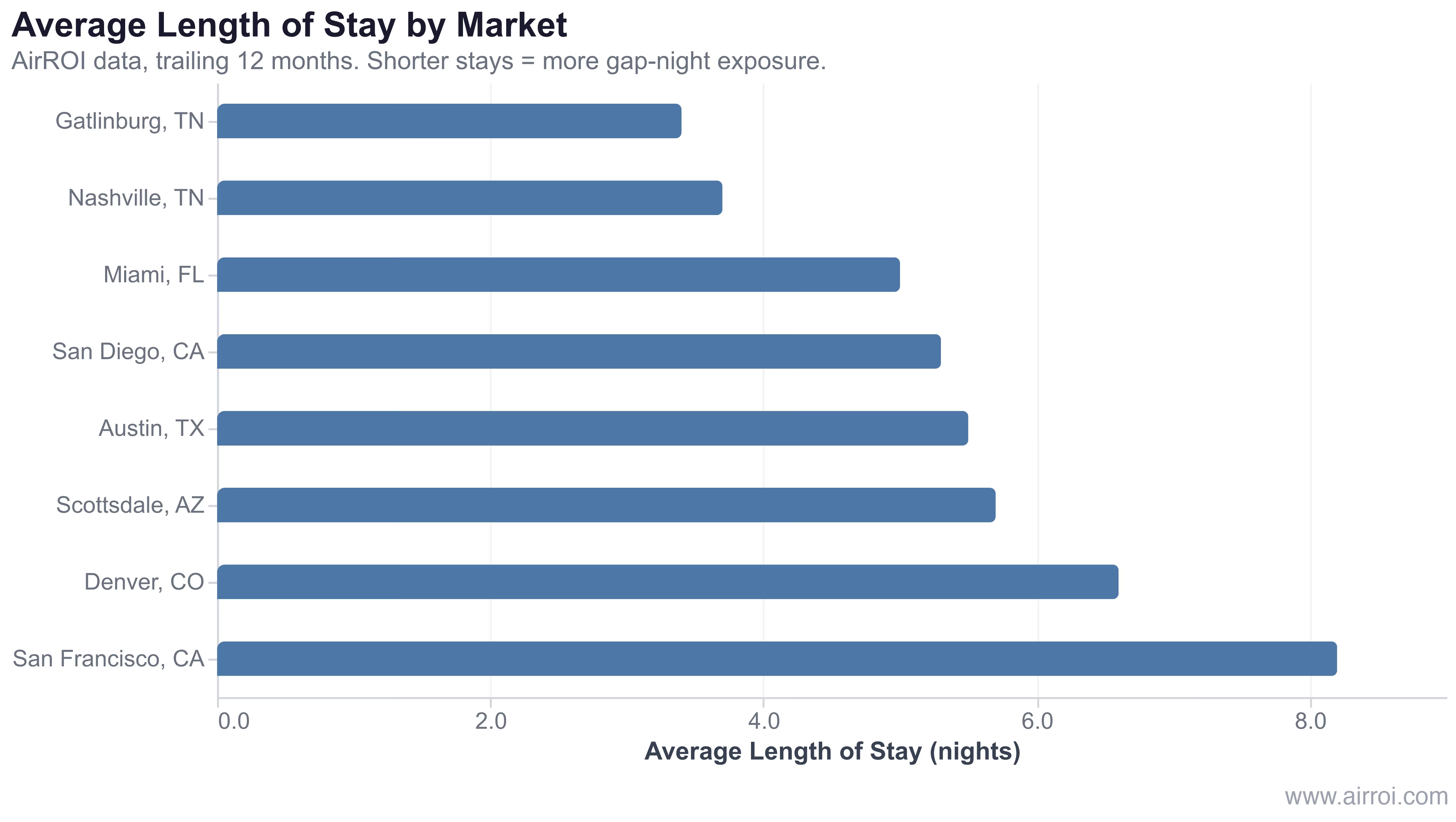
In AirROI's analysis of 70,632 active listings across eight markets, Gatlinburg (3,622 listings, 3.4-night median LOS) and Nashville (6,165 listings, 3.7 nights) carry the highest structural exposure to orphan days. San Francisco (4,355 listings, 8.2 nights) and Denver (3,739 listings, 6.6 nights) see fewer gap-night events per listing per month by virtue of fewer turnovers alone. Market choice, in other words, is itself a gap-night risk factor before hosts set a single pricing rule.
In short-LOS markets like Nashville and Gatlinburg, orphan days are not edge cases — they are a recurring structural feature of the calendar that hosts must actively manage every booking cycle.
Revenue Impact of Orphan Days
The revenue cost is straightforward: one orphan day = one night's ADR lost. What makes it dangerous is the compounding effect across months, markets, and seasonal rate peaks.
| Orphan Days/Month | Nightly Rate | Monthly Loss | Annual Loss |
|---|---|---|---|
| 2 | $125 | $250 | $3,000 |
| 2 | $221 (Denver median ADR) | $442 | $5,304 |
| 2 | $297 (Austin median ADR) | $594 | $7,128 |
| 2 | $376 (Gatlinburg median ADR) | $752 | $9,024 |
| 4 | $376 | $1,504 | $18,048 |
Strategies to Eliminate Orphan Days
2. Conditional minimum-stay reduction Set your standard minimum stay normally (e.g., 3 nights) but create an exception rule: allow 1-2 night stays only when a specific gap exists between two confirmed reservations. Airbnb's "preparation time" and minimum-stay settings support this at the platform level; third-party tools give more granular control.
3. Strategic check-in day alignment Standardizing check-in to Friday (or Sunday) and check-out to Monday (or Friday) concentrates gaps into predictable weekday windows where you can price them as "weeknight deals" rather than scrambling to fill ad hoc. This won't eliminate orphan days entirely, but it makes them predictable and easier to price.
4. Last-minute discounts as the dates approach As an orphan day window gets within 48-72 hours, a discounted night beats an empty one on every financial measure. A $120 night on a $175 property still covers variable costs (cleaning, utilities, platform fees) and contributes to fixed cost coverage. Price the floor at your break-even nightly rate, not at zero.
5. Same-day turnovers Preparation-time buffers between guests create one of the most avoidable types of orphan days. If your cleaning operation can execute same-day turnovers reliably, removing the buffer unlocks nights that were previously self-inflicted gaps. This is especially high-value in Gatlinburg and Nashville where the 3-4 night average LOS means every buffer day is a meaningful share of the booking cycle.
Frequently Asked Questions
Orphan days are short gaps of 1-2 nights between existing reservations that are too short for most guests to book under your minimum stay requirement. For example, if one reservation ends Monday and the next starts Wednesday, Tuesday night is an orphan day that earns $0 unless you actively fill it with a targeted discount or a temporary minimum-stay reduction.
Markets with the shortest average length of stay carry the most gap-night exposure because high booking turnover creates more opportunities for gaps to form. AirROI data shows Gatlinburg (3.4-night median LOS) and Nashville (3.7 nights) are the most exposed, while San Francisco (8.2 nights) and Denver (6.6 nights) have fewer turnovers and therefore fewer potential orphan windows per month.
Use gap-night pricing in your dynamic pricing tool to auto-detect and discount 1-2 night gaps by 10-25%, temporarily drop your minimum stay when a short gap appears between bookings, and set strategic check-in/check-out days that reduce mid-week fragmentation. Same-day turnovers eliminate buffer-night orphan days caused by preparation time settings.
The loss compounds with nightly rate and frequency. A Gatlinburg host averaging 3.4-night stays at the market median ADR of $376.50 who leaves just 2 gap nights per month forfeits roughly $9,036 in annual revenue — a meaningful share of the market's $50,438 median annual gross. In peak season the cost is higher still, because high-demand nights carry rate premiums that go uncaptured.
Lowering your minimum stay globally reduces orphan days but invites shorter, higher-turnover bookings that increase cleaning costs and guest-screening risk. The better approach is a conditional minimum-stay rule: keep your standard minimum but automatically allow 1-2 night stays only when a gap has already formed between two confirmed reservations, preserving revenue without changing your normal booking profile.