
Last-Minute Discount

A last-minute discount is a price reduction applied to unbooked short-term rental dates within 1–14 days of check-in, designed to attract guests who book on short notice. Rather than letting a night earn zero revenue, hosts reduce the rate to a level that converts a late-arriving, price-sensitive traveler into a paying booking — recovering 70–80 cents on the dollar instead of nothing.
Key Takeaways
- Last-minute discounts target unbooked dates within the next 1–14 days; deeper cuts (20–30%) apply to the final 1–3 days
- They should never push your rate below your minimum price floor — set that first
- Dynamic pricing tools automate rate reductions based on real-time demand signals and your booking curve
- Markets with shorter booking lead times — Miami, Austin, Las Vegas — benefit most, because a larger share of bookings naturally arrive at the last minute
- Use sparingly during peak season or around local events when spontaneous travelers still book at full rate
How Last-Minute Discounts Work
As unfilled dates approach, the probability of booking at full price declines. A last-minute discount progressively lowers the rate to match the shrinking demand window — converting marginal inventory into revenue before it expires worthless.
| Days Until Check-in | Suggested Discount | Rationale |
|---|---|---|
| 8–14 days | 5–10% | Mild nudge; full-rate booking still possible |
| 4–7 days | 10–20% | Moderate cut to attract deal-seekers |
| 1–3 days | 20–30% | Aggressive fill; any revenue beats zero |
| Same day | 25–35% | Maximum urgency; target spontaneous travelers |
Worked example:
- Standard nightly rate for a Thursday: $200
- Thursday remains unbooked on Monday (3 days out)
- 25% last-minute discount applied: $200 × 0.75 = $150
- Minimum price: $120 — the $150 rate clears the floor, so the discount proceeds
Booking Lead Time: Where Last-Minute Discounts Have the Most Impact
The effectiveness of last-minute discounting depends heavily on how far in advance guests typically book in your market. In a market where the median booking arrives 55 days before check-in, most of your revenue window is early — last-minute slots fill less reliably. In markets where guests routinely wait until the final two weeks, discounting into that window captures a larger share of natural demand.
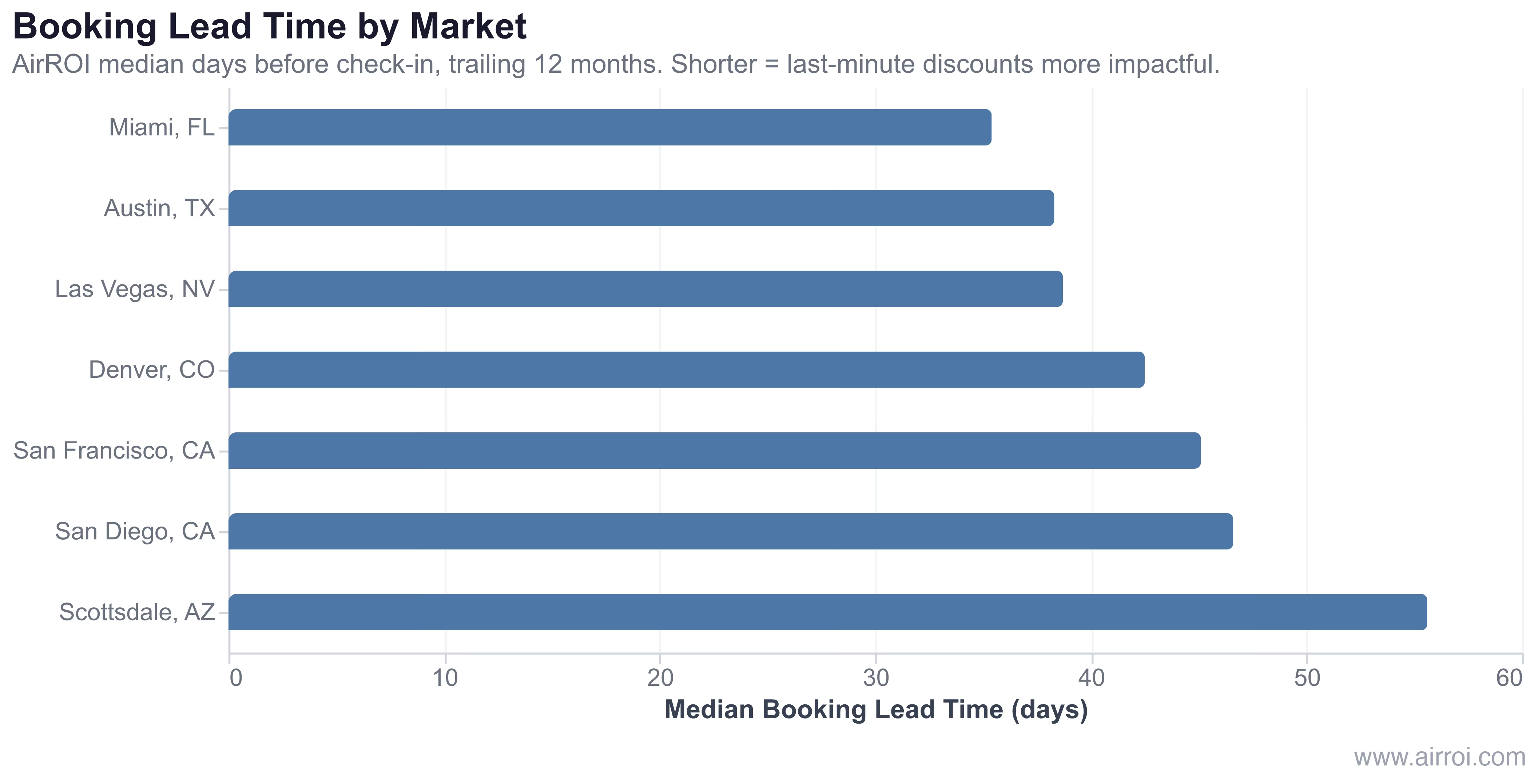
In AirROI's analysis of approximately 70,000 active listings across seven US markets, median booking lead time ranges from 35 days (Miami) to 56 days (Scottsdale). The gap matters for last-minute strategy:
| Market | Median Lead Time | Last-Minute Discount Relevance |
|---|---|---|
| Miami, FL | 35 days | High — frequent late bookings |
| Austin, TX | 38 days | High |
| Las Vegas, NV | 39 days | High |
| Denver, CO | 43 days | Moderate |
| San Francisco, CA | 45 days | Moderate |
| San Diego, CA | 47 days | Moderate |
| Scottsdale, AZ | 56 days | Lower — guests plan further ahead |
In short-lead-time markets, a last-minute discount is not a concession — it is the correct price for the remaining demand. The host who discounts at day 7 outperforms the one who holds firm and earns nothing.
Why Last-Minute Discounts Matter for Airbnb Hosts
- Revenue recovery: An empty night earns $0. A 25% discount on a $200 night recovers $150 — 75% of potential revenue that would otherwise vanish.
- Occupancy and RevPAR lift: Filling last-minute gaps raises overall occupancy and improves RevPAR, the metric that best captures price-adjusted occupancy performance.
- Orphan day solution: Isolated single-night gaps between reservations are nearly impossible to sell at full price. A last-minute discount is often the only viable path to any revenue on those dates.
- Search ranking: Airbnb's algorithm rewards booking frequency and recency. Consistently filling vacancies — even at a discount — keeps your listing active in search results relative to competitors with dark calendars.
When to Use (and Avoid) Last-Minute Discounts
| Situation | Discount? | Reason |
|---|---|---|
| Off-season weekday, 3 days out | Yes | Low probability of full-rate booking |
| Orphan day between two reservations | Yes | Will almost certainly go empty otherwise |
| Peak season weekend, 5 days out | No | High demand will fill at full rate |
| Major local event in town, 2 days out | No | Spontaneous travelers pay premium prices |
| Shoulder season, 7 days out | Conditional | Monitor demand signals before discounting |
Tips for Effective Last-Minute Discounting
- Automate with dynamic pricing — tools like PriceLabs and Beyond reduce rates automatically as check-in approaches, based on market demand signals rather than guesswork. See how data-driven dynamic pricing works in practice.
- Set your minimum price first — without a floor, an automated tool can push rates into unprofitable territory during slow periods.
- Watch your booking curve — if bookings are tracking ahead of your historical pace, skip the discount. You can likely fill at full price.
- Pair with early-bird discounts for a two-pronged strategy: reward advance planners and capture last-minute impulse bookers.
- Treat chronic last-minute discounting as a signal — if you consistently need deep reductions to fill the calendar, your base price is likely set above what the market will bear at full rate. Check whether comparable listings are pricing below yours. Dynamic pricing in the closing booking window covers how to calibrate this.
Frequently Asked Questions
A last-minute discount of 10–30% off your standard nightly rate is appropriate for most markets. For dates 1–3 days out, 20–30% is standard practice; for dates 4–7 days out, 10–15% is usually sufficient to attract deal-seekers. Never apply a discount that pushes your rate below your minimum price floor.
Apply last-minute discounts when dates within the next 1–14 days remain unbooked and your booking curve shows they are unlikely to fill at the current rate. In short-lead-time markets like Miami (median 35 days) and Austin (38 days), discounting earlier in the window is especially effective. Skip discounts during peak season or around local events when spontaneous travelers book at full price.
Not significantly, as long as discounts are moderate and strategic. Airbnb does not prominently display price history to future guests. The revenue from a discounted night far outweighs an empty one, and most guests booking last-minute actively seek and expect deals.
Markets with short booking lead times — where guests routinely book within 1–2 weeks of check-in — benefit most. AirROI data shows Miami (35 days), Austin (38 days), and Las Vegas (39 days) have the shortest median lead times, meaning a larger share of bookings arrive late and respond to discounted rates.
Dynamic pricing tools like PriceLabs and Beyond automatically reduce rates as check-in approaches based on real-time demand signals, eliminating the need for manual monitoring. Manual discounting is viable for hosts with one or two properties in a single market, but automation reduces the risk of either discounting too early (leaving revenue on the table) or too late (missing the booking window entirely).