
Base Price

Key Takeaways
- Base price is the reference rate that dynamic pricing tools adjust up or down; all multipliers compound from it
- Setting it too high causes systematic overpricing even on slow nights; too low caps revenue on your best nights
- The correct anchor is typically 80–90% of your market's median ADR, giving the algorithm room to reach or exceed market average on normal-demand nights
- Base price differs from rack rate: rack rate is a published standard; base price is an internal algorithm input guests never see directly
- Recalibrate quarterly — or immediately after adding a major amenity or receiving a sustained change in occupancy
How Base Price Works in Dynamic Pricing
When a dynamic pricing tool calculates the rate for a given night, it starts with your base price and applies a chain of multipliers:
Final Nightly Rate = Base Price × Demand Multiplier × Seasonal Factor × Day-of-Week Factor
High-demand example: A $200 base price during a peak-season weekend:
$200 × 1.30 (demand) × 1.20 (seasonal) × 1.10 (weekend) = $343 per night
Low-demand example: The same $200 base price on a midweek off-season night:
$200 × 0.80 (demand) × 0.85 (seasonal) × 0.90 (weekday) = $122 per night
The gap between $122 and $343 — a 181% swing — is generated entirely by the algorithm, but every cent of it is relative to that $200 anchor. An anchor that is off by 20% miscalibrates every single output by 20%.
Why Base Price Is the Most Important Pricing Input
Dynamic pricing software is only as accurate as the base price you give it. Three failure modes are common:
Anchored too low: Peak-night prices are capped because multipliers can only push so far before hitting your maximum price ceiling. You earn less on your best nights — the nights with the most revenue potential.
Market ADR: The Competitive Benchmark for Setting Base Price
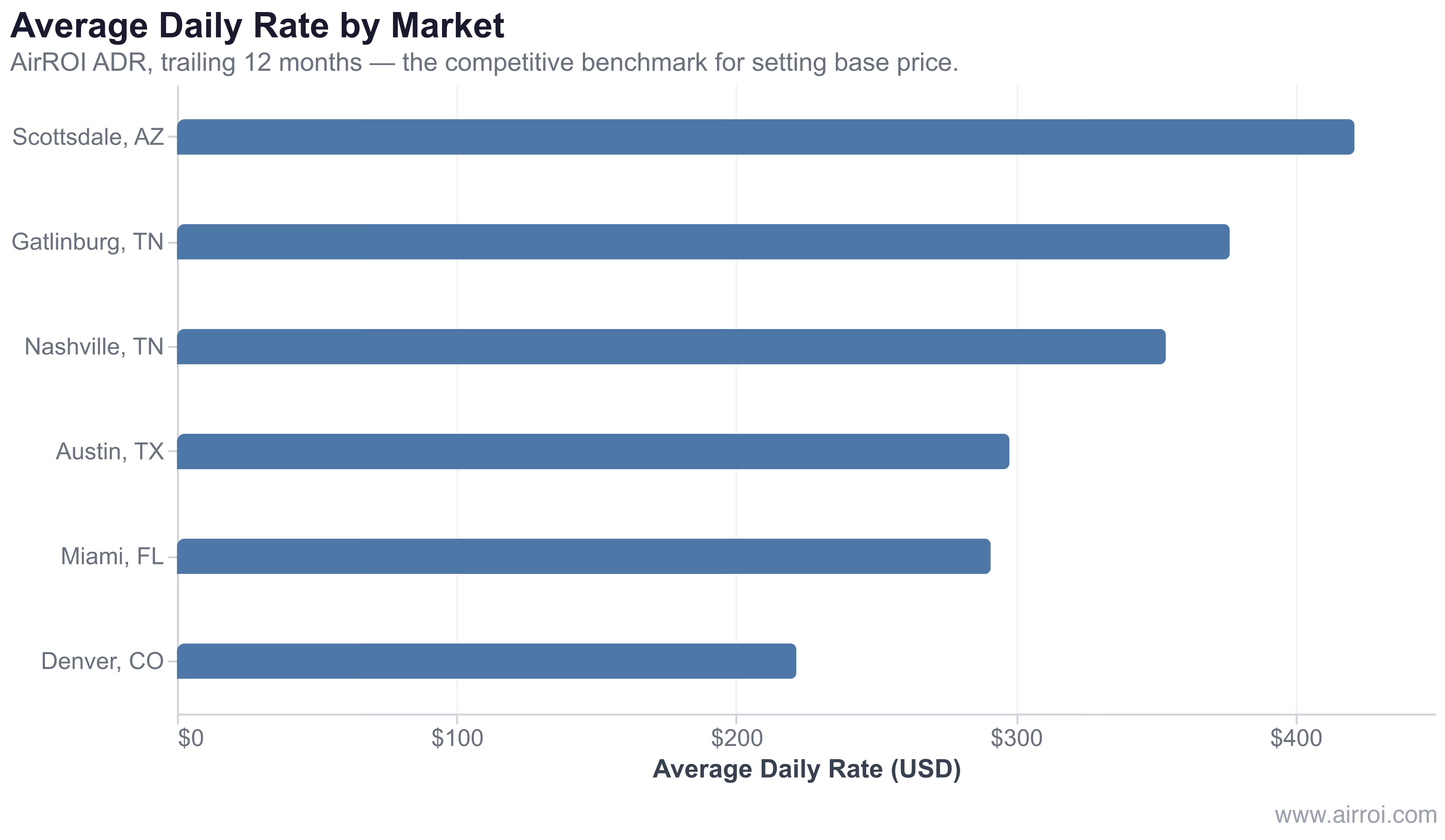
In AirROI's analysis of 34,515 active listings across six US markets (trailing 12 months), median ADR ranges from $221.50 in Denver to $421.10 in Scottsdale — a spread driven by property type, amenity profile, and local demand patterns.
| Market | Median ADR | Suggested Base Price Range (80–90% of ADR) |
|---|---|---|
| Scottsdale, AZ | $421.10 | $337–$379 |
| Gatlinburg, TN | $376.50 | $301–$339 |
| Nashville, TN | $353.60 | $283–$318 |
| Austin, TX | $297.70 | $238–$268 |
| Miami, FL | $291.00 | $233–$262 |
| Denver, CO | $221.50 | $177–$199 |
Your base price is not your target rate — it is the floor from which your best nights are built. Set it to reflect ordinary demand, and let the algorithm do the rest.
These are market-wide medians across all listing types. A property with premium amenities — private pool, mountain views, or a game room — can justify a base price above the 90th percentile of its comp set. A brand-new listing without reviews should start at the 80th percentile floor and earn upward.
How to Set Your Base Price
| Step | Action | Details |
|---|---|---|
| 1 | Research your market ADR | Use AirROI to find the trailing-12-month median nightly rate for comparable listings in your zip code |
| 2 | Assess your property tier | Entry-level: 75–80% of ADR. Standard: 80–90%. Premium amenities: 90–100%+ |
| 3 | Set guardrails | Define your minimum price (never book below cost) and maximum price ceiling |
| 4 | Monitor occupancy response | Target 65–75% occupancy at your base; adjust if you're consistently above 80% or below 50% |
| 5 | Recalibrate quarterly | Review after Q1 and Q3 to capture seasonal market shifts |
The Relationship Between Base Price, Occupancy, and Revenue
Tips for Optimizing Your Base Price
- Benchmark against actuals, not aspirations. Use closed bookings in your comp set, not listed prices. Listed prices include unsold inventory — a biased sample.
- Amenity premiums are real but bounded. A hot tub or pool can support a 10–20% base price premium, but only if comparable listings with the same amenity confirm it in your market data. Use AirROI's amenity revenue data to quantify the actual lift before pricing it in.
- New listings need a launch discount. Without reviews, you compete on price. Start at the 80th percentile of your comp set's base price and raise it after accumulating 10+ reviews.
- Minimum price is not base price. Your minimum price is the hard floor below which you never book; your base price is the algorithm's starting point. Keep them separate and make sure minimum price covers your variable costs (cleaning + supplies + platform fees) at minimum.
- Watch for rate ceiling compression. If your nightly rate is hitting your maximum price cap on more than 10–15% of nights, your base price is likely too low and your maximum price too close to the base. Either raise both or widen the gap.
Frequently Asked Questions
Start by benchmarking the median ADR for comparable listings in your market — AirROI's market data puts that figure between $221 (Denver) and $421 (Scottsdale) for active listings across major US STR markets. Set your base price at or slightly below the local median to give your dynamic pricing tool room to move upward on high-demand nights.
Base price is the static starting reference rate that the dynamic pricing algorithm reads before any adjustments. The nightly rate is the final price a guest sees after the algorithm applies demand, seasonality, day-of-week, and lead-time multipliers on top of the base price.
A base price set too high causes the algorithm to systematically overprice even on low-demand nights, suppressing occupancy. A base price set too low caps your revenue on peak nights because the algorithm's upward multipliers can only push so far before hitting your maximum price ceiling. Both errors compound across hundreds of nights per year.
Review your base price at least once per quarter. Signals that recalibration is needed include: occupancy consistently above 80% (base price may be too low), occupancy below 50% (possibly too high), newly added amenities like a hot tub or EV charger, or a meaningful shift in the local ADR benchmark.
Not necessarily. Market ADR is the median final rate across all listing nights — it already reflects dynamic adjustments. Your base price should sit somewhat below ADR so that the algorithm can reach ADR or higher on average-demand nights. A common starting point is 80–90% of the local market ADR.