NYC's Airbnb Drift Problem: 27% of Registered Listings Run Illegal

Of roughly 11,660 active NYC Airbnb listings in AirROI's April 2026 trailing-twelve-month sample, 1,495 match a triple-violation profile: entire-home room type, minimum-night setting under 30, and capacity for three or more guests. The median listing in that cohort pulls down $72,418 in annual revenue at 63% occupancy. Multiply through: the triple-violation cohort alone is producing close to $108 million a year in gross NYC short-term rental revenue that sits outside Local Law 18's hosted-stay rules.
Both numbers describe the same structural problem: Local Law 18 checks who a host is at signup, not how the listing actually operates afterward. The platform verification layer is working exactly as written — which is why the drift is quietly enormous.
What Local Law 18 actually requires — and where compliance quietly breaks
Local Law 18 turns booking platforms into registration gatekeepers, not behavior monitors. Passed by New York City Council on January 9, 2022 and enforced since September 5, 2023, the Short-Term Rental Registration Law requires every NYC host to register with OSE for a non-refundable $145 fee. Airbnb, VRBO, and Booking.com must verify that registration via an API check before processing any transaction under 30 nights.
None of that front-door rigor catches what happens after the approval email goes out. A host can be checked against the Prohibited Buildings List, verified as the unit's permanent occupant, and granted a registration number — and then log into Airbnb the next week and raise the guest max from 2 to 4, drop the minimum-night setting from 30 to 2, or flip the room type from "private room" to "entire home." The platform's LL18 verification API still returns a valid registration status every time it's queried. Nothing re-reads the rule book against the new settings.
"Regular people have been lured on to the site where it is easy to advertise illegal occupancy without restraint." — Christian Klossner, OSE Executive Director, speaking to The Guardian in January 2023 ahead of enforcement.
Three years into enforcement, the 27% number says the lure is still working — but now through accounts that cleared registration, not through listings that bypassed it.
OSE's April 21 disclosure: what the 27% number actually measures
The April 21 finding points at a different failure mode. Today's illegal NYC listings are, increasingly, listings that have a valid registration number and a cooperative platform — and drifted. OSE's description of the review is worth reading carefully:
"Airbnb is complying with Local Law 18 by verifying that hosts are registered with the city before they can list a property for fewer than 30 days — but the law does not mandate Airbnb to remove listings that later become non-compliant." — Paraphrased from OSE's statement to Skift, April 21, 2026.
The phrase "does not mandate" is doing a lot of work. It marks the exact line where the statute ends and the platform's voluntary behavior begins. NYC's position — more publicly asserted under the Mamdani administration than its predecessor — is that Airbnb could re-scan listings against the hosted-stay rules on a rolling basis and doesn't. Airbnb's position is that it's meeting the law.
Compliant hosts can see the gap from their own dashboards. On the r/airbnb_hosts forum, a NYC registered host summarized what looked odd to them: "Local Law 18 in NYC states that there is a guest limit of maximum 2 guests per booking, yet if I search listings for 4 adults I see around 10-20 listings available in Brooklyn for 2-4 bedroom homes for anywhere from 4-10 guests." The AirROI data turns that anecdotal signal into a measurable count.
The AirROI picture: 1,495 listings outside the hosted-stay rule
AirROI's NYC dataset identifies specific listing profiles that cannot be reconciled with Local Law 18's rules. A cohort matches when all three filters apply: room type is entire_home, the host's minimum-night setting is ≤ 29, and the listing's advertised guest capacity is ≥ 3. That combination violates the entire-home prohibition, the 30-night floor, and the two-guest cap simultaneously.
Running those filters across AirROI's full NYC market summary returns 1,495 active listings. Median trailing-twelve-month revenue per listing: $72,418. Average occupancy: 63%. Average daily rate: $512.
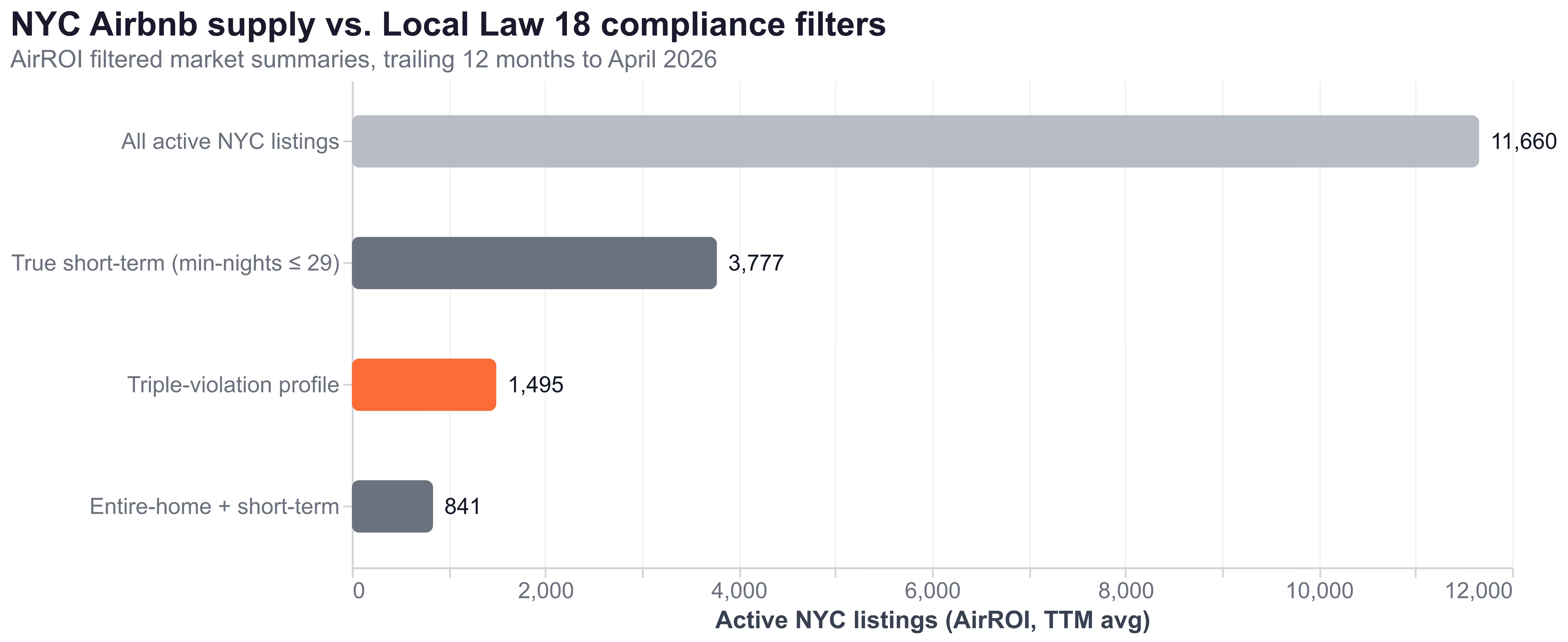
The triple-violation cohort is not a subset of a single other slice — it's a distinct pattern. Layering the filters separately produces different slices:
| Filter applied to all NYC listings | Count | Comment |
|---|---|---|
| All active listings | 11,660 | AirROI TTM baseline |
| True short-term (min-nights ≤ 29) | 3,777 | Listings that function as STRs, not mid-term rentals |
| Entire-home + short-term | 841 | Entire-unit STR profile (incompatible with hosted stay) |
| Triple-violation profile (entire-home + short-term + 3+ guests) | 1,495 | All three hosted-stay rules broken at once |
| Entire-home + short-term + ≥ 180 booked nights TTM | 867 | Operating at hotel-like volume |
A separate lens makes the pattern harder to miss. Split NYC's active inventory by whether listings ran short-term or mid-term, and compare their occupancy:
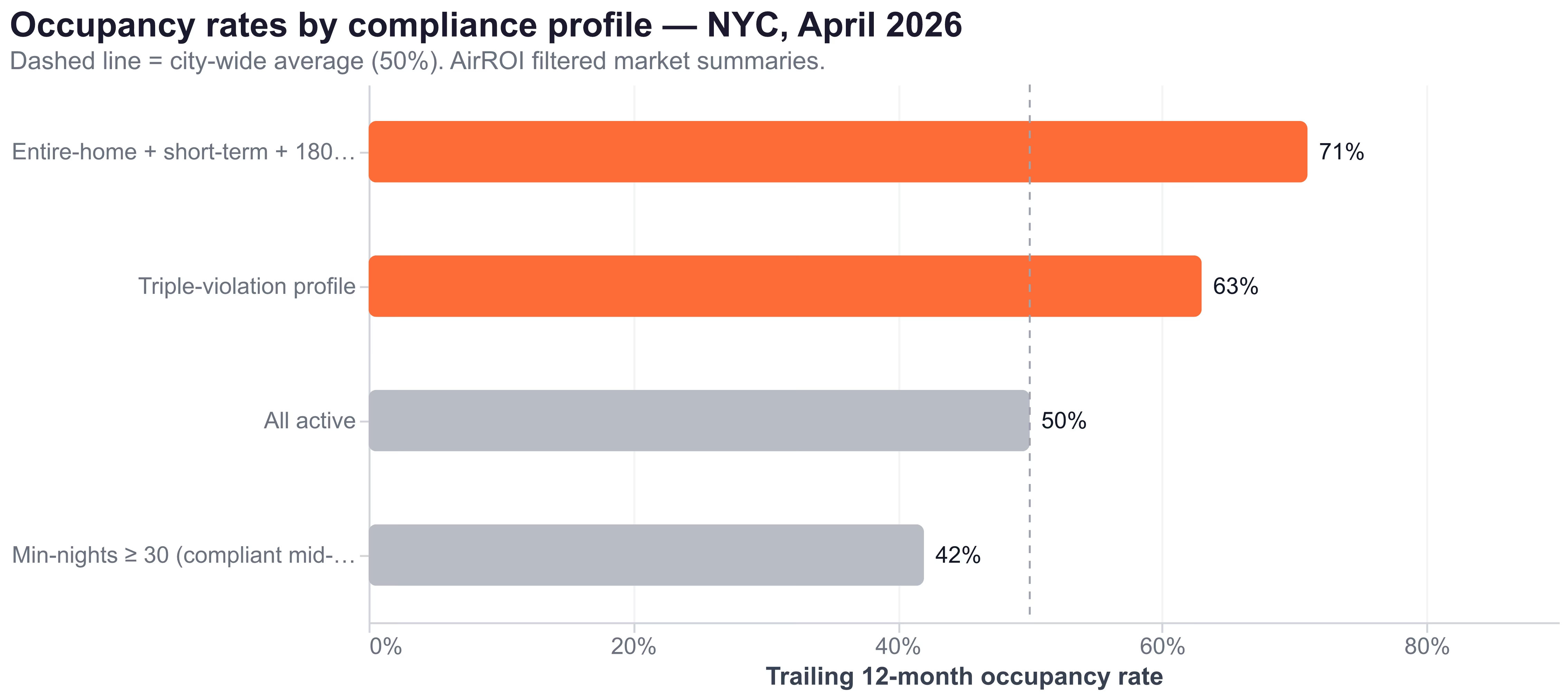
Compliant mid-term listings (min-nights ≥ 30) average 42% occupancy — consistent with a unit that books in large monthly blocks and accepts long vacancy windows. The triple-violation cohort averages 63%. The entire-home cohort booked 180-plus nights a year averages 71%. These are hotel-industry load factors, not hosted-stay load factors. A permanent resident physically present during every guest stay is not running a 71%-occupied listing in Manhattan.
Taken together, OSE's finding and AirROI's filtering describe the same drift from opposite directions. OSE is counting drift inside the 3,000 registered listings — about 810 appear illegal. AirROI is counting listings whose observable booking behavior cannot be produced by the hosted-stay rule — about 1,495. The two numbers don't need to match; they need to point in the same direction, and they do.
The Bineth lawsuit: how the identity gate was beaten
Mayor Zohran Mamdani's office framed the case in housing-preservation terms when it announced the suit:
"Housing stock belongs to the people of this city — and we will keep it accessible, safe, and affordable." — Mayor Zohran Mamdani, statement accompanying the April 16 lawsuit.
The city is seeking up to $5 million in combined penalties: $1 million in punitive damages plus $1,000-per-day fines extending back to April 2023. OSE had previously issued 35 summonses and collected $47,500 in fines across the same operation — each one after a neighbor complaint, each one a trailing indicator rather than a real-time control.
The mechanism is what matters for the platform-verification debate. Bineth's scheme defeated the identity-verification step — submitting false tenancy documents — and then used the resulting approval to run behavior that no one ever re-checked. What a pattern-monitoring system would have noticed on day one:
- Six listings cleared through LL18 verification under closely-related host accounts
- Those six listings clustered across only two property addresses
- Calendars on overlapping dates — physically impossible for a single "hosted stay" resident
- Guest max set at 4+ across the portfolio, not 2
- Entire-home room type on each listing, not "private room"
- Minimum-night settings at 2, not 30
None of those signals is hidden data. All six are stored in the platform's standard listing metadata and booking stream. What's missing is the scan.
Where the drift is concentrated
Brooklyn's high-density ZIP codes absorb the bulk of NYC's active Airbnb supply — and with it, the bulk of the drift. AirROI's ZIP-level data shows the concentration:
| NYC ZIP | Neighborhood | Active listings |
|---|---|---|
| 11233 | Bedford-Stuyvesant / Crown Heights (Brooklyn) | 732 |
| 11221 | Bushwick (Brooklyn) | 681 |
| 10019 | Midtown West / Hell's Kitchen (Manhattan) | 585 |
| 11211 | Williamsburg (Brooklyn) | 556 |
| 10036 | Times Square area (Manhattan) | 445 |
| 11237 | Bushwick East (Brooklyn) | 435 |
| 10001 | Chelsea / West 20s (Manhattan) | 394 |
| 10002 | Lower East Side (Manhattan) | 357 |
| 11207 | East New York (Brooklyn) | 330 |
| 10009 | East Village (Manhattan) | 318 |
Six of the top ten ZIPs are Brooklyn — and 8658 16th Avenue (Bineth's first property, in Bath Beach) and 114 Wilson Avenue (his Bushwick property, inside the 11221 ZIP) are exactly in the kind of density where a multi-unit subdivision can hide in the noise of legitimate hosted stays.
City-wide, the LL18 enforcement regime has clearly pulled supply out of the market. Active NYC Airbnb listings dropped from 13,721 in April 2025 to 10,823 in March 2026 — a 21% decline across twelve months, with the sharpest single-month step-down between October and November 2025:
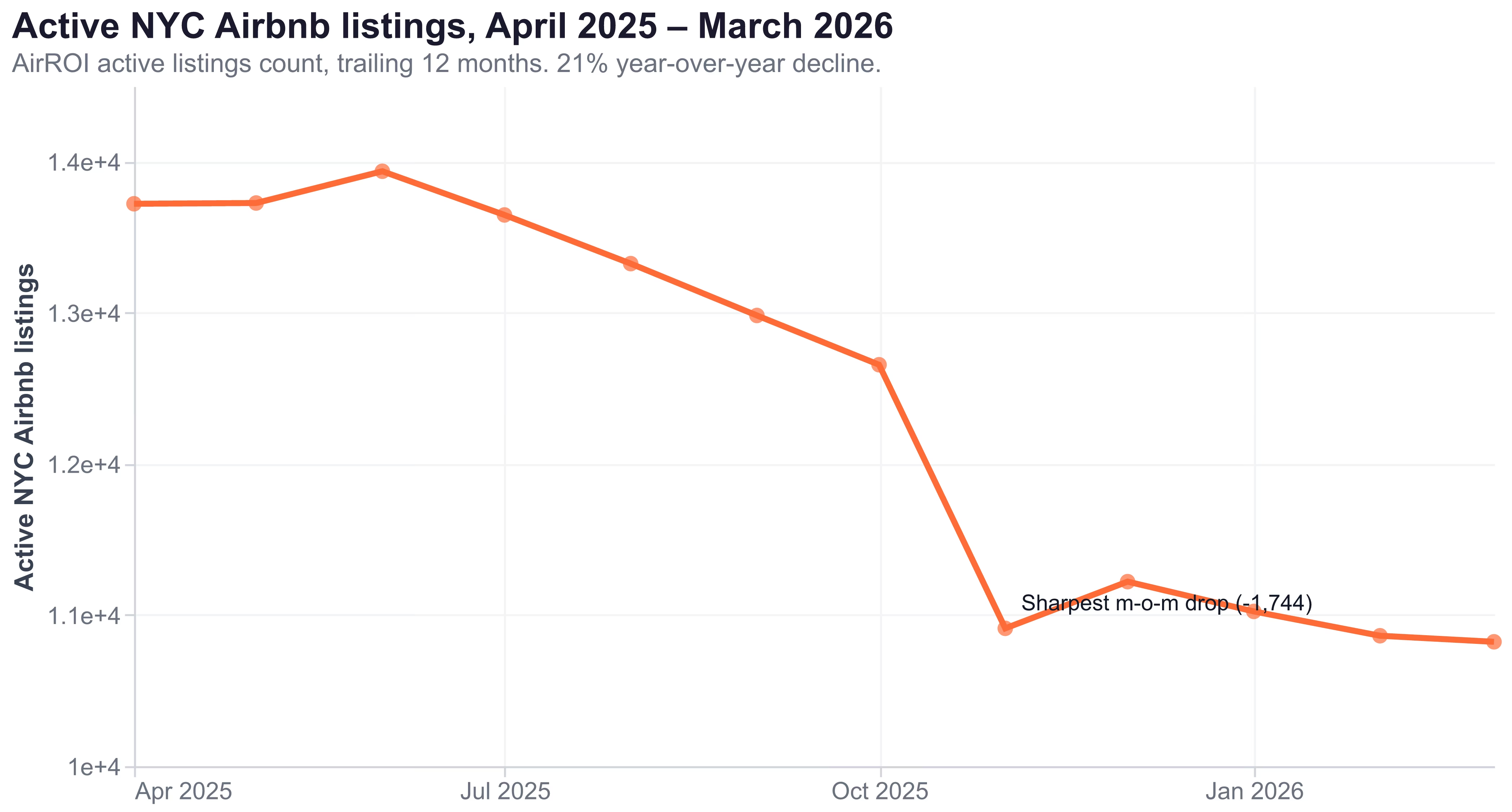
The contraction is the good-news story for Local Law 18's housing-preservation mandate. The drift data is the bad-news counterweight: even as the total shrinks, the share of the remaining supply that operates outside the hosted-stay envelope is large enough to measure at the listing level.
Across the Hudson, the spillover is measurable too. Jersey City hosts 1,740 active Airbnb listings under New Jersey's comparatively permissive STR framework; West New York, NJ adds 428 listings along the Hudson waterfront with Manhattan sightlines. When NYC's registered supply is capped, the demand doesn't vanish — it moves to the nearest legal substitute.
The revenue capture problem
At median TTM revenue of $72,418 per listing across 1,495 listings, the triple-violation cohort alone accounts for roughly $108 million in annualized gross Airbnb revenue operating outside Local Law 18's hosted-stay framework. That is an order of magnitude larger than the $1.3 million Bineth is accused of capturing across three years and six units — and ~80x the largest prior LL18-related recovery OSE has publicized.
Two caveats matter. First, $108 million is gross revenue, not net — platform fees, cleaning costs, and host operating costs come off the top. Second, not every triple-violation listing is the same magnitude of violation. Some are registered hosts who quietly raised the guest cap; some are Bineth-scale operations in early innings. But even after discounting for ambiguity, the figure dwarfs the penalty capacity the city can realistically deploy case by case.
World Cup 2026: the stress test nobody authorized
Local Law 18 contains no exception for major events, and the World Cup tournament begins June 11, 2026. MetLife Stadium in New Jersey — across the Hudson from Manhattan — hosts eight Group Stage matches plus a Semifinal and the Final on July 19. Demand for lodging across the NYC-NJ metro is about to step up sharply.
Three implications follow. First, the 27% OSE number is a baseline, not a ceiling — the economic case for drift gets stronger, not weaker, as demand spikes. Second, NYC's partial-review approach scales poorly; a review conducted in April tells you very little about what 3,000 registered listings are doing in June or July. Third, platform-side pattern monitoring goes from nice-to-have to load-bearing: only the platform has enough data velocity to catch behavior changes in the three weeks before matches start.
Five signals a compliance-minded platform would monitor
Every post-registration drift pattern OSE has surfaced maps to a signal that booking platforms already collect. The practical distance between today's compliance regime and a behavior-aware one is policy, not technology.
| Signal | What it indicates | How hard to detect |
|---|---|---|
| Room-type changed private-room → entire-home after registration | Violates hosted-stay requirement | Trivial — stored in listing metadata |
| Guest max raised above 2 | Violates two-guest cap | Trivial — listing field |
| Minimum-night floor dropped below 30 post-registration | Short-term operation without host presence | Trivial — listing field + history |
| Entire-home listing with 180+ booked nights over trailing 12 months | Full-time STR operation, not hosted stay | Trivial — reservation aggregate |
| Multiple listings sharing host ID or property address | Illegal subdivision / multi-unit scheme | Moderate — requires host-account and address joins |
Each signal is computable inside a single weekly data scan over the platform's own listing store. Each maps to a specific Local Law 18 rule. None requires cooperation from the host. In the Bineth case, at least four of the five would have fired on day one of the listings' activation — six listings at two addresses, entire-home room type, guest max of 4+, minimum-night floor under 30.
What NYC has asked for vs. what's in force
The Mamdani administration's public position is that Airbnb could monitor post-registration drift voluntarily — and the city will litigate until either that changes or the law does. As of April 2026, no Local Law 18 amendment is in active legislative motion that would require platforms to re-scan listings. Proposed reforms are running the opposite direction: Intro 1107, currently before Council, would ease hosted-stay restrictions for one- and two-family homes. The drift problem is not on that bill's agenda.
The NYC data suggests the cleanest fix. The registration layer of Local Law 18 is working. The drift layer needs one of two additions: an amendment mandating periodic re-verification by platforms, or a voluntary platform commitment to weekly rule scans. Until either arrives, every registered listing in NYC gets audited at most twice in the life of its registration — once at approval, once when OSE runs its next partial review. Between those two moments, the platform does what the law permits it to do. That permission is the whole story.
Frequently Asked Questions
NYC's Office of Special Enforcement announced on April 21, 2026 that a partial review of approved short-term rental listings found 27% operating illegally — mainly by offering entire-home stays or exceeding the two-guest cap that Local Law 18 permits for hosted stays. The disclosure followed a multi-million-dollar lawsuit filed five days earlier against a Brooklyn landlord accused of running an illegal STR scheme across six registered units.
Local Law 18 of 2022 is NYC's Short-Term Rental Registration Law. It requires short-term rental hosts to register with the Mayor's Office of Special Enforcement, limits hosted stays to two paying guests, requires host presence during guest stays, and prohibits booking platforms from processing transactions for unregistered listings. The law has been in effect since September 2023.
Post-registration drift is when a host receives legitimate Local Law 18 approval and subsequently changes a listing's operating parameters — raising guest max above 2, shortening minimum-night stays below 30, or flipping the room type to entire-home — without any re-verification by the city or the booking platform. OSE's April 2026 finding that 27% of registered listings were illegal is the first quantified measurement of this drift.
Chananya Bineth is a Brooklyn landlord named in a multi-million-dollar lawsuit filed by NYC on April 16, 2026. The city alleges that he, his wife, and associates submitted false tenancy claims to obtain Local Law 18 registrations for six illegally subdivided units across 8658 16th Avenue and 114 Wilson Avenue in Brooklyn. OSE alleges the scheme produced $1.3 million in payouts across roughly 1,400 short-term stays since April 2023.
Some NYC hosts set a 30-day minimum to place stays outside Local Law 18 — which only regulates rentals under 30 nights. However, AirROI data shows 3,193 NYC listings with 30-day-minimum settings have an average observed length of stay of only 7.6 nights, suggesting the 30-day setting is being routinely overridden via private negotiations or late cancellations rather than honored in practice.